From Surf Wiki (app.surf) — the open knowledge base
Symmetric relation
Type of binary relation
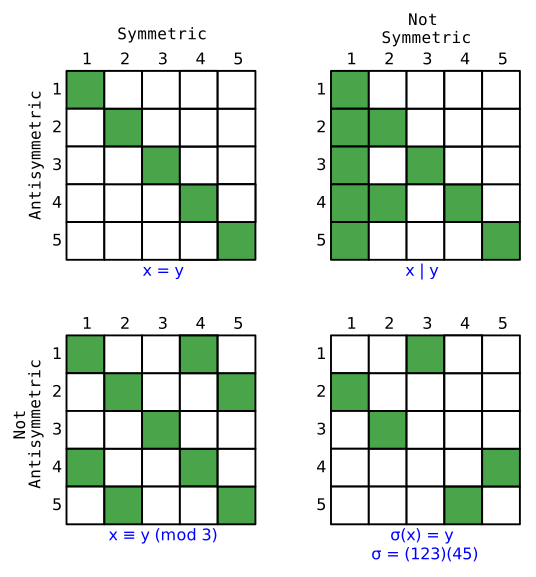
Type of binary relation
A symmetric relation is a type of binary relation. Formally, a binary relation R over a set X is symmetric if: : \forall a, b \in X(a R b \Leftrightarrow b R a) , where the notation aRb means that (a, b) ∈ R.
An example is the relation "is equal to", because if is true then is also true. If RT represents the converse of R, then R is symmetric if and only if .
Symmetry, along with reflexivity and transitivity, are the three defining properties of an equivalence relation.
Examples
In mathematics
- "is equal to" (equality) (whereas "is less than" is not symmetric)
- "is comparable to", for elements of a partially ordered set
- "... and ... are odd": ::::::[[Image:Bothodd.png]]
Outside mathematics
- "is married to" (in most legal systems)
- "is a fully biological sibling of"
- "is a homophone of"
- "is a co-worker of"
- "is a teammate of"
Relationship to asymmetric and antisymmetric relations
By definition, a nonempty relation cannot be both symmetric and asymmetric (where if a is related to b, then b cannot be related to a (in the same way)). However, a relation can be neither symmetric nor asymmetric, which is the case for "is less than or equal to" and "preys on").
Symmetric and antisymmetric (where the only way a can be related to b and b be related to a is if ) are actually independent of each other, as these examples show.
| Not antisymmetric | congruence in modular arithmetic | // (integer division), most nontrivial permutations |
|---|
| Not antisymmetric | is a full biological sibling of | preys on |
|---|
Properties
- A symmetric and transitive relation is always quasireflexive.
- One way to count the symmetric relations on n elements, that in their binary matrix representation the upper right triangle determines the relation fully, and it can be arbitrary given, thus there are as many symmetric relations as n × n binary upper triangle matrices, 2n(n+1)/2.
Notes
References
References
- "MAD3105 1.2". Florida State University.
This article was imported from Wikipedia and is available under the Creative Commons Attribution-ShareAlike 4.0 License. Content has been adapted to SurfDoc format. Original contributors can be found on the article history page.
Ask Mako anything about Symmetric relation — get instant answers, deeper analysis, and related topics.
Research with MakoFree with your Surf account
Create a free account to save articles, ask Mako questions, and organize your research.
Sign up freeThis content may have been generated or modified by AI. CloudSurf Software LLC is not responsible for the accuracy, completeness, or reliability of AI-generated content. Always verify important information from primary sources.
Report