From Surf Wiki (app.surf) — the open knowledge base
Sylheti Nagri
Indic abugida script used for the Sylheti language
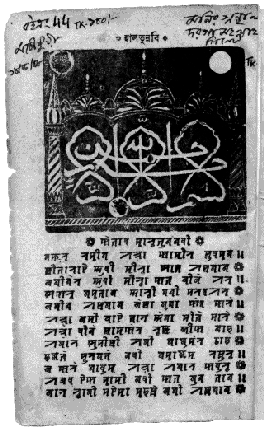
Indic abugida script used for the Sylheti language
| Field | Value | ||
|---|---|---|---|
| name | Sylheti Nagri | ||
| altname | {{Script | Sylo | ꠍꠤꠟꠐꠤ ꠘꠣꠉꠞꠤ}} |
| sample | Sylheti Nagari Script.jpg | ||
| imagesize | 250px | ||
| caption | Sylheti Nagari alphabet | ||
| type | Abugida | ||
| time | c. 15th century to present | ||
| languages | Middle Bengali | ||
| Sylheti | |||
| fam1 | Proto-Sinaitic | ||
| fam2 | Brāhmī | ||
| fam3 | Gupta | ||
| fam4 | Siddham | ||
| fam5 | Nāgarī | ||
| fam6 | Kaithi script | ||
| iso15924 | Sylo | ||
| unicode | U+A800–U+A82F |
Sylheti Sylheti Nagri or Sylheti Nāgarī (Bengali: সিলেটী নাগরি, , syl, ), known in classical manuscripts as Sylhet Nagri () as well as by many other names, is an Indic script. The script was historically used in the regions of Bengal and Assam, that were east of the Padma. (See Syloti Nagri (Unicode block) for more details.)
Historically the script was transcribed in Middle Bengali, though having similar characteristics to the more popular Dobhashi literary dialect, it was distinguished for its phonological influence from Sylheti. Sylheti Nagri therefore represented a unique literary culture of the Sylhet region. Contemporarily, the script is being revived by some as a key identity marker of Sylhet's cultural heritage.
Etymology and names
Sylhet Nagri is a compound of "Sylhet" ({{Script|Sylo|ꠍꠤꠟꠐ}}) and "nāgrī" ({{Script|Sylo|ꠘꠣꠉꠞꠤ}}). Sylhet is the name of the region in which the script was primarily used and originated from. Nagri means "of or pertaining to an abode (nagar)". Hence, Sylhet Nagri denotes from the abode or city of Sylhet. In recent times it has come to be known as Sylheti Nagri although this name was not used in the classical manuscripts such as Pohela Kitab by Muhammad Abdul Latif. Nagendranath Basu asserts that Nagri is named after the Nagar Brahmins who were known for retaining their Nagri scripts while adopting the local language of places which they migrated to.
The script has been known by other names such as Jalalabadi Nagri () after the name of Jalalabad (Sylhet), Phul Nagri (), Jangli Nagri and Kat Nagri, among others. Another popular term is Musalmani Nagri () due to its prevalence among Muslims of Sylhet.
History
Origins
According to Qadir (1999) and Professor Clifford Wright, the script descends from Kaithi script, a script predominantly used in Bihar.
The specific origin of the script is debated. Though most popular in Sylhet, the script was historically also used in Greater Mymensingh, Northeast India and West Bengal. One hypothesis is that the Muslims of Sylhet were the ones to invent it for the purpose of mass Islamic education, which is thought to have taken place during the 15th century, when Bengali Hindus led by Krishna Chaitanya, started a Sanskrit and Vaishnavist reawakening movement. On the other hand, Ahmad Hasan Dani believes that, it was invented by the Afghans during their rule of Bengal, since Nagri letters resemble Afghan coin symbols and the large number of Afghan inhabitants in Sylhet at the time. Another theory dates the script's origin as late as the seventeenth to eighteenth century, claiming that it was invented to facilitate the Muslim sepoys coming from the joint state of Bihar and other immigrant Muslims.
Though almost solely used by Muslims, there are other theories which point the script's origins to Buddhists and Hindus who later converted to Islam. A popular theory is that it was brought to the region via Nagar Brahmins. This is a Hindu caste known for travelling and settling across the subcontinent, adopting the local language but writing in their own Nagari-variant of Kaithi instead. The Brahmins converted to Islam though retained the practice of the Nagri script for poetry. This is also the case in other parts of South Asia such as Sindh, Multan and Varanasi. Baitali Kaithi was a former script used to write Hindustani at a similar time, and it was identical to Sylhet Nagri with the exception that the latter had a matra (upper horizontal line used in Brahmic scripts). Others say that the script was invented by immigrant Bhikkhus (originally Buddhist in faith) from neighbouring countries such as Nepal.
Manuscripts have been found of works such as Rag Namah by Fazil Nasim Muhammad, Shonabhaner Puthi by Abdul Karim and the earliest known work Talib Husan (1549) by Ghulam Husan.
Usage
The simplistic nature of the script inspired a lot of poets, though the bulk of Sylheti Nagri literature was born in the late 19th century. Abdul Karim, a munshi who was studying and completing his education in London, spent several years in the English capital to learn the printing trade. After returning home in circa 1869, he designed a woodblock type for the script and founded the Islamia Printing Press in Bandar Bazar, Sylhet. Padmanath Bhattacharjee Vidyabinod, who wrote the first scholarly article on the script, is of the opinion that Abdul Karim's standardisation marks the start of the script's reawakening (nobojonmo) period. Prior to Abdul Karim's intervention, not much is known about the popularity and usage of the script. The manuscripts were of prosaic quality, but poetry was also abundant. The Munshi Sadeq Ali is considered to have been the greatest and most popular writer of the script. Apart from renowned literary works such as Halat-un-Nabi, Jongonama, Mahabbatnama or Noor Noshihot, it has been used to write medicine and magical manuscripts, as well as Poems of the Second World War.
Other Sylheti Nagri presses were established in Sylhet, Sunamganj, Shillong and Kolkata. Some include the Sarada Printing and Publishing in Naiyorpul, Sylhet; and Calcutta's General Printing Works in 16 Gardner Lane, Taltala as well as the Hamidi Press in Sealdah. It has been asserted from scholarly writings that the script was used as far as Bankura, Barisal, Chittagong and Noakhali. The script had also spread to Tripura, Mymensingh and Dhaka. The script is thought to have spread to Chittagong and Barisal via river.

The script, never having been a part of any formal education, reached the common people with seeming ease. In the Sylhet region, at one stage literary works in Sylheti Nagri became more popular in usage than the Bengali script. Although the script vastly extended across Bengal, its use "was restricted to a certain class of Muslims", in particular Muslim women. As late as the 1930s, Nagendranath Basu noticed that the Bengali Muslims of Bishnupur, Bankura were using the Bengali alphabet for all purposes, but the Nagri script for puthis. Many Sylheti Nagri presses fell out of use during the Bangladesh War of Independence and Indo-Pakistani War of 1971, including Islamia Press in Sylhet town which was destroyed by a fire.
Revitalisation efforts
Research on the script multiplied to its greatest extent in post-colonial Pakistan and independent Bangladesh.
In 2009, the publication of literature in the Nagri script recommenced in Bangladesh through the efforts of Mostafa Selim, who founded a publishing company called Utsho Prokashon based in Dhaka, and Anwar Rashid's New Nation Library in Puran Lane, Sylhet. has begun hosting Nagri bookstalls at the Ekushey Book Fair. In 2014, a Nagri press conference was held at the Pathak Shamabesh Center in Shahbag, a major neighbourhood located in Bangladesh's capital, Dhaka. The Sylhet City Corporation and Sylhet District Council funded the establishment of a £20,000 circular mural at Surma Point known as the Nagri Chattar in 2018, which was designed by Shubhajit Chowdhury. The official building of Sylhet District's Deputy Commissioner has also installed Nagri signboards.
Another aspect of its contemporary revival is it being viewed as a key marker of Sylheti identity, in particular within the diaspora. This revival is primarily driven by efforts to preserve the Sylheti language as an integral part of a cultural heritage, in contrast to the dominance of Standard Bengali. SOAS University of London in the United Kingdom is one institute that has led such initiatives like the "Sylheti Project".
The New Testament is one of the few books that has been translated into Sylheti with the Sylheti Nagri script by James Lloyd-Williams and others in the UK, titled Pobitro Injil Shorif in 2014.
Letters
The Sylheti Nagri script can be divided into vowels and vowel diacritics/marks, consonants and consonant conjuncts, diacritical and punctuation marks. Vowels & consonants are used as alphabet and also as diacritical marks. The script is characterised by its simplistic glyph, with fewer letters than Bengali. The total number of letters is 32; there are 5 vowels and 28 consonants.
Vowels
The widely accepted number of vowels is 5, although some texts show additional vowels. For example, the diphthong ôi has sometimes been regarded as an additional vowel in its own right. The vowels do not follow the sequence of Bengali alphabet. All the vowels also have their own respective diacritics known as "xar" ().
| Letter | Diacritic | Transliteration | IPA | As diacritic with | ||||||
|---|---|---|---|---|---|---|---|---|---|---|
| {{script | Sylo | ꠀ}} | {{script | Sylo | ꠣ}} | {{script | Sylo | ꠇꠣ}} | ||
| {{script | Sylo | ꠁ}} | {{script | Sylo | ꠤ}} | {{script | Sylo | ꠇꠤ}} | ||
| {{script | Sylo | ꠃ}} | {{script | Sylo | ꠥ}} | {{script | Sylo | ꠇꠥ}} | ||
| {{script | Sylo | ꠄ}} | {{script | Sylo | ꠦ}} | {{script | Sylo | ꠇꠦ}} | ||
| none | {{script | Sylo | ꠂ}} | {{script | Sylo | ꠇꠂ}} | ||||
| {{script | Sylo | ꠅ}} | {{script | Sylo | ꠧ}} | {{script | Sylo | ꠇꠧ}} |
- "" sounds as the default inherent vowel for the entire script.
- When a vowel sound occurs syllable-initially or when it follows another vowel, it is written using a distinct letter. When a vowel sound follows a consonant (or a consonant cluster), it is written with a diacritic which, depending on the vowel, can appear above, below, before or after the consonant. These vowel marks cannot appear without a consonant and are called xar.
- An exception to the above system is the vowel , which has no vowel mark but is considered inherent in every consonant letter. To denote the absence of the inherent vowel following a consonant, a diacritic called the hośonto () may be written underneath the consonant.
- Although there is only one diphthong in the inventory of the script: oi , the phonetic system has, in fact, many diphthongs. Most diphthongs are represented by juxtaposing the graphemes of their constituent vowel elements, with the first taking the form of a diacritic and the second an independent vowel glyph, as in .
Vowel diacritics

Consonants
There are 27 consonants. The names of the letters are typically just the consonant sound with the inherent vowel . Since the inherent vowel is assumed and not written, most letters' names look identical to the letter itself, i.e. the name of the letter is ghô.
| Phonetics → | Occlusive | Nasal | Approximant | Fricative | Voicing → | Velar | Palatal | Retroflex | Dental | Labial |
|---|---|---|---|---|---|---|---|---|---|---|
| Voiceless | Voiced | Voiceless | Voiced | |||||||
Due to historical sound changes, the so-called "aspirated consonants" cause a higher or rising tone on the following vowel, but the consonants are pronounced just like the unaspirated ones (conceptually similar to Thai and Gurmukhi).
| IPA | Normal tone letter | High tone letter | Transcription | IPA transcription | Note | ||
|---|---|---|---|---|---|---|---|
| /~/ | syl | ꠇ}} | syl | ꠈ}} | kô / khô | / | Like the k in "kite" or the kh in "Khartoum" |
| depending on its position within vowels. | |||||||
| // | syl | ꠉ}} | syl | ꠊ}} | gô / ghô | / | Like the g in "garage". |
| /~/ | syl | ꠌ}} | syl | ꠍ}} | chô / chhô | / | Like the ch in "chat" or the s in "sun". |
| /~/ | syl | ꠎ}} | syl | ꠏ}} | jô / jhô | / | Like the j in "jungle" or the z in "zoo". |
| // | syl | ꠐ}} | syl | ꠑ}} | ṭô / ṭhô | / | Like the t in "tool". |
| // | syl | ꠒ}} | syl | ꠓ}} | ḍô / ḍhô | / | Like the d in "doll". |
| // | syl | ꠔ}} | syl | ꠕ}} | tô / thô | / | Like the t in "soviet". |
| // | syl | ꠖ}} | syl | ꠗ}} | dô / dhô | / | Like the th in "the". |
| // | syl | ꠘ}} | n/a | nô | Like the n in "net". | ||
| /~~/ | syl | ꠙ}} | n/a | pô | Like the p in "pool" or the f in "fun". | ||
| /~/ | n/a | syl | ꠚ}} | phô | Like the f in "food". | ||
| // | syl | ꠛ}} | syl | ꠜ}} | bô / bhô | / | Like the b in "big". |
| // | syl | ꠝ}} | n/a | mô | Like the m in "moon". | ||
| // | syl | ꠞ}} | n/a | rô | Like the r in "rose". | ||
| // | syl | ꠟ}} | n/a | lô | Like the l in "luck". | ||
| // | syl | ꠡ}} | n/a | shô | Like the sh in "shoe". | ||
| // | syl | ꠢ}} | n/a | hô | Like the h in "head". | ||
| // | syl | ꠠ}} | n/a | ṛô | Like the r in "hurry". |
There is a difference between the pronunciation of rô and ṛô, though in ordinary speech these are pronounced the same as .
Like many other Indic scripts, special ligatures for consonant clusters, or conjunct consonants, are used in Sylheti Nagri. For example, rlô is a conjunct of rô and lô. However, the number of conjuncts commonly used is lower than other Indic scripts, and as of 2024 many fonts, browsers and word processors do not support conjuncts for Sylheti Nagri.
Symbols
| Symbol | Name | Function | IPA | ||
|---|---|---|---|---|---|
| {{script | Sylo | ꠋ}} | Anusvara | Voiced velar nasal | |
| {{script | Sylo | ꠆}} | Hasanta | Suppresses the inherent vowel [] and forms conjuncts. | – |
| {{script | Sylo | ꠬}} | Alternate hasanta | Suppresses the inherent vowel [ɔ], but does not form conjuncts. | – |
Punctuation marks
Sylheti Nagari has four poetry marks. Besides, it uses the Brahmic mark daṇḍa as well as some Latin-based punctuation marks.
| Mark | Name | Function | ||
|---|---|---|---|---|
| {{script | Sylo | ꠨}} | Poetry mark-1 | – |
| {{script | Sylo | ꠩}} | Poetry mark-2 | – |
| {{script | Sylo | ꠪}} | Poetry mark-3 | – |
| {{script | Sylo | ꠫}} | Poetry mark-4 | – |
| । | Daṛi | Marks the end of a declarative sentence, equivalent to English full stop. | ||
| ⁕ | [Ful daṛi]() | Marks the end of a section. | ||
| , | Xoma | Separates parts of a sentence. | ||
| ? | Prośnobudóx sin | Indicates a question or interrogative clause. | ||
| ! | Aśsorzobudóx sin | |||
| : | Xolon | |||
| ; | Semixolon | |||
| - | Haifen | |||
| — | Ḍeś | |||
| ( ), { }, [ ] | Bondóni | |||
| / | Bikolfo sin | |||
| ‘ ’ | Udríti sin | |||
| " " | Zuṛa udríti sin | |||
| ... | Borzon sin |
Sample texts
The following is a sample text in Sylheti of Article 1 of the Universal Declaration of Human Rights by the United Nations:
Sylheti in Sylheti Nagari script
: ꠗꠣꠞꠣ ১: ꠢꠇꠟ ꠝꠣꠘꠥꠡ ꠡꠣꠗꠤꠘꠜꠣꠛꠦ ꠢꠝꠣꠘ ꠁꠎ꠆ꠎꠔ ꠀꠞ ꠅꠗꠤꠇꠣꠞ ꠟꠁꠀ ꠙꠄꠖꠣ ‘ꠅꠄ। ꠔꠣꠁꠘꠔꠣꠘ ꠛꠤꠛꠦꠇ ꠀꠞ ꠀꠇꠟ ꠀꠍꠦ। ꠄꠞ ꠟꠣꠉꠤ ꠢꠇꠟꠞ ꠄꠇꠎꠘꠦ ꠀꠞꠇꠎꠘꠞ ꠟꠉꠦ ꠛꠤꠞꠣꠖꠞꠤꠞ ꠝꠘ ꠟꠁꠀ ꠀꠌꠞꠘ ꠇꠞꠣ ꠃꠌꠤꠔ। Sylheti in phonetic Romanization
: Dára ex: Hôxôl manuṣ ṣadínbábe hôman ijjôt ar ôdíkar lôia fôeda ốe. Taintan bibex ar axôl asé. Er lagi hôxlôr exzône arôxzônôr lôge biradôrir môn lôia asôrôn xôra usit. Sylheti in IPA
: Gloss
: Clause 1: All human free-manner-in equal dignity and right taken birth-take do. Their reason and intelligence exist; therefore everyone-indeed one another's towards biradri attitude taken conduct do should. Translation
: Article 1: All human beings are born free and equal in dignity and rights. They are endowed with reason and conscience. Therefore, they should act towards one another in a spirit of brotherhood.
Fonts and keyboards
In 1997, Sue Lloyd-Williams of STAR produced the first computer font for script. The New Surma is a proprietary font. Noto fonts provides an open source font for the script. Syloti Nagri was added to the Unicode Standard in March 2005, with the release of version 4.1, and is available on Apple devices. Other fonts include Mukter Ahmed's Fonty 18.ttf, developed from manuscripts to include traditional Sylheti numbers. As a routine project of the Metropolitan University, Sylhet, Sabbir Ahmed Shawon and Muhammad Nurul Islam (under the name CapsuleStudio) developed and launched the Syloti Nagri Keyboard, also for Google Play, on 9 December 2017. Different keyboards and fonts are available now:
- Syloti Nagri Notes, by the UK-based Sureware Ltd on Google Play.
- Multiling O Keyboard, with additional app Sylheti Keyboard plugin by Honso, on Google Play.
- Google's GBoard has also made Sylheti (Syloti Nagri) available as an input from April 2019.
Unicode
Main article: Syloti Nagri (Unicode block)
Syloti Nagri was added to the Unicode Standard in March 2005 with the release of version 4.1.
The Unicode block for Syloti Nagri, is U+A800–U+A82F:
Gallery
File:Nagri sample.jpg|Book/Literature: A page from Shoddad-or Boyan (in Sylheti Nagri script) by Pir Azmot Ali File:Siloti lekha.jpg|Exhibition: Samples of Sylheti Nagri writing at a London exhibition File:Takbir in Sylheti Nagri script.jpg|The Takbir (Allāhu akbar) in Sylheti Nagri script
Notes
References
References
- Thibaut d'Hubert, Alexandre Papas (2018). ''Jāmī in Regional Contexts: The Reception of ʿAbd al-Raḥmān Jāmī’s Works in the Islamicate World, ca. 9th/15th-14th/20th Century''. pp.667-678. Brill.
- (2008). "Language in South Asia". [[Cambridge University Press]].
- (1993). "The Indo-Aryan languages".
- (1 November 2002). "Documentation in support of proposal for encoding Syloti Nagri in the BMP".
- (1 November 2002). "Proposal for Encoding Syloti Nagri Script in the BMP".
- It is also claimed that the [[orthography]] of the script equates with Sylheti, reflecting the phonetic and grammatical features of the vernacular, it provided a simpler and more precise representation than the more prevalent [[Bengali–Assamese script. Bengali script]].David Kane (2021). ''Puthi-Pora''. Blurb. p. 159. Retrieved 1 April 2021.
- (2013). "Minority Nationalisms in South Asia". Routledge.
- Arupjyoti Saikia (2023). ''The Quest for Modern Assam: A History 1942-2000.'' Penguin Random House India Private Limited.
- [https://www.lddjournal.org/article/id/1231/ Introducing the Sylheti language and its speakers, and the SOAS Sylheti project] Candide Simard, Sarah M. Dopierala, E. Marie Thaut (2020). Language Documentation and Description 18, pp.1-22. Retrieved on 2024-09-19.
- "Sylhét Nāgrir Pahélā Kétāb o Doi Khūrār Rāg".
- (1888). "From the Government of Bengal, No. 1363, dated 8th August 1888". Government Printing, India.
- ''"শ্রীহট্টে নাগরী সাহিত্য (জন্মকথা)"'', এম. আশরাফ হোসেন সাহিত্যরত্ন; শ্রীহট্ট সাহিত্য-পরিষৎ-পত্রিকা, ১ম বর্ষ ৩য় সংখ্যা; ১৩৪৩ বঙ্গাব্দ; পৃষ্ঠা ৯৮। উদ্ধৃতি: ''"সহজ ও সুন্দর বলিয়া জনসাধারণ ইহার অপর এক নাম দিয়াছিলেন সিলেটে 'ফুল নাগরী'।"''
- {{cite Banglapedia. Islam, Muhammad Ashraful
- Ahmad Hasan Dani. [[Bangla Academy (Bangladesh). Bangla Academy]]. (1958)
- {{cite Banglapedia. Islam, Muhammad Ashraful
- Ali. Syed Murtaza. (2003). "". Utsho Prokashon
- "Bangla Bishwakosh".
- [[Nagendranath Basu. (1933). "Proceedings And Transactions Of The Sixth All India Oriental Conference, December 1930". Bihar and Orissa Research Society.
- Saha, RN. (1935). "Report of All Asia Educational Conference (Benares, December 26-30, 1930)". The Indian Press Ltd.
- Bhattacharjee Vidyabinod, Padmanath. (1908). "Sylhet Nagri".
- Chanda, Anuradha. (2006). "Silet Nagarir Pahela Kitab O Daikhurar Rag". Dey's Publishing.
- Achyut Charan Choudhury. "Srihatter Itibritta Purbangsha".
- Sadiq. Mohammad. (2008). "". Asiatic Society of Bengal
- ''"সিলেট নাগরী"'', শ্রী পদ্মনাথ দেবশর্ম্মা; সাহিত্য-পরিষৎ-পত্রিকা, ৪র্থ সংখ্যা; ১৩১৫ বঙ্গাব্দ, পৃষ্ঠা ২৩৬।
- link. (11 December 2015). Das. Sumankumar. [[Prothom Alo]]
- Bhattacharjee, Nabanipa. (2010). "Communities cultures and identities a sociological study of the Sylheti community in contemporary India". [[Jawaharlal Nehru University]].
- George Grierson. (1903). "Language Survey of India - Vol. V Pt 1". Motilal Banarsidass.
- David Kane (2021). ''Puthi-Pora''. Blurb. pp.165. Retrieved 1 September 2024.
- Gupta, Sumanta. link. (8 June 2020)
- Mamun, Muntasir. (January 2004). "Dhaka: Smriti Bismritir Nogori". Ananya Publishers.
- link. Mostafa Selim. (4 June 2020)
- link. [[The Daily Ittefaq]]. (23 January 2014)
- link. [[Prothom Alo]]. (20 April 2014)
- [https://www.jagonews24.com/m/probash/news/455530 লন্ডনে ‘সিলেট নাগরী লিপি চর্চা আন্তর্জাতিক অঙ্গনে’ সেমিনার]. Jago News 24. 6 October 2018. Retrieved on 29 August 2024.
- [https://www.thedailystar.net/opinion/perspective/news/sylhetis-assamese-bongal-kheda-and-the-rolling-thunder-the-east-1630144 Sylhetis, Assamese, 'Bongal Kheda', and the rolling thunder in the east]. The Daily Star. Iftekhar Ahmed Chowdhury. 7 September 2018. Retrieved on 5 December 2022.
- (8 December 2014). "East End Life, Issue 1039, December 8, 2014". [[London Borough of Tower Hamlets]].
- (15 December 2014). "Language scholar prints first ever Sylheti bible". [[London Borough of Tower Hamlets]].
- (29 November 2017). "Encoding model to represent conjuncts in Syloti Nagri".
- "Siloṭi Nagri".
- "Unicode Data-4.1.0".
- "Syloti Nagri Keyboard".
- "Syloti Nagri Notes".
- "Sylheti Keyboard plugin".
- Wang, Jules. (18 April 2019). "Gboard updated with 63 new languages, including IPA".
This article was imported from Wikipedia and is available under the Creative Commons Attribution-ShareAlike 4.0 License. Content has been adapted to SurfDoc format. Original contributors can be found on the article history page.
Ask Mako anything about Sylheti Nagri — get instant answers, deeper analysis, and related topics.
Research with MakoFree with your Surf account
Create a free account to save articles, ask Mako questions, and organize your research.
Sign up freeThis content may have been generated or modified by AI. CloudSurf Software LLC is not responsible for the accuracy, completeness, or reliability of AI-generated content. Always verify important information from primary sources.
Report