From Surf Wiki (app.surf) — the open knowledge base
SWOT analysis
Business planning and analysis technique

Business planning and analysis technique
In strategic planning and strategic management, SWOT analysis (also known as the SWOT matrix, TOWS, WOTS, WOTS-UP, and situational analysis) is a decision-making technique that identifies the strengths, weaknesses, opportunities, and threats of an organization or project.
SWOT analysis evaluates the strategic position of organizations and is often used in the preliminary stages of decision-making processes to identify internal and external factors that are favorable and unfavorable to achieving goals. Users of a SWOT analysis ask questions to generate answers for each category and identify competitive advantages.
SWOT has been described as a "tried-and-true" tool of strategic analysis,Examples of the "tried-and-true" trope:
- See also .
but has also been criticized for limitations such as the static nature of the analysis, the influence of personal biases in identifying key factors, and the overemphasis on external factors, leading to reactive strategies. Consequently, alternative approaches to SWOT have been developed over the years.
Overview
The name is an acronym for four components:
- Strengths: characteristics of the business or project that give it an advantage over others
- Weaknesses: characteristics that place the business or project at a disadvantage relative to others
- Opportunities: elements in the environment that the business or project could exploit to its advantage
- Threats: elements in the environment that could cause trouble for the business or project
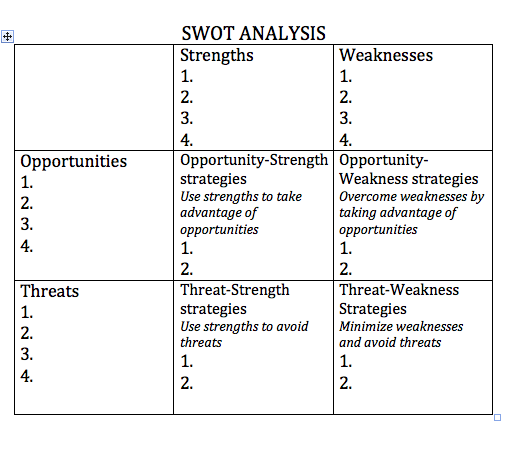
Results of the assessment are often presented in the form of a matrix.
Internal and external factors
Strengths and weaknesses are usually considered internal, while opportunities and threats are usually considered external. The degree to which an organization's internal strengths matches with its external opportunities is known as its strategic fit.
Internal factors may include:
- Human resources—staff, volunteers, board members, stakeholders
- Physical resources—location, building, equipment, plant
- Financial—revenue, grants, investments, other sources of income
- Activities and processes—projects, programs, systems
- Past experiences—reputation, knowledge
External factors may include:
- Future trends in the organization's field or society at large (e.g. macroeconomics, technological change)
- The economy—local, national, or international
- Funding sources—investors, foundations, donors, legislatures
- Demographics—changes in the age, race, gender, culture of those in the organization serviceable area
- Physical environment—growth of location in which organization is situated, access to location
- Legislation
- Local, national, or international events
A number of authors advocate assessing external factors before internal factors.
Use
SWOT analysis has been used at different levels of analysis, including businesses, non-profit organizations, governmental units, and individuals. SWOT analysis may also be used in pre-crisis planning, preventive crisis management, and viability study recommendation construction.
Strategic planning
SWOT analysis can be used to build organizational or personal strategy. Steps necessary to execute strategy-oriented analysis involve identifying internal and external factors, selecting and evaluating the most important factors, and identifying relationships between internal and external features. For instance, strong relations between strengths and opportunities can suggest good conditions in the company and allow using an aggressive strategy. On the other hand, strong interactions between weaknesses and threats could be analyzed as a warning to use a defensive strategy.
One form of SWOT analysis combines each of the four components with another to examine four distinct strategies:
- WT strategy (mini–mini): Faced with external threats and internal weaknesses, how to minimize both weaknesses and threats?
- WO strategy (mini–maxi): Faced with external opportunities and internal weaknesses, how to minimize weaknesses and maximize opportunities?
- ST strategy (maxi–mini): Faced with internal strengths and external threats, how to maximize strengths and minimize threats?
- SO strategy (maxi–maxi): Faced with external opportunities and internal strengths, how to maximize both opportunities and strengths?
Matching and converting
A SWOT analysis can be used to generate matching and converting strategies. Matching refers to seeking competitive advantage by matching strengths to opportunities. This strategy ensures that an organization leverages its core competencies, resources, and capabilities to capitalize on favorable market conditions, emerging trends, or unmet customer needs. Conversion refers to converting weaknesses or threats into strengths or opportunities. An example of a conversion strategy is to buy off a threat through collaboration or merger.
Marketing
Main article: Marketing management
In competitor analysis, marketers can use SWOT analysis to detail and profile the competitive strengths and weaknesses of each competitor in the market. This process may involve analysing competitors' cost structures, sources of profits, resources and competencies, competitive positioning, product differentiation, degree of vertical integration, historical responses to industry developments, among other factors. Relevant marketing research methods may include:
- Qualitative marketing research such as focus groups
- Quantitative marketing research such as statistical surveys
- Experimental techniques such as test markets
- Observational techniques such as ethnographic (on-site) observation
Marketing managers may also design and oversee various environmental scanning and competitive intelligence processes to help identify trends and inform the company's marketing analysis.
| Strengths | Weaknesses | Opportunities | Threats |
|---|---|---|---|
| Reputation in marketplace | Shortage of consultants at operating level rather than partner level | Well established position with a well-defined market niche | Large consultancies operating at a minor level |
| Expertise at partner level in HRM consultancy | Unable to deal with multidisciplinary assignments because of size or lack of ability | Identified market for consultancy in areas other than HRM | Other small consultancies looking to invade the marketplace |
In community organizations

Although the SWOT analysis was originally designed for business and industries, it has been used in non-governmental organisations as a tool for identifying external and internal support to combat internal and external opposition for successful implementation of social services and social change efforts. Understanding particular communities can come from public forums, listening campaigns, and informational interviews and other data collection. SWOT analysis provides direction to the next stages of the change process. It has been used by community organizers and community members to further social justice in the context of social work practice, and can be applied directly to communities served by a specific nonprofit or community organization.
Limitations and alternatives
SWOT analysis is intended as a starting point for discussion and not to, in itself, show managers how to achieve a competitive advantage.
In a highly-cited 1997 critique, "SWOT Analysis: It's Time for a Product Recall", Terry Hill and Roy Westbrook observed that one among many problems of SWOT analysis as often practiced is that "no-one subsequently used the outputs [of SWOT analysis] within the later stages of the strategy". Hill and Westbrook, among others, also criticized hastily designed SWOT lists. Other limitations of SWOT practice include: preoccupation with a single strength, such as cost control, leading to a neglect of weaknesses, such as product quality; Many other limitations have been identified.
Business professors have suggested various ways to remedy the common problems and limitations of SWOT analysis while retaining the SWOT framework.Some examples of publications that suggest remedies for common problems and limitations of SWOT analysis:
Porter's five forces
Main article: Porter's five forces analysis
Michael Porter developed the five forces framework as an alternative to SWOT analyses, which he found lacking in rigor and over-dependent on individual company circumstances.
SOAR
SOAR (strengths, opportunities, aspirations, and results) is an alternative technique inspired by appreciative inquiry. SOAR has been criticized as having similar limitations as SWOT, such as "the inability to identify the necessary data".
SVOR
In project management, the alternative to SWOT known by the acronym SVOR (Strengths, Vulnerabilities, Opportunities, and Risks) compares the project elements along two axes: internal and external, and positive and negative.
| Forces | Internal | Mathematical link | External |
|---|---|---|---|
| Positive | Total Forces | Total Forces given constraints = Infrastructures / Opportunities | Opportunities |
| Mathematical link | Vulnerabilities given constraints = 1 / Total Forces | constant k | Opportunities given constraints = 1 / Risks |
| Negative | Vulnerabilities | Risks given constraints = k / Vulnerabilities | Risks |
Constraints consist of: calendar of tasks and activities, costs, and norms of quality. The "k" constant varies with each project (for example, it may be valued at 1.3).
History
In 1965, three colleagues at the Long Range Planning Service (LRPS) of Stanford Research Institute—Robert F. Stewart, Otis J. Benepe, and Arnold Mitchell—wrote a technical report titled Formal Planning: The Staff Planner's Role at Start-Up. The report described how a person in the role of a company's staff planner would gather information from managers assessing operational issues grouped into four components represented by the acronym SOFT: the "satisfactory" in present operations, "opportunities" in future operations, "faults" in present operations, and "threats" to future operations. Stewart et al. focused on internal operational assessment and divided the four components into present (satisfactory and fault) and future (opportunity and threat), and not, as would later become common in SWOT analysis, into internal (strengths and weaknesses) and external (opportunities and threats).
Also in 1965, four colleagues at the Harvard Graduate School of Business Administration (later the Harvard Business School)—Edmund P. Learned, C. Roland Christensen, Kenneth R. Andrews, and William D. Guth—published the first of many editions of the textbook Business Policy: Text and Cases. (Business policy was a term then current for what has come to be called strategic management.) The first chapter of the textbook stated, without using the acronym, the four components of SWOT and their division into internal and external appraisal:
Looking back from three decades later, in the book Strategy Safari (1998), management scholar Henry Mintzberg and colleagues said that Business Policy: Text and Cases "quickly became the most popular classroom book in the field", widely diffusing its authors' ideas, which Mintzberg et al. called the "design school" model (in contrast to nine other schools that they identified) of strategic management, "with its famous notion of SWOT" emphasizing assessment of a company's internal and external situations. More generally, Mintzberg et al. attributed some conceptual influences on what they called the "design school" (of which they were strongly critical) to earlier books by Philip Selznick (Leadership in Administration, 1957) and Alfred D. Chandler Jr. (Strategy and Structure, 1962),
However, a 2023 history of SWOT by Richard W. Puyt and colleagues criticized Mintzberg's "vilification of SWOT" and Mintzberg's apparently poor knowledge of the LRPS at Stanford. Puyt et al. considered the LRPS to be the originator of SWOT (via SOFT) and said that the claim of Mintzberg and others that SWOT was invented at, or disseminated by, Harvard Business School is an "academic urban legend".
By the end of the 1960s, the four components of SWOT (without using the acronym) had appeared in other publications on strategic planning by various authors,Examples of publications in the late 1960s that mention the four components of SWOT without using the acronym include:
and by 1972 the acronym had appeared in the title of a journal article by Norman Stait, a management consultant at the British firm Urwick, Orr and Partners. By 1973, the acronym was well-known enough that accountant William W. Fea, in a published lecture, mentioned "the mnemonic, familiar to students, of S.W.O.T., namely strengths, weaknesses, opportunities, threats". Early examples of a 2 × 2 SWOT matrix are found in John Argenti's book Systematic Corporate Planning (1974) and in a 1980 article by management professor Igor Ansoff (but Ansoff used the acronym T/O/S/W instead of SWOT). In the 1960s Ansoff had worked with the LRPS, where the SOFT approach originated.
In popular culture
- Television: In the 2015 Silicon Valley episode "Homicide" (Season 2, Episode 6), Jared Dunn (Zach Woods) introduces the Pied Piper team to SWOT analysis. Later in that episode Dinesh (Kumail Nanjiani) and Gilfoyle (Martin Starr) employ the method when deciding whether or not to inform a stunt driver that the calculations for his upcoming jump were performed incorrectly.
References
References
- (Summer 1993). "Transforming public organizations with strategic management and strategic leadership". [[Journal of Management]].
- Silva, Carlos Nunes. (2005). "Encyclopedia of the city". [[Routledge]].
- (23 February 2021). "Are you doing the SWOT analysis backwards?".
- Andrews, Kenneth R.. (1971). "The concept of corporate strategy". Dow Jones–Irwin.
- "Community Toolbox: Section 14. SWOT analysis". Center for Community Health and Development at the [[University of Kansas]].
- Weihrich, Heinz. (April 1982). "The TOWS matrix—a tool for situational analysis". Long Range Planning.
- Watkins, Michael D.. (27 March 2007). "From SWOT to TOWS: answering a reader's strategy question".
- Armstrong, Michael. (2001). "A handbook of human resource management practice". [[Kogan Page]].
- Welch, James Stewart Jr.. (July 2023). "Visioning strategy through the "Johari window": discovering critical "unknowns" in a rapidly evolving context". Strategy and Leadership.
- (March 1998). "What's swot in strategic analysis?". Strategic Change.
- (31 January 2014). "Organization's stability and productivity: the role of SWOT analysis". International Journal of Innovative and Applied Research.
- (May 1989). "Making SWOT analysis work". Marketing Intelligence & Planning.
- Armstrong, Michael. (1990). "Management processes and functions". Institute of Personnel Management.
- (2017). "The practice of generalist social work". [[Routledge]].
- (February 2001). "A SWOT analysis of social work education in Canada". Social Work Education: The International Journal.
- (2012). "Strategic management: text and cases". [[McGraw-Hill/Irwin]].
- (February 1997). "SWOT analysis: it's time for a product recall". Long Range Planning.
- Koch, Adam. (2000). "SWOT does not need to be recalled: It needs to be enhanced". Richards College of Business, [[State University of West Georgia]].
- (December 2007). "The use of and misuse of SWOT analysis and implications for HRD professionals". Human Resource Development International.
- (2002). "An interview with Michael Porter". The Academy of Management Executive (1993–2005).
- (2007). "The change handbook: the definitive resource on today's best methods for engaging whole systems". Berrett-Koehler.
- (2009). "The thin book of SOAR: building strengths-based strategy". Thin Book Pub. Co..
- McLean, Gary N.. (Winter 2017). "Will SOAR really help organization development soar?: an invited reaction to Zarestky and Cole, 2017". New Horizons in Adult Education and Human Resource Development.
- Mesly, Olivier. (2017). "Project feasibility: tools for uncovering points of vulnerability". [[CRC Press]].
- (July 2020). "Origins of SWOT analysis". Academy of Management Proceedings.
- (1965). "Business policy: text and cases". Richard D. Irwin, Inc..
- (1999). "Management: a critical text". [[Macmillan Education]].
- (1998). "Strategy safari: a guided tour through the wilds of strategic management". [[Free Press (publisher).
- Mintzberg, Henry. (March 1990). "The design school: reconsidering the basic premises of strategic management". [[Strategic Management Journal]].
- Kiechel, Walter. (2010). "The lords of strategy: the secret intellectual history of the new corporate world". [[Harvard Business Press]].
- {{harvnb. Hill. Westbrook. 1997
- McKinsey, James Oscar. (1932). "Adjusting policies to meet changing conditions". [[American Management Association]].
- Puyt, Richard W.. (2023-06-01). "The origins of SWOT analysis". Long Range Planning.
- Stait, Norman H.. (July 1972). "Management training and the smaller company: SWOT analysis". Industrial and Commercial Training.
- Fea, William W.. (1973). "The sixtieth Thomas Hawksley lecture: The accountant—overhead burden or service?". [[Proceedings of the Institution of Mechanical Engineers]].
- (June 2024). "From SOFT approach to SWOT analysis, a historical reconstruction". Journal of Management History.
- Ansoff, H. Igor. (April 1980). "Strategic issue management". [[Strategic Management Journal]].
- (November 2024). "The Ansoff archive: revisiting Ansoff's legacy and the holistic approach to strategic management". Strategic Change.
- Kemper, Carrie. (May 17, 2015). "Homicide".
This article was imported from Wikipedia and is available under the Creative Commons Attribution-ShareAlike 4.0 License. Content has been adapted to SurfDoc format. Original contributors can be found on the article history page.
Ask Mako anything about SWOT analysis — get instant answers, deeper analysis, and related topics.
Research with MakoFree with your Surf account
Create a free account to save articles, ask Mako questions, and organize your research.
Sign up freeThis content may have been generated or modified by AI. CloudSurf Software LLC is not responsible for the accuracy, completeness, or reliability of AI-generated content. Always verify important information from primary sources.
Report