From Surf Wiki (app.surf) — the open knowledge base
Swedish Air Force
Air warfare branch of Sweden's military

Air warfare branch of Sweden's military
| Field | Value | |||||||||||||
|---|---|---|---|---|---|---|---|---|---|---|---|---|---|---|
| unit_name | Swedish Air Force | |||||||||||||
| native_name | Flygvapnet | |||||||||||||
| image | [[File:Flygvapnet vapen bra.svg | 150px]] | ||||||||||||
| caption | Coat of arms of the Swedish Air Force | |||||||||||||
| start_date | ||||||||||||||
| country | Sweden | |||||||||||||
| type | Air force | |||||||||||||
| role | Aerial warfare | |||||||||||||
| size | 2,700 | |||||||||||||
| command_structure | Swedish Armed Forces | |||||||||||||
| colors | ||||||||||||||
| colors_label | ||||||||||||||
| march | ||||||||||||||
| equipment | 207 aircraft | |||||||||||||
| battles | {{blist | |||||||||||||
| Winter War<ref>{{cite web | url | http://www.smb.nu/index.php/finlands-krig/1199-i-luftstrid-oever-lappland | title=I luftstrid över Lappland | first=Lars | last=Gyllenhaal | website=Svenskt Militärhistoriskt Bibliotek | access-date=11 December 2012 | language=sv | url-status=dead | archive-url=https://web.archive.org/web/20130714055944/http://www.smb.nu/index.php/finlands-krig/1199-i-luftstrid-oever-lappland | archive-date=14 July 2013 }} | Congo Crisis | Afghanistan War | 2011 military intervention in Libya}} |
| commander1 | MajGen Jonas Wikman | |||||||||||||
| commander1_label | Chief of Air Force | |||||||||||||
| commander2 | BGen | |||||||||||||
| commander2_label | Deputy Chief of Air Force | |||||||||||||
| commander3 | Col Dennis Hedström | |||||||||||||
| commander3_label | Chief of the Air Staff | |||||||||||||
| notable_commanders | Bengt Nordenskiöld | |||||||||||||
| identification_symbol | [[File:Roundel of Sweden.svg | 80px]] [[File:Roundel of Sweden – Low Visibility.svg | 80px]] | |||||||||||
| identification_symbol_label | Roundel | |||||||||||||
| aircraft_electronic | Saab 340 AEW&C, Gulfstream IV-SP | |||||||||||||
| aircraft_fighter | JAS 39 Gripen | |||||||||||||
| aircraft_helicopter | A109LUH, NH90, UH-60M | |||||||||||||
| aircraft_trainer | Grob G 120TP | |||||||||||||
| aircraft_transport | C-130H Hercules, Saab 340B, Gulfstream IV-SP, Gulfstream G550 |
|Winter War|Congo Crisis|Afghanistan War|2011 military intervention in Libya}}
The Swedish Air Force ( or just Flygvapnet) is the air force branch of the Swedish Armed Forces.
History
The Swedish Air Force was created on 1 July 1926 when the aircraft units of the Army and Navy were merged. Because of the escalating international tension during the 1930s the Air Force was reorganized and expanded from four to seven squadrons.
World War II
When World War II broke out in 1939 further expansion was initiated and this substantial expansion was not finished until the end of the war. Although Sweden never entered the war, a large air force was considered necessary to ward off the threat of invasion and to resist pressure through military threats from the great powers. By 1945 the Swedish Air Force had over 800 combat-ready aircraft, including 15 fighter divisions.
A major problem for the Swedish Air Force during World War II was the lack of fuel. Sweden was surrounded by countries at war and could not rely on imported oil. Instead domestic oil shale was heated to produce the needed petrol.
About 250 aircrew were killed in crashes 1939-1945 according to statistics that were not disclosed during the war years but published afterwards.
Expansion during the Cold War

The Swedish Air Force underwent a rapid modernization from 1945. It was no longer politically acceptable to equip it with second-rate aircraft types. Instead, the Air Staff purchased the best it could find from abroad, e.g. P-51D Mustangs, De Havilland Mosquito NF.19 night fighters and de Havilland Vampires, and supported the development of top performance domestic models. The Saab 29 Tunnan jet fighter was introduced around 1950.
In the late 1950s the Swedish Air Force introduced the Bas 60 air base system, which revolved around force dispersal of air squadrons across many wartime air bases in case of war in order to make it complicated for an opponent to destroy the air force on the ground. Road runways were also introduced as backup runways. Bas 60 was developed further into Bas 90 during the 1970s and 1980s.
During the Cold War large amounts of money (including funds intended for the Swedish nuclear weapons programme) were spent on the Swedish Air Force and domestic aircraft production. In 1957 Sweden had the world's fourth most powerful air force, with about 1,000 modern planes in front-line service. During the 1950s, it introduced fighters such as the Saab J 29 Tunnan, Saab A 32 Lansen and Saab J 35 Draken.
In June 1952 the Swedish Air Force lost two aircraft on Cold War operations, in what became known as the Catalina affair. A signals intelligence Douglas DC-3 was intercepted by Soviet MiG-15s over the Baltic, and shot down with the loss of three aircrew and five civilian technicians. A PBY Catalina rescue seaplane was then also downed, the five-man crew being rescued from the sea by a freighter.
In the air defence role the Swedish Air Force also operated surface-to-air missiles. Svea Air Corps (F 8) operated de Havilland J-28B Vampire jet aircraft in 1949 being replaced in 1953 by Saab J-29 Tunnan and in 1957 by J-34 Hunter fighters. As of 1961 F 8 reroled into missile defence role becoming the air force technical training centre for using the new RB-68 Bloodhound systems in 2 squadrons until 1974.
These Swedish units also operated the RB-68 missile system (1 squadron each):
- Scania Wing, also F 10 Ängelholm
- Kalmar Wing, also F 12 Kalmar,
- Bråvalla Wing, also F 13 Norrköping
- Blekinge Wing, also F 17 Kallinge,
Death toll during the Cold War
In the Cold War era, more than 600 Swedish fighter pilots were killed in crashes during peacetime exercises and training in the 1945–1991 period. In the 1950s–60s era the flight training curriculum was deficient and the training regimes were too risky and some aircraft types had design flaws. In the 1950s, about 21 pilots were killed annually.
In the 1960s the average number of killed were 13 per year, which meant Sweden had sixfold mortality rate per 100,000 flight hours compared to the United States. In the 1960s flight safety started to become a consideration, not due to the death toll but because the aircraft were getting increasingly expensive. In October 1960, a Lansen fighter crashed into a farmhouse and killed 7 people. In the 1970s the death toll was reduced to 6–7 per year. In subsequent years, it continued to fall and from 1996 onwards, no fatal accident has been recorded.
War service
The Swedish Air Force has been involved in three wars, the Finno-Soviet Winter War in 1939–40, in which volunteers took part, the Congo Crisis, 1961–64, and in the 2011 Libyan civil war.
Finland 1940
When the Soviet Union attacked Finland in November 1939, Sweden came to its neighbour's assistance but eventually decided not to join the war.
A Swedish volunteer infantry brigade and a volunteer air squadron fought in northern Finland from January to March 1940. The squadron was designated F 19 and consisted of 12 Gloster Gladiator fighters and four Hawker Hart dive-bombers.
Congo 1961–1964

The Swedish Air Force saw combat as part of the United Nations peace-keeping mission ONUC during the Congo Crisis in 1961 to 1964. It established a separate air wing, F 22, equipped with a dozen Saab 29 Tunnans, which performed well under the rough conditions in central Africa. The secessionist adversaries possessed only a small number of aircraft with poor combat capabilities, e.g. Fouga Magister trainers.
1990s restructuring
With the end of the Cold War the Swedish Armed Forces underwent a massive restructuring process. During this time, several air bases were deemed unnecessary and closed with fighters like the Saab 37 Viggen retired prematurely. In 1994 the Air Force had over 400 fighters, by 2005 that number had shrunk to fewer than 150.
Libya 2011
On 29 March 2011, the Swedish prime minister announced that eight Saab JAS 39 Gripens would support the UN-mandated no-fly zone over Libya. The announcement responded to a NATO request for assistance. The Swedish fighters were limited to supporting the no-fly zone and were not authorized to engage in ground attack sorties. The deployment was approved by the Swedish Riksdag on 1 April 2011 and the first jets departed for Libya on 2 April. A C-130 Hercules accompanied the fighters for mid-air refueling.
Poland 2025
In March of 2025 Sweden, now a part of NATO, sent six Saab Gripen fighters to Poland to take part in an enhanced air policing mission to protect NATO's borders from Russia.
Equipment
Aircraft
.jpg)
_15025_25_levels.jpg)
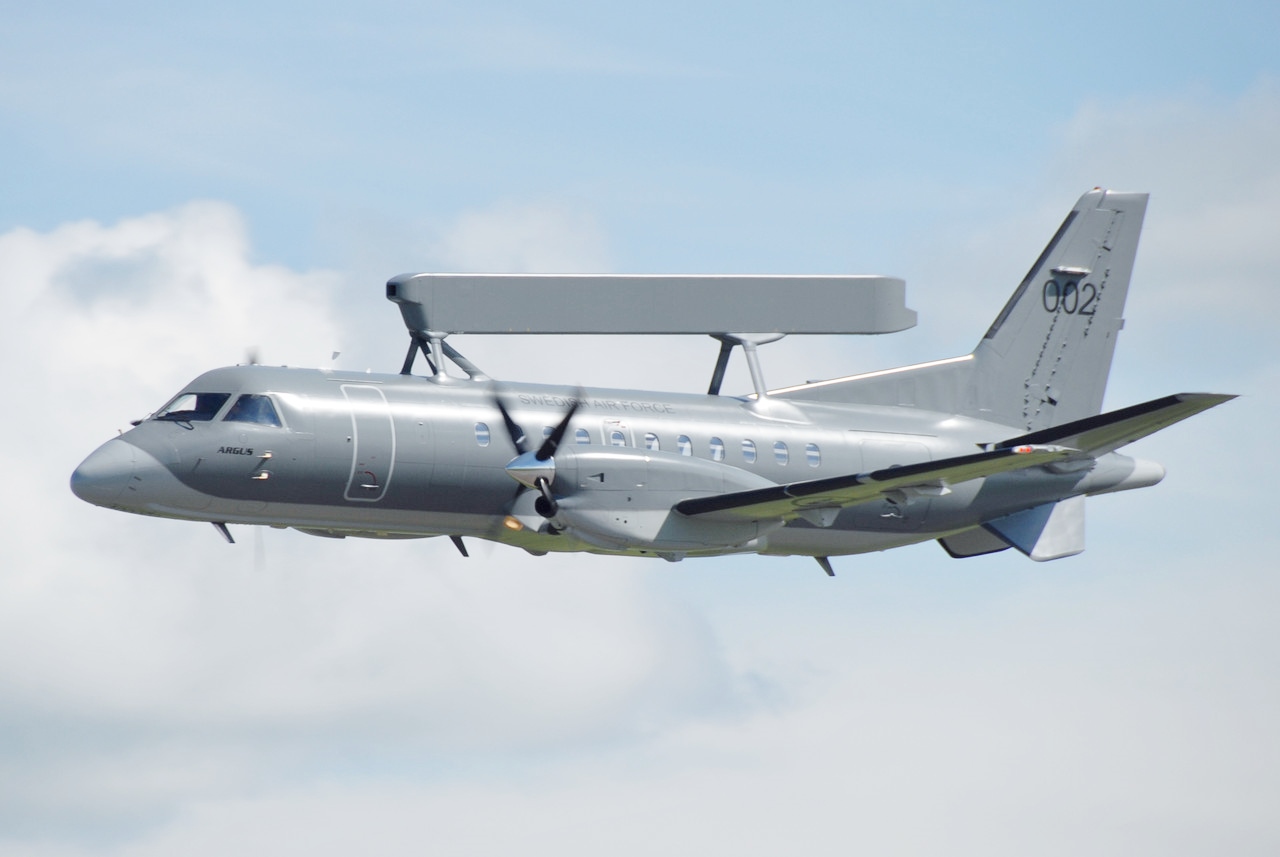
| Aircraft | Origin | Type | Variant | In service | Notes | Combat aircraft | AWACS | Reconnaissance | Tanker | Transport | Helicopters | Trainer aircraft | UAV | |||||||
|---|---|---|---|---|---|---|---|---|---|---|---|---|---|---|---|---|---|---|---|---|
| JAS 39 Gripen | Sweden | Multirole | JAS 39C | last=Hoyle | first=Craig | year=2023 | title=World Air Forces 2024 | url=https://www.flightglobal.com/download?ac=98881 | access-date=12 December 2023 | publisher=Flightglobal Insight | doi=}} | 60 E variants on order | ||||||||
| Saab 340 | AEW&C | S 100D (ASC 890) | 2 | Equipped with the Erieye radar. | ||||||||||||||||
| Gulfstream IV | USA | SIGINT | S 102 B | 2 | ||||||||||||||||
| KC-130H Hercules | USA | Aerial refueling | KC-130H | 1 | Being replaced by Embraer C-390 | |||||||||||||||
| Saab 340 | Utility transport | TP 100 | 2 | One used for reconnaissance | ||||||||||||||||
| Gulfstream IV | USA | VIP transport | TP 102 C | 1 | Being replaced by Bombardier Global 6500 | |||||||||||||||
| Gulfstream 550 | USA | VIP transport | TP 102 D | 1 | Being replaced by Bombardier Global 6500 | |||||||||||||||
| C-130H Hercules | USA | Tactical airlifter | TP 84D | 5 | Being replaced by Embraer C-390 | |||||||||||||||
| Embraer C-390 | Brazil | Tactical airlifter | (4 on order) | |||||||||||||||||
| Boeing C-17A Globemaster III | USA | Tactical airlifter | C-17 | 3 | Operated by Heavy Airlift Wing | |||||||||||||||
| Sikorsky UH-60M | USA | Utility | HKP 16 | 15 (27) | Additional 12 on order | |||||||||||||||
| NHIndustries NH90 | Germany | Utility / Transport | HKP 14E | 9 | ||||||||||||||||
| AgustaWestland AW109 | Italy | Trainer / Light utility | HKP 15A | 12 | ||||||||||||||||
| Grob G 120TP | Germany | Basic trainer | 10 | 3 on order in 2024, to be delivered by 2025. | ||||||||||||||||
| AAI RQ-7 Shadow | USA | Surveillance | 8 | |||||||||||||||||
| Elbit Skylark | Israel | Surveillance |
Note: Three C-17 Globemaster III's are available through the Heavy Airlift Wing based in Hungary
In 2025 the Swedish Air Force announced the intention to join the NATO MMR fleet together with the Danish Air Force.
Weapons
Main article: Swedish Air Force weapons
Organization
Fighter wings
There are four fighter wings:
- Skaraborg Wing (F 7), at Såtenäs Air Base, operates JAS 39C/D
- Uppland Wing (F 16), at Ärna Air Base, reestablished in 2021 and without fighter divisions as of 2024
- Blekinge Wing (F 17), at Ronneby Air Base, operates JAS 39C/D
- Norrbotten Wing (F 21), at Luleå Air Base, operates JAS 39C/D
Helicopter squadrons
The aviation units that were formerly under the Swedish Army ("Arméflyget") and the Swedish Navy ("Marinflyget") have been merged with the helicopter units of the Air Force to form the single Helicopter Wing (Hkpflj) for the entire Armed Forces. The wing has been placed under the authority of the Air Force and consists of:
- 1st Helicopter Squadron, co-located with Norrbotten Wing at Luleå Air Base, operates NH90 TTH (Hkp 14E)
- 2nd Helicopter Squadron, at Malmen Air Base, operates AW109 (Hkp 15) and UH-60M Black Hawk (Hkp 16)
- 3rd Helicopter Squadron, co-located with Blekinge Wing at Ronneby Air Base, operates NH90 TTH (Hkp 14F) and AW109 (Hkp 15)
- 4th Helicopter Squadron, at Malmen Air Base, operates AW109 (Hkp 15) and UH-60M Black Hawk (Hkp 16)
Other squadrons
The air transport units perform airlift operations, and are used in both national and in international missions. The unit also organizes the Swedish part of the Heavy Airlift Wing in Hungary. Signals reconnaissance units conduct electronic combat reconnaissance and intelligence gathering.
- 71st Air Transport Squadron, co-located with Skaraborg Wing at Såtenäs Air Base, operates C-130H Hercules
- 74th Special Air Squadron, at Malmen Air Base, operates Gulfstream IV-SP, Saab 340 AEW&C and Saab 340
- 75th State Air Squadron, at Arlanda Air Base, operates Gulfstream IV and Gulfstream 550
Future of the Swedish Air Force
_(cropped).jpg)
At RIAT 2022, the commander of the Swedish Air Force stated that the air force in the future (2030) will consist of 60 Jas 39C/D and 60 Jas 39E in a total of 7 fighter squadrons.
In November 2022, the Strategic Defence Plan was published in which it was announced that all NH90 helicopters will be phased out and replaced, additional Sikorsky Black Hawks will be ordered for the tactical transport role, a new medium sized helicopter for the ASW/ASuW role will be selected.
Saab JAS 39 Gripen E
Currently the Swedish Air Force main fighter is the Saab JAS 39 Gripen, in the C/D versions. By 2018 95 fighters were active with about 30 of these being updated from the A version.
The heavily modernised E version will augment the current fleet of Gripen C/D. The aircraft includes a new Active Electronically Scanned Array (AESA) radar, an Infrared search and track (IRST) sensor and is powered by the improved General Electric F414G. Gripen E also has an increased maximum take-off weight, carries more fuel and has two more hardpoints than the Gripen C/D allowing it to carry more weapons. The upgrade also includes the integration of new weapons like the Meteor air-to-air missile. In 2013 Saab signed an agreement with the Swedish Defence Materiel Administration for 60 new Gripen E. JAS 39E will join the Swedish Air Force in 2025 and is planned to remain in service until at least 2060.
Next generation fighter jet
The Swedish Air Force plans to retain its fleet of JAS 39C/D until some time after 2030. In an effort to replace JAS 39C/D the Swedish Air Force has formulated three options for the procurement of a new fighter jet with a decision to be made in 2031 at the latest.
- Fully domestic development of a next generation fighter jet
- Joint development of a next generation fighter jet with other countries
- "Off-the-shelf" purchase of a foreign fighter jet
In an effort to maintain the possibility of pursuing any of the three options SAAB was awarded a two year contract by the Swedish Air Force for concept studies for next generation fighter jet studies in 2024. The program, called KFS, includes the development of both a next generation crewed fighter jet and uncrewed systems such as loyal wingmen. The construction of technology demonstrators is planned during the second phase of studies which will commence in 2026.
Sweden had signed a memorandum of Understanding (MOU) with the United Kingdom and Italy in 2021 regarding the joint development of next generation technologies for the Tempest fighter jet. Sweden would later walk away from the project which by then had evolved into GCAP citing differences between its requirements for a next generation fighter jet and those of the UK, Italy and Japan.
_at_RIAT_Fairford_17July2017_arp.jpg)
Military transport aircraft
The Swedish C-130 Hercules (TP 84) were bought from the United States in the 1960s and has been updated several times. The Swedish Defence Materiel Administration has been tasked to update the aircraft so they can remain in service until 2030. In November 2024 the Swedish Air Force announced that it had selected the Embraer C-390 Millennium as its future military transport aircraft. As part of the Heavy Airlift Wing cooperation, Sweden also operates three Boeing C-17 which are located at Pápa Air Base in Hungary.
Training aircraft
Sweden used the Saab 105 as the primary jet-trainer until phase out per June 2024. About forty planes were operational. Designed in the 1960s the aircraft is starting to show its age and were gradually phased out from active service. The Swedish Air Force selected the Grob G 120TP as its new Basic Trainer Aircraft, designated SK 40. Ten aircraft have been ordered and delivered but due to work environment problems caused by high workload the implementation of the new planes have been put on hold temporarily.
Saab GlobalEye AEW&C
Sweden will procure the Saab GlobalEye airborne early warning and control (AEW&C) platform to replace its two S100D/ASC890. The Swedish Armed Forces submitted an official request to the government to buy the Saab GlobalEye platform on October 1, 2021. On October 24, 2021 the Swedish government approved the purchase to replace its old S100D/ASC890.
On 30 June 2022 SAAB and the Swedish Defence Materiel Administration (FMV) signed a contract for the acquisition of two GlobalEye aircraft, to be designated S 106 in Swedish service. The deal is valued at 7,3 billion SEK (US$710 million) and deliveries was scheduled for 2027. The contract also included the option to procure up to two additional GlobalEye aircraft. After pledging its current Saab ASC 890 platforms to Ukraine, the GlobalEye delivery was expedited and one additional aircraft was ordered by the Swedish Air Force.
Space
The interest in military use of the space domain by the Swedish Armed Forces became established after the Gulf War where the necessity of military satellites in modern warfare became apparent.
The Defence Act of 2020 included provisions for the establishment of a space-focused unit, influenced by the recent formation of the United States Space Force. By this time, the Swedish Armed Forces had also identified the need for such a capability to safeguard national sovereignty. As a result, the Space Division was established within the Swedish Air Force in 2023.
On 16 August 2024, in cooperation with SpaceX, the Swedish Armed Forces launched their first military satellite, the experimental communications satellite GNA-3, from Vandenberg Space Force Base.
Ranks
Main article: Military ranks of the Swedish Armed Forces
;Commissioned officer ranks The rank insignia of commissioned officers.
;Other ranks The rank insignia of non-commissioned officers and enlisted personnel.
References
References
- IISS. (2022). "The Military Balance 2022". Routledge.
- Gyllenhaal, Lars. "I luftstrid över Lappland".
- (1976). "Oil Shale". Elsevier.
- (17 February 2018). "Svenska flygvapnets dödliga facit".
- Rystedt, Jörgen. (1 October 2005). "Flygbassystem 60".
- Rystedt, Jörgen. (25 April 2009). "Flygbassystem 90".
- Törnell, Bernt. (5 February 2007). "Svenska militära flygbaser".
- Andersson, Lennart. (23 November 2006). "Svenska reservvägbaser".
- (1 May 2010). "The Growth of the Air Force".
- "Flygvapnet 80 år".
- "TP 47 - Flygvapenmuseum". Flygvapenmuseum.
- (14 March 2013). "Pilotdöden – vårt okända nationella trauma".
- (29 April 2013). "Nu utreds massdöden inom flygvapnet". [[Expressen]].
- (29 March 2011). "Sweden plans to join Libya no-fly zone with fighter jets, but no ground attacks".
- (2 April 2011). "Swedish Gripen Planes Headed to Libya". [[The Local]].
- "NATO's newest ally is sending its Gripen jets made for war with Russia out to patrol alliance borders for the first time".
- Hoyle, Craig. (2023). "World Air Forces 2024". Flightglobal Insight.
- (2023-10-19). "Leverans av det första serieproducerade JAS 39E-planet till FMV". [[Swedish Defence Materiel Administration]].
- Hoyle, Craig. (2024-06-12). "Why Swedish Gripen fleet is NATO's new ACE off base".
- (2024-05-29). "Sweden Sending Two Saab 340 AEWCS Sky and Sea Surveillance Planes to Ukrainian Air Force".
- Rogoway, Thomas Newdick, Tyler. (2024-05-29). "Ukraine Getting Swedish Airborne Early Warning Radar Planes Is A Big Deal".
- Giulia Bernacchi. (October 7, 2025). "Sweden Orders Four C-390 Millennium Aircraft From Embraer". The Defense Post.
- "Beställning av tolv helikoptrar".
- "Materiel och teknik: UAV 3 Ornen".
- "Materiel och teknik Flyg: SUAV systemet Falken".
- "Heavy Airlift Wing". [[Strategic Airlift Capability]] Program.
- "Förband och förmågor: Julgran markerar slutet för en epok".
- Olofsson, Kristoffer. "Upplands flygflottilj är tillbaka".
- Perry, Dominic. (2022-11-01). "Sweden to axe NH90 fleet under revised defence equipment plan". Flightglobal.
- Gummesson, Jonas. (29 April 2015). "Vart tredje JAS-plan taget ur drift". [[Svenska Dagbladet]].
- "Gripen E-series {{!}} Saab".
- "Gripen C-series {{!}} Saab".
- "Gripen E Multirole Fighter Aircraft".
- (15 February 2013). "Saab signs agreement for the next generation fighter aircraft Gripen E and receives development order".
- "Swedish Air Force Details Gripen E Introduction Timeline {{!}} Aviation Week Network".
- (2022). "Försvarsmaktens budgetunderlag för 2022". [[Swedish Armed Forces]].
- Martin, Tim. (2023-11-07). "Sweden commits to future fighter procurement decision in 2031: Official".
- "Saab receives order for Swedish future fighter concept studies".
- Martin, Tim. (2024-05-22). "Saab teases future fighter demonstrator concepts, awaits direction from Sweden".
- Newdick, Thomas. (2024-12-18). "These Are Saab's Concepts For Its Next Generation Fighter, Drones".
- D'Urso, Stefano. (2021-01-05). "Italy, United Kingdom And Sweden Sign Tempest FCAS Cooperation Memorandum Of Understanding".
- "Sweden Preparing For Future Combat Aircraft Studies {{!}} Aviation Week Network".
- "Portal Embraer".
- Sundgren, Linda. (2023-04-14). "Akuta arbetsmiljöproblem på Flygskolan - införandet av SK 40 påverkas".
- "FMV tecknar kontrakt om tidigarelagd leverans av S 106".
- "Saab signs contract with Swedish FMV for a third GlobalEye".
- SDRA. (2004). "Militarisering av rymden.".
- Headquarters. (2022-07-11). "Rymden – den nya frontlinjen".
- Balkander, Mattias. (2024-05-20). "Försvaret vill skjuta upp militära satelliter från Kiruna". [[Göteborgs-Posten]].
- Ek, Bo Torbjörn. (2025-01-31). "Musks bolag har skjutit upp svensk militär satellit".
- Air Force. (2025-01-31). "Sveriges första militära satellit uppsänd".
This article was imported from Wikipedia and is available under the Creative Commons Attribution-ShareAlike 4.0 License. Content has been adapted to SurfDoc format. Original contributors can be found on the article history page.
Ask Mako anything about Swedish Air Force — get instant answers, deeper analysis, and related topics.
Research with MakoFree with your Surf account
Create a free account to save articles, ask Mako questions, and organize your research.
Sign up freeThis content may have been generated or modified by AI. CloudSurf Software LLC is not responsible for the accuracy, completeness, or reliability of AI-generated content. Always verify important information from primary sources.
Report