From Surf Wiki (app.surf) — the open knowledge base
Swage nut
Type of fastener
Type of fastener
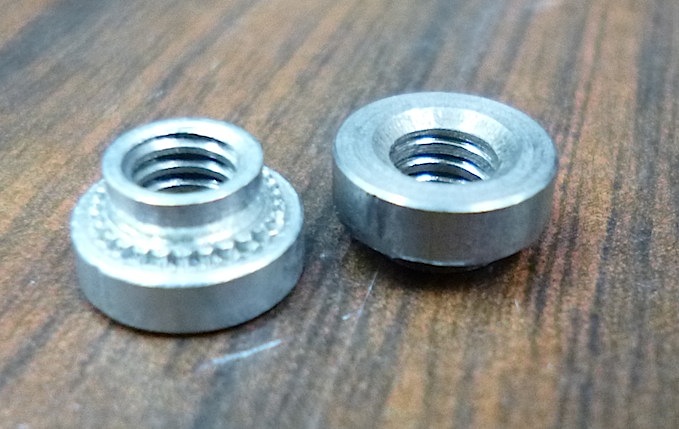
A swage nut or self-clinching nut is a type of nut or threaded insert that is used on sheet metal.
It permanently anchors itself to the sheet metal by swaging the surrounding material. Generally, the swage nut is made of a hard metal such as stainless steel, which is inserted into a pre-drilled hole in a softer ductile material such as aluminum. The inserted shank has three diameters: a main shaft which fits the hole closely, a thin smaller-diameter undercut, and a larger-diameter serrated clinching ring. Forcing the clinching ring into softer material, with an arbor press or by tightening a screw through the hole, causes it to plastically deform (swage) into the annular recess in the shank. This locks the nut into the hole. The knurling on the clinching ring is not necessary for this step, but prevents the nut from rotating after installation.
This is a popular method for adding strong, load-bearing threads to a relatively thin piece of sheet metal. Commercial varieties exist to suit common sheet metals, such as mild steel, stainless steel, and aluminum, and can include finishes for corrosion resistance.
Self-clinching nuts are described in National Aerospace Standard NASM45938 which supersedes military specification MIL-N-45938{{Cite web
History
Albert Spokes filed for a U.S. patent on the swage nut in early 1958. The swage nut is descended from an older idea, the clinch nut. Clinch nuts incorporate a tubular shaft that fits through the part to be attached and is clinched or riveted in place from the opposite side.
References
References
- Smith, Carroll. (1990). "Carroll Smith's Nuts, Bolts, Fasteners, and Plumbing Handbook". MotorBooks/MBI Publishing Company.
- "Nut with recesses to receive metal of the workpiece".
- "Rivetable nut".
- "Nut structure".
This article was imported from Wikipedia and is available under the Creative Commons Attribution-ShareAlike 4.0 License. Content has been adapted to SurfDoc format. Original contributors can be found on the article history page.
Ask Mako anything about Swage nut — get instant answers, deeper analysis, and related topics.
Research with MakoFree with your Surf account
Create a free account to save articles, ask Mako questions, and organize your research.
Sign up freeThis content may have been generated or modified by AI. CloudSurf Software LLC is not responsible for the accuracy, completeness, or reliability of AI-generated content. Always verify important information from primary sources.
Report