From Surf Wiki (app.surf) — the open knowledge base
Supreme Court of Cassation (Italy)
Italian Court of Justice in Rome
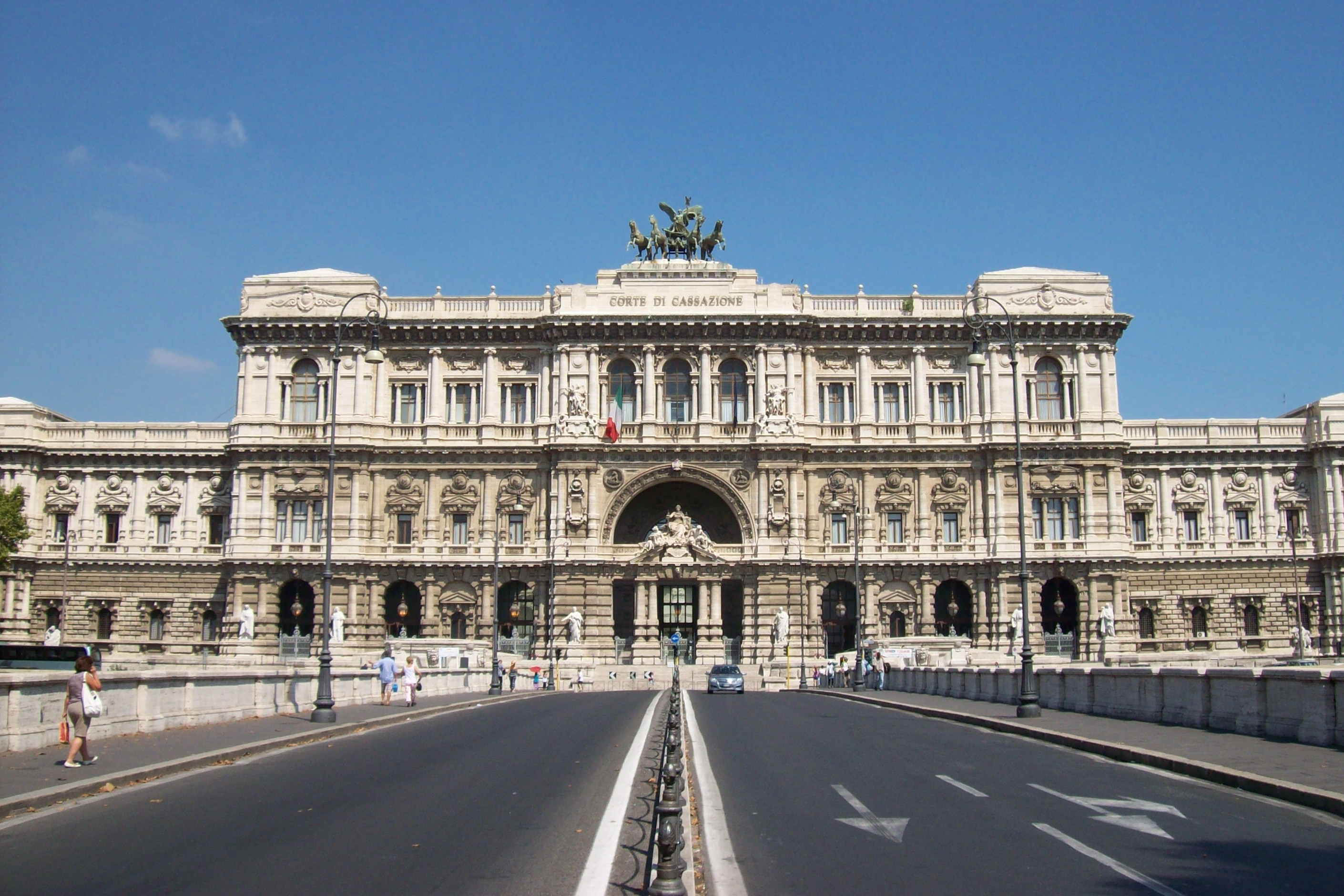
Italian Court of Justice in Rome
| Field | Value |
|---|---|
| court_name | Supreme Court of Cassation |
| native_name | Corte Suprema di Cassazione |
| image | Italian Supreme Court logo.png |
| established | |
| jurisdiction | Italy |
| location | Rome, Italy |
| authority | Constitution of Italy |
| appealsto | |
| appealsfrom | |
| terms | |
| positions | 65 |
| budget | |
| website | |
| chiefjudgetitle | President |
| chiefjudgename | Pasquale D'Ascola |
| termstart | 9 September 2025 |
| termend | |
| termend2 | |
| chiefjudgetitle2 | |
| chiefjudgename2 | |
| termstart2 | |
| termend3 | |
| termend4 | |
| chiefjudgetitle3 | |
| chiefjudgename3 | |
| termstart3 | |
| termend5 | |
| termend6 | |
| division_map | |
| division_map_upright | |
| division_map_size | |
| division_map_alt |
| tribunal-type =
The Supreme Court of Cassation () is the highest court of appeal or court of last resort in Italy. It has its seat in the Palace of Justice, Rome.
The Court of Cassation also ensures the correct application of law in the inferior and appeal courts and resolves disputes as to which lower court (penal, civil, administrative, military) has jurisdiction to hear a given case.
Procedure
The Italian Supreme Court of Cassation is the highest court of Italy. Appeals to the Court of Cassation generally come from the Appellate Court, the second instance courts, but defendants or prosecutors may also appeal directly from trial courts, first instance courts. The Supreme Court can reject, or confirm, a sentence from a lower court. If it rejects the sentence, it can order the lower court to amend the trial and sentencing, or it can annul the previous sentence altogether. A sentence confirmed by the Supreme Court of Cassation is final and definitive, and cannot be further appealed for the same reasons. Although the Supreme Court of Cassation cannot overrule the trial court's interpretation of the evidence it can correct a lower court's interpretation or application of the law connected to a specific case.
As explained by the Cassazione, "The appeal in cassation may be lodged against the measures issued by the ordinary courts at the appellate level or in degree only: the reasons given to support the use may be, in civil matters, the violation of the right material (errores in iudicando) or procedural (errores in proceeding), the vices of motivation (lack, insufficiency or contradiction) of the judgment under appeal; or, again, the grounds for jurisdiction. A similar scheme is expected to appeal to the Supreme Court in criminal matters".
The Italian judicial system is based on civil law within the framework of late Roman law, and not based on common law. Its core principles are entirely codified into a normative system which serves as the primary source of law, which means judicial decisions of the supreme court, as well as those of lower courts, are binding within the frame of reference of each individual case submitted, but do not constitute the base for judicial precedent for other future cases as in Common Law. While in Civil Law jurisdictions the doctrine of stare decisis (precedent) does not apply, in practice the decisions of the Supreme Court of Cassation usually provide a very robust reference point in jurisprudence constante. The two essential aims of the Supreme Court of Cassation are to ensure that lower courts correctly follow legal procedure, and to harmonize the interpretation of laws throughout the judicial system.
Members and organization
The Supreme Court of Cassation is organized into two divisions: a criminal section and a civil section. The court has a general president, The First President of the Court of Cassation, a deputy, and each section has its own president. Cases brought to the supreme court are normally heard by a panel of five judges. In more complex cases, especially those concerning compounded matters of statutory interpretation an extended panel of nine judges ("united sections" of the supreme court) hear the case. In addition, in every case submitted to the supreme court, the office of public prosecutor must state their interpretation of the applicable law, to assist and facilitate the court, in a consultative capacity, in reaching its final decision.
Brief history
The need for this kind of court in Europe became apparent with the Ancien Régime's difficulties in maintaining both uniformity of interpretation and supremacy of the central laws against local privileges and rights. This kind of court first appeared during the French Revolution. The original French courts were initially much more like a legislative body than a judicial one. During his conquests, Napoleon greatly influenced Italian legal theory, and the Court of Cassation was formed using many imported French ideas.
The Court of Cassation was provided by the former Italian Civil Code in 1865 and then it was reorganized by royal decree 12 on 30 January 1941,
On 1 March 2023, the High Council of the Judiciary unanimously elected the magistrate Margherita Cassano in the role of first president of the Court of Cassation. She is the first woman to hold this position.
References
References
- G. Di Federico, La Corte di cassazione: la giustizia come organizzazione, Laterza Editore, 1969.
- "Corte di Cassazione – Funzioni della Corte".
- P. Calamandrei, Istituzioni di diritto processuale civile, Padova, 1943
- G. Leone, Lineamenti di diritto processuale penale italiano, Giuffre Editore, 1956
- S. Satta, Diritto processuale civile, CEDAM, Padova, 1959
- V. Lacoppola, La competenza civile nella giurisprudenza della cassazione, Milano, 1988.
- (2003). "Il progetto di riforma dell'ordinamento giudiziario e le "sentenze suicide"". Forum di Quaderni Costituzionali.
- (1 March 2023). "Cassation, for the first time a woman president: who is Margherita Cassano". [[Il Sole 24 Ore]].
- (1 March 2023). "Who is Margherita Cassano, first woman president of the Court of Cassation: her career and the CSM-Council of State clash". [[Il Riformista]].
- (1 March 2023). "Who is Cassano, first woman president of the Court of Cassation". [[Avvenire]].
This article was imported from Wikipedia and is available under the Creative Commons Attribution-ShareAlike 4.0 License. Content has been adapted to SurfDoc format. Original contributors can be found on the article history page.
Ask Mako anything about Supreme Court of Cassation (Italy) — get instant answers, deeper analysis, and related topics.
Research with MakoFree with your Surf account
Create a free account to save articles, ask Mako questions, and organize your research.
Sign up freeThis content may have been generated or modified by AI. CloudSurf Software LLC is not responsible for the accuracy, completeness, or reliability of AI-generated content. Always verify important information from primary sources.
Report