From Surf Wiki (app.surf) — the open knowledge base
Superior highly composite number
Class of natural numbers with many divisors
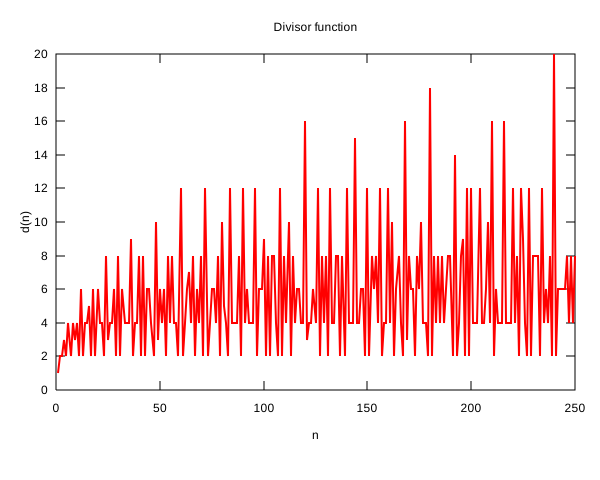
Class of natural numbers with many divisors

In number theory, a superior highly composite number is a natural number which, in a particular rigorous sense, has many divisors. Particularly, it is defined by a ratio between the number of divisors an integer has and that integer raised to some positive power.
For any possible exponent, whichever integer has the greatest ratio is a superior highly composite number. It is a stronger restriction than that of a highly composite number, which is defined as having more divisors than any smaller positive integer.
The first ten superior highly composite numbers and their factorization are listed.
| # prime | |||||
|---|---|---|---|---|---|
| factors | SHCN | ||||
| n | Prime | ||||
| factorization | Prime | ||||
| exponents | # divisors | ||||
| d(n) | Primorial | ||||
| factorization | |||||
| 1 | 2 | 2 | 1 | 2 | 2 |
| 2 | 6 | 2 ⋅ 3 | 1,1 | 4 | 6 |
| 3 | 12 | 22 ⋅ 3 | 2,1 | 6 | 2 ⋅ 6 |
| 4 | 60 | 22 ⋅ 3 ⋅ 5 | 2,1,1 | 12 | 2 ⋅ 30 |
| 5 | 120 | 23 ⋅ 3 ⋅ 5 | 3,1,1 | 16 | 22 ⋅ 30 |
| 6 | 360 | 23 ⋅ 32 ⋅ 5 | 3,2,1 | 24 | 2 ⋅ 6 ⋅ 30 |
| 7 | 2520 | 23 ⋅ 32 ⋅ 5 ⋅ 7 | 3,2,1,1 | 48 | 2 ⋅ 6 ⋅ 210 |
| 8 | 5040 | 24 ⋅ 32 ⋅ 5 ⋅ 7 | 4,2,1,1 | 60 | 22 ⋅ 6 ⋅ 210 |
| 9 | 55440 | 24 ⋅ 32 ⋅ 5 ⋅ 7 ⋅ 11 | 4,2,1,1,1 | 120 | 22 ⋅ 6 ⋅ 2310 |
| 10 | 720720 | 24 ⋅ 32 ⋅ 5 ⋅ 7 ⋅ 11 ⋅ 13 | 4,2,1,1,1,1 | 240 | 22 ⋅ 6 ⋅ 30030 |

For a superior highly composite number n there exists a positive real number ε 0 such that for all natural numbers k 1 we have \frac{d(n)}{n^\varepsilon}\geq\frac{d(k)}{k^\varepsilon} where d(n), the divisor function, denotes the number of divisors of n. The term was coined by Ramanujan (1915).
For example, the number with the most divisors per square root of the number itself is 12; this can be demonstrated using some highly composites near 12. \frac{2}{2^{0.5}}\approx 1.414, \frac{3}{4^{0.5}}=1.5, \frac{4}{6^{0.5}}\approx 1.633, \frac{6}{12^{0.5}}\approx 1.732, \frac{8}{24^{0.5}}\approx 1.633, \frac{12}{60^{0.5}}\approx 1.549
120 is another superior highly composite number because it has the highest ratio of divisors to itself raised to the 0.4 power. \frac{9}{36^{0.4}}\approx 2.146, \frac{10}{48^{0.4}}\approx 2.126, \frac{12}{60^{0.4}}\approx 2.333, \frac{16}{120^{0.4}}\approx 2.357, \frac{18}{180^{0.4}}\approx 2.255, \frac{20}{240^{0.4}}\approx 2.233, \frac{24}{360^{0.4}}\approx 2.279
The first 15 superior highly composite numbers, 2, 6, 12, 60, 120, 360, 2520, 5040, 55440, 720720, 1441440, 4324320, 21621600, 367567200, 6983776800 are also the first 15 colossally abundant numbers, which meet a similar condition based on the sum-of-divisors function rather than the number of divisors. Neither set, however, is a subset of the other.
Properties
All superior highly composite numbers are highly composite. This is easy to prove: if there is some number k that has the same number of divisors as n but is less than n itself (i.e. d(k) = d(n), but k), then \frac{d(k)}{k^\varepsilon} \frac{d(n)}{n^\varepsilon} for all positive ε, so if a number "n" is not highly composite, it cannot be superior highly composite. Furthermore, all superior highly numbers have the greatest possible number of divisors for the number of (not necessarily distinct) prime factors it has.
An effective construction of the set of all superior highly composite numbers is given by the following monotonic mapping from the positive real numbers. Let e_p(x) = \left\lfloor \frac{1}{\sqrt[x]{p} - 1} \right\rfloor for any prime number p and positive real x. Then s(x) = \prod_{p \in \mathbb{P}} p^{e_p(x)} is a superior highly composite number.
Note that the product need not be computed indefinitely, because if p 2^x then e_p(x) = 0, so the product to calculate s(x) can be terminated once p \ge 2^x.
Also note that in the definition of e_p(x), 1/x is analogous to \varepsilon in the implicit definition of a superior highly composite number.
Moreover, for each superior highly composite number s' exists a half-open interval I \subset \R^+ such that \forall x \in I: s(x) = s'.
This representation implies that there exist an infinite sequence of \pi_1, \pi_2, \ldots \in \mathbb{P} such that for the n-th superior highly composite number s_n holds s_n = \prod_{i=1}^n \pi_i
The first \pi_i are 2, 3, 2, 5, 2, 3, 7, ... . In other words, the quotient of two successive superior highly composite numbers is a prime number.
Radices
The first few superior highly composite numbers have often been used as radices, due to their high divisibility for their size. For example:
- Binary (base 2)
- Senary (base 6)
- Duodecimal (base 12)
- Sexagesimal (base 60)
Bigger SHCNs can be used in other ways. 120 appears as the long hundred, while 360 appears as the number of degrees in a circle.
Notes
References
- Reprinted in Collected Papers (Ed. G. H. Hardy et al.), New York: Chelsea, pp. 78–129, 1962
References
- Weisstein, Eric W.. "Superior Highly Composite Number".
- (2012-02-21). "Dozensonline-Oddcompoflanks".
- Ramanujan (1915); see also URL http://wwwhomes.uni-bielefeld.de/achim/hcn.dvi
This article was imported from Wikipedia and is available under the Creative Commons Attribution-ShareAlike 4.0 License. Content has been adapted to SurfDoc format. Original contributors can be found on the article history page.
Ask Mako anything about Superior highly composite number — get instant answers, deeper analysis, and related topics.
Research with MakoFree with your Surf account
Create a free account to save articles, ask Mako questions, and organize your research.
Sign up freeThis content may have been generated or modified by AI. CloudSurf Software LLC is not responsible for the accuracy, completeness, or reliability of AI-generated content. Always verify important information from primary sources.
Report