From Surf Wiki (app.surf) — the open knowledge base
Superformula
Equation in polar coordinates
Equation in polar coordinates
a generalization of the superellipse
The superformula is a generalization of the superellipse and was proposed by Johan Gielis in 2003. Gielis suggested that the formula can be used to describe many complex shapes and curves that are found in nature. Gielis has filed a patent application related to the synthesis of patterns generated by the superformula, which expired effective 2020-05-10.
In polar coordinates, with r the radius and \varphi the angle, the superformula is:
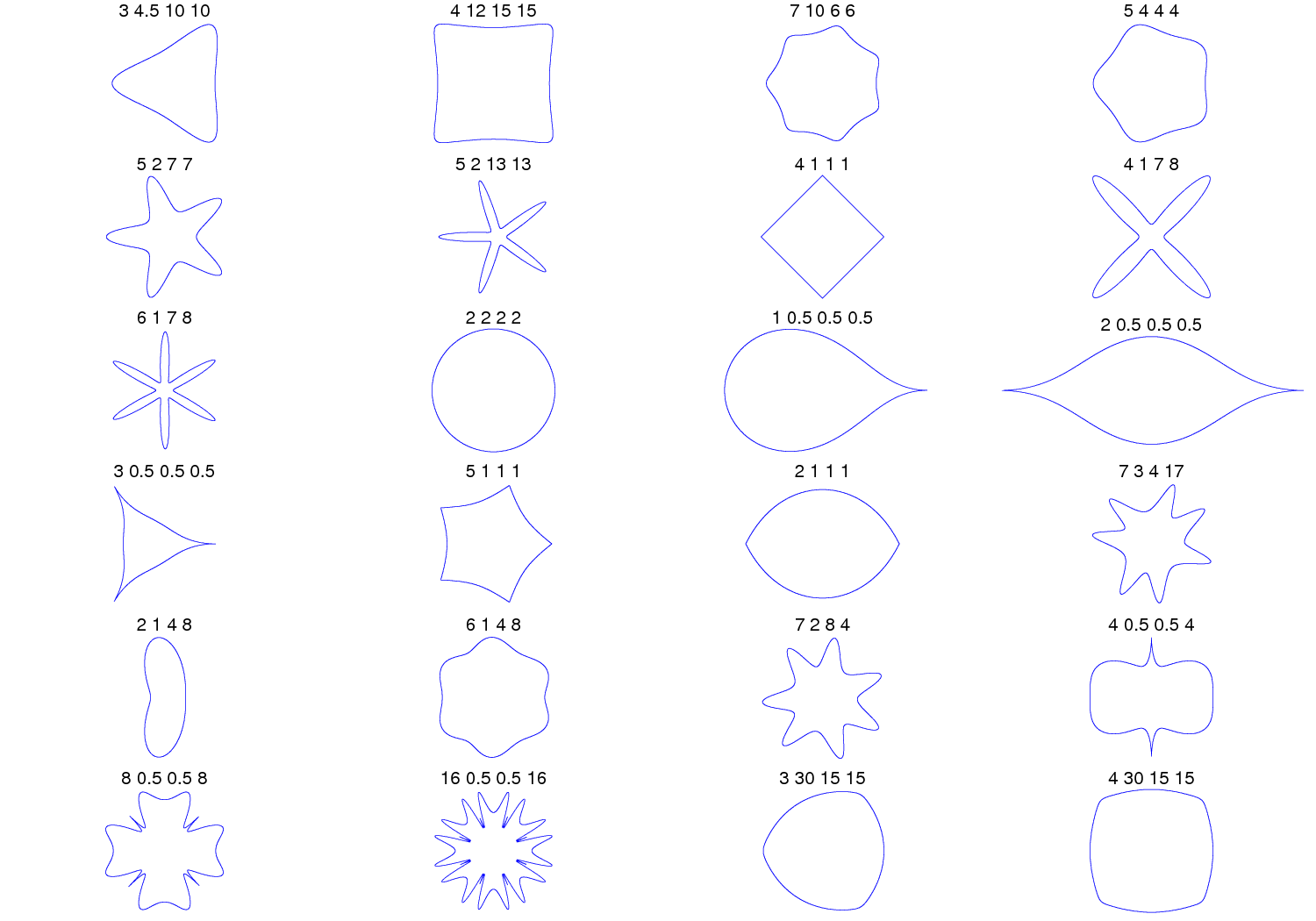
r\left(\varphi\right) = \left( \left| \frac{\cos\left(\frac{m\varphi}{4}\right)}{a} \right| ^{n_2} + \left| \frac{\sin\left(\frac{m\varphi}{4}\right)}{b} \right| ^{n_3} \right) ^{-\frac{1}{n_{1}}}. By choosing different values for the parameters a, b, m, n_1, n_2, and n_3, different shapes can be generated.
The formula was obtained by generalizing the superellipse, named and popularized by Piet Hein, a Danish mathematician.
2D plots
In the following examples the values shown above each figure should be m, n1, n2 and n3.
A GNU Octave program for generating these figures
function sf2d(n, a)
  u = [0:.001:2 * pi];
  raux = abs(1 / a(1) .* abs(cos(n(1) * u / 4))) .^ n(3) + abs(1 / a(2) .* abs(sin(n(1) * u / 4))) .^ n(4);
  r = abs(raux) .^ (- 1 / n(2));
  x = r .* cos(u);
  y = r .* sin(u);
  plot(x, y);
end
Extension to higher dimensions
It is possible to extend the formula to 3, 4, or n dimensions, by means of the spherical product of superformulas. For example, the 3D parametric surface is obtained by multiplying two superformulas r1 and r2. The coordinates are defined by the relations:
x = r_1(\theta)\cos\theta \cdot r_2(\phi)\cos\phi, y = r_1(\theta)\sin\theta \cdot r_2(\phi)\cos\phi, z = r_2(\phi)\sin\phi,
where \phi (latitude) varies between −π/2 and π/2 and θ (longitude) between −π and π.
3D plots
3D superformula: a = b = 1; m, n1, n2 and n3 are shown in the pictures.
Image:Sf3d_3257.svg Image:Sf3d_3.5.5.5.svg Image:Sf3d_3301515.svg Image:Sf3d_7284.svg Image:Sf3d_5111.svg Image:sf3d_4.5.54.svg Image:sf3d_8.5.58.svg Image:Sf3d_4121515.svg
A GNU Octave program for generating these figures:
function sf3d(n, a)
  u = [- pi:.05:pi];
  v = [- pi / 2:.05:pi / 2];
  nu = length(u);
  nv = length(v);
  for i = 1:nu
    for j = 1:nv
      raux1 = abs(1 / a(1) * abs(cos(n(1) .* u(i) / 4))) .^ n(3) + abs(1 / a(2) * abs(sin(n(1) * u(i) / 4))) .^ n(4);
      r1 = abs(raux1) .^ (- 1 / n(2));
      raux2 = abs(1 / a(1) * abs(cos(n(1) * v(j) / 4))) .^ n(3) + abs(1 / a(2) * abs(sin(n(1) * v(j) / 4))) .^ n(4);
      r2 = abs(raux2) .^ (- 1 / n(2));
      x(i, j) = r1 * cos(u(i)) * r2 * cos(v(j));
      y(i, j) = r1 * sin(u(i)) * r2 * cos(v(j));
      z(i, j) = r2 * sin(v(j));
    endfor;
  endfor;
  mesh(x, y, z);
endfunction;
Generalization
The superformula can be generalized by allowing distinct m parameters in the two terms of the superformula. By replacing the first parameter m with y and second parameter m with z: r\left(\varphi\right) = \left( \left| \frac{\cos\left(\frac{y\varphi}{4}\right)}{a} \right| ^{n_2} + \left| \frac{\sin\left(\frac{z\varphi}{4}\right)}{b} \right| ^{n_3} \right) ^{-\frac{1}{n_{1}}}
This allows the creation of rotationally asymmetric and nested structures. In the following examples a, b, {n_2} and {n_3} are 1:

References
References
- (2003). "A generic geometric transformation that unifies a wide range of natural and abstract shapes". [[American Journal of Botany]].
- "Method and apparatus for synthesizing patterns".
- (2004). "SuperformulaU".
This article was imported from Wikipedia and is available under the Creative Commons Attribution-ShareAlike 4.0 License. Content has been adapted to SurfDoc format. Original contributors can be found on the article history page.
Ask Mako anything about Superformula — get instant answers, deeper analysis, and related topics.
Research with MakoFree with your Surf account
Create a free account to save articles, ask Mako questions, and organize your research.
Sign up freeThis content may have been generated or modified by AI. CloudSurf Software LLC is not responsible for the accuracy, completeness, or reliability of AI-generated content. Always verify important information from primary sources.
Report