From Surf Wiki (app.surf) — the open knowledge base
Supercluster
Large group of smaller galaxy clusters or galaxy groups
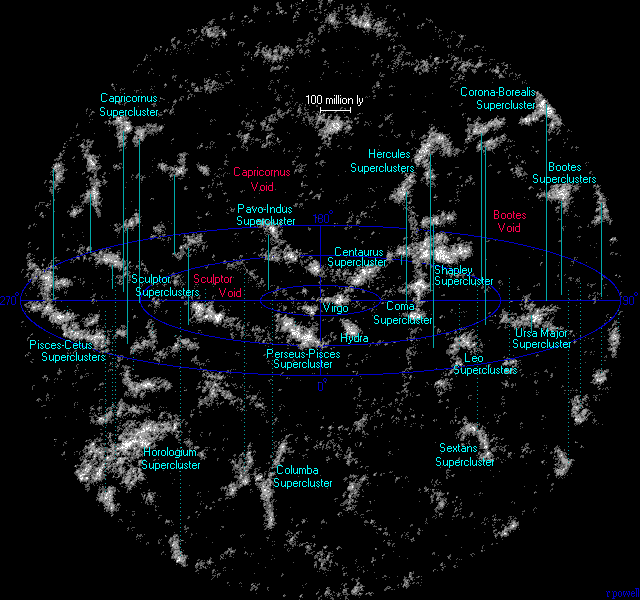
Large group of smaller galaxy clusters or galaxy groups
A supercluster is a large group of smaller galaxy clusters or galaxy groups; they are among the largest known structures in the universe. The Milky Way is part of the Local Group galaxy group (which contains more than 54 galaxies), which in turn is part of the Virgo Supercluster, which is part of the Laniakea Supercluster, which is part of the Pisces–Cetus Supercluster Complex. The large size and low density of superclusters means that most of them, unlike clusters, expand with the Hubble expansion. The number of superclusters in the observable universe is estimated to be 10 million.
Existence
The existence of superclusters indicates that the galaxies in the Universe are not uniformly distributed; most of them are drawn together in groups and clusters, with groups containing up to some dozens of galaxies and clusters up to several thousand galaxies. Those groups and clusters and additional isolated galaxies in turn form even larger structures called superclusters.[[File:An Intergalactic Heavyweight.jpg|thumb|left|The Abell 901/902 supercluster is located a little over two billion light-years from Earth.|200x200px]]
Their existence was first postulated by George Abell in his 1958 Abell catalogue of galaxy clusters. He called them "second-order clusters", or clusters of clusters.
Superclusters form massive structures of galaxies, called "filaments", "supercluster complexes", "hyperclusters", "chains", "strands", "superstructures", "walls" or "sheets", that may span between several hundred million light-years to 10 billion light-years, covering more than 5% of the observable universe. These are the largest structures known to date. Observations of superclusters can give information about the initial condition of the universe, when these superclusters were created. The directions of the rotational axes of galaxies within superclusters are studied by those who believe that they may give insight and information into the early formation process of galaxies in the history of the Universe. | display-authors=etal
Interspersed among superclusters are large voids of space where few galaxies exist. Superclusters are frequently subdivided into groups of clusters called galaxy groups and clusters.
Although superclusters are supposed to be the largest structures in the universe according to the cosmological principle, larger structures have been observed in surveys, including the Sloan Great Wall.
List of superclusters
| Galaxy supercluster | Data | Notes | |||||||||||||||||||||
|---|---|---|---|---|---|---|---|---|---|---|---|---|---|---|---|---|---|---|---|---|---|---|---|
| Einasto Supercluster | Discovered in 2023 by analyzing Sloan Digital Sky Survey images. Claimed to be the most massive galaxy supercluster discovered so far. | ||||||||||||||||||||||
| King Ghidorah Supercluster | last1=Shimawaka | first1=Rhythm | last2=Okabe | first2=Nobuhiro | last3=Shirasaki | first3=Masat | last4=Tanaka | first4=Masayuki | date=22 November 2022 | title=King Ghidorah Supercluster: Mapping the light and dark matter in a new supercluster at z = 0.55 using the subaru hyper suprime-cam | journal=Monthly Notices of the Royal Astronomical Society: Letters | volume=519 | issue=1 | pages=L45–L50 | url=https://academic.oup.com/mnrasl/article-abstract/519/1/L45/6847752?redirectedFrom=fulltext | url-access=subscription | bibcode=2023MNRAS.519L..45S | doi=10.1093/mnrasl/slac150 | doi-access=free | arxiv=2211.11970 | s2cid=253761264 | issn=1745-3933}} | |
| Laniakea Supercluster | The Laniakea Supercluster is the supercluster that contains the Virgo Cluster, Local Group, and by extension on the latter, our galaxy; the Milky Way. | ||||||||||||||||||||||
| Virgo Supercluster | It contains the Local Group with our galaxy, the Milky Way. It also contains the Virgo Cluster near its center, and is sometimes called the Local Supercluster. It is thought to contain over 47,000 galaxies. | ||||||||||||||||||||||
| Hydra–Centaurus Supercluster | SCl 128 - It is composed of two lobes, sometimes also referred to as superclusters, or sometimes the entire supercluster is referred to by these other two names | ||||||||||||||||||||||
| Pavo–Indus Supercluster | |||||||||||||||||||||||
| Southern Supercluster | |||||||||||||||||||||||
| Saraswati Supercluster | Gpc]]) | The Saraswati Supercluster consists of 43 massive galaxy clusters such as Abell 2361 and has a mass of about and is seen in the Pisces constellation |
Nearby superclusters
| Galaxy supercluster | Data | Notes |
|---|---|---|
| Perseus–Pisces Supercluster | SCl 40 | |
| Coma Supercluster | SCl 117 - Forms most of the CfA Homunculus, the center of the CfA2 Great Wall galaxy filament | |
| Sculptor Superclusters | SCl 9 | |
| Hercules Superclusters | SCl 160 | |
| Leo Supercluster | SCl 93 | |
| Ophiuchus Supercluster | (no SCl number) - Forming the far wall of the Ophiuchus Void, it may be connected in a filament, with the Pavo-Indus-Telescopium Supercluster and the Hercules Supercluster. This supercluster is centered on the cD cluster Ophiuchus Cluster, and has at least two more galaxy clusters, four more galaxy groups, several field galaxies, as members. | |
| Shapley Supercluster | SCl 124 - The second supercluster found, after the Local Supercluster. |
Distant superclusters
| Galaxy supercluster | Data | Notes |
|---|---|---|
| Pisces–Cetus Supercluster | SCl 10 | |
| Boötes Supercluster | SCl 138 | |
| Horologium–Reticulum Supercluster | SCl 48 + SCl 49 | |
| Corona Borealis Supercluster | SCl 158 | |
| Columba Supercluster | (no SCl number) | |
| Aquarius Supercluster | SCl 4 | |
| Aquarius B Supercluster | SCl 193 | |
| Aquarius–Capricornus Supercluster | SCl 189 | |
| Aquarius–Cetus Supercluster | SCl 188 | |
| Bootes A Supercluster | SCl 150 | |
| Caelum Supercluster | SCl 59 | |
| Draco Supercluster | SCl 114 | |
| Draco–Ursa Major Supercluster | SCl 257 | |
| Fornax–Eridanus Supercluster | SCl 53 | |
| Grus Supercluster | SCl 197 | |
| Leo A Supercluster | SCl 100 | |
| Leo–Sextans Supercluster | SCl 91 | |
| Leo–Virgo Supercluster | SCl 107 | |
| Microscopium Supercluster | SCl 174 | |
| Pegasus–Pisces Supercluster | SCl 3 | |
| Perseus–Pisces Supercluster | SCl 40 | |
| Pisces–Aries Supercluster | SCl 30 | |
| Ursa Majoris Supercluster | SCl 109 | |
| Virgo-Coma Supercluster | SCl 111 |
Extremely distant superclusters
| Galaxy supercluster | Data | Notes | ||
|---|---|---|---|---|
| Hyperion proto-supercluster | z=2.45 | This supercluster at the time of its discovery in 2018 was the earliest and largest proto-supercluster found to date. | ||
| Lynx Supercluster | z=1.27 | Discovered in 1999 | ||
| SCL @ 1338+27 at z=1.1 | A rich supercluster with several galaxy clusters was discovered around an unusual concentration of 23 QSOs at z=1.1 in 2001. The size of the complex of clusters may indicate a wall of galaxies exists there, instead of a single supercluster. The size discovered approaches the size of the CfA2 Great Wall filament. At the time of the discovery, it was the largest and most distant supercluster beyond z=0.5 | |||
| SCL @ 1604+43 at z=0.9 | z=0.91 | 16 | 04 | 25.7}}, {{cite journal |
| North Ecliptic Pole Supercluster (NEP Supercluster, NEPSC) | z=0.88 | |||
| SCL @ 0018+16 at z=0.54 in SA26 | z=0.54 | This supercluster lies around radio galaxy 54W084C (z=0.544) and is composed of at least three large clusters, CL 0016+16 (z=0.5455), RX J0018.3+1618 (z=0.5506), RX J0018.8+1602 . | ||
| MS 0302+17 | This supercluster has at least three member clusters, the eastern cluster CL 0303+1706, southern cluster MS 0302+1659 and northern cluster MS 0302+1717. |
Diagram
References
References
- Cain, Fraser. (4 May 2009). "Local Group". [[Universe Today]].
- Gibney, Elizabeth. (2014-09-03). "Earth's new address: 'Solar System, Milky Way, Laniakea'". Nature.
- "The Universe within 14 billion Light Years". Atlas of the Universe.
- "An Intergalactic Heavyweight". ESO Picture of the Week.
- Abell. (1958). "The distribution of rich clusters of galaxies. A catalogue of 2,712 rich clusters found on the National Geographic Society Palomar Observatory Sky Survey". [[The Astrophysical Journal Supplement Series]].
- (15 March 2016). "One of the most distant, massive "hypercluster" of galaxies has been discovered".
- (2025). "Galaxy Superclusters and Their Complexes in the Cosmic Web". Universe.
- (2011-05-09). "The Sloan Great Wall. Morphology and galaxy content". [[The Astrophysical Journal]].
- (2024-02-19). "Einasto Supercluster: the new heavyweight contender in the universe {{!}} Tartu Ülikool".
- (2023). "Identification of Superclusters and Their Properties in the Sloan Digital Sky Survey Using the WHL Cluster Catalog". The Astrophysical Journal.
- (22 November 2022). "King Ghidorah Supercluster: Mapping the light and dark matter in a new supercluster at z = 0.55 using the subaru hyper suprime-cam". Monthly Notices of the Royal Astronomical Society: Letters.
- Tully. (2 September 2014). "The Laniakea supercluster of galaxies". [[Nature (journal).
- Mitra, Shyamal. (1989). "The World of Galaxies". Springer, New York, NY..
- Postman, M.. (1988). "The dynamics of the Corona Borealis supercluster". [[Astronomical Journal]].
- Miranda. (October 17, 2018). "Scientists in Chile unveil 'A Cosmic Titan' cluster of galaxies". Reuters.
- (2018). "The progeny of a Cosmic Titan: a massive multi-component proto-supercluster in formation at z=2.45 in VUDS". [[Astronomy & Astrophysics]].
- University of Hawaii, [http://www.ifa.hawaii.edu/~kaiser/pictures/ms0302/caption.html "The MS0302+17 Supercluster"], Nick Kaiser. Retrieved 15 September 2009.
This article was imported from Wikipedia and is available under the Creative Commons Attribution-ShareAlike 4.0 License. Content has been adapted to SurfDoc format. Original contributors can be found on the article history page.
Ask Mako anything about Supercluster — get instant answers, deeper analysis, and related topics.
Research with MakoFree with your Surf account
Create a free account to save articles, ask Mako questions, and organize your research.
Sign up freeThis content may have been generated or modified by AI. CloudSurf Software LLC is not responsible for the accuracy, completeness, or reliability of AI-generated content. Always verify important information from primary sources.
Report