From Surf Wiki (app.surf) — the open knowledge base
Super Scope
SNES light gun peripheral
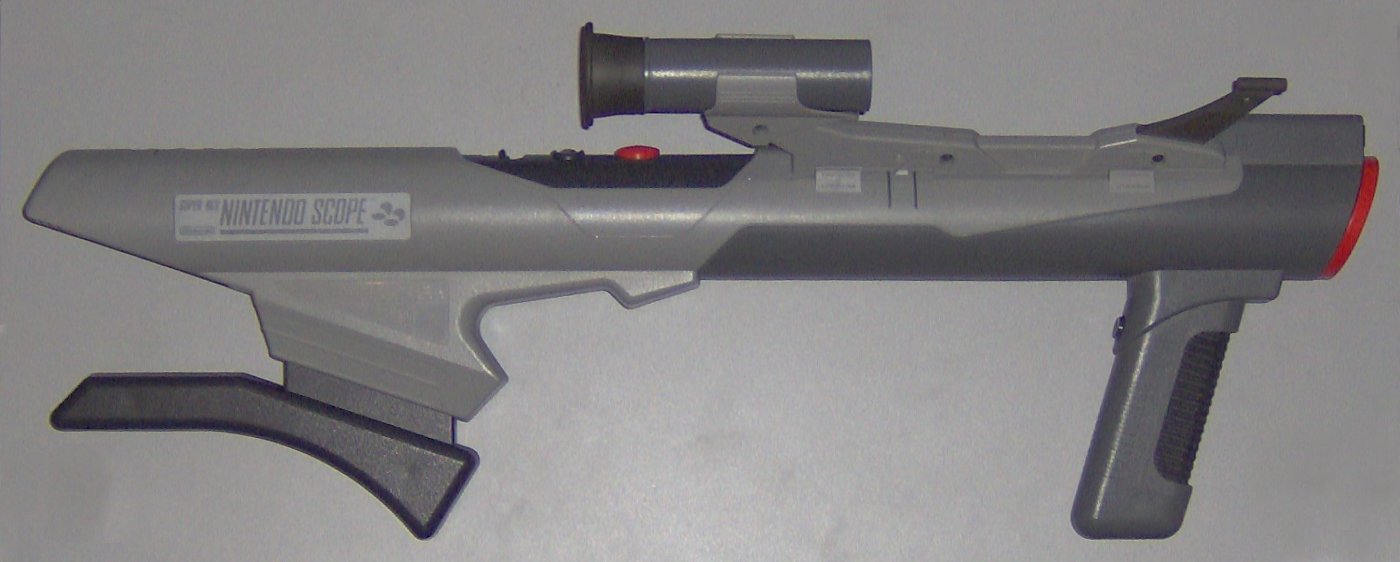
SNES light gun peripheral
| Field | Value | |
|---|---|---|
| name | Super Scope | |
| image | [[File:Nintendo-SNES-Super-Scope-L.jpg | 250px]] |
| caption | The Nintendo Super Scope (without its sight) | |
| aka | Nintendo Scope | |
| developer | Nintendo | |
| manufacturer | Nintendo | |
| type | Video game console peripheral | |
| generation | Fourth generation | |
| release_date | 1992 | |
| discontinued | 1997 | |
| media | Input device | |
| os | ||
| location |
The known as the Nintendo Scope in Europe and Australia, is a light gun peripheral created by Nintendo for the Super Nintendo Entertainment System. It is able to aim and fire at targets on a screen by connecting to a small infrared receiver module placed on top of the television. The peripheral was released in 1992 and packaged with the video game Super Scope 6. However, only twelve total games were compatible with the device, all released between 1992 and 1994.
Overview
Design

The Super Scope is a bazooka-shaped device, just under 2 ft long. Unlike its predecessor, the NES Zapper, the Super Scope does not use a wired connection to the system and instead requires six AA batteries for power.
On the end is the infrared receiver lens, approximately 1 in in diameter, which picks up the light from a TV. The sight mount is shaped like a wide, very shallow "U", about five inches long. The end that faces toward the shoulder mount end of the Super Scope has a round open cylinder holder, where the eyepiece goes. The other end has a short, narrow tube, which forms the sight when one looks through the eyepiece that is in-line across from it. The end of the eyepiece is very simple: it is a cylinder with the diameter of a quarter, with a removable rubber piece through which the shooter looks. The sight is designed so that the aim will be correct at a distance of 3 m.
The Super Scope comes packaged with a small infrared receiver module, 2.5 x in size, with a standard Super NES controller cord attached. On the front is an oval-shaped black area, receding back from the two sides to an infrared transmitter about the size of a dime. The receiver must be placed above the screen and connected to the system's second controller port for play.
Functionality

The Super Scope makes use of the scanning process used in cathode-ray-tube monitors, as CRTs were the only widely used TV monitors until the early 2000s. On a CRT, the screen is drawn by a scanning electron beam that travels horizontally across each line of the screen from top to bottom. A fast photodiode will see any particular area of the screen illuminated only briefly as that point is scanned, while the human eye will see a consistent image due to persistence of vision.
The Super Scope interprets this by outputting a signal when it sees the television raster scan and a signal when it does not. Inside the console, this signal is delivered to the PPU, which notes which screen pixel it is outputting at the moment the signal transitions from to . At the end of the frame, the game software can retrieve this stored position to determine where on the screen the gun was aimed.
The Super Scope ignores red light, as do many guns of this type because red phosphors have a much slower rate of decay than green or blue phosphors. Since the Super Scope depends on the short persistence and scan pattern of CRT pixels, it will not function with modern displays (such as plasma screens or LCDs) that continuously light each pixel.
History
The Super Scope was released in North America and the PAL region in 1992, followed by a limited release in Japan in 1993. The peripheral came bundled with the video game Super Scope 6, which was created to demonstrate the device's functionality.
Compatible games
Only 12 games were released that feature Super Scope compatibility, half of which require the accessory for play. Certain games released after the Super Scope—such as Yoshi's Island and Kirby Super Star—display a warning message indicating that the game is incompatible if it detects the receiver is plugged in.
| Title | Year | Publisher | Required | Note | Battle Clash | Bazooka Blitzkrieg | Lamborghini American Challenge | Lemmings 2: The Tribes | Metal Combat: Falcon's Revenge | Operation Thunderbolt | Super Scope 6 | T2: The Arcade Game | Tin Star | X-Zone | Yoshi's Safari |
|---|---|---|---|---|---|---|---|---|---|---|---|---|---|---|---|
| 1992 | Nintendo | ||||||||||||||
| 1992 | Bandai | ||||||||||||||
| 1993 | Hi-Tech Expressions, Inc. | Only used for bonus games | |||||||||||||
| 1993 | Titus France | Features an optional Super Scope-exclusive mode | |||||||||||||
| 1994 | Psygnosis | A secret easter egg allows the Super Scope to destroy lemmings | |||||||||||||
| 1993 | Nintendo | ||||||||||||||
| 1994 | Taito | Also compatible with a standard controller or the Super NES Mouse | |||||||||||||
| 1992 | Nintendo | Packaged with the Super Scope | |||||||||||||
| 1993 | Acclaim Entertainment | Also compatible with a standard controller or the Super NES Mouse | |||||||||||||
| 1994 | Nintendo | Also compatible with a standard controller or the Super NES Mouse | |||||||||||||
| 1993 | Kemco | ||||||||||||||
| 1993 | Nintendo |
Mario & Wario was also planned to support the accessory, but this was dropped before release.
Legacy
In response to the Super Scope, Sega would release their own light gun peripheral for the Sega Genesis, the Menacer, later the same year.
A Super Scope was used as a prop in the live-action Super Mario Bros. film (1993), representing King Koopa's "Devo gun". Images from the film were used to promote the Super Scope's 1993 release in Japan. In the 2026 animated film The Super Mario Galaxy Movie, Yoshi is seen wielding a blue Super Scope.
During the 1993–94 United States Senate hearings on video games, Senator Joe Lieberman used the Super Scope as evidence of video games promoting violence among children, citing the peripheral's resemblance to a real assault weapon.
The Super Scope has made cameo appearances in other Nintendo games, including as a recurring item in the Super Smash Bros. series beginning with Super Smash Bros. Melee (2001), as a microgame element in the WarioWare series,
In 2020, a hobbyist developer created a hardware mod to allow the Super Scope to be used with modern televisions.
Notes
References
References
- McFerran, Damien. (January 16, 2016). "Hardware Classics: Nintendo Super Scope".
- [[Nintendo]]. (1999). "Super Scope 6". Nintendo.
- Bertoli, Ben. (March 13, 2019). "Remembering the First and Only Mario FPS".
- Szczepaniak, John. (March 2022). "30 Years of the Super Scope". [[Future plc]].
- Olney, Alex. (May 12, 2025). "Video: Switch 2's Mouse Controls Are Nothing New For Nintendo".
- Hilliard, Kyle. (August 9, 2017). "Game Freak's Origins And Its Pre-''Pokémon'' Games". [[GameStop]].
- (March 16, 2013). "Menacer retrospective: The Mega Drive's light-gun flop". [[Digital Spy]].
- McFerran, Damien. (October 29, 2016). "How we got to the Switch: a brief history of Nintendo controllers".
- Phillips, Tom. (January 25, 2026). "The Super Mario Galaxy Movie Nintendo Direct: Everything Announced".
- Walsh, Mark. (December 15, 1993). "Coalition To Develop Rating System for Video Games". [[Education Week]].
- Trammell, David. (May 21, 2001). "Super Smash Bros. Melee Hands-on Preview".
- Pattison, Narayan. (June 24, 2008). "Smash Bros. Brawl AU Review".
- (November 28, 2001). "Super Smash Bros. Melee".
- LaBella, Anthony. (October 16, 2014). "Super Smash Bros. (3DS) Item List".
- Norman, Jim. (December 1, 2023). "Splatoon 3: Chill Season 2023 - Every New Weapon, Stage, Feature".
- Lawler, Richard. (October 28, 2020). "Modder's DIY project makes the SNES Super Scope work on your flat TV".
This article was imported from Wikipedia and is available under the Creative Commons Attribution-ShareAlike 4.0 License. Content has been adapted to SurfDoc format. Original contributors can be found on the article history page.
Ask Mako anything about Super Scope — get instant answers, deeper analysis, and related topics.
Research with MakoFree with your Surf account
Create a free account to save articles, ask Mako questions, and organize your research.
Sign up freeThis content may have been generated or modified by AI. CloudSurf Software LLC is not responsible for the accuracy, completeness, or reliability of AI-generated content. Always verify important information from primary sources.
Report