From Surf Wiki (app.surf) — the open knowledge base
Super I/O
Class of I/O controller integrated circuits
Class of I/O controller integrated circuits
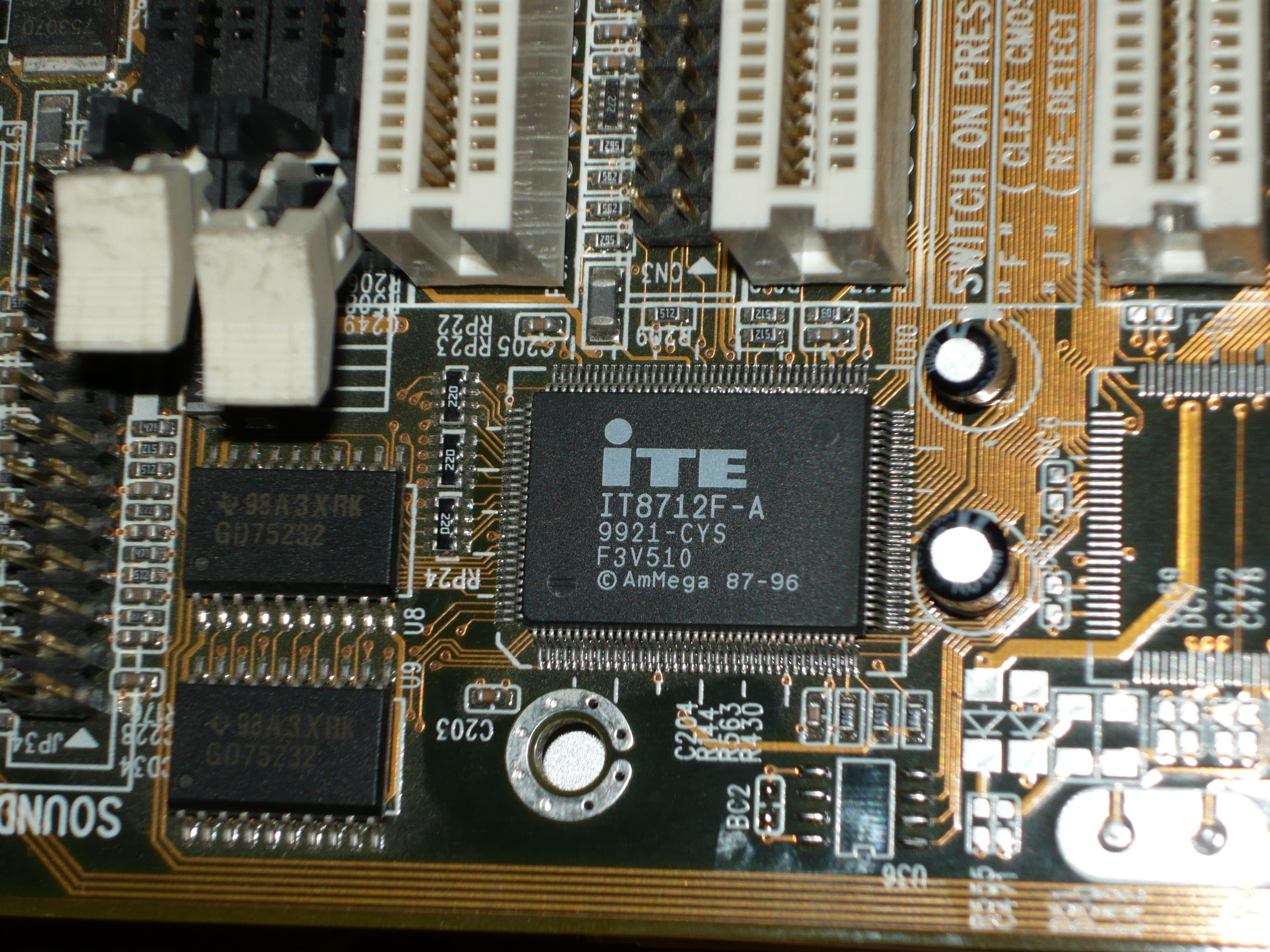

Super I/O (sometimes Multi-IO) is a class of I/O controller integrated circuits that began to be used on personal computer motherboards in the late 1980s, originally as add-in cards, later embedded on the motherboards. A super I/O chip combines interfaces for a variety of low-bandwidth devices. Now the I/O controller that combined Super I/O function and Embedded Controller function is called embedded Super I/O (eSIO).
Functions
The functions below are usually provided by the super I/O if the motherboard has these functions:
- A floppy-disk controller
- An IEEE 1284-compatible parallel port (commonly used for printers)
- One or more 16C550-compatible serial port UART's
- Keyboard controller for PS/2 keyboard and/or mouse
Most Super I/O chips include some additional low-speed devices, such as:
- Temperature, voltage, and fan speed interface
- Connect temperature and voltage sensors via SMBus
- Thermal Zone
- Chassis intrusion detection
- Mainboard power management, including control voltage regulator module
- LED management
- PWM fan speed control
- An IrDA Port controller
- A game port (not provided by recent super I/O chips because Windows XP is the last Windows OS to natively support game ports, requiring vendors to supply their own drivers for later Windows operating systems)
- A watchdog timer
- A consumer IR receiver
- A MIDI port
- Some GPIO pins
- Legacy Plug and Play or ACPI support for the included devices
By combining many functions in a single chip, the number of parts needed on a motherboard is reduced, thus reducing the cost of production.
History
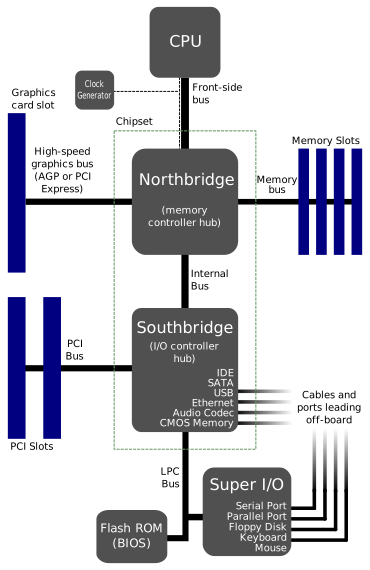
The original super I/O chips communicated with the central processing unit (CPU) via the ISA bus. With the evolution away from ISA towards use of the PCI bus, the Super I/O chip was often the biggest remaining reason for continuing inclusion of ISA on the motherboard.
Later super I/O chips use the LPC bus instead of ISA for communication with the central processing unit. This normally occurs through an LPC interface on the Southbridge chip of the motherboard.
Since Intel is replacing the LPC bus with the eSPI bus, super I/O chips that connect to that bus have appeared on the market.
Companies that make super I/O controllers include Nuvoton (spun off from Winbond), , Fintek Inc. ,ENE Tech. (for laptop) and Microchip Technology (which bought SMSC™). National Semiconductor used to make super I/O controllers but sold that business to Winbond at 2005, which already had a competing super I/O controller business. In 2008, Winbond then spun off its logic businesses to a wholly owned subsidiary, Nuvoton. SMSC made super I/O chips and then got acquired by Microchip Technology.
Common models
ENE Tech.
Many models are used for laptops with built-in keyboard controllers
- KB3930
- KB930QF
ITE Inc.
- T8510E series
Microchip Technology (SMSC)
Microchip Technology provides Super I/O components with their SCH, MEC and LPC47 series. Here are some examples:
- SCH3112
- SCH3114
- SCH3116
- SCH3223
Nuvoton Technology ([[Winbond]])
- NCT6776
References
|access-date=2019-03-07
References
- Leonhardt, Frank. (1995). "Personal Computer World". VNU Business Publications.
- (2004). "PCI Express System Architecture". Addison-Wesley.
This article was imported from Wikipedia and is available under the Creative Commons Attribution-ShareAlike 4.0 License. Content has been adapted to SurfDoc format. Original contributors can be found on the article history page.
Ask Mako anything about Super I/O — get instant answers, deeper analysis, and related topics.
Research with MakoFree with your Surf account
Create a free account to save articles, ask Mako questions, and organize your research.
Sign up freeThis content may have been generated or modified by AI. CloudSurf Software LLC is not responsible for the accuracy, completeness, or reliability of AI-generated content. Always verify important information from primary sources.
Report