From Surf Wiki (app.surf) — the open knowledge base
Sup'ung Dam
Dam in China and North Korea
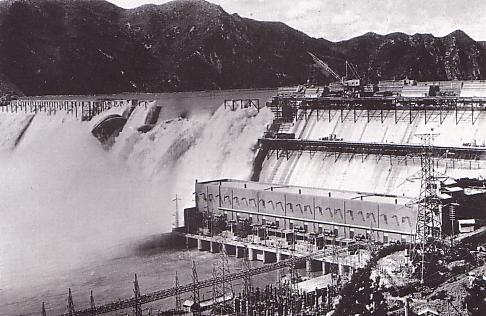
Dam in China and North Korea
| Field | Value |
|---|---|
| name | Sup'ung Dam |
| image | SupongDamOct2010-2.jpg |
| location_map | China#North Korea |
| coordinates | |
| country | China/North Korea |
| location | Liaoning Province/North Pyongan. |
| status | O |
| construction_began | 1937 |
| opening | 1943 |
| dam_type | Gravity |
| dam_height | 106 m |
| dam_length | 899.5 m |
| dam_elevation_crest | 126.4 m |
| spillway_type | Main: 26 x sluice gates |
| Auxiliary: 16 x sluice gates | |
| spillway_capacity | Main: 37650 m3/s |
| Auxiliary: 17046 m3/s | |
| res_name | Supung Lake |
| res_capacity_total | 14600000000 m3 |
| res_capacity_active | 7900000000 m3 |
| res_capacity_inactive | 4180000000 m3 |
| res_catchment | 52912 km2 |
| res_surface | 274 km2 |
| res_elevation | 123 m |
| plant_hydraulic_head | 77 m |
| plant_operator | Korea-China Hydroelectric Co |
| plant_commission | 1941 |
| plant_turbines | 6 x 10⁵ MW Francis-type |
| 2 x 67.5 MW Francis-type | |
| plant_capacity | 765 MW |
Auxiliary: 16 x sluice gates Auxiliary: 17046 m3/s 2 x 67.5 MW Francis-type The Sup'ung Dam (), also referred to as the Shuifeng Dam and originally the Suihō Dam, is a gravity dam on the Yalu River between Kuandian Manchu Autonomous County, Liaoning Province in China and Sakju County, North Pyongan Province in North Korea. The reservoir is called Supung Lake. The dam was constructed by the Japanese between 1937 and 1943 in order to generate electricity and has been repaired and renovated several times throughout the years, mainly due to spillway damage from flooding.
During the Korean War, the dam was bombed by the United Nations Command three separate times in order to disrupt power generation for the North Koreans. At the time of its completion, the dam was the largest in Asia, and power station was third-largest (after Hoover Dam and Wilson Dam) hydroelectric power station in the world. It is still the largest hydroelectric power station on the Yalu (Korean: Amnok) River. Power produced at the dam's main 630 MW power station is evenly shared between China and North Korea.
The dam is featured on the national emblem of North Korea.
Background
In 1937, during Japan's colonization of Korea, the Yalu Hydroelectric Company was established and in the same year construction began on the dam, with the Pyeongbuk Railway opening a rail line in 1939 to assist with the construction. In 1941, the dam was complete with two 100 MW generators operational, and the emperor of Manchukuo, Puyi, visited the dam. Four more generators were later operational in 1943. The seventh generator was German-made and not delivered due to shipping difficulties during World War II. At the time of its completion, the dam was the largest in Asia and third largest in the world. Power from the dam was used throughout the Korean peninsula and southern Manchuria (Manchukuo at the time). After World War II, in 1947, the Soviet Union occupied the area, and dismantled and carried three of the seven generators to the Irtysh River dam in Kazakhstan. They were later re-installed during the 1950s.
Korean War attacks
Main article: Attack on the Sui-ho Dam
The dam's power station and transformer yard were targeted by the United Nations Command three times during the Korean War in order to disrupt power supply. Between 23 and 24 June 1952, the dam was attacked by 250 bombers and fighters, dropping 90 tons of munitions on the power station, transformer yard and auxiliary facilities. The power station was destroyed but the dam left intact. After intelligence indicated it may have been partially operational again, the power station was again targeted and disabled on 12 September 1952 by B-29 bombers. By 1 February 1953, it was believed that two generators had been repaired and were operational once again. This resulted in a third raid on the dam on 15 February which left the power station inoperable once again.
Repairs and renovations
Throughout the dam's history, it underwent several renovations and repairs. Flooding in 1946 damaged the stilling basin at the toe of the dam and destroyed its spillway, requiring repairs the next year. Between September 1949 and April 1950, in a second repair, the spillway and plunge pool were renovated. Between 1955 and 1958, permanent post-war repairs were made to the dam and power station. The generators removed by the Soviets were replaced and the installed capacity of the power station upgraded to 630 MW. In 1983, China began constructing an additional power station just downstream of the dam on their side of the river with two 67.5 MW generators. The first was commissioned in 1987 and the second in 1988. The most recent renovation occurred between 2009 and 2011 in order to improve the function of the dam's spillways. The US$24.5 million renovation was funded by State Grid Corporation of China.
Design

The Supung is a 106 m tall and 899.5 m long concrete gravity dam with a crest elevation of 126.4 m. The dam's spillway consists of 26 sluice gates with a maximum discharge capacity of 37650 m3/s. An auxiliary spillway 1.7 km north of the dam consists of 16 sluice gates and has a maximum discharge capacity of 17046 m3/s. The dam's reservoir has a capacity of 14600000000 m3 of which 7900000000 m3 is active (or "useful") for power generation. The dam sits at the head of a 52912 km2 catchment area and its reservoir has a surface area of 274 km2. The original power station at the base of the dam contains six 105 MW Francis turbine-generators which are afforded an average hydraulic head of 77 m. The additional power station on China's side contains two 67.5 MW Francis turbine generators. The total installed capacity of the dam's power stations is 765 MW.
References
References
- 朝鮮總督府官報 (The Public Journal of the Governor-General of Korea), Shōwa Nr. 3813, 3 October 1939
- Kokubu, Hayato, 将軍様の鉄道 (Shōgun-sama no Tetsudō), {{ISBN. 978-4-10-303731-6
- Rees, David. (2001). "Korea: An Illustrated History from Ancient Times to 1945". Hippocrene Books.
- K. Armstrong, Charles. (2005). "Korea at the Center: Dynamics of Regionalism in Northeast Asia". M.E. Sharpe.
- (1980). "Airpower". Arno Press.
- Kai, Yu. (1998). "Shuifeng dam design review comments". Ministry of Water Resources Survey.
- "Supung station (before restoration) Details". Sino Hydro.
- "China completes renovation of hydropower station on river bordering DPRK". Xinhua News Agency.
- "Hydraulic structure Shuifeng Dam". Weipu Academic.
This article was imported from Wikipedia and is available under the Creative Commons Attribution-ShareAlike 4.0 License. Content has been adapted to SurfDoc format. Original contributors can be found on the article history page.
Ask Mako anything about Sup'ung Dam — get instant answers, deeper analysis, and related topics.
Research with MakoFree with your Surf account
Create a free account to save articles, ask Mako questions, and organize your research.
Sign up freeThis content may have been generated or modified by AI. CloudSurf Software LLC is not responsible for the accuracy, completeness, or reliability of AI-generated content. Always verify important information from primary sources.
Report