From Surf Wiki (app.surf) — the open knowledge base
Sunbeam 3-litre

| Field | Value |
|---|---|
| image | File:1926 Sunbeam Twin Cam Tourer (19872363904).jpg |
| caption | 1926 Sunbeam 3-litre Super Sports 2-door |
| name | Sunbeam 3-litre |
| manufacturer | Sunbeam |
| production | 1926–1930 |
| body_style | lightweight open tourer |
| engine | 2920 cc Straight-6 dohc |
| transmission | 4-speed manual sliding-pinion |
| wheelbase | 130.5 in |
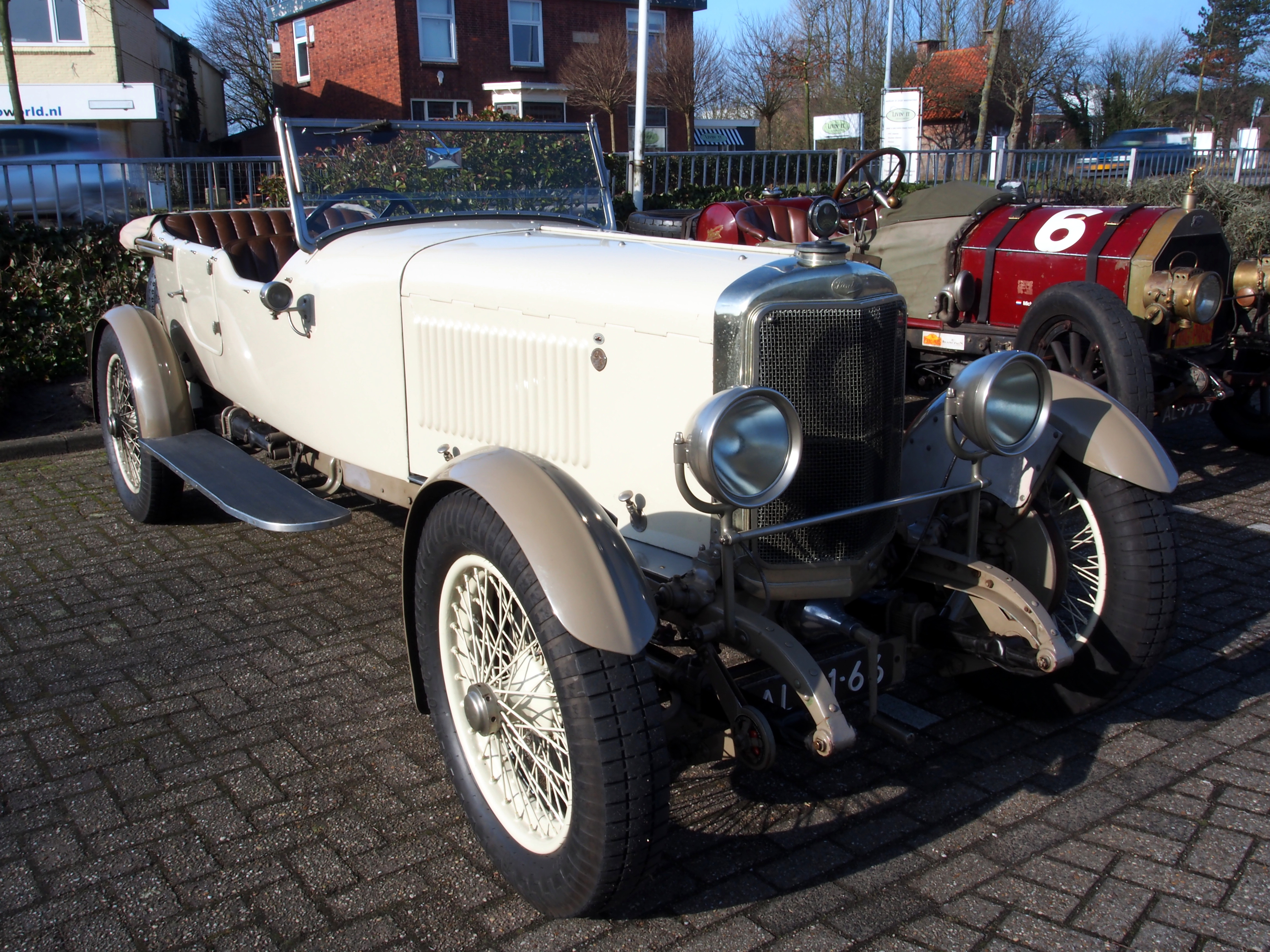
The Sunbeam 3-litre is a 26 long cwt at the London Motor Show, and was offered from 1926 until 1930. It was seen at the time and subsequently as the retort of Louis Hervé Coatalen, Sunbeam's energetic chief engineer, to the Bentley 3 Litre which by then was beginning to make its mark, having won at Le Mans earlier that year.
The Sunbeam's engine was of 2,920 cc, distributed between six cylinders.
The cylinder bores translated into a fiscal horse-power rating of 20.9 hp which under the system operating in the 1920s attracted an annual Road Fund Tax of £21. The big four-cylinder engines of the competitor vehicles from Bentley incurred an annual Road Fund Tax of £16. The difference of £5 might be considered immaterial for anyone who could afford to purchase and run a car of this type, but £5 was at the time more than the average weekly wage in Britain, so the annual saving to the Bentley buyer may well have been significant even in this class.
The Bentley gained a reputation as the more robust of the two cars, although in standard form the Sunbeam was reported to be marginally quicker. Two Sunbeams were entered in the 1925 Le Mans, one driven by Henry Segrave and George Duller, the other by Jean Chassagne and Sammy Davis. Segrave and Duller were forced to retire but Chassagne and Davis achieved second place, beaten only by the Lorraine-Dietrich of Rossignol and de Courcelles. In retrospect the Sunbeam's achievement became eclipsed by the extent to which the race came to be dominated by Bentleys during the second half of the decade.
Although the sturdily constructed chassis was based on that from earlier Sunbeams, the hitherto characteristic semi-elliptical leaf springs were, at the back, replaced by cantilever rear springs which during the second half of the decade became a Sunbeam hallmark.
References
References
- Ian Nickols and Kent Karslake, ''Motoring Entente'', Cassell, London 1956
- (1 October 1977). "Talking of sports cars: Sunbeam three-litre". [[Autocar (magazine).
- sports car introduced by [[Sunbeam Motor Car Company. Sunbeam]] in October 1925The Motor Show IV, Sunbeam Cars. ''The Times'', Tuesday, Oct 13, 1925; pg. 8; Issue 44091
- (2004). "Vintage Cars - The Finest Prewar Automobiles". Grange Books.
- "Sunbeam 3 Litre Super Sports". sunbeam.org.au.
This article was imported from Wikipedia and is available under the Creative Commons Attribution-ShareAlike 4.0 License. Content has been adapted to SurfDoc format. Original contributors can be found on the article history page.
Ask Mako anything about Sunbeam 3-litre — get instant answers, deeper analysis, and related topics.
Research with MakoFree with your Surf account
Create a free account to save articles, ask Mako questions, and organize your research.
Sign up freeThis content may have been generated or modified by AI. CloudSurf Software LLC is not responsible for the accuracy, completeness, or reliability of AI-generated content. Always verify important information from primary sources.
Report