From Surf Wiki (app.surf) — the open knowledge base
Sun Yat-sen University
National public research university in China

National public research university in China
| Field | Value |
|---|---|
| name | Sun Yat-sen University |
| native_name | zh-cn |
| image_name | Sun Yat-sen University Logo.png |
| image_upright | .7 |
| motto | 博学、审问、慎思、明辨、笃行 |
| mottoeng | Study Extensively, Inquire Accurately, Reflect Carefully, Discriminate Clearly, Practise Earnestly |
| established | |
| type | Public research university |
| president | Gao Song |
| budget | ¥17.51 billion (2019) |
| endowment | ¥2.20 billion (2019) |
| city | Guangzhou (South, North and East Campus)/ Zhuhai (Zhuhai Campus)/ Shenzhen (Shenzhen Campus) |
| province | Guangdong |
| country | People's Republic of China |
| undergrad | 32,220 |
| postgrad | 23,827 |
| faculty | 17,022 |
| campus | Urban, 9.15 km2 |
| address | 135 XinGangxi Road, Haizhu District, Guangzhou |
| zipcode | 510275 |
| former_names | National Guangdong University |
| affiliations | Project 985 |
| Project 211 | |
| APAIE | |
| The Peking Union | |
| Guangdong-Hong Kong-Macao University Alliance | |
| website | |
| module | {{infobox Chinese |
| child | yes |
| s | 中山大学 |
| t | 中山大學 |
| p | Zhōngshān Dàxué |
| j | zung1 saan1 daai6 hok6 |
| order | st}} |
the university in Guangzhou
Project 211 APAIE The Peking Union Guangdong-Hong Kong-Macao University Alliance
Sun Yat-sen University (, pinyin - zhōngshān dàxué; SYSU, also known as Zhongshan University) is a public university in Guangzhou, Guangdong, China. It is affiliated with the Ministry of Education, and co-funded by the Ministry of Education, SASTIND, and Guangdong Provincial Government. As one of the top universities in China, it is part of Project 211, Project 985, and the Double First-Class Construction.
The university was founded in 1924 by and named after Sun Yat-sen (who in China is referred to as "Zhongshan"), a revolutionary and the founder of the Republic of China. The university's main campus, commonly referred to as the South Campus, is located in Haizhu, Guangzhou, inheriting the campus from the former Lingnan University (est. 1888). The university has five campuses in the three cities of Guangzhou, Zhuhai and Shenzhen, and ten affiliated hospitals.
The SYSU organised centennial celebration conference on November 12, 2024 where a number of initiatives were announced for the future.
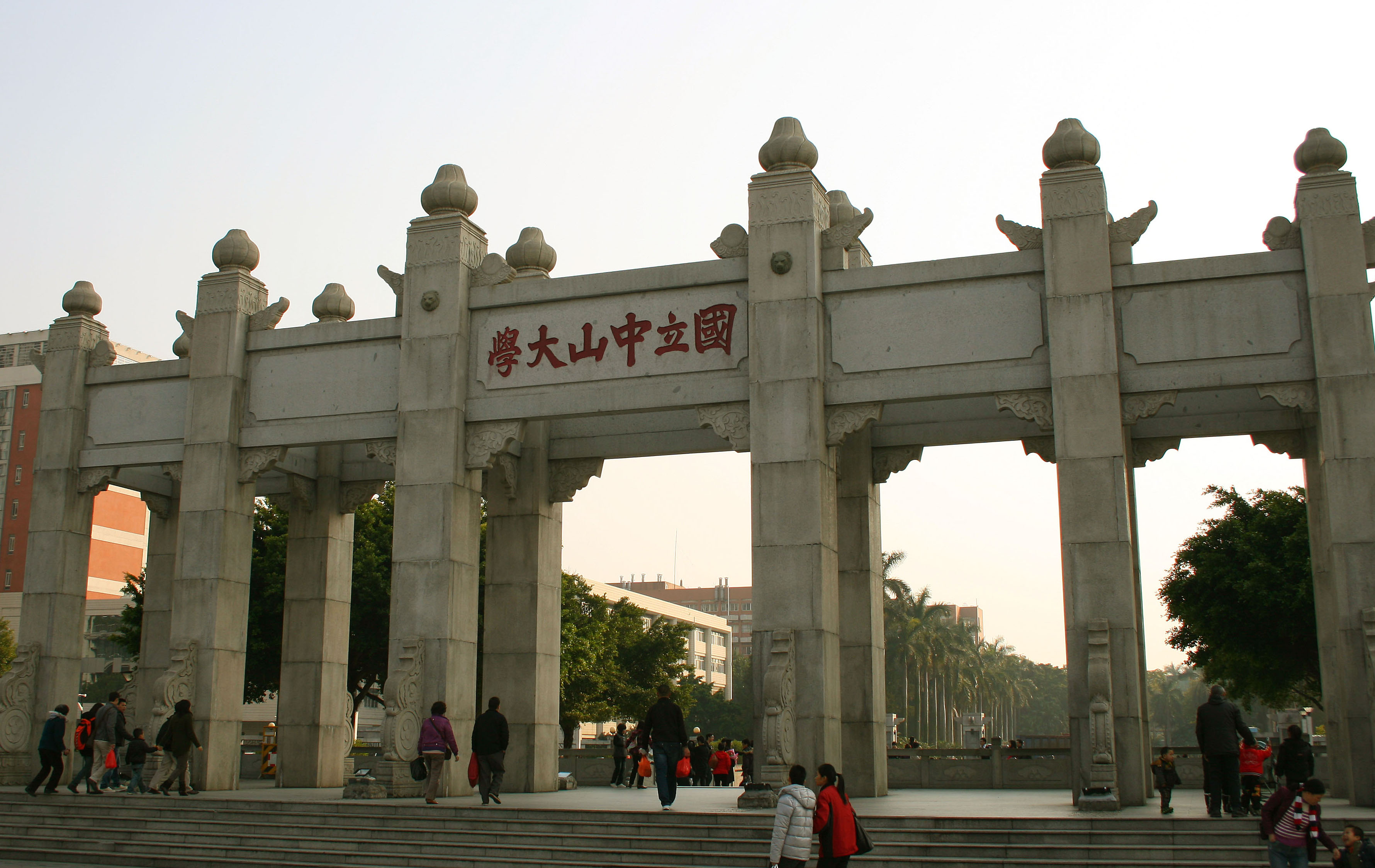


History


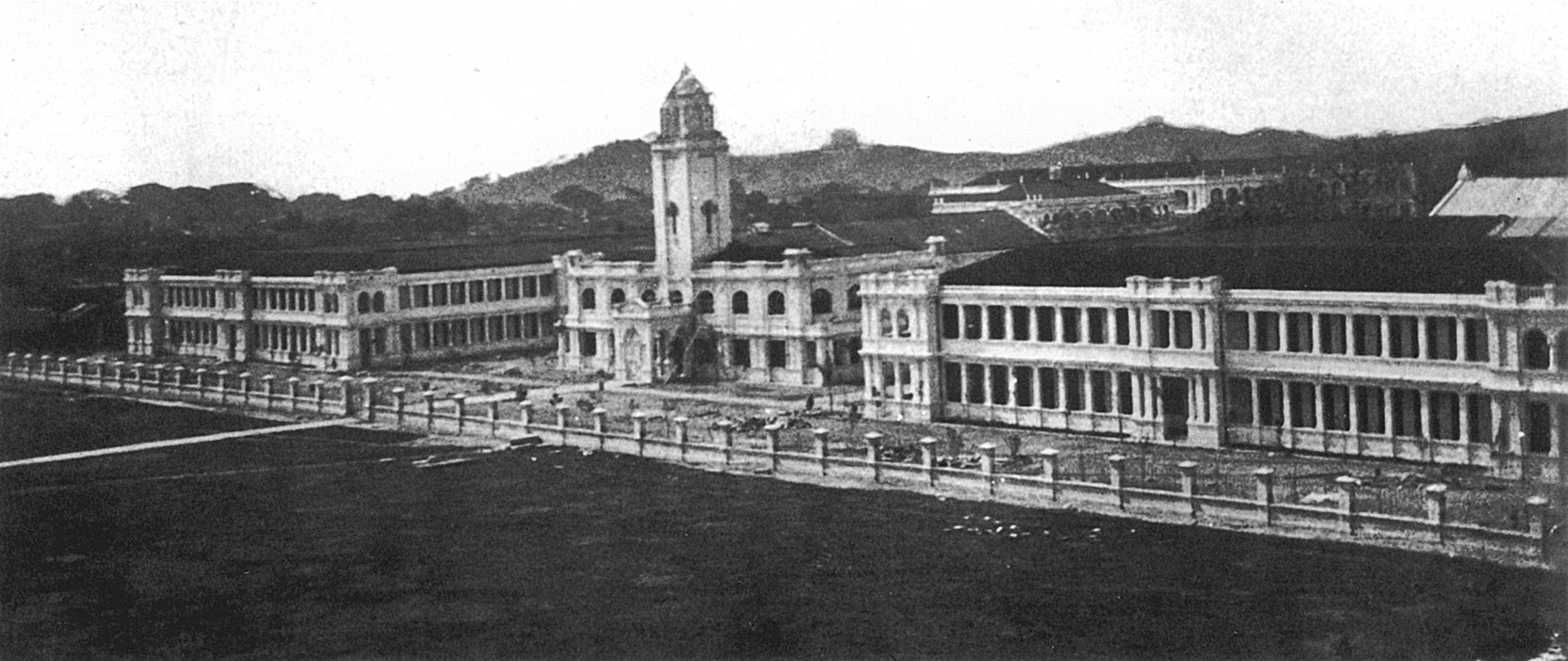

Originally, each of the Sun Yat-sen Universities were adopted a statism educational model, (中山大學模式) and based on Sun Yat-sen's political philosophy, present-day Sun Yat-sen University is the result of multiple mergers as well as splits and restructurings that have involved more than a dozen academic institutions over time. The most recent merger happened in 2001, when Sun Yat-sen University of Medical Science merged with Sun Yat-sen University and became Sun Yat-sen College of Medical Science.
Sun Yat-sen University
In 1924, Sun Yat-sen founded ** National Kwangtung University ** (國立廣東大學) in Canton and inscribed in his own handwriting the school motto of "Study Extensively, Enquire Accurately, Reflect Carefully, Discriminate Clearly, Practise Earnestly." In 1926, there were four National Sun Yat-sen Universities: National First Sun Yat-sen University in Canton (the current Sun Yat-sen University), National Second Sun Yat-sen University in Wuhan (the current Wuhan University), National Third Sun Yat-sen University in Hangzhou (the current Zhejiang University), National Fourth Sun Yat-sen University in Nanking (the predecessor of the current Nanjing University, Southeast University, and National Central University). The Nationalist government also planned to organize the National Fifth Sun Yat-sen University in Zhengzhou, but end up naming it as the Henan Provincial Sun Yat-sen University (the current Henan University).
In the 1930s, there were seven schools in the University: the Schools of Arts, Sciences, Law, Engineering, Agricultural Studies, Medicine and Education. In 1935, National Sun Yat-sen University, concurrently with National Tsinghua University and National Peking University, set up the first graduate schools in China and began to enroll graduate students.
In 1949, the University removed its prefix "National" and has been thereafter referred directly to ** Sun Yat-sen University ** (中山大学). In the 1950s, colleges, schools and departments were readjusted nationwide, and Sun Yat-sen University became a national top-tier comprehensive university with the liberal arts and sciences as its backbone disciplines.
Sun Yat-sen University of Medical Sciences
One of the predecessors of the Sun Yat-sen University of Medical Science was the Pok Tsai Medical School, which, founded in 1866, was the earliest institution of learning of western medicine in China, where Sun Yat-sen once studied and engaged in revolutionary activities.
The Pok Tsai Medical School evolved into the College of Medicine of Lingnan University in 1936. The Kung Yee Medical School and Hospital in Guangzhou (Canton) was founded in 1908. In 1925, the Kung Yee institutions were taken over by the government and became the Medical Department of the National First Sun Yat-sen (Zhongshan) University. In 1953, the Colleges of Medicine in Sun Yat-sen University and Lingnan University merged to form the College of Medicine of South China, which was joined by the Guangdong Guanghua College of Medicine in 1954. The university was renamed Guangzhou College of Medicine and Sun Yat-sen College of Medical Science successively, and finally Sun Yat-sen University of Medical Science in 1985, which has developed steadfastly into a comprehensive medical university with multi-schools and multiple levels, has reached national advanced level and achieved remarkable successes in scientific research in medical genetics, ophthalmology, tumor study, parasite study, the kidney disease of internal medicine, organ transplant, infectious liver disease, biological medical project and molecular medical science. In 2001, Sun Yat-sen University of Medical Science merged with Sun Yat-sen University and became Sun Yat-sen College of Medical Science.
Lingnan University
Main article: Lingnan University (Guangzhou)
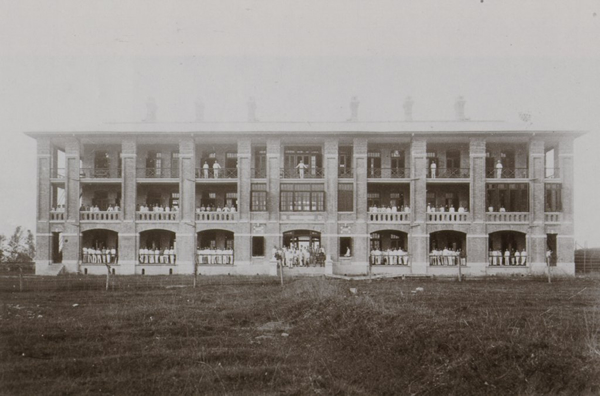
Lingnan University () was a private university established by Andrew Happer, MD and a group of American missionaries in Guangzhou in 1888. At its founding it was named Canton Christian College (格致書院).
The Hackett Medical College for Women (夏葛女子醫學院, the first medical college for women in China) and its affiliated hospital known as David Gregg Hospital for Women and Children (柔濟醫院), located in Guangzhou, China, were parts of a medical center that was founded by female medical missionary Mary H. Fulton (1854-1927). Fulton was sent by the Foreign Missions Board of the Presbyterian Church (USA), with the support of the Lafayette Avenue Presbyterian Church of Brooklyn, New York, of which David Gregg was pastor The college was dedicated in 1902 and offered a four-year medical curriculum. At the end of 1932, the medical center was registered and put under the control of the Chinese government. Furthermore, it affiliated with Guangzhou Hospital and Lingnan University to form the Sun Yat-Sen Medical College in 1936.
Lingnan University was incorporated into Sun Yat-sen University in 1953 under the order of the Communist Party's government. Members of the university moved to Hong Kong and founded the Lingnan School in Wan Chai in 1967, which was relocated to Tuen Mun in the mid-1990s and renamed Lingnan University in 1999. In 1988, Lingnan College was reestablished within Sun Yat-sen University and is now one of the top schools of economics and management in China.
Rankings and reputation
Sun Yat-sen University is ranked as one of the top universities in China by all the most influential and widely observed international university rankings, for example, #7 nationwide in Times Higher Education World University Rankings 2015, #6 nationwide in the Academic Ranking of World Universities 2015, and #8 nationwide in U.S. News Global University Ranking 2015.
The Times Higher Education 2011 placed Sun Yat-sen University 171st in the world and 5th in China, and the university is regarded as one of the most reputable Chinese universities by the Times Higher Education World Reputation Rankings where it ranked 151st globally. Sun Yat-sen graduates employability rankings placed at #191 in the world in the QS Graduate Employability Rankings.
As of 2025, out of all universities worldwide, SYSU is ranked #65 by the Academic Ranking of World Universities, #85 by the U.S. News Global University Ranking, #95 by the Center for World University Rankings, #201 by the Times Higher Education, and #276 by the QS World University Rankings.
The 2025 CWTS Leiden Ranking ranked SYSU 7th in the world by total publications and #26 in the world based on the number of their scientific publications belonging to the top 1% in their fields for the time period 2020–2023.
Nature Index
Nature Index tracks the affiliations of high-quality scientific articles and presents research outputs by institution and country on monthly basis. Regarding scientific research output, the Nature Index 2024 ranked SYSU the No. 7 university in the Asia Pacific region, and 8th in the world among the global universities.
| Year | Rank | Valuer |
|---|---|---|
| 2024 | 8 | Nature Index - Academic Institutions - Global |
| 2024 | 7 | Nature Index - Academic Institutions - China |
Academics
Statistics (2018)
Source:
| Annual Budget (billion USD) | $2.5 |
|---|
Faculties and Schools
Sun Yat-sen University has made several adjustments to its academic departments throughout its history. Starting from the end of 2022, Sun Yat-sen University has implemented a three-tier academic governance system consisting of "University-Faculties-Schools (Departments)." As of now, the university comprises a total of 67 schools (including directly affiliated departments and teaching units), which are divided among seven faculties: the Faculty of Humanities, the Faculty of Social Sciences, the Faculty of Economics and Management, the Faculty of Natural Sciences, the Faculty of Engineering, the Faculty of Information Science and Technology, and the Faculty of Medicine. These schools are spread across five campuses.
| Schools and Departments | Faculties | Campuses |
|---|---|---|
| Department of Chinese Language and Literature | Faculty of Humanities | Guangzhou South Campus |
| Department of History | Faculty of Humanities | Guangzhou South Campus |
| Department of Philosophy | Faculty of Humanities | Guangzhou South Campus |
| School of Foreign Languages | Faculty of Humanities | Guangzhou South Campus |
| School of Art | Faculty of Humanities | Guangzhou South Campus |
| Liberal Arts College (Boya College) | Faculty of Humanities | Guangzhou South Campus |
| Department of Chinese Language and Literature (Zhuhai) | Faculty of Humanities | Zhuhai Campus |
| Department of History (Zhuhai) | Faculty of Humanities | Zhuhai Campus |
| Department of Philosophy (Zhuhai) | Faculty of Humanities | Zhuhai Campus |
| School of International Studies | Faculty of Humanities | Zhuhai Campus |
| School of Sociology and Anthropology | Faculty of Social Sciences | Guangzhou South Campus |
| School of Government | Faculty of Social Sciences | Guangzhou East Campus |
| School of Law | Faculty of Social Sciences | Guangzhou East Campus |
| School of Marxism | Faculty of Social Sciences | Guangzhou South Campus |
| Department of Psychology | Faculty of Social Sciences | Guangzhou South Campus |
| School of Journalism and Communication | Faculty of Social Sciences | Guangzhou East Campus |
| School of Information Management | Faculty of Social Sciences | Guangzhou East Campus |
| School of International Relations | Faculty of Social Sciences | Zhuhai Campus |
| Department of Physical Education | Faculty of Social Sciences | Guangzhou South Campus |
| Lingnan (University) College | Faculty of Economics and Management | Guangzhou South Campus |
| School of Business (SYSBS) | Faculty of Economics and Management | Guangzhou East Campus |
| School of Tourism Management | Faculty of Economics and Management | Zhuhai Campus |
| International School of Business and Finance | Faculty of Economics and Management | Zhuhai Campus |
| Business School | Faculty of Economics and Management | Shenzhen Campus |
| School of Mathematics | Faculty of Natural Sciences | Guangzhou South Campus |
| School of Physics | Faculty of Natural Sciences | Guangzhou South Campus |
| School of Chemistry | Faculty of Natural Sciences | Guangzhou East Campus |
| School of Life Sciences | Faculty of Natural Sciences | Guangzhou South Campus |
| School of Geography and Planning | Faculty of Natural Sciences | Guangzhou South Campus |
| School of Mathematics (Zhuhai) | Faculty of Natural Sciences | Zhuhai Campus |
| School of Physics and Astronomy | Faculty of Natural Sciences | Zhuhai Campus |
| School of Science | Faculty of Natural Sciences | Shenzhen Campus |
| School of Earth Science and Geological Engineering | Faculty of Natural Sciences | Zhuhai Campus |
| School of Atmospheric Sciences | Faculty of Natural Sciences | Zhuhai Campus |
| School of Marine Sciences | Faculty of Natural Sciences | Zhuhai Campus |
| School of Ecology | Faculty of Natural Sciences | Shenzhen Campus |
| School of Agriculture | Faculty of Natural Sciences | Shenzhen Campus |
| School of Chemical Engineering and Technology | Faculty of Engineering | Zhuhai Campus |
| School of Materials Science and Engineering | Faculty of Engineering | Guangzhou East Campus |
| School of Environmental Science and Engineering | Faculty of Engineering | Guangzhou East Campus |
| School of Systems Science and Engineering | Faculty of Engineering | Guangzhou East Campus |
| The Sino-French Institute of Nuclear Engineering & Technology | Faculty of Engineering | Zhuhai Campus |
| School of Civil Engineering | Faculty of Engineering | Zhuhai Campus |
| School of Geospatial Engineering and Science | Faculty of Engineering | Zhuhai Campus |
| School of Marine Sciences | Faculty of Engineering | Zhuhai Campus |
| School of Aeronautics and Astronautics | Faculty of Engineering | Shenzhen Campus |
| School of Materials | Faculty of Engineering | Shenzhen Campus |
| School of Intelligent Systems Engineering | Faculty of Engineering | Shenzhen Campus |
| School of Biomedical Engineering | Faculty of Engineering | Shenzhen Campus |
| School of Advanced Energy | Faculty of Engineering | Shenzhen Campus |
| School of Advanced Manufacture | Faculty of Engineering | Shenzhen Campus |
| School of Computer Science and Technology | Faculty of Information Science and Technology | Guangzhou East Campus |
| School of Electronics and Information Technology | Faculty of Information Science and Technology | Guangzhou East Campus |
| School of Microelectronics Science and Technology | Faculty of Information Science and Technology | Zhuhai Campus |
| School of Artificial Intelligence | Faculty of Information Science and Technology | Zhuhai Campus |
| School of Software Engineering | Faculty of Information Science and Technology | Zhuhai Campus |
| School of Electronics and Communication Engineering | Faculty of Information Science and Technology | Shenzhen Campus |
| School of Integrated Circuits | Faculty of Information Science and Technology | Shenzhen Campus |
| School of Cyber Science and Technology | Faculty of Information Science and Technology | Shenzhen Campus |
| Zhongshan School of Medicine | Faculty of Medicine | Guangzhou North Campus |
| School of Public Health | Faculty of Medicine | Guangzhou North Campus |
| School of Pharmaceutical Sciences | Faculty of Medicine | Guangzhou East Campus |
| School of Nursing | Faculty of Medicine | Guangzhou North Campus |
| Guanghua School of Stomatology | Faculty of Medicine | Guangzhou North Campus |
| School of Medicine | Faculty of Medicine | Shenzhen Campus |
| School of Public Health (Shenzhen) | Faculty of Medicine | Shenzhen Campus |
| School of Pharmaceutical Science (Shenzhen) | Faculty of Medicine | Shenzhen Campus |
Lingnan (University) College


Since 2015, Lingnan (University) college is also triple-accredited by AACSB, EQUIS and AMBA. The college is originated from Lingnan University (), a renowned private university established by a group of American missionaries in 1888.
Affiliated hospitals

The university has the largest affiliated hospital system in China, including Sun Yat-sen University First Hospital, Sun Yat-sen Memorial Hospital (or Sun Yat-sen University Second Hospital), Sun Yat-sen University Third Hospital, Sun Yat-sen University Fourth Hospital (has merged into the First Hospital), Sun Yat-sen University Fifth Hospital (or Zhuhai Hospital), Sun Yat-sen University Sixth Hospital (or Sun Yat-sen University Gastrointestinal & Anal Hospital), Sun Yat-sen University Cancer Center, Sun Yat-sen University Stomatologic Hospital, Sun Yat-sen University Ophthalmologic Center, Sun Yat-sen University Seventh Hospital (Shenzhen), Sun Yat-sen University Eighth Hospital (Shenzhen). All eight general hospitals, the Sun Yat-sen University Cancer Center and Sun Yat-sen University Ophthalmology Center are 3A class hospitals.
The First Affiliated Hospital, SYSU
The First Affiliated Hospital, Sun Yat-sen University was established in 1910, initially called the Affiliated Hospital of Guangdong Public Institution of Medicine. As a 3A hospital (the top level in China), the hospital is the largest and the most comprehensive one among all affiliated hospitals of SYSU, as well as one of the largest hospitals in the country.
- Sun Yat-sen University First Hospital is ranked #2 in "Top 10 General Hospital in China" rankings.
Sun Yat-Sen Memorial Hospital, SYSU
Founded as Ophthalmic Hospital in Canton by American Peter Parker in 1835. It originally dealt with diseases of the eye, but later treated other ailments. It later became the Canton Hospital.
Sun Yat-sen University Cancer Center
Sun Yat-sen University Cancer Center is a level III (highest rank in China) and class A hospital. It was awarded as "key subject of China" in 2001. In 1980, SYSUCC was designated as World Health Organization (WHO) Collaborating Center for research on cancer. Since 2003, SYSUCC became a sister institution of the University of Texas MD Anderson Cancer Center. In 2004, SYSUCC has set up a joint laboratory with Karolinska Institutet of Sweden for research in immunotherapy, molecular virology and oncological epidemiology.
- Sun Yat-sen University Cancer Center is ranked #1 in "Top 10 Cancer Hospitals in China" rankings.
Zhongshan Ophthalmic Center (ZOC) of Sun Yat-sen University
Zhongshan Ophthalmic Center (ZOC) of Sun Yat-sen University is the first and leading advanced ophthalmic center and the last resort for advanced eye care in China, integrating eye care, teaching, eye research and blindness prevention. It is also one of the 20 largest general ophthalmic centers in the world. In 2006, the ZOC was approved to be the State Key Laboratory of Ophthalmology, the only one of its kind in China.
- ZOC is ranked #1 in "Best Ophthalmologic Hospitals in China" rankings.
Sun Yat-sen University Libraries
The university's system of libraries is one of the largest in China. By December 2012, it held more than 6 million paper volumes, including periodicals.
The Hilles Collection
In June 2005, Harvard College Library of Harvard University donated 158,000 volumes in Hilles Library to Sun Yat-sen University. Developed over a century, the collection is composed of titles in the humanities and social sciences, primarily in English, but also in Western foreign languages.
Confucius Institutes
Sun Yat-sen University has established five Confucius Institutes since 2006:
- The Confucius Institute at Ateneo de Manila University
- The Confucius Institute in Indianapolis, established together with Indiana University-Purdue University Indianapolis
- The Confucius Institute at Autonomous University of Yucatan
- The Confucius Institute in Lyon, established together with Lumière University Lyon 2 and Jean Moulin University Lyon 3
- The Confucius Institute at University of Cape Town.
Research


Essential Science Indicators (ESI)
According to statistics of the Essential Science Indicators (ESI) database from January 2003 to February 2013, the total number of citations of papers in 15 disciplines of Sun Yat-sen University entered global top 1%. Following Peking University, Sun Yat-sen University ranked 2nd in universities in China, tied with Fudan University, Shanghai Jiao Tong University and Zhejiang University. The 15 disciplines include Chemistry, Clinical Medicine, Physics, Biology and Biochemistry, Materials Science, Molecular Biology & Genetics, Engineering, Plant and Animal Science, Environment/Ecology, Pharmacology & Toxicology, Neuroscience & Behavior, Mathematics, Microbiology, Agricultural Sciences, and Social Sciences, General.
Nature Publishing Index (NPI)
Nature Publishing Index shows both Research Articles (Articles, Letters & Brief Communications) and Reviews, published in Nature and/or Nature research journals. The rankings are based on the number of papers that were published during the last 12 months. In time range of 01.07.2013-06.30.2014, Sun Yat-sen University is ranked #5 among Chinese Universities.
Postdoctoral Research Stations
Sun Yat-sen University has 39 postdoctoral research stations.
Journals
Sun Yat-sen University publishes altogether 25 scholarly journals, including
- Acta Scientiarum Naturalium Universitatis Sunyatseni
- Journey of Sun Yat-sen University Social Science Edition
- Journey of Sun Yat-sen University (medical science)
- Diagnostic Imaging & Interventional Radiology (in Chinese)
- Modern Clinical Nursing (in Chinese)
- New Medicine (in Chinese)
- Chinese Journal of Nervous and Mental Diseases (in Chinese)
- Chinese Journal of Cancer
- Eye Science
Campuses


At present, the university covers a total area of 6.17 sqkm, and has 5 campuses: Guangzhou South Campus (广州校区南校园) in Haizhu District, Guangzhou North Campus (广州校区北校园) in Yuexiu District, Guangzhou East Campus (广州校区东校园) in Panyu District, Zhuhai Campus (珠海校区), and Shenzhen Campus.
Guangzhou South Campus
The south campus of Sun Yat-sen University is located in Haizhu District, Guangzhou, and covers a total area of 1.17 square kilometers. It mainly hosts disciplines in sciences and humanities.
Add: No. 135, Xingang Road West, Guangzhou 510275, P. R. China
Guangzhou North Campus
The North Campus is located in Yuexiu District, Guangzhou, and covers an area of 0.39 square kilometers. It is a campus mainly for disciplines in medical sciences.
Add: No. 74, Zhongshan 2nd Road, Guangzhou 510085, P. R. China
Guangzhou East Campus
The East Campus is located at the north end of the Guangzhou Higher Education Mega Center in Xiaoguwei, Panyu, and covers an area of 1.13 square kilometers. The Guangzhou University City is a major development made by the People's Government of Guangdong Province in an effort to implement the strategy of building Guangdong through science and education. The first batch of students started school there in September 2004.
Add: Xiaoguwei Island, Panyu District, Guangzhou 510006, P. R. China
Zhuhai Campus
The Zhuhai Campus is located at Tang Jia Wan, Zhuhai City, and covers an area of 3.48 square kilometers. Freshmen and sophomores of some disciplines in liberal arts, natural sciences, and medical sciences are currently living and studying on campus with students from the School of Network Education and Continuing Education.
Add: Tang Jia Wan, Zhuhai 519082, P. R. China
Shenzhen Campus
The Shenzhen Campus is located at Guangming District in Shenzhen City, and covers an area of 3.217 square kilometers. Construction started in 2016 and the campus opened in September 2018.
Alumni
Since 2017, at least 36 billionaires graduated from Sun Yat-sen University, putting it the first place in the South Central China region and 7th nationally.
- Sonia Chan, 2nd Secretary for Administration and Justice of Macau
- George Chann, Chinese-American painter
- Fang Fenglei, former deputy director of China International Capital Corporation and Chairman of Goldman Sachs China
- Li Fanghua, physicist
- Shiu-Ying Hu, botanist
- Huang Huahua, former Governor of Guangdong
- Muzi Mei, blogger
- Xu Ningsheng, 21st President of Fudan University
- Xu Ze, politician
- Xu Yinchuan, former world xiangqi (Chinese chess) champion
- Shou-Wu Zhang, Chinese-American mathematician
- Yingying Zhang, researcher on photosynthesis and crop productivity
- Zhang Huaicun, artist and writer of children's books
- Guotai Zhou, major general of the People's Liberation Army
- Ye Shuhua, prominent astronomer
- Tsang Hin-chi, entrepreneur and politician, founder of the Goldlion Group
- Lai Minhua, Director General of Macao Customs Service
References
References
- "校歌 校訓 校徽 (Chinese)".
- "SYSU Today".
- "Sun Yat-sen University's FY 2019 Budget". Sun Yat-sen University.
- (2019). "2019中国大学评价研究报告". Science Press (China).
- (November 2024). "China's Sun Yat-sen University turns 100". ummid.com.
- 海南省作家协会. (1997). "天涯". 《天涯》杂志社.
- Wen-Hsin Yeh, ''The Alienated Academy: Culture and Politics in Republican China, 1919-1937''. Harvard University Asia Center (November 15, 2000). p.173-176.
- (2015). "中华民国专题史·第十卷:教育的变革与发展". [[Nanjing University Press]].
- (2004). "校影". 中山大学出版社.
- (2005). "中国知名大学校长访谈录". 中国文联出版社.
- (1998). "中华人民共和国地名大词典". [[Commercial Press]].
- Spencer, C.. (1967). "Sun Yat-sen, Founder of the Chinese Republic". John Day Company.
- Chi-Min Wong, Liande Wu, ''History of Chinese Medicine: Being a Chronicle of Medical Happenings in China from Ancient Times to the Present Period'', AMS Press, 1973, p. 658.
- "大屋顶老虎窗 见证"柔济"历史--24小时滚动新闻--人民网".
- (1919). "A Crusade of Compassion for the Healing of the Nations".
- "ҽԺʵ".
- (1924). "Hackett Medical College for Women, Turner Training School for Nurses, David ... - Hackett Medical College - Google Books".
- (2011). "American Doctors in Canton". Transaction Publishers.
- PANG Suk Man. (February 1998). "The Hackett Medical College for Women in China (1899-1936)". Hong Kong Baptist University.
- "中国近代第一所女子医学院--夏葛医学院".
- Archives of Lafayette Avenue Presbyterian Church, Brooklyn, New York
- Mary H. Fulton. (2010). "Inasmuch". BiblioBazaar.
- Rebecca Chan Chung, Deborah Chung and Cecilia Ng Wong, "Piloted to Serve", 2012
- "Piloted to Serve". Facebook.
- (2015-07-02). "中山大学和岭南大学的历史沿革图". 风雨同舟 • 学脉赓续 - 国立中山大学与私立岭南大学历史图片展.
- "A new age for Lingnan University".
- (10 June 2015). "Asia University Rankings 2015". Times Higher Education.
- "Academic Ranking of World Universities". Shanghai Ranking.
- "Search Top World Universities - US News Best Global Universities".
- (13 April 2015). "World University Rankings 2011".
- (2022-10-06). "World Reputation Rankings".
- "Graduate Employability Rankings 2019".
- "ShanghaiRanking's Academic Ranking of World Universities".
- (2024-06-25). "Sun Yat Sen University in China - US News Best Global Universities 2025".
- "World University Rankings 2025 {{!}} Global 2000 List {{!}} CWUR".
- (2023-09-27). "Sun Yat-sen University".
- (2025-06-18). "QS World University Rankings 2026: Top global universities".
- Studies (CWTS), Centre for Science and Technology. "CWTS Leiden Ranking Traditional Edition".
- "FAQ {{!}} Nature Index".
- "最新自然指数排名出炉:中山大学进入世界20强,湖大进50强!_全球_中国_高校".
- "2024 Research Leaders: Leading academic institutions {{!}} Nature Index".
- "中山大学 SUN YAT-SEN UNIVERSITY - 学生情况".
- "中山大学 SUN YAT-SEN UNIVERSITY".
- "AACSB Accreditation - Full Global Listing".
- "EQUIS Accredited Schools". Efmd.org.
- "Lingnan (University) College | Association of MBAs". Ambaguide.com.
- "中山大学-学校简介".
- "中山大学附属第一医院 中山大学附属第一医院".
- "Back to AT0086".
- "Archived copy".
- "Top 10 Cancer Hospitals in China - China Service Mall !". At0086.com.
- "Zhongshan Ophthalmic Center (ZOC) of Sun Yat-sen University - Facebook".
- (2013-12-05). "中山大学新闻网". News2.sysu.edu.cn.
- "About Us". Sun Yat-sen University Libraries.
- "Harvard University Library Notes".
- Harvard News Office. "Harvard Gazette: HCL presents collection to China's Sun Yat-Sen University Library".
- "SUN YAT-SEN UNIVERSITY : Essential Science Indicators".
- "Research & Teaching - 15 disciplines of SYSU enter the ESI global top 1%, SYSU's international academic influence keeps rising - 中山大学 SUN YAT-SEN UNIVERSITY".
- "Nature Publishing Index China".
- "Acta Scientiarum Naturalium Universitatis SunYatseni".
- "中山大学:旅游管理".
- "联系我们". Sun Yat-sen University.
- "Shenzhen Campus of Sun Yat-sen University".
- "中山大学:广州校区南校园".
- (2022-04-20). "Sun Yat-sen University Shenzhen Campus_Universities-Shenzhen Government Online".
- (2024-03-25). "Shenzhen achieves milestone in higher education development".
- (2017-08-29). "Top 10 Chinese universities with most billionaire alumni".
This article was imported from Wikipedia and is available under the Creative Commons Attribution-ShareAlike 4.0 License. Content has been adapted to SurfDoc format. Original contributors can be found on the article history page.
Ask Mako anything about Sun Yat-sen University — get instant answers, deeper analysis, and related topics.
Research with MakoFree with your Surf account
Create a free account to save articles, ask Mako questions, and organize your research.
Sign up freeThis content may have been generated or modified by AI. CloudSurf Software LLC is not responsible for the accuracy, completeness, or reliability of AI-generated content. Always verify important information from primary sources.
Report