From Surf Wiki (app.surf) — the open knowledge base
Sumerian religion
First known Mesopotamian religion
.jpg)
First known Mesopotamian religion
Sumerian religion was the religion practiced by the people of Sumer, the first literate civilization found in recorded history and based in ancient Mesopotamia, and what is modern day Iraq. The Sumerians widely regarded their divinities as responsible for all matters pertaining to the natural and social orders of their society.
Overview
Before the beginning of kingship in Sumer, the city-states were effectively ruled by theocratic priests and religious officials. Later, this role was supplanted by kings, but priests continued to exert great influence on Sumerian society. In early times, Sumerian temples were simple, one-room structures, sometimes built on elevated platforms. Towards the end of Sumerian civilization, these temples developed into ziggurats—tall, pyramidal structures with sanctuaries at the tops.
The Sumerians believed that the universe had come into being through a series of cosmic births such as gods. First, Nammu, the primeval waters, gave birth to Ki (the earth) and An (the sky), who mated together and produced a son named Enlil. Enlil separated heaven from earth and claimed the earth as his domain. Humans were believed to have been created by AnKi or Enki, the son of the An and Ki.
Heaven was reserved exclusively for deities. Meanwhile, after death, all mortals' spirits, regardless of their behavior while alive, were believed to go to Kur, a cold, dark cavern deep beneath the earth, which was ruled by the goddess Ereshkigal and where the only food available was dry dust. In later times, Ereshkigal was believed to rule alongside her husband Nergal, the god of death.
The major deities in the Sumerian pantheon included An, the god of the heavens, Enlil, the god of wind and storm, AnKi/Enki, the god of water and human culture, Ninhursag, the goddess of fertility and the earth, Utu, the god of the sun and justice, and his father Nanna, the god of the moon. During the Akkadian Empire, Inanna, the goddess of sex, beauty, and warfare, was widely venerated across Sumer and appeared in many myths, including the famous story of her descent into the Underworld.
Sumerian texts often report that the gods possess and perform 'Me'. Recent studies by Annette Zgoll have shown that these 'Me' are rituals whose acquisition and proper performance were central to Mesopotamian culture.
Sumerian religion heavily influenced the religious beliefs of later Mesopotamian peoples; elements of it are retained in the mythologies and religions of the Hurrians, Akkadians, Babylonians, Assyrians, and other Middle Eastern culture groups. Scholars of comparative mythology have noticed parallels between the stories of the ancient Sumerians and those recorded later in the early parts of the Hebrew Bible.
Worship
Written cuneiform
Sumerian myths were passed down through the oral tradition until the invention of writing (the earliest myth discovered so far, the Epic of Gilgamesh, is Sumerian and is written on a series of fractured clay tablets). Early Sumerian cuneiform was used primarily as a record-keeping tool; it was not until the late Early Dynastic period that religious writings first became prevalent as temple praise hymns and as a form of "incantation" called the nam-šub (prefix + "to cast"). These tablets were also made of stone clay or stone, and they used a small pick to make the symbols.
Architecture
Main article: Sumerian architecture

In the Sumerian city-states, temple complexes originally were small, elevated one-room structures. In the early dynastic period, temples developed raised terraces and multiple rooms. Toward the end of the Sumerian civilization, ziggurats became the preferred temple structure for Mesopotamian religious centers. Temples served as cultural, religious, and political headquarters until approximately 2500 BC, with the rise of military kings known as Lu-gals ("man" + "big") after which time the political and military leadership was often housed in separate "palace" complexes.
Priesthood
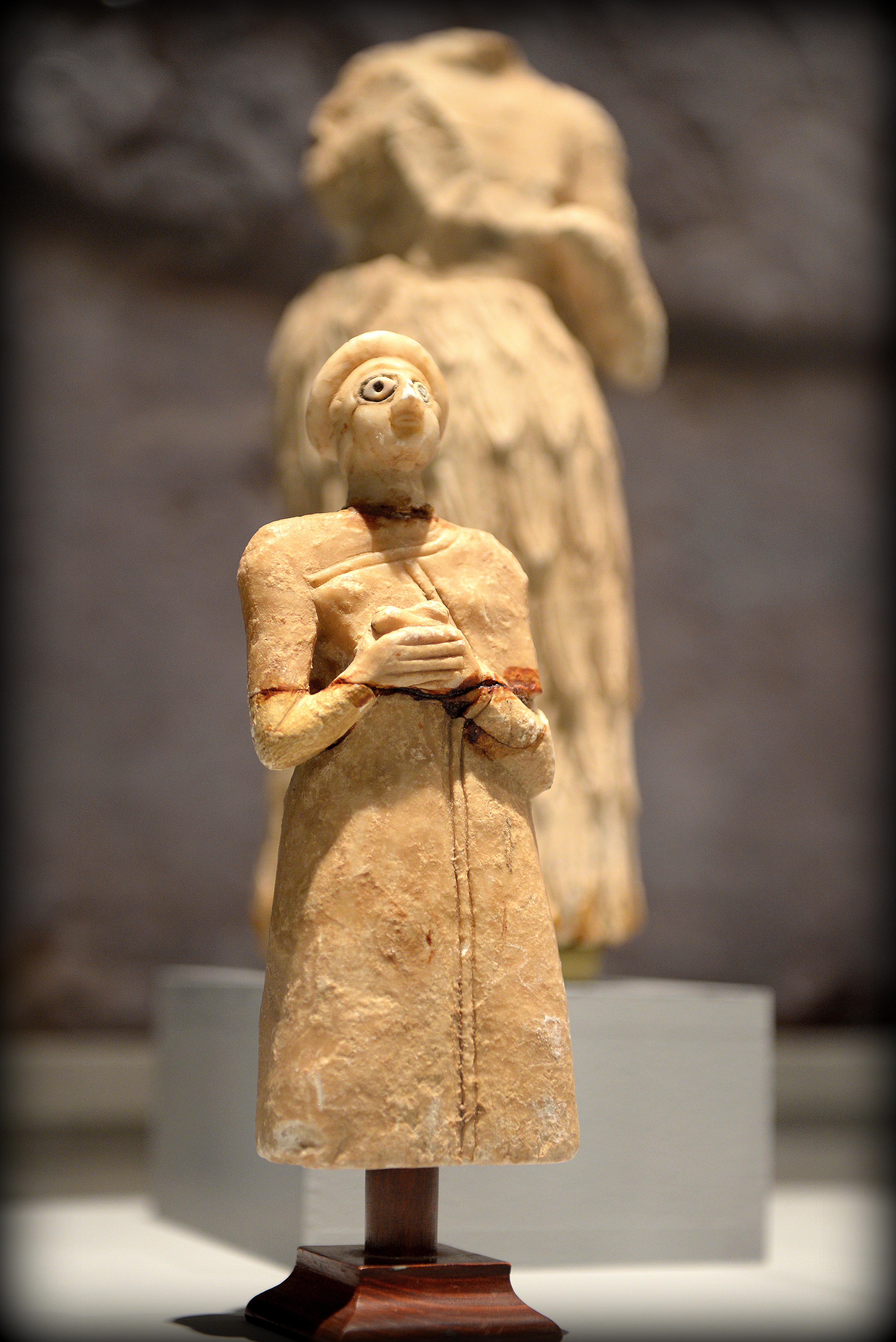
Until the advent of the Lugal ("King"), Sumerian city-states were under a virtually theocratic government controlled by various En or Ensí, who served as the high priests of the cults of the city gods. (Their female equivalents were known as Nin.) Priests were responsible for continuing the cultural and religious traditions of their city-state, and were viewed as mediators between humans and the cosmic and terrestrial forces. The priesthood resided full-time in temple complexes, and administered matters of state including the large irrigation processes necessary for the civilization's survival.
Deified kings
Some cities in Sumer had periods where their kings were worshipped as gods, and occasionally, these times spread to all cities in the region.
Ceremony
During the Third Dynasty of Ur, the Sumerian city-state of Lagash was said to have had sixty-two "lamentation priests" who were accompanied by 180 vocalists and instrumentalists.
Cosmology
Main article: Ancient near eastern cosmology
The Sumerians envisioned the universe as a closed dome surrounded by a primordial saltwater sea. Underneath the terrestrial earth, which formed the base of the dome, existed an underworld and a freshwater ocean called the Abzu. The deity of the dome-shaped firmament was named An; that of the earth was named Ki. First the underground world was believed to be an extension of the goddess Ki, but later developed into the concept of Kur. The primordial saltwater sea was named Nammu, who became known as Tiamat during and after the Ur III period. Some ancient Sumerians believed that salt and other minerals were alive, and could even think independent thoughts.
Creation story
The main source of information about Sumerian creation mythology is the prologue to the epic poem Gilgamesh, Enkidu, and the Netherworld, which briefly describes the process of creation: originally, there was only Nammu, the primeval sea. Then, Nammu without a father gave birth to Utu, then went on to create An the sky, and Ki, the earth. An and Ki mated with each other, causing Ki to give birth to Enlil, the god of wind, rain, and storm. Enlil separated An from Ki and carried off the earth as his domain, while An carried off the sky.
Heaven
Main article: Seven Heavens
The ancient Mesopotamians regarded the sky as a series of domes (usually three, but sometimes seven) covering the flat earth and a place where holy stars resided. Each dome was made of a different kind of precious stone. The lowest dome of heaven was made of jasper and was the home of the stars. The middle dome of heaven was made of saggilmut stone and was the abode of the Igigi. Instead, after a person died, his or her soul went to Kur (later known as Irkalla), a dark shadowy underworld, located deep below the surface of the earth.
Afterlife
Main article: Kur


The Sumerian afterlife was a dark, dreary cavern located deep below the ground, where inhabitants were believed to continue "a shadowy version of life on earth". This bleak domain was known as Kur, and was believed to be ruled by the goddess Ereshkigal. All souls went to the same afterlife, and a person's actions during life had no effect on how the person would be treated in the world to come.
The souls in Kur were believed to eat nothing but dry dust and family members of the deceased would ritually pour libations into the dead person's grave through a clay pipe, thereby allowing the dead to drink. Nonetheless, there are assumptions according to which treasures in wealthy graves had been intended as offerings for Utu and the Anunnaki, so that the deceased would receive special favors in the underworld. During the Third Dynasty of Ur, it was believed that a person's treatment in the afterlife depended on how he or she was buried; those that had been given sumptuous burials would be treated well, but those who had been given poor burials would fare poorly, and were believed to haunt the living.
The entrance to Kur was believed to be located in the Zagros Mountains in the far east. It had seven gates, through which a soul needed to pass. The god Neti was the gatekeeper. Ereshkigal's sukkal, or messenger, was the god Namtar. Galla were a class of demons that were believed to reside in the underworld; their primary purpose appears to have been to drag unfortunate mortals back to Kur. They are frequently referenced in magical texts, and some texts describe them as being seven in number. Several extant poems describe the galla dragging the god Dumuzid into the underworld. The later Mesopotamians knew this underworld by its East Semitic name: Irkalla. During the Akkadian Period, Ereshkigal's role as the ruler of the underworld was assigned to Nergal, the god of death. The Akkadians attempted to harmonize this dual rulership of the underworld by making Nergal Ereshkigal's husband.
Pantheon
Development

It is generally agreed that Sumerian civilization began at some point between c. 4500 and 4000 BC, but the earliest historical records only date to around 2900 BC. The Sumerians originally practiced a polytheistic religion, with anthropomorphic deities representing cosmic and terrestrial forces in their world.
During the middle of the third millennium BC, Sumerian society became more urbanized.
During the late 2000s BC, the Sumerians were conquered by the Akkadians. The Akkadians syncretized their own gods with the Sumerian ones, causing Sumerian religion to take on a Semitic coloration. Male deities became dominant and the gods completely lost their original associations with natural phenomena. People began to view the gods as living in a feudal society with class structure. Powerful deities such as Enki and Inanna became seen as receiving their power from the chief god Enlil.
Major deities
_-_EnKi_(Sumerian).jpg)
The majority of Sumerian deities belonged to a classification called the Anunna ("[offspring] of An"), whereas seven deities, including Enlil and Inanna, belonged to a group of "underworld judges" known as the Anunnaki ("[offspring] of An" + Ki). During the Third Dynasty of Ur, the Sumerian pantheon was said to include sixty times sixty (3600) deities.
Enlil was the god of air, wind, and storm. He was also the chief god of the Sumerian pantheon and the patron deity of the city of Nippur. His primary consort was Ninlil, the goddess of the south wind, who was one of the patron deities of Nippur and was believed to reside in the same temple as Enlil. Ninurta was the son of Enlil and Ninlil. He was worshipped as the god of war, agriculture, and one of the Sumerian wind gods. He was the patron deity of Girsu and one of the patron deities of Lagash. "Sumerian cities each had their own gods but acknowledged the supremacy of...Enlil."
Enki was god of freshwater, male fertility, and knowledge. His most important cult center was the E-abzu temple in the city of Eridu. He was the patron and creator of humanity and the sponsor of human culture. His primary consort was Ninhursag, the Sumerian goddess of the earth. Ninhursag was worshipped in the cities of Kesh and Adab.

Inanna was the Sumerian goddess of love, sexuality, prostitution, and war. Deified kings may have re-enacted the marriage of Inanna and Dumuzid with priestesses. Many of the myths involving her revolve around her attempts to usurp control of the other deities' domains.
Utu was god of the sun, whose primary center of worship was the E-babbar temple in Sippar. Utu was principally regarded as a dispenser of justice; He may have also been the father of Inanna and Ereshkigal. Ningal was the wife of Nanna, as well as the mother of Utu, Inanna, and Ereshkigal.
Ereshkigal was the goddess of the Sumerian Underworld, which was known as Kur. In later myth, her husband was the god Nergal. The gatekeeper of the underworld was the god Neti.
Nammu was a goddess representing the primeval waters (Engur), who gave birth to An (heaven) and Ki (earth) and the first deities; while she is rarely attested as an object of cult, she likely played a central role in the early cosmogony of Eridu, and in later periods continued to appear in texts related to exorcisms. An was the ancient Sumerian god of the heavens. He was the ancestor of all the other major deities and the original patron deity of Uruk.
Most major gods had a so-called sukkal, a minor deity serving as their vizier, messenger or doorkeeper.
Legacy
Akkadians
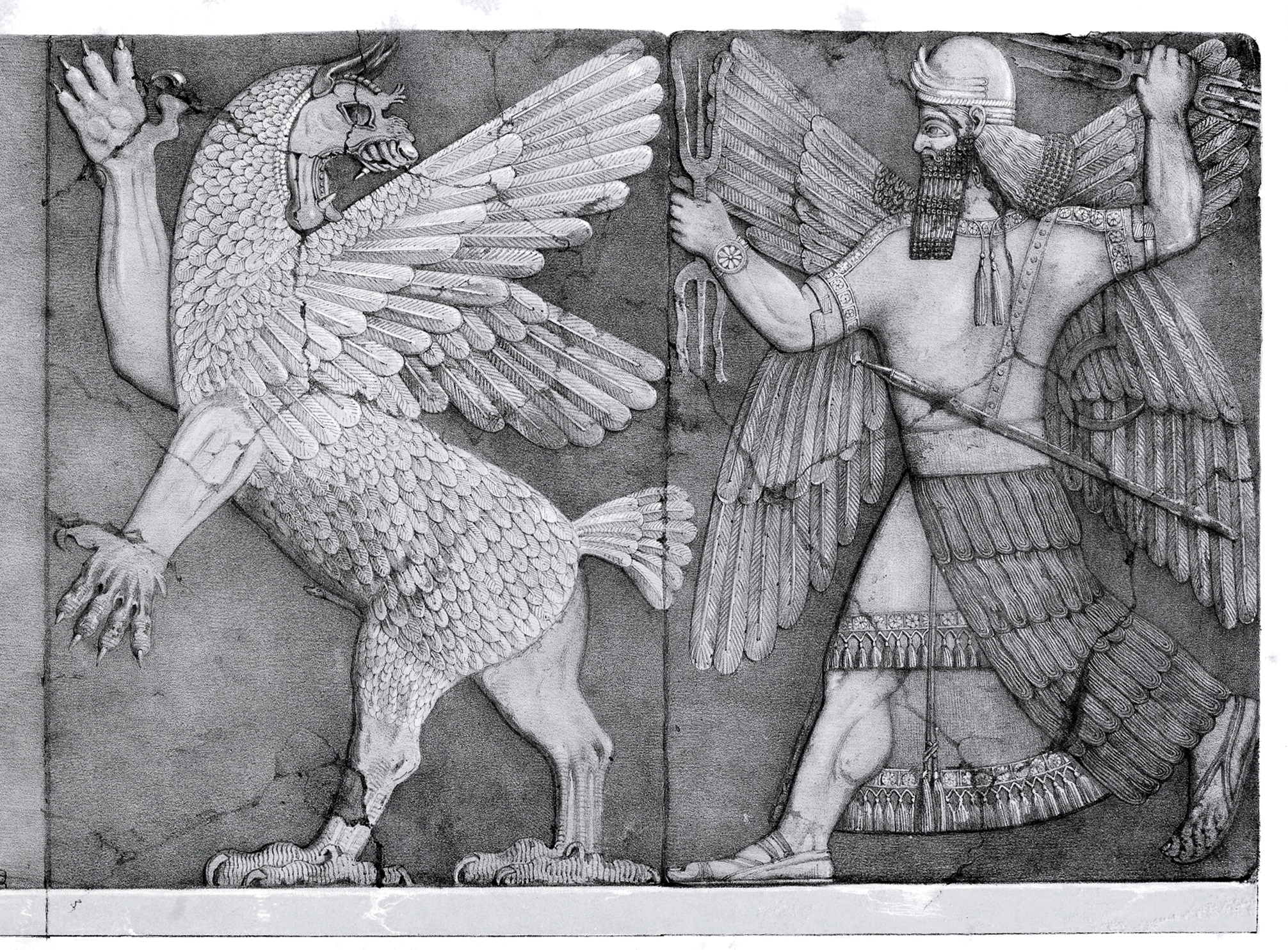
The Sumerians had a linguistic and cultural exchange with the Semitic Akkadian peoples in northern Mesopotamia for generations prior to the conquests of Sargon of Akkad in 2340 BC. Sumerian mythology and religious practices were rapidly integrated into Akkadian culture.
Babylonians
The Amorite Babylonians gained dominance over southern Mesopotamia by the mid-17th century BC. During the Old Babylonian Period, the Sumerian and Akkadian languages were retained for religious purposes; the majority of Sumerian mythological literature known to historians today comes from the Old Babylonian Period, either in the form of transcribed Sumerian texts (most notably the Babylonian version of the Epic of Gilgamesh) or in the form of Sumerian and Akkadian influences within Babylonian mythological literature (most notably the Enûma Eliš). The Sumerian-Akkadian pantheon was altered, most notably with the introduction of a new supreme deity, Marduk. The Sumerian goddess Inanna also developed the counterpart Ishtar during the Old Babylonian Period.
Hurrians
The Hurrians adopted the Akkadian god Anu into their pantheon sometime no later than 1200 BC. Other Sumerian and Akkadian deities adapted into the Hurrian pantheon include Ayas, the Hurrian counterpart to Ea; Shaushka, the Hurrian counterpart to Ishtar; and the goddess Ninlil.
Parallels
Some stories recorded in the older parts of the Hebrew Bible bear strong similarities to the stories in Sumerian mythology. For example, the Genesis flood narrative bears a striking resemblance to the Sumerian deluge myth, recorded in a Sumerian tablet discovered at Nippur. The Judaic underworld Sheol is very similar in description with the Sumerian Kur, ruled by the goddess Ereshkigal, as well as the Babylonian underworld Irkalla. Sumerian scholar Samuel Noah Kramer has also noted similarities between many Sumerian and Akkadian "proverbs" and the later Hebrew proverbs, many of which are featured in the Book of Proverbs.
Genealogy of Sumerian deities
References
References
- For a better image: [https://cdli.ucla.edu/dl/photo/P480697_d.jpg] {{Webarchive. link. (2021-03-07)
- (2003). "Art of the First Cities: The Third Millennium B.C. from the Mediterranean to the Indus". Metropolitan Museum of Art.
- (1963). "The Sumerians: Their History, Culture, and Character". The Univ. of Chicago Press.
- Zgoll, Annette. (2025). "Rituale: Schlüssel zur Welt hinter der Keilschrift". Universitätsverlag Göttingen.
- (1922). "A guide to the Babylonian and Assyrian antiquities". British Museum.
- "Sumerian Literature". Electronic Text Corpus of Sumerian Literature.
- "The Sumerian Lexicon". John A. Halloran.
- (2003). "Art of the First Cities: The Third Millennium B.C. from the Mediterranean to the Indus". Metropolitan Museum of Art.
- (1900). "Ur excavations". Trustees of the Two Museums by the aid of a grant from the Carnegie Corporation of New York.
- "Inside a Sumerian Temple". The Neal A. Maxwell Institute for Religious Scholarship at Brigham Young University.
- Woolley, C. Leonard. (1965). "The Sumerians". [[W. W. Norton]].
- Gelb, L.J.. (1975). "Homo Ludens in Early Mesopotamia". Studia Orientalia.
- "The Firmament and the Water Above". Westminster Theological Journal 53 (1991), 232-233.
- Subin, Anna Della. "The Enchanted Worlds of Marshall Sahlins".
- "Louvre Museum Official Website".
- Nemet-Nejat, Karen Rhea. (1998). "Daily Life in Ancient Mesopotamia". Greenwood.
- Ceram, C. W.. (1967). "Gods, Graves, and Scholars: The Story of Archaeology". [[Alfred A. Knopf]].
- (2016). "Ancient Mesopotamian Religion and Mythology: Selected Essays". Mohr Siebeck.
- Stephens, Kathryn. (2013). "An/Anu (god): Mesopotamian sky-god, one of the supreme deities; known as An in Sumerian and Anu in Akkadian". University of Pennsylvania Museum.
- (2000). "The Early History of Heaven". Oxford University Press.
- Choksi, M.. (2014). "Ancient Mesopotamian Beliefs in the Afterlife".
- Barret, C. E.. (2007). "Was dust their food and clay their bread?: Grave goods, the Mesopotamian afterlife, and the liminal role of Inana/Ištar". Brill.
- Bertman, Stephen. (2003). "Handbook to life in ancient Mesopotamia". Facts on File.
- (2015). "The Dictionary of Mythology: An A-Z of Themes, Legends, and Heroes". Arcturus Publishing Limited.
- Kramer, Samuel Noah. (1983). "The Sumerian Deluge Myth: Reviewed and Revised". British Institute at Ankara.
- Schneider, Tammi J.. (2011). "An Introduction to Ancient Mesopotamian Religion". William B. Eerdman's Publishing Company.
- Hallo, William W.. (1996). "Journal of the American Oriental Society".
- (2006). "The Literature of Ancient Sumer". Oxford University Press.
- "An adab to Ninlil (Ninlil A)". Electronic Text Corpus of Sumerian Literature.
- (October 2014). "History of the World in 1,000 Objects". [[DK (publisher).
- (1983). "Inanna: Queen of Heaven and Earth: Her Stories and Hymns from Sumer". Harper&Row Publishers.
- Harris, Rivkah. (February 1991). "Inanna-Ishtar as Paradox and a Coincidence of Opposites". History of Religions.
- Vanstiphout, H. L.. (1984). "Inanna/Ishtar as a Figure of Controversy.". Mouton Publishers.
- "A hymn to Utu (Utu B)". Electronic Text Corpus of Sumerian Literature.
- "A balbale to Nanna (Nanna B)". Electronic Text Corpus of Sumerian Literature.
- F. Wiggermann, ''[https://www.academia.edu/2378479/Nammu Nammu] {{Webarchive. link. (2021-06-05 '' [in] ''Reallexikon der Assyriologie und vorderasiatischen Archäologie'' vol 9, 1998, p. 135-140)
- "Anunna (Anunnaku, Anunnaki) (a group of gods)". University of Pennsylvania Museum.
- F. Wiggermann, [https://www.academia.edu/252789/The_Staff_of_Ninsubura ''The Staff of Ninsubura''] {{Webarchive. link. (2021-06-06 , ''JEOL'' 29)
- "Mesopotamia: the Sumerians". Washington State University.
- "Hurrian Mythology REF 1.2". Christopher B. Siren.
- (1972). "Sumerian Mythology: A Study of Spiritual and Literary Achievement in the Third Millennium B.C.". University of Pennsylvania Press.
- (1956). "From the Tablets of Sumer.". The Falcon's Wing Press.

This article was imported from Wikipedia and is available under the Creative Commons Attribution-ShareAlike 4.0 License. Content has been adapted to SurfDoc format. Original contributors can be found on the article history page.
Ask Mako anything about Sumerian religion — get instant answers, deeper analysis, and related topics.
Research with MakoFree with your Surf account
Create a free account to save articles, ask Mako questions, and organize your research.
Sign up freeThis content may have been generated or modified by AI. CloudSurf Software LLC is not responsible for the accuracy, completeness, or reliability of AI-generated content. Always verify important information from primary sources.
Report