From Surf Wiki (app.surf) — the open knowledge base
Sultanate of Rum
Turkish state in central Anatolia from 1077 to 1308

Turkish state in central Anatolia from 1077 to 1308
| Field | Value | ||||||||||
|---|---|---|---|---|---|---|---|---|---|---|---|
| conventional_long_name | Sultanate of Rum | ||||||||||
| native_name | tr | ||||||||||
| status | {{Plainlist | ||||||||||
| *Seljuk vassal (1078–1092)<ref>{{Cite journal | last | Özaydın | first=Abdülkerim | date=2020-12-29 | title=Büyük Selçuklular’ın Hizmetinde Bir Aile: Porsukoğulları | url=http://iupress.istanbul.edu.tr/journal/tjh/article/buyuk-selcuklularin-hizmetinde-bir-aile-porsukogullari | journal=Tarih Dergisi | issue=71 | pages=95 | doi=10.26650/TurkJHist.2020.007 | doi-access=free }} |
| government_type | |||||||||||
| year_start | 1077 | ||||||||||
| year_end | 1308 | ||||||||||
| p1 | Byzantine Empire under the Doukas dynastyByzantine Empire | ||||||||||
| p2 | Seljuk Empire | ||||||||||
| p3 | Danishmends | ||||||||||
| p4 | Mengujekids | ||||||||||
| p5 | Saltukids | ||||||||||
| p6 | Artuqids | ||||||||||
| s1 | Anatolian beyliks | ||||||||||
| s2 | Ilkhanate | ||||||||||
| event_pre | Battle of Manzikert | ||||||||||
| date_pre | 1071 | ||||||||||
| event_start | Division from the Seljuk Empire | ||||||||||
| event1 | Battle of Köse Dağ | ||||||||||
| date_event1 | 1243 | ||||||||||
| event_end | Karamanid conquest | ||||||||||
| image_flag | Double-headed eagle of the Sultanate of Rum.svg | ||||||||||
| flag_size | 100px | ||||||||||
| flag_type | Double-headed eagle used by the Rum Seljuks | ||||||||||
| flag_border | no | ||||||||||
| image_coat | Seljuk Lion and Sun.svg | ||||||||||
| coa_size | 100px | ||||||||||
| symbol_type_article | Lion and Sun#Iranian and Turkic dynasties | ||||||||||
| symbol_type | Lion and Sun adopted by Kaykhusraw II | ||||||||||
| image_map | Sultanate of Rûm.svg | ||||||||||
| image_map_size | 285px | ||||||||||
| image_map_caption | Expansion of the Sultanate, | ||||||||||
| capital | {{plainlist | ||||||||||
| religion | Sunni Islam (official), Greek Orthodox (majority of population) | ||||||||||
| common_languages | {{ubl | ||||||||||
| Persian (official, literature)<ref>Grousset, Rene, The Empire of the Steppes: A History of Central Asia, (Rutgers University Press, 2002), 157; "...the Seljuk court at Konya adopted Persian as its official language."</ref><ref>Bernard Lewis, Istanbul and the Civilization of the Ottoman Empire, (University of Oklahoma Press, 1963), 29; "The literature of Seljuk Anatolia was almost entirely in Persian...".</ref><ref name | "SC30"/ | ||||||||||
| Arabic (numismatics, religious, scientific, and philosophical writing){{sfn | Mecit | 2013 | p | 82}} | |||||||
| Old Anatolian Turkish<ref>{{cite book | title | Early Mystics in Turkish Literature | first=Mehmed Fuad | last=Koprulu | year=2006 | page=207}} | |||||
| title_leader | Sultan | ||||||||||
| leader1 | Suleiman ibn Qutalmish (first) | ||||||||||
| year_leader1 | 1077–1086 | ||||||||||
| leader3 | Mesud II (last) | ||||||||||
| year_leader3 | 1303–1308 | ||||||||||
| common_name | Rum | ||||||||||
| today | Turkey |
fa Saljūqiyān-i Rūm
- Seljuk vassal (1078–1092)
- Independent sultanate (1077–1078) (1092–1243)
- Mongol vassal (1243–1256)
- Ilkhanid vassal (1256–1308)
- Nicaea (İznik)
- (1077–1097)
- Iconium (Konya)
- (1097–1308)
- Sebastia (Sivas)
- (1211–1220) | Persian (official, literature) | Arabic (numismatics, religious, scientific, and philosophical writing) | Byzantine Greek | Old Anatolian Turkish The Sultanate of Rum, or Seljuk Empire of Rum, was a culturally Turco-Persian Sunni Muslim state, established over conquered Byzantine territories and peoples (Rum) of Anatolia by the Seljuk Turks following their entry into Anatolia after the Battle of Manzikert in 1071. The name Rum was a synonym for the medieval Roman Empire and its peoples, as it remains in modern Turkish.Alexander Kazhdan, "Rūm" The Oxford Dictionary of Byzantium (Oxford University Press, 1991), vol. 3, p. 1816. Paul Wittek, Rise of the Ottoman Empire, Royal Asiatic Society Books, Routledge (2013), p. 81: "This state too bore the name of Rûm, if not officially, then at least in everyday usage, and its princes appear in the Eastern chronicles under the name Seljuks of Rûm (Ar.: Salâjika ar-Rûm). A. Christian Van Gorder, Christianity in Persia and the Status of Non-muslims in Iran p. 215: "The Seljuqs called the lands of their sultanate Rûm because it had been established on territory long considered 'Roman', i.e. Byzantine, by Muslim armies." The name is derived from the Aramaic () and Parthian () names for ancient Rome, via the Greek Ῥωμαῖοι () meaning Anatolia. It is considered to be the beginning of Turkish history in Anatolia.
The Sultanate of Rum seceded from the Seljuk Empire under Suleiman ibn Qutalmish in 1077. It had its capital first at Nicaea and then at Iconium. It reached the height of its power during the late 12th and early 13th century, when it succeeded in taking key Byzantine ports on the Mediterranean and Black Sea coasts. In the east, the sultanate reached Lake Van. Trade through Anatolia from Iran and Central Asia was developed by a system of caravanserai. Especially strong trade ties with the Genoese formed during this period. The increased wealth allowed the sultanate to absorb other Turkish states that had been established following the conquest of Byzantine Anatolia: Danishmendids, House of Mengüjek, Saltukids, Artuqids.
The Seljuk sultans bore the brunt of the Crusades and eventually succumbed to the Mongol invasion at the 1243 Battle of Köse Dağ. For the remainder of the 13th century, the Seljuks acted as vassals of the Ilkhanate. Their power disintegrated during the second half of the 13th century. The last of the Seljuk vassal sultans of the Ilkhanate, Mesud II, was murdered in 1308. The dissolution of the Seljuk state left behind many small Anatolian beyliks (Turkish principalities), among them the Ottoman dynasty which eventually conquered the rest and reunited Anatolia to become the Ottoman Empire.
History
Establishment
Since the 1030s, migratory Turkish groups in search of pastureland had penetrated Byzantine borders into Anatolia. In the 1070s, after the Battle of Manzikert, the Seljuk commander Suleiman ibn Qutulmish, a distant cousin of Alp Arslan and a former contender for the throne of the Seljuk Empire, came to power in western Anatolia. Between 1075 and 1081, he gained control of the Byzantine cities of Nicaea and briefly also Nicomedia. Around two years later, he established a principality that, while initially a Byzantine vassal state, became increasingly independent after six to ten years. Nevertheless, it seems that Suleiman was tasked by Byzantine emperor Alexios I Komnenos in 1085 to reconquer Antioch and the former travelled there on a secret route, presumably guided by the Byzantines.
Suleiman tried unsuccessfully to conquer Aleppo in 1086 and died in the Battle of Ain Salm, either fighting his enemies or by suicide. In the aftermath, Suleiman's son Kilij Arslan I was imprisoned and a general of his, Abu'l-Qasim, took power in Nicaea. Following the death of sultan Malik Shah in 1092, Kilij Arslan was released and established himself in his father's territories between 1092 and 1094, possibly with the approval of Malik Shah's son and successor Berkyaruq.
Crusades
Kilij Arslan, although victorious against the People's Crusade of 1096, was defeated by princely soldiers of the First Crusade and driven back into south-central Anatolia, where he set up his state with its capital in Konya. He defeated three Crusade contingents in the Crusade of 1101. In 1107, he ventured east and captured Mosul but died the same year fighting Malik Shah's son, Mehmed Tapar. He was the first Muslim commander against the crusades.
Meanwhile, another Rum Seljuk, Malik Shah (not to be confused with the Seljuk sultan of the same name), captured Konya. In 1116 Kilij Arslan's son, Mesud I, took the city with the help of the Danishmends. Upon Mesud's death in 1156, the sultanate controlled nearly all of central Anatolia.
The Second Crusade was announced by Pope Eugene III and was the first of the crusades to be led by European kings, namely Louis VII of France and Conrad III of Germany, with help from other European nobles. The armies of the two kings marched separately across Europe. After crossing Byzantine territory into Anatolia, both armies were separately defeated by the Seljuk Turks. The main Western Christian source, Odo of Deuil, and Syriac Christian sources claim that Byzantine Emperor Manuel I Komnenos secretly hindered the Crusaders' progress, particularly in Anatolia, where he is alleged to have deliberately ordered Turks to attack them. However, this alleged sabotage was likely fabricated by Odo, who saw the empire as an obstacle, and moreover Emperor Manuel had no political reason to do so. Louis and Conrad and the remnants of their armies reached Jerusalem and participated in 1148 in an ill-advised attack on Damascus, which ended in their retreat. In the end, the crusade in the east was a victory for the Muslims.

Mesud's son, Kilij Arslan II, is the first known Seljuk ruler who is known to have used the title of sultan and captured the remaining territories around Sivas and Malatya from the last of the Danishmends. At the Battle of Myriokephalon in 1176, Kilij Arslan II defeated a Byzantine army led by Manuel I Komnenos. Despite a temporary occupation of Konya in 1190 by the Holy Roman Empire's forces of the Third Crusade, the sultanate was quick to recover and consolidate its power. During the last years of Kilij Arslan II's reign, the sultanate experienced a civil war with Kaykhusraw I fighting to retain control and losing to his brother Suleiman II in 1196.
Following Kilij Arslan II's death, the sultanate was divided amongst his sons. Elbistan was given to Tughril ibn Kılıç Arslan II, but when Erzurum was taken from the Saltukids at the start of the 13th century, he was installed there. Tughril governed Erzurum from 1192 to 1221. During 1211–1212, he broke free from the Seljuk state. In 1230, Jahan Shah bin Tughril who was allied to the Khwarazmshah Jalal al-Din, lost the Battle of Yassıçemen, allowing for Erzurum to be annexed by the Seljuk sultanate.
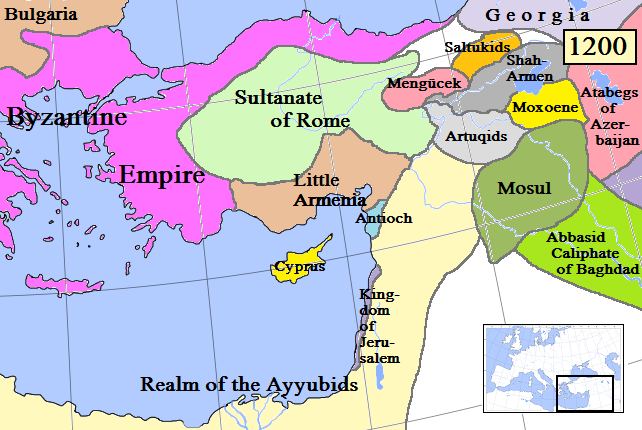
Suleiman II rallied his vassal emirs and marched against Georgia, with an army of 150,000–400,000 and encamped in the Basiani valley. Tamar of Georgia quickly marshaled an army throughout her possessions and put it under command of her consort, David Soslan. Georgian troops under Soslan made a sudden advance into Basiani and assailed the enemy's camp in 1203 or 1204. In a pitched battle, the Seljukid forces managed to roll back several attacks of the Georgians but were eventually overwhelmed and defeated. Loss of the sultan's banner to the Georgians resulted in a panic within the Seljuk ranks. Süleymanshah was wounded and withdrew to Erzurum. Both the Rum Seljuk and Georgian armies suffered heavy casualties, but coordinated flanking attacks won the battle for the Georgians.
Suleiman II died in 1204 and was succeeded by his son Kilij Arslan III, whose reign was unpopular. Kaykhusraw I seized Konya in 1205 reestablishing his reign. Under his rule and those of his two successors, Kaykaus I and Kayqubad I, Seljuk power in Anatolia reached its apogee. Kaykhusraw's most important achievement was the capture of the harbour of Attalia (Antalya) on the Mediterranean coast in 1207. His son Kaykaus captured Sinop and made the Empire of Trebizond his vassal in 1214. He also subjugated Cilician Armenia but in 1218 was forced to surrender Aleppo, acquired from al-Kamil. Ala Al-Din Kayqubad I continued to acquire lands along the Mediterranean coast from 1221 to 1225.
In the 1220s, he sent an expeditionary force across the Black Sea to Crimea. In the east he defeated the Mengujekids and began to put pressure on the Artuqids.
Mongol conquest
Main article: Mongol conquest of Anatolia

Kaykhusraw II (1237–1246) began his reign by capturing the region around Diyarbakır, but in 1239 he had to face an uprising led by a popular preacher named Baba Ishak. After three years, when he had finally quelled the revolt, the Crimean foothold was lost and the state and the sultanate's army had weakened. It is in these conditions that he had to face a far more dangerous threat, that of the expanding Mongols. The forces of the Mongol Empire took Erzurum in 1242 and in 1243, the sultan was crushed by Baiju in the Battle of Köse Dağ (a mountain between the cities of Sivas and Erzincan), resulting in the Seljuk Turks being forced to swear allegiance to the Mongols and became their vassals. The sultan himself had fled to Antalya after the battle, where he died in 1246; his death started a period of tripartite, and then dual, rule that lasted until 1260.
The Seljuk realm was divided among Kaykhusraw's three sons. The eldest, Kaykaus II (1246–1260), assumed the rule in the area west of the river Kızılırmak. His younger brothers, Kilij Arslan IV (1248–1265) and Kayqubad II (1249–1257), were set to rule the regions east of the river under Mongol administration. In October 1256, Bayju defeated Kaykaus II near Aksaray and all of Anatolia became officially subject to Möngke Khan. In 1260 Kaykaus II fled from Konya to Crimea where he died in 1279. Kilij Arslan IV was executed in 1265, and Kaykhusraw III (1265–1284) became the nominal ruler of all of Anatolia, with the tangible power exercised either by the Mongols or the sultan's influential regents.
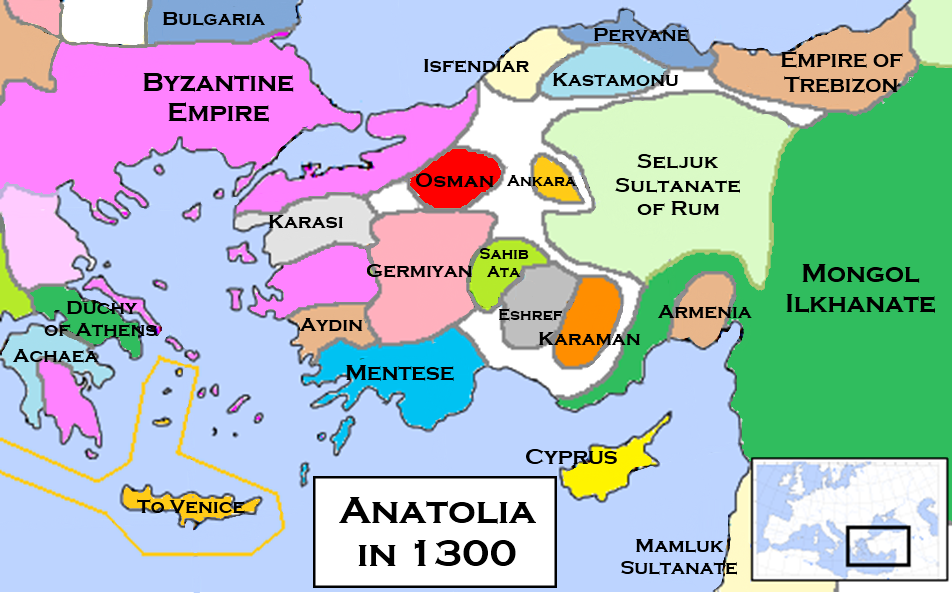
The Seljuk state had started to split into small emirates (beyliks) that increasingly distanced themselves from both Mongol and Seljuk control. In 1277, responding to a call from Anatolia, the Mamluk Sultan Baibars raided Anatolia and defeated the Mongols at the Battle of Elbistan, temporarily replacing them as the administrator of the Seljuk realm. Following the ensuing chaos, the Karamanids under Shams al-Din Mehmed managed to capture Konya, briefly installing Jimri as a puppet ruler of the Sultanate of Rum. Since the native forces who had called him to Anatolia did not manifest themselves for the defense of the land, Baibars soon had to return to his home base in Egypt, and the Mongol administration was re-assumed, officially and severely. Also, the Armenian Kingdom of Cilicia captured the Mediterranean coast from Selinos to Seleucia, as well as the cities of Marash and Behisni, from the Seljuk in the 1240s.
Near the end of his reign, Kaykhusraw III could claim direct sovereignty only over lands around Konya. Some of the beyliks (including the early Ottoman state) and Seljuk governors of Anatolia continued to recognize, albeit nominally, the supremacy of the sultan in Konya, delivering the khutbah in the name of the sultans in Konya in recognition of their sovereignty, and the sultans continued to call themselves Fahreddin, the Pride of Islam. When Kaykhusraw III was executed in 1284, the Seljuk dynasty suffered another blow from internal struggles which lasted until 1303 when the son of Kaykaus II, Mesud II, established himself as sultan in Kayseri. He was murdered in 1308 and his son Mesud III soon afterwards. A distant relative to the Seljuk dynasty momentarily installed himself as emir of Konya, but he was defeated and his lands conquered by the Karamanids in 1328. The sultanate's monetary sphere of influence lasted slightly longer and coins of Seljuk mint, generally considered to be of reliable value, continued to be used throughout the 14th century, once again, including by the Ottomans.
Culture and society
In Anatolia, a Turco-Persian cultural synthesis gradually emerged which, by the 13th century, came to define the intellectual and aesthetic life, to the point of Seljuk elites naming their sons with New Persian names. The Seljuks of Rum had made Turco-Persian tradition the culture of their court, and had inherited the tımar and tahrir methods of Persian statecraft from the Seljuk Empire, which they later passed on to the Ottomans. Despites such influences, Seljuk art remained essentially Central Asian in character.
As an expression of Turco-Persian culture, Rum Seljuks patronized Persian art, architecture, and literature. Unlike the Seljuk Empire, the Seljuk sultans of Rum had Persian names such as Kay Khosrow, Kay Kawad/Qobad, and Kay Kāvus. The bureaucrats and religious elite of their realm were generally Persian. In the 13th century, most Muslim inhabitants in major Anatolian urban hubs reportedly spoke Persian as their main language.
It was in the 13th century that the proneness of imitating Iran in terms of administration, religion and culture reached its zenith, encouraged by the major influx of Persian refugees fleeing Mongol invasions, who brought Persian culture with them and were instrumental in creating a "second Iran" in Anatolia. Iranian cultural, political, and literary traditions deeply influenced Anatolia in the early 13th century. The notable historian Ibn Bibi composed a six-volume Persian language poetic work called the Selçukname, modeled after the Shahnamah, which focused on the Seljuk sultans.

Despite their Turkic origins, the Seljuks used Persian for administrative purposes; even their histories, which replaced Arabic, were in Persian. Their usage of Turkish was hardly promoted at all. Even Sultan Kilij Arslan II, as a child, spoke to courtiers in Persian. Khanbaghi states the Anatolian Seljuks were even more Persianized than the Seljuks that ruled the Iranian plateau. Persian poetry was written by sultans Suleiman II, Kayqubad I, and Kaykhusraw II. Written documents used either Persian or Anatolian Turkic, but the army used the Turkic language exclusively.
The Rahat al-sudur, the history of the Great Seljuk Empire and its breakup, written in Persian by Muhammad bin Ali Rawandi, was dedicated to Sultan Kaykhusraw I. Even the Tārikh-i Āl-i Saldjūq, an anonymous history of the Sultanate of Rum, was written in Persian. The sultans of Rum were largely not educated in Arabic. This clearly limited the Arab influence, or at least the direct influence, to a relatively small degree. In contrast, Persian literature and Iranian influence expanded because most sultans and even a significant portion of the townspeople knew the language.
One of its most famous Persian writers, Rumi, took his name from the name of the state. Moreover, Byzantine influence in the Sultanate was also significant, since Byzantine Greek aristocracy remained part of the Seljuk nobility, and the native Byzantine (Rûm) peasants remained numerous in the region. Based on their genealogy, it appears that the Seljuk sultans favored Christian slave-concubines, just like the early Ottoman sultans. Within the Seljuk harem, Greek women were the most dominant.
In Anatolia, Turkic languages and culture were present, but they stayed at the edges of the Irano-Greek world, mainly kept alive by nomadic Turkic groups through oral tradition. Turkic culture held little prestige, and many viewed it as inferior. As a result, nobles and middle-class Turkic families (and possibly lower classes) often married into what was considered more "cultured" communities, learned Persian and Greek, and adopted urban customs to elevate their social standing. Some sultans merged Iranian and Greek identities by claiming to be the khusraw-i Yunan ("the Chosroes of Greece"). Cultural Turkification in Anatolia first started during the 14th-century, particularly during the gradual rise of the Ottomans. With a population that included Byzantine Greeks, Armenians, Kurds, Turks, and Persians, the Seljuks were very successful between 1220 and 1250 and set the groundwork for later Islamization of Anatolia.
From the 12th century onward, Western European chroniclers often referred to Anatolia and the Sultanate of Rum as Turchia, the predecessor of the name Turkey.
Architecture
Main article: Anatolian Seljuk architecture
.jpg)
Architectural styles of the Sultanate of Rum were rather eclectic. The walls of Konya in particular, built by Kayqubad I, adopted many western decorative elements, such as a statue of Hercules, a frieze from a Roman sarcophagus, courtly scenes with seated figures in toga, winged deities around the figure of the sun, mixed with inscriptions in Arabic. It would seem that such symbolism mixing Western and Eastern elements was mostly derived from the influence of the Artuqids, who were adept at combining Classical and Perso-Islamic approaches.
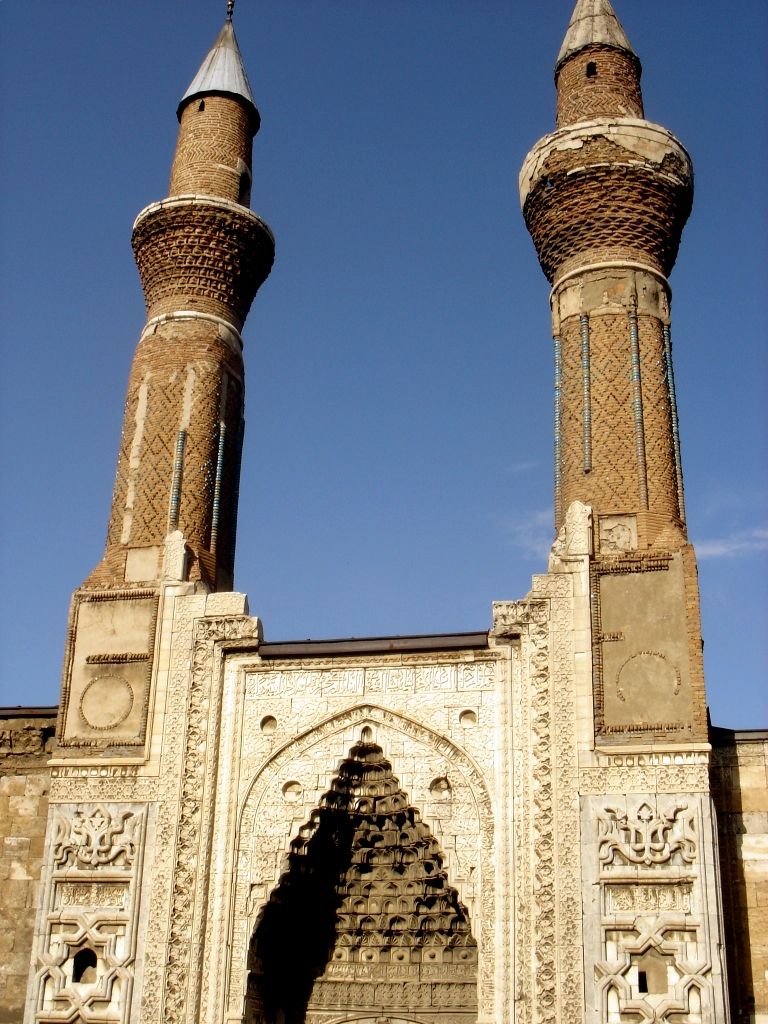
In their construction of caravanserais, madrasas and mosques, the Rum Seljuks translated the Iranian Seljuk architecture of bricks and plaster into the use of stone. Among these, the caravanserais (or hans), used as stops, trading posts and defense for caravans, and of which about a hundred structures were built during the Anatolian Seljuk period, are particularly remarkable. Along with Persian influences, which had an indisputable effect, Seljuk architecture was inspired by local Byzantine architects, for example in the Celestial Mosque in Sivas, and by Armenian architecture. Anatolian architecture represents some of the most distinctive and impressive constructions in the entire history of Islamic architecture. Later, this Anatolian architecture would be inherited by the Sultanate of India.
The largest caravanserai is the Sultan Han (built 1229) on the road between Konya and Aksaray, in Sultanhanı, covering 3900 m2. Two caravanserais carry the name Sultan Han, the other one being between Kayseri and Sivas. Furthermore, apart from Sultanhanı, five other towns across Turkey owe their names to caravanserais built there. These are Alacahan in Kangal, Durağan, Hekimhan and Kadınhanı, as well as the township of Akhan within the Denizli metropolitan area. The caravanserai of Hekimhan is unique in having, underneath the usual inscription in Arabic with information relating to the tower, two further inscriptions in Armenian and Syriac, since it was constructed by the sultan Kayqubad I's doctor (hekim), who is thought to have been a Christian convert to Islam.
There are other particular cases, like the settlement in Kalehisar contiguous to an ancient Hittite site near Alaca, founded by the Seljuk commander Hüsameddin Temurlu, who had taken refuge in the region after the defeat in the Battle of Köse Dağ and had founded a township comprising a castle, a madrasa, a habitation zone and a caravanserai, which were later abandoned apparently around the 16th century. All but the caravanserai, which remains undiscovered, was explored in the 1960s by the art historian Oktay Aslanapa, and the finds as well as several documents attest to the existence of a vivid settlement in the site, such as a 1463 Ottoman firman which instructs the headmaster of the madrasa to lodge not in the school but in the caravanserai.
The Seljuk palaces, as well as their armies, were staffed with ghilmān (), singular ghulam), slave-soldiers taken as children from non-Muslim communities, mainly Greeks from former Byzantine territories. The practice of keeping ghilmān may have offered a model for the later devşirme during the time of the Ottoman Empire.
Literature
_disguised_as_a_man,_watches_as_her_lover_Varqa_(centre)_and_his_rival_Rabi_fight_on_horseback.jpg)
The earliest known illustrated manuscript in the Persian language is an early 13th century copy of the epic Varka and Golshah, which was most probably created in Konya, under the Seljuk Sultanate of Rum. It can be dated to c.1250.
The miniatures represent typical Central Asian people, thickset with large round heads. They also provide rare depictions of the contemporary military of the Seljuk period, and may have influenced other known depictions of Turkic Seljuk soldiers. All depicted costumes and accoutrements are contemporary to the artist, in the 13th century. The miniatures constitute the first known example of illustrated Persian-language manuscript, dating from the pre-Mongol era, and are useful in studying weapons of the period. Particularly, metal face masks and chainmail helmets in Turkic fashion, and armor with small metal plates connected through straps, large round shields (the largest of them called "kite-shields") and long teardrop shields, armoured horses are depicted. The weapons and armour types depicted in the miniatures were common in the Middle East and the Caucasus in the Seljuk era.
Persian was the preferred language for literature, while Arabic remained the standard language for religious, scientific, and philosophical writing.
Numismatics
The earliest documented Rum Seljuq copper coins were made in the first part of the twelfth century in Konya and the eastern Anatolian emirates. Extensive numismatic evidence suggests that, starting in the middle of the thirteenth century and continuing until the end of the Seljuk dynasty, silver-producing mints and silver coinage flourished, particularly in central and eastern Anatolia.
.jpg)
Most of Kilij Arslan II's coins were minted in Konya between 1177–78 and 1195, with a small amount also occurring in Sivas, which the Rum Seljuks conquered from the Danishmendids. Sivas may have started minting coins in 1185–1186. The majority of Kılıj Arslan II's coins are silver dirhams; however, there are also a few dinars and one or two fulūs (small copper coins) issues. Following his death the sultanate was divided among his sons. Muhyiddin Mesut, son of Kilij Arslan II, minted coins in the northwesterly cities of Ankara, Çankırı, Eskişehir, and Kaztamunu from 1186 to 1200. Tughril ibn Kılıç Arslan II's reign in Erzurum, another son of Kilij Arslan II, minted silver dirhams in 1211–1212.
_Astrological_Device_(Sun-Lion)_dated_638_AH_(1240–41_CE).jpg)
The sun-lion and the equestrian are the two central motifs in the Rum Seljuq numismatic figural repertoire. The image of a horseman with two more arrows ready and his bow taut represents strength and control and is a representation of the ideal Seljuq king of the Great Age. The image initially appeared on Rum Seljuq copper coins in the late eleventh century. The first to add equestrian iconography to silver and gold coins was Suleiman II of Rûm. Antalya minted coins with Kaykaus I's name from November 1261 to November 1262. Between 1211 and 1219, the bulk of his coins are minted at Konya and Sivas.
A significant portion of the Islamic Near East may have experienced a "silver famine" owing to little, or very little, silver mintings from the eleventh and most of the twelfth centuries. However, at the start of the thirteenth century a "silver flood" occurred in Rum Seljuq territory when Anatolian silver mines were discovered. The fineness of Rum Seljuq dirhams is similar to that of dinars; frequently, both were struck using the same dies. The Seljuq silver coinage's superior quality and prominence contributed to the dynasty's affluence throughout the early part of the thirteenth century and explains why it served as a kind of anchor for the local "currency community." The Empire of Trebizond and Armenian Kingdom of Cilicia silver coins were modeled after the fineness and weight specifications of Rum Seljuq coins.
Dynasty

As regards with the names of the sultans, there are variants in form and spelling depending on the preferences displayed by one source or the other, either for fidelity in transliterating the Persian variant of the Arabic script which the sultans used, or for a rendering corresponding to the modern Turkish phonology and orthography. Some sultans had two names that they chose to use alternatively in reference to their legacy. While the two palaces built by Alaeddin Keykubad I carry the names Kubadabad Palace and Keykubadiye Palace, he named his mosque in Konya as Alâeddin Mosque and the port city of Alanya he had captured as "Alaiye". Similarly, the medrese built by Kaykhusraw I in Kayseri, within the complex (külliye) dedicated to his sister Gevher Nesibe, was named Gıyasiye Medrese, and the one built by Kaykaus I in Sivas as Izzediye Medrese.
| Sultan | Reign | Notes |
|---|---|---|
| 1. Qutalmish | 1060–1064 | Contended with Alp Arslan for succession to the Imperial Seljuk throne. |
| 2. Suleiman ibn Qutulmish | 1075–1077 de facto rules Turkmen around İznik and İzmit; | |
| 1077–1086 recognised Sultan of Rûm by Malik-Shah I of the Great Seljuks | Founder of Anatolian Seljuk Sultanate with capital in İznik | |
| 3. Kilij Arslan I | 1092–1107 | First sultan in Konya |
| 4. Malik Shah | 1107–1116 | |
| 5. Mesud I | 1116–1156 | |
| 6. 'Izz al-Din Kilij Arslan II | 1156–1192 | |
| 7. Ghiyath al-Din Kaykhusraw I | 1192–1196 | First reign |
| 8. Rukn al-Din Suleiman II | 1196–1204 | |
| 9. Kilij Arslan III | 1204–1205 | |
| (7.) Ghiyath al-Din Kaykhusraw I | 1205–1211 | Second reign |
| 10. 'Izz al-Din Kayka'us I | 1211–1220 | |
| 11. 'Ala al-Din Kayqubad I | 1220–1237 | |
| 12. Ghiyath al-Din Kaykhusraw II | 1237–1246 | After his death, sultanate split until 1260 when Kilij Arslan IV remained the sole ruler |
| 13. 'Izz al-Din Kayka'us II | 1246–1262 | |
| 14. Rukn al-Din Kilij Arslan IV | 1249–1266 | |
| 15. 'Ala al-Din Kayqubad II | 1249–1254 | |
| 16. Ghiyath al-Din Kaykhusraw III | 1266–1284 | |
| 17. Ghiyath al-Din Masud II | 1282–1296 | First reign |
| 18. 'Ala al-Din Kayqubad III | 1298–1302 | |
| (17.) Ghiyath al-Din Masud II | 1303–1308 | Second reign |
Family tree
The colors of the boxes are as follows
: : : |
Comparative genealogy
| The comparative genealogy of the Sultanate of Rûm with their contemporary neighbors in Central Asia |
|---|
Notes
Footnotes
References
Sources
References
- Özaydın, Abdülkerim. (2020-12-29). "Büyük Selçuklular’ın Hizmetinde Bir Aile: Porsukoğulları". Tarih Dergisi.
- A.C.S. Peacock and Sara Nur Yildiz, ''The Seljuks of Anatolia: Court and Society in the Medieval Middle East'', (I. B. Tauris, 2015), 265.
- Grousset, Rene, ''The Empire of the Steppes: A History of Central Asia'', (Rutgers University Press, 2002), 157; "...the Seljuk court at Konya adopted Persian as its official language."
- Bernard Lewis, ''Istanbul and the Civilization of the Ottoman Empire'', (University of Oklahoma Press, 1963), 29; "The literature of Seljuk Anatolia was almost entirely in Persian...".
- Andrew Peacock and Sara Nur Yildiz, ''The Seljuks of Anatolia: Court and Society in the Medieval Middle East'', (I. B. Tauris, 2013), 132; "''The official use of the Greek language by the Seljuk chancery is well known''".
- Koprulu, Mehmed Fuad. (2006). "Early Mystics in Turkish Literature".
- Beihammer, Alexander Daniel (2017). ''Byzantium and the Emergence of Muslim-Turkish Anatolia, ca. 1040–1130''. New York: Routledge. p. 15.
- (1 January 1992). "The Origins of the Ottoman Empire". State University of New York Press.
- (29 October 1976). "History of the Ottoman Empire and Modern Turkey: Volume 1, Empire of the Gazis: The Rise and Decline of the Ottoman Empire 1280-1808". Cambridge University Press.
- Everett-Heath, John. (2018). "The Concise Dictionary of World Place-Names". Oxford University Press.
- John Joseph Saunders, ''The History of the Mongol Conquests'' (University of Pennsylvania Press, 1971), 79.
- A.C.S. Peacock and Sara Nur Yildiz, ''The Seljuks of Anatolia: Court and Society in the Medieval Middle East'', (I.B. Tauris, 2015), 12.
- Sicker, Martin, ''The Islamic world in ascendancy: from the Arab conquests to the siege of Vienna'', (Greenwood Publishing Group, 2000), 63–64.
- A.C.S. Peacock and Sara Nur Yildiz, ''The Seljuks of Anatolia: Court and Society in the Medieval Middle East'', (I.B. Tauris, 2015), 72.
- Sicker, Martin, ''The Islamic world in ascendancy: from the Arab conquests to the siege of Vienna '', (Greenwood Publishing Group, 2000), 65.
- (2002). "Historical atlas of the Crusades". New York : Checkmark Books.
- (1980). "The Art and architecture of Turkey". New York : Rizzoli.
- A.C.S. Peacock and Sara Nur Yildiz, ''The Seljuks of Anatolia: Court and Society in the Medieval Middle East'', (I.B. Tauris, 2015), 73.
- ''Anatolia in the period of the Seljuks and the "beyliks"'', Osman Turan, ''The Cambridge History of Islam'', Vol. 1A, ed. P.M. Holt, Ann K.S. Lambton and Bernard Lewis, (Cambridge University Press, 1995), 244–245.
- A.C.S. Peacock and Sara Nur Yildiz, ''The Seljuks of Anatolia: Court and Society in the Medieval Middle East'', (I.B. Tauris, 2015), 29.
- Alexander Mikaberidze, ''Historical Dictionary of Georgia'', (Rowman & Littlefield, 2015), 184.
- Claude Cahen, ''The Formation of Turkey: The Seljukid Sultanate of Rum: Eleventh to Fourteenth'', transl. & ed. P.M. Holt, (Pearson Education Limited, 2001), 42.
- A.C.S. Peacock, [https://www.jstor.org/stable/25188622 "The Saliūq Campaign against the Crimea and the Expansionist Policy of the Early Reign of'Alā' al-Dīn Kayqubād"], ''Journal of the Royal Asiatic Society'', Vol. 16 (2006), pp. 133–149.
- (2005). "Turks: a journey of a thousand years, 600-1600". Royal Academy of Arts ; Distributed in the U.S. and Canada by Harry N. Abrams.
- Rudi Paul Lindner, ''Explorations in Ottoman Prehistory'', (University of Michigan Press, 2003), 3.
- (2005). "Turks: a journey of a thousand years, 600-1600". Royal Academy of Arts ; Distributed in the U.S. and Canada by Harry N. Abrams.
- (1986). "Traditional Turkish Arts: Tiles and ceramics". General Directorate of Fine Arts, Ministry of Culture and Tourism,Turkish Republic.
- (1980). "The Art and architecture of Turkey". New York : Rizzoli.
- "KUBAD ABAD: Beyşehir Gölü Kıyısında Bir Selçuklu Sitesi". Konya Büyükşehir Belediyesi Kültür Yayınları.
- Yemelianova, Galina M.. (2025). "Turkism in Eurasia: Identity, Ideology and Politics". I.B. Tauris.
- Nassiri, Giv. (2002). "Turco-Persian Civilization and the Role of Scholars’ Travel and Migration in its Elaboration and Continuity". University of California.
- Lewis, Bernard. "Istanbul and the Civilization of the Ottoman Empire".
- Grousset, Rene. (1931). "Civilizations of the East". Hamish Hamilton.
- (2005). "Turks: a journey of a thousand years, 600-1600". Royal Academy of Arts ; Distributed in the U.S. and Canada by Harry N. Abrams.
- {{harvnb. Hillenbrand. 2021
- (2005). "The Turks in World History". Oxford University Press, USA.
- (2005). "Turks: a journey of a thousand years, 600-1600". Royal Academy of Arts ; Distributed in the U.S. and Canada by Harry N. Abrams.
- (2005). "Turks: a journey of a thousand years, 600-1600". Royal Academy of Arts ; Distributed in the U.S. and Canada by Harry N. Abrams.
- Shukurov, Rustam. (2011). "Identities and Allegiances in the Eastern Mediterranean After 1204". Ashgate Publishing, Ltd..
- Korobeinikov, Dimitri. (2007). "Eat, Drink, and be Merry (Luke 12:19): Food and Wine in Byzantium: Papers of the 37th Annual Spring Symposium of Byzantine Studies, in Honour of Professor A.A.M. Bryer". Ashgate Publishing, Ltd..
- A.C.S. Peacock and Sara Nur Yildiz, ''The Seljuks of Anatolia: Court and Society in the Medieval Middle East'', (I.B. Tauris, 2015), 121.
- (1968). "Pre-Ottoman Turkey: A General Survey of the Material and Spiritual Culture and History, 1071–1330". Taplinger.
- (2010). "The Cambridge History of Turkey, Volume 1: Byzantium to Turkey, 1071–1453". Cambridge University Press.
- (1 January 2012). "‘ALA AL-DIN KAYQUBAD ILLUMINATED: A RUM SELJUQ SULTAN AS COSMIC RULER". Muqarnas Online.
- (1 January 2012). "‘ALA AL-DIN KAYQUBAD ILLUMINATED: A RUM SELJUQ SULTAN AS COSMIC RULER". Muqarnas Online.
- (2004). "Atlas of World Art". Laurence King Publishing.
- ''Architecture (Muhammadan)'', H. Saladin, ''Encyclopaedia of Religion and Ethics'', Vol.1, Ed. James Hastings and John Alexander, (Charles Scribner's son, 1908), 753.
- ''Armenia during the Seljuk and Mongol Periods'', Robert Bedrosian, ''The Armenian People From Ancient to Modern Times: The Dynastic Periods from Antiquity to the Fourteenth Century'', Vol. I, Ed. Richard Hovannisian, (St. Martin's Press, 1999), 250.
- ''Lost in Translation: Architecture, Taxonomy, and the "Eastern Turks"'', Finbarr Barry Flood, ''Muqarnas: History and Ideology: Architectural Heritage of the "Lands of Rum'', 96.
- Rodriguez, Junius P.. (1997). "The Historical Encyclopedia of World Slavery". ABC-CLIO.
- (1979). "Oriental Armour of the Near and Middle East from the Eighth to the Fifteenth Centuries as Shown in Works of Art (in Islamic Arms and Armour)". Robert Elgood.
- (July–August 2015). "The miniatures of the manuscript "Varka and Gulshah" as a source for the study of weapons of XII–XIII centuries in Azerbaijan". Austrian Journal of Humanities and Social Sciences.
- (2023). "Under the adorned dome: four essays on the arts of Iran and India". Brill.
- {{harvnb. Hillenbrand. 2021
- (19 January 2020). "Islamic Calligraphy". Edinburgh University Press.
- (1 October 2009). "Muqarnas". BRILL.
- (14 May 2009). "Grove Encyclopedia of Islamic Art & Architecture: Three-Volume Set". OUP USA.
- (1977). "Arab painting". New York : Rizzoli.
- (1975). "An Illustrated Persian Text of Kalīla and Dimna Dated 707/1307-8". The British Library Journal.
- (1977). "Arab painting". New York : Rizzoli.
- (1979). "Oriental Armour of the Near and Middle East from the Eighth to the Fifteenth Centuries as Shown in Works of Art (in Islamic Arms and Armour)". Robert Elgood.
- {{harvnb. Canby. Beyazit. Rugiadi. Peacock. 2016
- {{harvnb. Canby. Beyazit. Rugiadi. Peacock. 2016
- "Dirham of Ghiyath al-Din Kai Khusrau II (r. 1239–46); Astrological Device (Sun-Lion)". The Metropolitan Museum of Art.
- (1993). "Thirteenth-Century Rum Seljuq Palaces and Palace Imagery". Ars Orientalis.
- Râvendî, Muhammed b. Ali, ''Râhatü’s-sudûr,'' (Ateş Publications), vol. I, p. 85.
- Müstevfî, ''Târîḫ-i Güzîde,'' (Nevâî Publications), p. 426.
- Zahîrüddîn-i Nîsâbûrî, ''[[:tr:Selçuknâme. Selcûḳnâme]],'' (Muhammed Ramazânî Publications), [[Tahran]] 1332, p. 10.
- [[Rashid-al-Din Hamadani. Reşîdüddin Fazlullāh-ı Hemedânî]], ''[[Jāmiʿ al-Tawārīkh. Câmiʿu’t-tevârîḫ]],'' (Ahmed Ateş Publications), [[Ankara]] 1960, vol. II/5, p. 5.
- Osman Gazi Özgüdenli. (2016). "MÛSÂ YABGU". [[Diyanet.
- Beyhakī, ''Târîḫ,'' (Behmenyâr), p. 71.
- Osman Gazi Özgüdenli. "MÛSÂ YABGU".
- Faruk Sümer. (2002). "KUTALMIŞ". [[Diyanet.
- Sevim, Ali. (2010). "SÜLEYMAN ŞAH I". [[Diyanet.
- Sümer, Faruk. (2009). "ANADOLU SELÇUKLULARI". [[Diyanet.
- Özaydın, Abdülkerim. (2002). "KAVURD BEY". [[Diyanet.
- Sevim, Ali. "ÇAĞRI BEY".
- Sümer, Faruk. "SELÇUKLULAR".
- Sümer, Faruk. (2009). "Kirman Selçuks". [[Diyanet.
- Sümer, Faruk. (2009). "SELÇUKLULAR". [[Diyanet.
- Bezer, Gülay Öğün. "TERKEN HATUN, the mother of MAHMÛD I".
- Özaydın, Abdülkerim. "MELİKŞAH".
- Özaydın, Abdülkerim. "BERKYARUK".
- [[Enveri. Enverî]], ''Düstûrnâme-i Enverî,'' pp. 78-80, 1464.
- Özaydın, Abdülkerim. "MAHMÛD b. MUHAMMED TAPAR".
- Sümer, Faruk. "TUĞRUL I".
- Sümer, Faruk. "MES‘ÛD b. MUHAMMED TAPAR".
- Sümer, Faruk. "Ebû Tâlib TUĞRUL b. ARSLANŞAH b. TUĞRUL".
- Sümer, Faruk. "ARSLANŞAH b. TUĞRUL".
- Sümer, Faruk. "IRAK SELÇUKLULARI".
This article was imported from Wikipedia and is available under the Creative Commons Attribution-ShareAlike 4.0 License. Content has been adapted to SurfDoc format. Original contributors can be found on the article history page.
Ask Mako anything about Sultanate of Rum — get instant answers, deeper analysis, and related topics.
Research with MakoFree with your Surf account
Create a free account to save articles, ask Mako questions, and organize your research.
Sign up freeThis content may have been generated or modified by AI. CloudSurf Software LLC is not responsible for the accuracy, completeness, or reliability of AI-generated content. Always verify important information from primary sources.
Report