From Surf Wiki (app.surf) — the open knowledge base
Sultan of Egypt
Status held by the rulers of Egypt from 1174 to 1517, 1523 to 1524 and 1914 to 1922
.JPG)
Status held by the rulers of Egypt from 1174 to 1517, 1523 to 1524 and 1914 to 1922
| Field | Value |
|---|---|
| royal_title | Sultan |
| realm | Egypt |
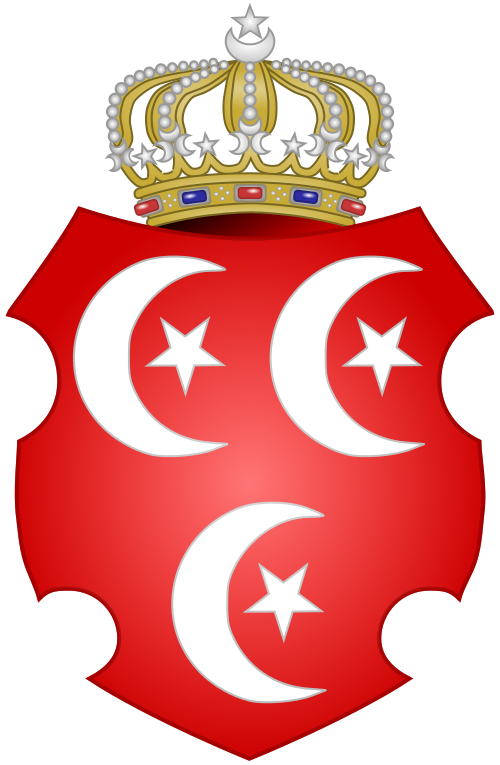
| coatofarms | Coat of Arms of the Sultan of Egypt.svg |
| coatofarmssize | 90px |
| coatofarmscaption | Royal Standard of Egypt |
| image | Consellor.jpg |
| caption | 1799 painting of a counsellor to the Sultan |
| style | His Majesty |
| residence | Cairo Citadel, Cairo, Egypt |
| appointer | Hereditary |
| began | 1174 |
| Precursor: Pharaoh | |
| ended | 15 March 1922 |
| Successor: King of Egypt |
Precursor: Pharaoh Successor: King of Egypt
Sultan of Egypt was the status held by the rulers of Egypt after the establishment of the Ayyubid dynasty of Saladin in 1174 until the Ottoman conquest of Egypt in 1517. Though the extent of the Egyptian Sultanate ebbed and flowed, it generally included Sham and Hejaz, with the consequence that the Ayyubid and later Mamluk sultans were also regarded as the Sultans of Syria. From 1914, the title was once again used by the heads of the Muhammad Ali dynasty of Egypt and Sudan, later being replaced by the title of King of Egypt and Sudan in 1922.
Ayyubid dynasty
Main article: Ayyubid dynasty
Prior to the rise of Saladin, Egypt was the center of the Shia Fatimid Caliphate, the only period in Islamic history when a caliphate was ruled by members of the Shia branch of Islam. The Fatimids had long sought to completely supplant the Sunni Abbasid Caliphate based in Iraq, and like their Abbasid rivals, they also took the title Caliph, representing their claim to the highest status within the Islamic hierarchy. However, with Saladin's rise to power in 1169, Egypt returned to the Sunni fold and the Abbasid Caliphate. Recognizing the Abbasid Caliph as his theoretical superior, Saladin took the title of Sultan in 1174, though from this point until the Ottoman conquest, supreme power in the caliphate would come to rest with the Sultan of Egypt.
Mamluk dynasties
Main article: Mamluk Sultanate
In 1250, the Ayyubids were overthrown by the Mamluks, who established the Bahri dynasty and whose rulers also took the title sultan. Notable Bahri sultans include Qutuz, who defeated the invading Mongol army of Hulagu at the Battle of Ain Jalut, and Baibars, who finally recaptured the last remnants of the Crusader Kingdom of Jerusalem. The Bahri were later overthrown by a rival Mameluke group, who established the Burji dynasty in 1382.
Egypt Eyalet and autonomous Khedivate
Main article: Egypt Eyalet, Khedivate of Egypt
The Ottoman conquest of Egypt in 1517 ended the Egyptian Sultanate, with Egypt henceforth a province of the Ottoman Empire. It also marked the end of the Mamluk Abbasid dynasty, as the Ottomans captured the current Caliph Al-Mutawakkil III, and forced him to relinquish the title to the Ottoman Sultan Selim I. The Ottomans subsequently paid little interest to Egyptian affairs, and the Mamelukes rapidly regained most of their power within Egypt. However, they remained vassals of the Ottoman Sultan and their leaders were limited to the title of Bey.
In 1523, the Ottoman-appointed Turkish governor of Egypt, Hain Ahmed Pasha, declared himself the Sultan of Egypt and Egypt independent from the Ottoman Empire. He struck his own coins to legitimize his rule, but soon thereafter, Ottoman forces under Pargalı Ibrahim Pasha captured him and executed him, with Ibrahim Pasha assuming the governorship until he found a more permanent replacement, Hadım Süleyman Pasha.
Following the defeat of Napoleon I's forces in 1801, Muhammad Ali Pasha seized power, overthrowing the Mamelukes, and declaring himself ruler of Egypt. In 1805, the Ottoman Sultan Selim III reluctantly recognized him as Wāli under Ottoman suzerainty. Muhammad Ali, however, styled himself as Khedive, and though technically a vassal of the Ottoman Empire, governed Egypt as if it were an independent state. Seeking to rival and ultimately supplant the Ottoman Sultan, Muhammad Ali implemented a rapid modernization and militarization program, and expanded Egypt's borders south into Sudan and north into Syria. Eventually, he waged war on the Ottoman Empire with the intention of overthrowing the ruling Osman Dynasty and replacing it with his own. Though the intervention of the Great Powers prevented Muhammad Ali from realizing his grandiose ambitions of becoming sultan himself, obliging Egypt to remain technically part of the Ottoman Empire, Egypt's autonomy survived his death with the Porte recognizing the Muhammad Ali Dynasty as hereditary rulers of the country.

Muhammad Ali's grandson, Ismail I, acceded to the Egyptian throne in 1863 and immediately set about achieving his grandfather's aims, though in a less confrontation manner. A combination of growing Egyptian power, deteriorating Ottoman strength, and outright bribery led to Ottoman Sultan Abdulaziz formally recognizing the Egyptian ruler as Khedive in 1867. As Ismail expanded Egypt's borders in Africa, and the Ottoman Empire continued to decay, Ismail believed he was close to realizing formal Egyptian independence, and even contemplated using the opening of the Suez Canal in 1869 to declare himself Sultan of Egypt. He was persuaded otherwise by pressure from the Great Powers, who feared the consequences of further disintegration of Ottoman power. Ultimately, Ismail's reign ended in failure, due to the massive debt his ambitious projects had incurred. European and Ottoman pressure forced his removal in 1879 and replacement by his far more pliant son Tewfik. The subsequent Orabi Revolt resulted in Great Britain invading Egypt in 1882 on the invitation of Khedive Tewfik, and beginning its decades long occupation of the country.
Restoration of Egyptian Sultanate
Main article: Sultanate of Egypt
From 1882 onwards, Egypt's status became deeply convoluted: officially a province of the Ottoman Empire, semi-officially a virtually independent state with its own monarchy, armed forces, and territorial possessions in Sudan, and for practical purposes a British puppet. The legal fiction of Ottoman sovereignty in Egypt was finally ended in 1914 when the Ottoman Empire joined the Central Powers in First World War. Alarmed that the anti-British Khedive Abbas II would side with the Ottomans, the British deposed him in favor of his uncle Hussein Kamel and declared Egypt a British protectorate. Symbolizing the official end of Ottoman rule, Hussein Kamel took the title Sultan as did his brother Fuad I who succeeded him in 1917, though in reality Egypt remained under British domination. Both Hussein Kamel and Fuad maintained Egypt's claim to Sudan, with Egyptian nationalists declaring both in turn to be the "Sultan of Egypt and Sudan".
Rising nationalist anger at the continued British occupation forced Britain to formally recognize Egyptian independence, in 1922. However, the title of Sultan was dropped and replaced with King. Nationalist leader Saad Zaghlul, who was later exiled by the British, maintained that this was because the British refused to recognize a sovereign Egyptian ruler who outranked their own king (in the hierarchy of titles, sultan, like shah in Iran, is comparable to emperor, being a sovereign who recognizes no secular superior). Another reason offered for the change in title is that it reflected the growing secularization of Egypt at the time, as sultan has Islamic overtones, whereas the Arabic word for king, malik, does not.
Upon overthrowing Fuad's son, King Farouk I, in the Egyptian revolution of 1952, the Free Officers briefly considered declaring his infant son Sultan to reinforce Egypt's sovereignty over Sudan and demonstrate their rejection of British occupation. However, since the revolutionaries had already decided to abolish the Egyptian monarchy after a brief period of consolidating their hold on power, they determined that it would be an idle gesture and Farouk's son was duly declared King Fuad II. The following year, on 18 June 1953, the revolutionary government officially abolished the monarchy and Egypt became a republic.
List of Sultans
Ayyubid Dynasty
- Saladin (1171–1193)
- Al-Aziz (1193–1198)
- Al-Mansur (1198–1200)
- Al-Adil I (1200–1218)
- Al-Kamil (1218–1238)
- Al-Adil II (1238–1240)
- As-Salih Ayyub (1240–1249)
- Turanshah (1249–1250)
- Shajar al-Durr (1250–1250)
- Al-Ashraf II (1250–1254) (nominally, actually the Mamluk Aybak ruled)
Bahri Dynasty
| Number | Royal title | Name | Reign start | Reign end | Ethnicity | Background notes | Coinage | ||||||||
|---|---|---|---|---|---|---|---|---|---|---|---|---|---|---|---|
| 1st | Al-Malik al-Mu'izz | Izz ad-Din Aybak | 31 July 1250 | 10 April 1257 | Turkmen | Middle-ranking mamluk of Ayyubid sultan as-Salih Ayyub. Married the latter's widow, Shajar ad-Durr, who became sultan on 2 May 1250 until she abdicated in favor of Aybak. | [[File:Silver dirham of Aybak.jpg | 100x100px]] | |||||||
| 2nd | Al-Malik al-Mansur | Nur ad-Din Ali | last1=Stewart | first1=John | title=African States and Rulers | date=2006 | publisher=McFarland & Company | isbn=9780786425624 | url=https://books.google.com/books?id=I7UUAQAAIAAJ&q=%2215+April+1257%22 | page=86}} | November 1259 | Turkmen | Son of Aybak. | [[File:Gold dinar of al-Mansur Nur ad-Din Ali.jpg | 100x100px]] |
| 3rd | Al-Malik al-Muzaffar | Sayf ad-Din Qutuz | November 1259 | 24 October 1260 | Khwarazmian Turk | A mamluk of Aybak and head of Aybak's mamluk faction, the Mu'izziya, Aybak's chief deputy, and strongman of Ali's sultanate. | [[File:Qutuz gold dinar obverse.jpg | 100x100px]] | |||||||
| 4th | Al-Malik az-Zahir | Rukn ad-Din Baybars | 24 October 1260 | 1 July 1277 | Kipchak Turk | Bahri mamluk and founder of the Bahri dynasty. | [[File:Egitto, califfo al baybars, dinar mamelucco, 1260-1277.JPG | 100x100px]] | |||||||
| 5th | Al-Malik as-Sa'id | Nasir ad-Din Barakah | 3 July 1277 | August 1279 | Kipchak Turk | Son of Baybars and his wife, who was the daughter of Husam ad-Din Baraka Khan, a Khwarazmian warrior chief, after whom Barakah was named. | [[File:Barakah coin.jpg | 100x100px]] | |||||||
| 6th | Al-Malik al-Adil | Badr ad-Din Salamish | August 1279 | November 1279 | Kipchak Turk | Son of Baybars. | |||||||||
| 7th | Al-Malik al-Mansur | Sayf ad-Din Qalawun | November 1279 | 10 November 1290 | Kipchak Turk | Bahri mamluk and Baybars' chief deputy | [[File:Silver dirham of Sultan Qalawun.jpg | 100x100px]] | |||||||
| 8th | Al-Malik al-Ashraf | Salah ad-Din Khalil | 12 November 1290 | 12 December 1293 | Kipchak Turk | Son of Qalawun. | [[File:Ashraf Khalil coin.jpg | 100x100px]] | |||||||
| 9th | Al-Malik an-Nasir | Nasir ad-Din Muhammad | 14 December 1293 | December 1294 | Kipchak Turk | Son of Qalawun. First reign. | [[File:Gold dinar of an-Nasir Muhammad.jpg | 100x100px]] | |||||||
| 10th | Al-Malik al-Adil | Zayn ad-Din Kitbugha | December 1294 | 7 December 1296 | Mongol | A mamluk of Qalawun. | [[File:Mamluk Kitbugha copper fals 1294 1296.jpg | 100x100px]] | |||||||
| 11th | Al-Malik al-Mansur | Husam ad-Din Lajin | 7 December 1296 | 16 January 1299 | Circassian | Yosef | 2012 | p=396}} | [[File:Gold dinar of Lajin.jpg | 100x100px]] | |||||
| 12th | Al-Malik an-Nasir | Nasir ad-Din Muhammad | 16 January 1299 | March 1309 | Kipchak Turk | Second reign. | [[File:Gold dinar of an-Nasir Muhammad.jpg | 100x100px]] | |||||||
| 13th | Al-Malik al-Muzaffar | Rukn ad-Din Baybars al-Jashnakir | April 1309 | 5 March 1310 | Circassian | A mamluk of Qalawun. Relative to Husam ad-Din Lajin | |||||||||
| 14th | Al-Malik an-Nasir | Nasir ad-Din Muhammad | 5 March 1310 | 6 June 1341 | Kipchak Turk | Third reign. | [[File:Gold dinar of an-Nasir Muhammad.jpg | 100x100px]] | |||||||
| 15th | Al-Malik al-Mansur | Sayf ad-Din Abu Bakr | 8 June 1341 | August 1341 | Kipchak Turk | Son of an-Nasir Muhammad and his concubine Narjis. Real power in Abu Bakr's sultanate was held by Qawsun, a mamluk and senior emir of an-Nasir Muhammad. | |||||||||
| 16th | Al-Malik al-Ashraf | Ala'a ad-Din Kujuk | August 1341 | 21 January 1342 | Kipchak Turk and Tatar | Son of an-Nasir Muhammad and his Tatar concubine Ardu. An infant when he was made sultan by strongman Qawsun. | |||||||||
| 17th | Al-Malik an-Nasir | Shihab ad-Din Ahmad | 21 January 1342 | 27 June 1342 | Kipchak Turk | Son of an-Nasir Muhammad and his concubine Bayad, a freed slave girl. | |||||||||
| 18th | Al-Malik as-Salih | Imad ad-Din Abu'l Fida Isma'il | 27 June 1342 | wstitle= Egypt/3 History | volume= 09 | pages = 80–130; see pages 101 to 103 | quote=Decline of the Bahri power}} | Kipchak Turk | Son of an-Nasir Muhammad and one of his concubines, unnamed by the sources. | ||||||
| 19th | Al-Malik al-Kamil | Sayf ad-Din Sha'ban | 3 August 1345 | 18 September 1346 | Kipchak Turk | Son of an-Nasir Muhammad and one of his concubines, unnamed by the sources (same mother of as-Salih Isma'il). | |||||||||
| 20th | Al-Malik al-Muzaffar | Sayf ad-Din Hajji | 18 September 1346 | 10 December 1347 | Kipchak Turk | Son of an-Nasir Muhammad and one of his other unnamed concubines. | [[File:Copper fals of Muzaffar Hajji.jpg | 100x100px]] | |||||||
| 21st | Al-Malik an-Nasir | Badr ad-Din Hasan | December 1347 | 21 August 1351 | Kipchak Turk | Son of an-Nasir Muhammad and his concubine Kuda, who died in Hasan's infancy. First reign. Hasan acceded to the sultanate as a young child and real power was shared by four senior emirs, Shaykhu an-Nasiri, Taz an-Nasiri, Manjak al-Yusufi and Baybugha al-Qasimi. Hasan was toppled when he challenged their power. | [[File:Copper fals of an-Nasir Hasan.jpg | 100x100px]] | |||||||
| 22nd | Al-Malik as-Salih | Salah ad-Din Salih | 21 August 1351 | 20 October 1354 | Kipchak Turk | Son of an-Nasir Muhammad and his wife Qutlumalik, daughter of Emir Tankiz al-Husami. | [[File:Copper fals of as-Salih Salih.jpg | 100x100px]] | |||||||
| 23rd | Al-Malik an-Nasir | Badr ad-Din Hasan | 20 October 1354 | 16 March 1361 | Kipchak Turk | Second reign. He was killed by Emir Yalbugha al-Umari. | [[File:Copper fals of an-Nasir Hasan.jpg | 100x100px]] | |||||||
| 24th | Al-Malik al-Mansur | Salah ad-Din Muhammad | 17 March 1361 | 29 May 1363 | Kipchak Turk | Son of Hajji. Real power was held by Emir Yalbugha al-Umari, who toppled him. | [[File:Dinar LACMA M.2006.143.8 (1 of 2).jpg | 100x100px]] | |||||||
| 25th | Al-Malik al-Ashraf | Zayn ad-Din Sha'ban (Sha'ban II) | 29 May 1363 | 15 March 1377 | Kipchak Turk | Son of al-Amjad Husayn (d. 21 January 1363), the last surviving son of an-Nasir Muhammad who never reigned, and Khawand Baraka. | [[File:Mamluk Shaban II copper fals Hama.jpg | 100x100px]] | |||||||
| 26th | Al-Malik al-Mansur | Ala'a ad-Din Ali | 15 March 1377 | 19 May 1381 | Kipchak Turk | Son of Sha'ban II. Was an infant during his accession, and real power was initially held by emirs Ibek and Qartay until the latter was ousted by the former. Ibek was later killed and power passed to Barquq, a former mamluk of Yalbugha an-Nasiri. | [[File:M56 fals Bahrites 1ar85 (8594902625).jpg | 100x100px]] | |||||||
| 27th | Al-Malik as-Salih | Salah ad-Din Hajji | 19 May 1381 | 26 November 1382 | Kipchak Turk | Son of al-Ashraf Sha'ban. Was an infant during his succession and real power was held by Barquq. | [[File:Mamluk Haji II copper fals 1382.jpg | 100x100px]] |
Burji Dynasty
| Number | Royal title | Name | Reign start | Reign end | Ethnicity | Background notes | Coinage | |
|---|---|---|---|---|---|---|---|---|
| 28th | Al-Malik az-Zahir | Sayf ad-Din Barquq | 26 November 1382 | 1 June 1389 | Circassian | A mamluk of Yalbugha al-Umari. Son of Anas, who was brought to Egypt by Barquq in 1381 and converted to Islam. First reign. Established the Burji dynasty. | [[File:Mamluk Barquq copper fals Damascus 1382 1389.jpg | 100x100px]] |
| 29th | Al-Malik as-Salih | Salah ad-Din Hajji | 1 June 1389 | January 1390 | Kipchak Turk | Second reign. Installed during a rebellion against Barquq in which the latter was toppled. When Barquq was restored, Hajji was allowed to continue residing in the Cairo Citadel. | [[File:Mamluk Haji II copper fals 1382.jpg | 100x100px]] |
| 30th | Al-Malik az-Zahir | Sayf ad-Din Barquq | 21 January 1390 | 20 June 1399 | Circassian | Second reign. | [[File:Mamluk Barquq copper fals Damascus 1382 1389.jpg | 100x100px]] |
| 31st | Al-Malik an-Nasir | Nasir ad-Din Faraj | 20 June 1399 | 20 September 1405 | Circassian | Son of Barquq. | [[File:Gold dinar of an-Nasir Faraj.jpg | 100x100px]] |
| 32nd | Al-Malik al-Mansur | Izz ad-Din Abd al-Aziz | 20 September 1405 | November 1405 | Circassian | Son of Barquq. | ||
| 33rd | Al-Malik an-Nasir | Nasir ad-Din Faraj | November 1405 | 23 May 1412 | Circassian | Second reign. | [[File:Gold dinar of an-Nasir Faraj.jpg | 100x100px]] |
| 34th | Al-Malik al-Adil | Al-Musta'in Billah | 23 May 1412 | 6 November 1412 | Arab | The Abbasid caliph in Cairo. He was appointed by the Burji emir Shaykh Mahmudi as a figurehead, but then compelled him to abdicate. | ||
| 35th | Al-Malik al-Mu'ayyad | Shaykh al-Mahmudi | 6 November 1412 | 13 January 1421 | Circassian | A mamluk of Barquq. | [[File:Gold dinar of Shaykh al-Mahmudi.jpg | 100x100px]] |
| 36th | Al-Malik al-Muzaffar | Ahmad | 13 January 1421 | 29 August 1421 | Circassian | Son of Shaykh. Was an infant during accession. | ||
| 37th | Al-Malik az-Zahir | Sayf ad-Din Tatar | 29 August 1421 | 30 November 1421 | Circassian | A mamluk of Barquq | ||
| 38th | Al-Malik as-Salih | An-Nasir ad-Din Muhammad | 30 November 1421 | 1 April 1422 | Circassian | Son of Tatar. Was an infant during accession. | ||
| 39th | Al-Malik al-Ashraf | Sayf ad-Din Barsbay | 1 April 1422 | 7 June 1438 | Circassian | A mamluk of Barquq. He was a tutor of Muhammad before he toppled him. | [[File:Barsbay gold ashrafi 1422 1438.jpg | 100x100px]] |
| 40th | Al-Malik al-Aziz | Jamal ad-Din Abu al-Mahasin Yusuf | 7 June 1438 | 9 September 1438 | Circassian | Son of Barsbay. Was a child during accession. | ||
| 41st | Al-Malik az-Zahir | Sayf ad-Din Jaqmaq | 9 September 1438 | 1 February 1453 | Circassian | A mamluk of Barquq. | [[File:Gold dinar of Jaqmaq.jpg | 100x100px]] |
| 42nd | Al-Malik al-Mansur | Fakhr ad-Din Uthman | 1 February 1453 | 15 March 1453 | Circassian | Son of Jaqmaq. | ||
| 43rd | Al-Malik al-Ashraf | Sayf ad-Din Inal | 15 March 1453 | 26 February 1461 | Circassian | A mamluk of Barquq. | [[File:Silver dirham of Sayf ad-Din Inal.jpg | 100x100px]] |
| 44th | Al-Malik al-Mu'ayyad | Shihab ad-Din Ahmad | 26 February 1461 | 28 June 1461 | Circassian | Son of Inal. | ||
| 45th | Al-Malik az-Zahir | Sayf ad-Din Khushqadam | 28 June 1461 | 9 October 1467 | Greek | A mamluk of Shaykh. | [[File:Gold dinar of Khushqadam.jpg | 100x100px]] |
| 45th | Al-Malik az-Zahir | Sayf ad-Din Bilbay | 9 October 1467 | 4 December 1467 | Circassian | A mamluk of Shaykh. | ||
| 46th | Al-Malik az-Zahir | Timurbugha | 4 December 1467 | 31 January 1468 | Greek | A mamluk of Jaqmaq. | ||
| 47th | Al-Malik al-Ashraf | Sayf ad-Din Qa'itbay | 31 January 1468 | 7 August 1496 | Circassian | A mamluk of Barsbay. | [[File:Gold dinar of Qaitbey.jpg | 100x100px]] |
| 48th | Al-Malik an-Nasir | Muhammad | 7 August 1496 | 31 October 1498 | Circassian | Son of Qa'itbay | ||
| 49th | Al-Malik az-Zahir | Abu Sa'id Qansuh | 31 October 1498 | 30 June 1500 | Circassian | A mamluk of Qa'itbay. | ||
| 50th | Al-Malik al-Ashraf | Abu al-Nasir Janbalat | 30 June 1500 | 25 January 1501 | Circassian | Originally a mamluk of Emir Yashbak min Mahdi, who gave Janbalat to Qa'itbay, who then freed him. | ||
| 51st | Al-Malik al-Adil | Sayf ad-Din Tumanbay | 25 January 1501 | 20 April 1501 | Circassian | A mamluk of Qa'itbay. | ||
| 52nd | Al-Malik al-Ashraf | Qansuh al-Ghawri | 20 April 1501 | 24 August 1516 | Circassian | His mamluk origins are unclear, but he was trained in the Ghawr Barracks of Cairo, hence his name "al-Ghawri". Prior to his accession to the sultanate, he was an emir of ten and a provincial governor. | ||
| 53rd | Al-Malik al-Ashraf | Tumanbay II | 17 October 1516 | 15 April 1517 | Circassian | Last Mamluk sultan. | [[File:Gold dinar of Tumanbay II.jpg | 100x100px]] |
Hain Ahmed Pasha's Revolt
- Hain Ahmed Pasha (1523–1524)
Muhammad Ali dynasty (1914–1922)
- Hussein Kamel (Sultan of Egypt and Sudan) – 19 December 1914 – 9 October 1917
- Fuad I (Sultan of Egypt and Sudan) – 9 October 1917 – 16 March 1922
References
References
- Northrup 1998, p. 69.
- Northrup 1998, p. 70.
- (2006). "African States and Rulers". McFarland & Company.
- (2003). "Tale of Two Factions, A: Myth, Memory, and Identity in Ottoman Egypt and Yemen". State University of New York Press.
- Northrup, ed. Petry 1998, p. 250.
- Northrup 1998, p. 71.
- (1992). "The Lion of Egypt: Sultan Baybars I and the Near East in the Thirteenth Century". Longman.
- Holt 2004, p. 99.
- Yosef, Koby. (2012). "Dawlat al-atrāk or dawlat al-mamālīk? Ethnic origin or slave origin as the defining characteristic of the ruling élite in the Mamlūk sultanate". Hebrew University of Jerusalem.
- Northrup, ed. Petry 1998, p. 252.
- (1974). "Tarikh, Volumes 5-6: Peoples and Kingdoms of West Africa in the Pre-Colonial Period". Longman.
- Drory 2006, p. 20.
- Bauden 2009, p. 63.
- Levanoni 1995, p. 102.
- Drory 2006, p. 24.
- Drory 2006, p. 28.
- {{cite EB1911
- Holt, eds. Vermeulen and De Smet, p. 319.
- (2005). "Beyond The Exotic: Women's Histories In Islamic Societies". Syracuse University Press.
- Garcin, ed. Petry 1998, p. 293.
- Levanoni, eds. Winter and Levanoni 2004, p. 82.
- (1996). "Islamic Dynasties of the Arab East: State and Civilization During the Later Medieval Times". M.D. Publications Private Limited.
- Garcin, ed. Petry 1998, p. 295.
- (2001). "The Living Stones of Cairo". American University in Cairo Press.
- Mayer, L. A.. (1933). "Saracenic Heraldry: A Survey". Clarendon Press.
- Garcin, ed. Petry 1998, p. 297.
- Petry 1994, p. 20.
This article was imported from Wikipedia and is available under the Creative Commons Attribution-ShareAlike 4.0 License. Content has been adapted to SurfDoc format. Original contributors can be found on the article history page.
Ask Mako anything about Sultan of Egypt — get instant answers, deeper analysis, and related topics.
Research with MakoFree with your Surf account
Create a free account to save articles, ask Mako questions, and organize your research.
Sign up freeThis content may have been generated or modified by AI. CloudSurf Software LLC is not responsible for the accuracy, completeness, or reliability of AI-generated content. Always verify important information from primary sources.
Report