From Surf Wiki (app.surf) — the open knowledge base
Sukhoi Su-30MKI
Indian variant of Russian-origin Sukhoi Su-30 fighter aircraft

Indian variant of Russian-origin Sukhoi Su-30 fighter aircraft
| Field | Value |
|---|---|
| name | Su-30MKI |
| image | Sukhoi Su-30MKi.jpg |
| caption | An Indian Air Force Su-30MKI |
| type | Multirole fighter, air superiority fighter, fighter-bomber |
| national_origin | Russia / India |
| manufacturer | Hindustan Aeronautics Limited |
| design_group | Sukhoi |
| first_flight | Su-30МК: |
| Su-30MKI: | |
| introduction | 27 September 2002 |
| number_built | 272 |
| status | In service |
| primary_user | Indian Air Force |
| produced | Su-30MKI: 2000–present |
| developed_from | Sukhoi Su-30 |
| variants | Sukhoi Su-30MKM |
| Sukhoi Su-30MKA |
Su-30MKI: Sukhoi Su-30MKA
The Sukhoi Su-30MKI (NATO reporting name: Flanker-H) is a two-seater, twinjet multirole air superiority fighter developed by Russian aircraft manufacturer Sukhoi and built under licence by India's Hindustan Aeronautics Limited (HAL) for the Indian Air Force (IAF). A variant of the Sukhoi Su-30, it is a heavy, all-weather, long-range fighter.
Development of the variant started after India signed a deal with Russia in 2000 to manufacture 140 Su-30 fighter aircraft. The first Russian-made Su-30MKI variant was accepted into the Indian Air Force in 2002, while the first Su-30MKI assembled in India entered service with the IAF in November 2004. The IAF has nearly 260 Su-30MKIs in inventory . The Su-30MKI was expected to form the backbone of the IAF's fighter fleet beyond 2020.
The aircraft is tailor-made for Indian specifications and integrates Indian systems and avionics as well as French and Israeli sub-systems. It has abilities similar to the Sukhoi Su-35 with which it shares many features and components.
Development
Origins and acquisition
The Su-30MKI was designed by Russia's Sukhoi Corporation beginning in 1995 and built under licence by India's Hindustan Aeronautics Limited (HAL). The Su-30MKI is derived from the Sukhoi Su-27 and has a fusion of technology from the Su-37 demonstrator and Su-30 program, being more advanced than the baseline Su-30. Russia's Defence Ministry was impressed with the type's performance envelope and ordered 30 Su-30SMs, a localised Su-30MKI, for the Russian Air Force. It features state-of-the-art avionics developed by Russia, India and Israel for display, navigation, targeting and electronic warfare; France and South Africa provided other avionics.
After two years of evaluation and negotiations, on 30 November 1996, India signed a US$1.462 billion deal with Sukhoi for 50 Russian-produced Su-30MKIs in five batches. The first batch was eight Su-30Ks, the basic export version of Su-30 (designated Su-30MKI-I by India). The second batch of 10 was also Su-30Ks, but equipped with French and Israeli avionics (designated Su-30MKI-I by India). The third batch were to be 10 Su-30MKIs featuring canard foreplanes. The fourth batch of 12 Su-30MKIs and fifth batch of 10 Su-30MKIs were to have the AL-31FP turbofans. The Su-30Ks were upgraded to Su-30MKI configuration by HAL later on.
In October 2000, a memorandum of understanding (MoU) was signed for Indian license production of 140 Su-30MKIs; in December 2000, a deal was sealed at Russia's Irkutsk aircraft plant for full technology transfer. The Indian Air Force (IAF) has ordered 272 aircraft, of which 50 were to be delivered by Russia in 2002-2004 and 2007. The rest of the 222 planes are to be produced under license at HAL's Indian facilities in 2004. The first Nasik-built Su-30MKIs were to be delivered by 2004, with staggered production until 2017–18. In November 2002, the delivery schedule was expedited with production to be completed by 2015. An estimated 920 AL-31FP turbofans are to be manufactured at HAL's Koraput Division, while the mainframe and other accessories are to be manufactured at HAL's Lucknow and Hyderabad divisions. Final integration and test flights of the aircraft are carried out at HAL's Nasik Division. Four manufacturing phases were outlined with progressively increasing Indian content: Phase I, II, III and IV. In Phase I, HAL manufactured the Su-30MKIs from knocked-down kits, transitioning to semi knocked-down kits in Phase II and III; in Phase IV, HAL produced aircraft from scratch from 2013 onwards.
In 2007, another order of 40 Su-30MKIs was placed. In 2009, the planned fleet strength was to be 230 aircraft. In 2008, Samtel HAL Display Systems (SHDS), a joint venture between Samtel Display Systems and HAL, won a contract to develop and manufacture multi-function avionics displays for the MKI. A helmet mounted display, Topsight-I, based on technology from Thales and developed by SHDS will be integrated on the Su-30MKI in the next upgrade. In March 2010, it was reported that India and Russia were discussing a contract for 42 more Su-30MKIs. In June 2010, it was reported that the Cabinet Committee on Security had cleared the deal and that the 42 aircraft would be in service by 2018.
By August 2010, the cost increased to $4.3 billion or $102 million each. This increased unit cost compared to the previous unit cost of $40 million in 2007, has led to the rumours that these latest order of 42 Su-30MKIs are for the Strategic Forces Command (SFC) and these aircraft will be optimised and hardwired for nuclear weapons delivery. The SFC had previously submitted a proposal to the Indian Defence Ministry for setting up two dedicated squadrons of fighters consisting of 40 aircraft capable of delivering nuclear weapons.
HAL expected that indigenisation of the Su-30MKI programme would be completed by 2010; V. Balakrishnan, general manager of the Aircraft Manufacturing Division stated that "HAL will achieve 100 per cent indigenisation of the Sukhoi aircraft – from the production of raw materials to the final plane assembly". As of 2017, HAL manufactures more than 80% of the aircraft. On 11 October 2012, the Indian Government confirmed plans to buy another 42 Su-30MKI aircraft. On 24 December 2012, India ordered assembly kits for 42 Su-30MKIs by signing a deal during President Putin's visit to India. This increases India's order total to 272 Su-30MKIs.
As of 2024, the IAF has received a total of 272 units of Su-30MKI, with phased orders of 50 units directly imported followed by orders of 140 units in December 2000, 40 in March 2007 and 42 in December 2012.
In June 2018, India has reportedly decided not to order any further Su-30s as they feel its cost of maintenance is very high compared to Western aircraft.
Additional purchase
In June 2020, India decided to place an order for 12 more Su-30MKI aircraft along with 21 MiG-29s. The Su-30MKI order is to compensate for losses due to crashes to maintain the sanctioned strength of 272 Su-30MKIs. The MiG-29 order was placed to form a fourth MiG-29 squadron to bolster depleted IAF strength. The MiGs were ordered despite being an older platform since they were deliverable within a 2-3-year timeframe, because they were built for an order that was previously canceled and since they were very reasonably priced compared to newer aircraft. On 18 March 2022, it was reported that India would order additional 12 Su-30MKIs.
In May 2022, the Indian government suspended the Su-30MKI order due to concerns over Moscow's ability to deliver parts to Hindustan Aeronautics and issues related to payment transfers. On 15 September 2023, the Indian government preliminarily approved to procure 12 Su-30MKIs for the air force with more than 60% indigenous content to replace jets that have crashed. The additional Su30MKIs will be incorporated with the Super Sukhoi upgrades. As of November 2024, the order is expected to be finalised by the end of FY2024-25. On 12 December 2024, the Cabinet Committee on Security cleared the procurement at a cost of . The contract was signed on the same day. These aircraft will feature an indigenous content of around 62.6%.
HAL will be restarting operations of its Nashik plant near Nashik Airport for the new potential orders which was previously used for producing 272 units of the jet earlier. The 12 jets are to be delivered at a short span of time.
Upgrades

In 2004, India signed a deal with Russia to domestically produce the Novator K-100 missile, designed to shoot down airborne early warning and control (AEW&C) and C4ISTAR aircraft, for the Su-30MKI, however the project did not proceed.
In May 2010, India Today reported that Russia had won a contract to upgrade 40 Su-30MKIs with new radars, onboard computers, electronic warfare systems and the ability to carry the BrahMos cruise missile. The first two prototypes with the "Super-30" upgrade would be delivered to the IAF in 2012, after which the upgrades would be performed on the last batch of 40 production aircraft. The Brahmos missile integrated on the Su-30MKI will provide the capability to attack ground targets from stand-off ranges of around 300 km. On 25 June 2016, HAL conducted the first test flight of a Su-30MKI fitted with a BrahMos-A missile from Nashik, India. The first air launch of BrahMos from a Su-30MKI was successfully carried out on 22 November 2017.
The Indian Defence Ministry proposed several upgrades for the Su-30MKI to the Indian Parliament, including the fitting of Russian Phazotron Zhuk-AE Active electronically scanned array AESA radars starting in 2012. During MMRCA trials the Zhuk-AE AESA radar demonstrated significant capabilities, including ground-mapping modes and the ability to detect and track aerial targets. At the 2011 MAKS air-show, Irkut chairman Alexy Fedorov offered an upgrade package with an improved radar, and reduced radar signature to the Indian fleet to make them "Super Sukhois".
But the plan for equipping the jets with Russian AESA radar was dropped in favor of phase wise upgradation of the jets with Indian avionics like by equipping the jets with an enlarged variant of Indian made Uttam AESA radar that was developed for the HAL LCA. India also started to replace the Russian made fly-by-wire system with an Indian-made Flight Control system and even adopted a new digital RWR (Radar Warning Receiver) to replace the outdated manual Radar Warning Receiver previously used.
In 2011, India issued a request for information to MBDA for the integration of the Brimstone ground attack missile and the long-range Meteor air-to-air missile.
In 2012, upgrades of the earlier 80 Su-30MKIs involved equipping them with stand-off missiles with a range of 300 km; a request for information (ROI) was issued for such weapons.
In August 2017, the Indian government cleared a proposal of to equip the planes with new reconnaissance pods.
India is currently increasing the Su-30MKI's Beyond Visual Range (BVR) engagement capability by arming its entire fleet with the indigenous Astra missile having a range of 110 km and the Israeli Derby after it was found that the Russian R-77 active-radar homing BVR missile has inadequate performance. In September 2019, the Astra missile was in multiple user-trials by Indian Air Force to validate its lethality for the Su-30MKI.
Although not initially designed to carry nuclear or strategic weapons, India has considered integrating an air-launched version of the nuclear-capable Nirbhay cruise missile.
Super Sukhoi project
In 2024, the Super Sukhoi project — a programme to upgrade IAF's Su-30MKI, considered the backbone of its fleet — was first announced. The upgrade included the introduction of AESA radars, long-range weapons and electronic warfare suite (EWS) to the fleet in order to extend its service life by 30 years. Additionally, the Su-30MKI will have Suppression of Enemy Air Defenses (SEAD) capabilities along with offensives against ground targets in contested airspace. The upgrade is to be carried out by Hindustan Aeronautics Limited (HAL) with the support of Defence Research and Development Organisation (DRDO) and several private companies. Overall, 51 systems are to be upgraded including 30 by HAL, 13 by DRDO and 8 by private sector companies. The Indian indigenous content shall be increased to 78%. The upgrade is to allow the fighter to remain in service beyond 2055.
Under this upgrade, many older Russian subsystems will be replaced by more modern Indian subsystems. Initially, around 90 aircraft will be upgraded to these standards. According to a report, "The project is divided into two phases, focusing initially on installing new avionics and radars, followed by enhancements to the flight control systems." "The upgrade will see significant private sector participation, with HAL as the lead integrator," CMD of HAL CB Ananthakrishnan said.
The Defence Acquisition Council (DAC) had granted Acceptance of Necessity (AoN) for the upgrade programme on 30 November 2023.
As of November 2024, the financial aspects of the upgrade programme is being assessed. This will be followed by government clearance, which is expected early 2025. The first phase of the project, will include the upgradation of 84 jets which will take 15 years including testing and certification process followed by the upgrade process will take 5 to 7 years.
The project is likely to be reviewed in the first week of July 2025, by the DAC under the Ministry of Defence during a scheduled meeting. As of late October 2025, the ministry was examining the proposal to fast-track its clearance from the Cabinet Committee on Security (CCS). The CCS approval will be followed by the design and development phase. HAL has set a timeline to deliver the initial operational clearance (IOC) and final operational clearance (FOC) version within the fifth and seventh year of CCS nod, respectively. The upgraded aircraft will receive a redesigned cockpit along with new avionics, radars and IR sensors, a new electronic warfare suite including jammer pods.
The CCS clearance is expected soon as of 27 November 2025. Russia is likely to have a small role in the project.
AESA radar
The current radar is to be replaced with a modern AESA radar named DRDO Virupaakhsha (enhanced variant of Uttam AESA Radar) which will increase the detection range by 1.5 to 1.7 times making the jets capable to operate long range weapons like Astra Mk3.
Electronic warfare suite
In May 2024, DRDO's CASDIC released an Expression of Interest (EoI) to collaborate with a Development-cum-Production Partner (DccP) to develop an indigenous Electronic Warfare suite. The allocated timeframe for Design and Development (D&D) 32 months. This programme includes integration, testing and trials of the system that is developed. On 3 December 2024, the Defence Acquisition Council (DAC) cleared the procurement of Electronic Warfare Suite (EWS) compromising of External Airborne Self Protection Jammer pods, Dhruti Next Generation Radar Warning Receiver, Dual Color Missile Approach Warning System and associated equipment.
On 15 November 2025, the Ministry of Defence released a Request for Information (RFI) to procure 100 sets of Aircraft Self Protection Jammers (ASPJ) complemented by associated equipment for the Su-30MKI aircraft. The last date for a vendor to respond to the RFI is 22 December. The deliveries are to be completed within a timeline of 36 months. The pods must be capable of jamming and spoofing enemy airborne and ground radars.
Long-range weapons
The jets will also be modified to fire BrahMos-ER missiles. Other missiles which are to be integrated on these jets include Rudram-II, Astra series and R-37M missiles.
New engines and others
In August 2024, a report suggested that the Ministry of Defence (MoD) has prepared to sign a deal with HAL to purchase 230 AL-31FP engines under a deal to replace older engines. A total of 950 engines are required. On 2 September, Cabinet Committee on Security (CCS) approved the purchase of 240 such engines for . The delivery of the engines will continue from 1 year of signing the contract to 8th year of signing the contract. The engines will be manufactured in HAL's Engine Division Koraput and will have an indigenous content of 54%. The contract was signed officially on 9 September 2024. The first engine was delivered on 1 October 2024 while all the engines will be delivered within 8 years at a production rate of 30 units per year.
IIT Bombay has been engaged in the development of Artificial Intelligence-based engine and asset maintenance solutions for spares, inventory and combat potential optimisation. This will replace the current electronic maintenance management system. Sukhoi will also be involved in the project for the upgrade of fly-by-wire system.
Licensed export
In 2024, Indian media reported negotiations between HAL and Russia for exporting Indian-produced Su-30MKIs. This may be to circumvent American economic sanctions on the export of Russian weapons and their technology.
Design
Characteristics
The Su-30MKI is a highly integrated twin-finned aircraft. The airframe is constructed of titanium and high-strength aluminium alloys. The engine intake ramps and nacelles are fitted with trouser fairings to provide a continuous streamlined profile between the nacelles and the tail beams. The fins and horizontal tail consoles are attached to tail beams. The central beam section between the engine nacelles consists of the equipment compartment, fuel tank and the brake parachute container. The fuselage head is of semi-monocoque construction and includes the cockpit, radar compartments and the avionics bay.
Su-30MKI aerodynamic configuration is a longitudinal triplane with relaxed stability. The canard increases the aircraft lift ability and deflects automatically to allow high angle of attack (AoA) flights allowing it to perform Pugachev's Cobra. The integral aerodynamic configuration combined with thrust vectoring results in extremely capable manoeuvrability, taking off and landing characteristics. This high agility allows rapid deployment of weapons in any direction as desired by the crew. The canard notably assists in controlling the aircraft at large angles-of-attack and bringing it to a level flight condition. The aircraft has a fly-by-wire (FBW) with quadruple redundancy. Dependent on flight conditions, signals from the control stick position transmitter or the FCS may be coupled to remote control amplifiers and combined with feedback signals from acceleration sensors and rate gyros. The resultant control signals are coupled to the high-speed electro-hydraulic actuators of the elevators, rudders and the canard. The output signals are compared and, if the difference is significant, the faulty channel is disconnected. FBW is based on a stall warning and barrier mechanism which prevents stalls through dramatic increases of control stick pressure, allowing a pilot to effectively control the aircraft without exceeding the angle of attack and acceleration limitations. Although the maximum angle of attack is limited by the canards, the FBW acts as an additional safety mechanism.
The Su-30MKI has a range of 3,000 km with internal fuel which ensures a 3.75 hour combat mission. Also, it has an in-flight refueling (IFR) probe that retracts beside the cockpit during normal operation. The air refueling system increases the flight duration up to 10 hours with a range of 3,000 km combat radius. Su-30MKIs can also use the Cobham 754 buddy refueling pods.
The Su-30MKI's radar cross-section (RCS) is reportedly from 4 to 20 square metres.
Cockpit
The displays include a customised version of the Israeli Elbit Su 967 head-up display (HUD) consisting of bi-cubic phase conjugated holographic displays and seven multifunction liquid-crystal displays, six 127 mm × 127 mm and one 152 mm × 152 mm. Flight information is displayed on four LCD screens which include one for piloting and navigation, a tactical situation indicator, and two for display systems information including operating modes and overall status. Variants of this HUD have also been chosen for the IAF's Mikoyan MiG-27 and SEPECAT Jaguar upgrades for standardisation. The rear cockpit has a larger monochrome display for air-to-surface missile guidance.
The Su-30MKI on-board health and usage monitoring system (HUMS) monitors almost every aircraft system and sub-system, and can also act as an engineering data recorder. From 2010, indigenously designed and built HUDs and Multi-Function Displays (MFD) were produced by the Delhi-based Samtel Group Display Systems.
The crew are provided with zero-zero NPP Zvezda K-36DM ejection seats. The rear seat is raised for better visibility. The cockpit is provided with containers to store food and water reserves, a waste disposal system and extra oxygen bottles. The K-36DM ejection seat is inclined at 30°, to help the pilot resist aircraft accelerations in air combat.
Avionics
The forward-facing NIIP N011M Bars (Panther) is a powerful integrated passive electronically scanned array (PESA) radar. The N011M is a digital multi-mode dual frequency band radar. The N011M can function in air-to-air and air-to-land/sea mode simultaneously while being tied into a high-precision laser-inertial or GPS navigation system. It is equipped with a modern digital weapons control system as well as anti-jamming features. N011M has a 400 km search range and a maximum 200 km tracking range, and 60 km in the rear hemisphere. The radar can track 15 air targets and engage 4 simultaneously. These targets can even include cruise missiles and motionless helicopters. The Su-30MKI can function as a mini-AWACS as a director or command post for other aircraft. The target co-ordinates can be transferred automatically to at least four other aircraft. The radar can detect ground targets such as tanks at 40–50 km. The Bars radar was planned to be replaced by Zhuk-AESA in all Su-30MKI aircraft, but this has since been abandoned in favor of indigenous upgrades.
OLS-30 laser-optical Infra-red search and track includes a day and night FLIR capability and is used in conjunction with the helmet mounted sighting system. The OLS-30 is a combined IRST/LR device using a cooled, broad waveband sensor. Detection range is up to 90 km, while the laser ranger is effective to 3.5 km. Targets are displayed on the same LCD screen as the radar. Israeli LITENING targeting pod is used to target laser guided munitions. The original Litening pod includes a long range FLIR, a TV camera, laser spot tracker to pick up target designated by other aircraft or ground forces, and an electro-optical point and inertial tracker, which enables engagement of the target even when partly obscured by clouds or countermeasures; it also integrates a laser range-finder and flash-lamp powered laser designator for the delivery of laser-guided bombs, cluster and general-purpose bomb.
The aircraft is fitted with a satellite navigation system (A-737 GPS compatible), which permits it to make flights in all weather, day and night. The navigation complex includes the high accuracy SAGEM Sigma-95 integrated global positioning system and ring laser gyroscope inertial navigation system. Phase 3 of further development of the MKI, will integrate avionic systems being developed for the Indo-Russian Fifth Generation Fighter Aircraft programme.
Sukhoi Su-30MKI has electronic counter-measure systems. The RWR system is of Indian design, developed by India's DRDO, called Tarang, (Wave in English). It has direction finding capability and is known to have a programmable threat library. The RWR is derived from work done on an earlier system for India's MiG-23BNs known as the Tranquil, which is now superseded by the more advanced Tarang series. Elta EL/M-8222 a self-protection jammer developed by Israel Aircraft Industries is the MKI's standard EW pod, which the Israeli Air Force uses on its F-15s. The ELTA El/M-8222 Self Protection Pod is a power-managed jammer, air-cooled system with an ESM receiver integrated into the pod. The pod contains an antenna on the forward and aft ends, which receive the hostile RF signal and after processing deliver the appropriate response.
In April 2022, Bharat Electronics and Hindustan Aeronautics signed a contract for co-development and co-production of long range dual band infra-red search and track system for Su-30MKI. This will replace the current OLS-30 system with an initial order of 100 units. The IRST will feature Television Day Camera, Infrared & LASER sensors in single window for air to air and air to ground target tracking and localization.
Propulsion
The Su-30MKI is powered by two Lyulka-Saturn AL-31FP turbofans, each rated at 12,500 kgf (27,550 lbf) of full after-burning thrust, which enable speeds of up to Mach 2 in horizontal flight and a rate of climb of 230 m/s. The mean time between overhaul is reportedly 1,000 hours with a full-life span of 3,000 hours; the titanium nozzle has a mean time between overhaul of 500 hours. In early 2015, Defence Minister Manohar Parrikar stated before Parliament that the AL-31FP had suffered numerous failures, between the end of 2012 and early 2015, a total of 69 Su-30MKI engine-related failures had occurred; commons causes were bearing failures due to metal fatigue and low oil pressure, in response several engine modifications were made to improve lubrication, as well as the use of higher quality oil and adjustments to the fitting of bearings.
The Su-30MKI's AL-31FP powerplant built on the earlier AL-31FU, adding two-plane thrust vectoring nozzles are mounted 32 degrees outward to longitudinal engine axis (i.e. in the horizontal plane) and can be deflected ±15 degrees in one plane. The canting allows the aircraft to produce both roll and yaw by vectoring each engine nozzle differently; this allows the aircraft to create thrust vectoring moments about all three rotational axes, pitch, yaw and roll. Engine thrust is adjusted via a conventional engine throttle lever as opposed to a strain-gauge engine control stick. The aircraft is controlled by a standard control stick. The pilot can activate a switch for performing difficult maneuvers; while this is enabled, the computer automatically determines the deflection angles of the swiveling nozzles and aerodynamic surfaces.
Operational history

The Sukhoi Su-30MKI is the most potent fighter jet in service with the Indian Air Force in the late 2000s. The MKIs are often fielded by the IAF in bilateral and multilateral air exercises. In 2004, India sent Su-30MKs, the initial variant of the Su-30MKI, to take part in war games with the United States Air Force (USAF) during Cope India 04. The results have been widely publicised, with the Indians winning "90% of the mock combat missions" against the USAF's F-15C. The parameters of the exercise heavily favored the IAF; none of the six 3rd Wing F-15Cs were equipped with the newer long-range, active electronically scanned array (AESA) radars and, at India's request, the U.S. agreed to mock combat at 3-to-1 odds and without the use of simulated long-range, radar-guided AIM-120 AMRAAMs for beyond-visual-range kills. In Cope India 05, the Su-30MKIs reportedly beat the USAF's F-16s.
India exercised its Su-30MKIs against the Royal Air Force's Tornado ADVs in October 2006. This was the first large-scale bilateral aerial exercise with any foreign air force during which the IAF used its Su-30MKIs extensively. This exercise was also the first in 43 years with the RAF. During the exercise, the RAF Air Chief Marshal Glenn Torpy was given permission by the IAF to fly the MKI. RAF's Air Vice Marshal, Christopher Harper, praised the MKI's dogfight ability, calling it "absolutely masterful in dogfights".

In July 2007, the Indian Air Force fielded the Su-30MKI during the Indra-Dhanush exercise with Royal Air Force's Eurofighter Typhoon. This was the first time that the two fighters took part in such an exercise. The IAF did not allow their pilots to use the radar of the MKIs during the exercise so as to protect the highly classified N011M Bars radar system. Also in the exercise were RAF Tornado F3s and a Hawk. RAF Tornado pilots were candid in their admission of the Su-30MKI's superior manoeuvring in the air, and the IAF pilots were impressed by the Typhoon's agility.
In July 2008, the IAF sent 6 Su-30MKIs and 2 Il-78MKI aerial-refueling tankers, to participate in the Red Flag exercise. The IAF again did not allow their pilots to use the radar of the MKIs during the exercise so as to protect the highly classified N011M Bars. In October 2008, a video surfaced on the internet which featured a USAF colonel, Terrence Fornof, criticising Su-30MKI's performance against the F-15C, engine serviceability issues, and high friendly kill rate during the Red Flag exercise. Several of his claims were later rebutted by the Indian side and the USAF also distanced itself from his remarks.
In June 2010, India and France began the fourth round of their joint air exercises, "Garuda", at the Istres Air Base in France. During Garuda, the IAF and the French Air Force were engaged in various missions ranging from close combat engagement of large forces, slow mover protection, protecting and engaging high value aerial assets. This exercise marked the first time the Su-30MKI took part in a military exercise in France.
The IAF took part in the Red Flag exercise in July 2013, at Nellis Air Force Base, Nevada, United States. For the exercise, it is dispatching eight Su-30MKIs, two Lockheed C-130J Hercules tactical aircraft, two Ilyushin Il-78 (NATO reporting name "Midas") mid-air refueling tankers, one Ilyushin Il-76 (NATO reporting name "Candid") heavy-lift aircraft, and over 150 personnel.
The IAF again fielded its MKIs in the Garuda-V exercise with France in June 2014, where they manoeuvred in mixed groups with other IAF aircraft and French Rafales.
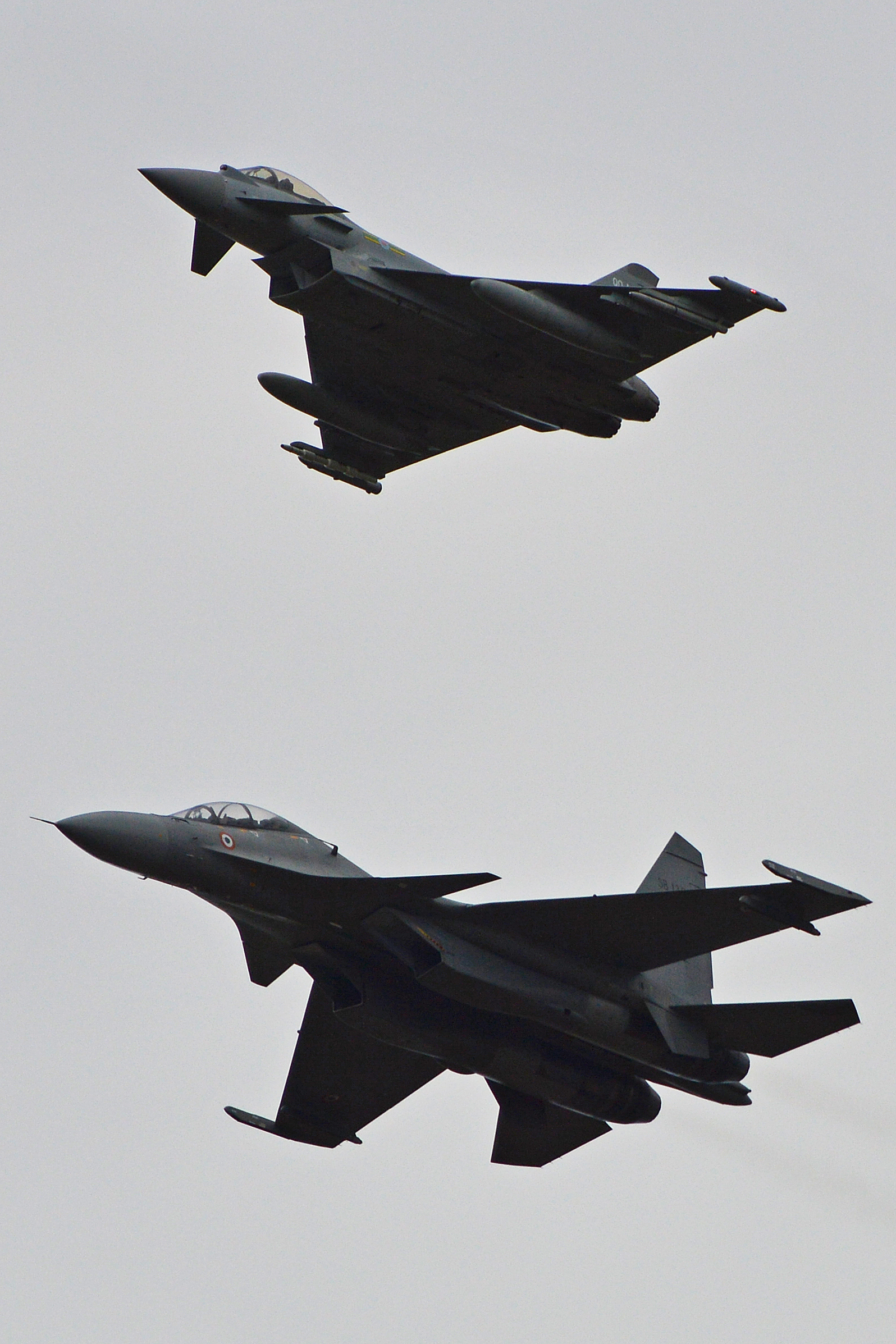
On 21 July 2015, India and UK began the bilateral exercise named Indradhanush with aircraft operating from three Royal Air Force bases. The exercises included both Beyond Visual Range (BVR) and Within Visual Range (WVR) exercises between the Su-30MKI and Eurofighter Typhoon. Indian media reported the results were in favour of the IAF with a score of 12–0 at WVR engagements. They also claim that the IAF Su-30MKIs held an edge over the Typhoons in BVR engagements though not in as dominating a manner. The RAF issued a statement that the results being reported by the Indian media did not reflect the results of the exercise. According to Aviation International News, "In close combat, thrust vector control on the Flankers more than compensated for the greater thrust-to-weight ratio of the Typhoon".
On 26 February 2019, four Sukhoi Su-30MKIs escorted Mirage 2000s into Pakistan for the Balakot airstrike which destroyed a Jaish-e-Mohammed terrorist camp. The following day, two Su-30MKIs on combat air patrol were attacked by multiple Pakistani F-16s using AMRAAM missiles. The jets successfully dodged and jammed multiple missiles. The debris of an AMRAAM missile was later recovered and displayed by the IAF to disprove the Pakistani claim of not using the F-16 as Pakistan can only use the missile with F-16s. PAF claimed that it had downed an Indian Sukhoi Su-30MKI in the aerial skirmish. The Indian Air Force stated that all dispatched Sukhoi aircraft returned safely with the only confirmed loss was a MiG-21. On 8 October 2019, during the Indian Air Force Day celebrations, the IAF flew the Su-30MKI that Pakistan claimed to have shot down.
In 2024, IAF deployed four Su-30MKIs to multinational Exercise Pitch Black 2024 hosted by Royal Australian Air Force which will be held from July 12 to August 2. The long distance flight is supported by Il-78MKI mid-air refueller, C-17 Globemaster and a hault in Halim, Indonesia. The Indian contingent conprises of 150 personnel including pilots, engineers, technicians, controllers, and other subject matter experts. This will be the largest version of the exercise since its inception in 1981. The same contingent participated in Exercise Udara Shakti with Sukhoi Su-30MKM of the Royal Malaysian Air Force which was conducted from 5 to 9 August at Kuantan, Malaysia. The contingent returned to India on 10 August 2024.
On 9 January 2025, Su-30MKI and Jaguar aircraft of the Indian Air Force conducted joint anti-aircraft drills with Rafale M aircraft of the French Navy. The French Carrier Strike Group (CSG) centered on the , the carrier air wing including Rafale M, her escort ships and fleet support ship Jacques Chevallier were on a visit to India between 4 and 9 January 2025 during the Mission Clemenceau 25. Simultaneously, conducted joint navigational drills and Maritime Partnership Exercise with the escort ships.
From 28 August to 10 September 2025, the Indian Air Force deployed five of its Su-30MKI and a C-17 Globemaster for the multilateral, tri-service Exercise Bright Star.
India launched Operation Sindoor in the early hours of 7 May 2025, targeting nine alleged terror camps across Pakistan and Pakistan-occupied Kashmir in response to the Pahalgam attack. During the mission, Su-30MKIs of the Indian Air Force provided air defence cover to ensure that Indian strike aircraft could carry out the mission without threat from Pakistani interceptors. On 10 May 2025, the IAF Su-30MKIs reportedly struck 11 PAF airbases with the BrahMos missile resulting in extensive damage to some of them. France's air chief told reporters in June and claimed that he had seen evidence of the loss of a fighter and two other aircraft including a Russian-made Sukhoi.
Potential operators
According to multiple reports in November 2025, Armenia is expected to sign a deal worth $3 billion for 12 Su-30MKIs of the Super Sukhoi standard with Hindustan Aeronautics Limited for the Armenian Air Force. The deal was made as a response to the acquisition of 40 JF-17 Thunder fighters by the Azerbaijani Air Force from Pakistan.
The first phase of the purchase includes the delivery of 8-12 aircraft with personnel training, ground support, and weapons integration.https://militarnyi.com/en/news/armenia-to-buy-indian-made-su-30-fighter-jets/ Deliveries are expected by 2027.
Operators

;India
- Indian Air Force – 260 in service. 12 on order.
- Bareilly AFS: 15 Wing
- No. 8 Squadron IAF (Eight Pursoots)
- No. 24 Squadron IAF (Hawks)
- Chabua AFS: 14 Wing
- No. 102 Squadron IAF (Trisonics)
- Halwara AFS: 9 Wing
- No. 220 Squadron IAF (Desert Tigers)
- No. 221 Squadron IAF (Valiants)
- Jodhpur AFS: 32 Wing
- No. 31 Squadron IAF (Lions)
- Lohegaon AFS: 2 Wing
- No. 20 Squadron IAF (Lightnings)
- No. 30 Squadron IAF (Rhinos)
- Sirsa AFS: 45 Wing
- No. 15 Squadron IAF (Flying Lancers)
- Tezpur AFS: 11 Wing
- No. 2 Squadron IAF (Winged Arrows)
- No. 106 Squadron IAF (Lynxes)
- Maharajpur AFS: 40 Wing
- Tactics and Air Combat Development Establishment (TACDE)
- Thanjavur AFS: 47 Wing
- No. 222 Squadron IAF (Tigersharks)
- Uttarlai AFS: 5 FBSU
- No. 4 Squadron IAF (Oorials)
- Bareilly AFS: 15 Wing
Accidents and incidents
Since Su-30MKI's entry to service in 2002, the aircraft flew seven years without any major incidents. The first crash occurred in 2009. As of November 2024, 13 Su-30MKIs were lost in crashes including 3 fatalities.
- On 30 April 2009, an Su-30MKI (SB-021) from the 30 Squadron crashed in Rajasthan. Both the pilots ejected successfully but one of them succumbed to injuries. According to reports. the pilots had inadvertently switched off the aircraft's flight control system.
- On 30 November 2009, another aircraft from the 31 Squadron crashed over Pokhran, Rajasthan during a training sortie after an engine caught fire. Both pilots ejected successfully.
- On 13 December 2011, an aircraft (SB-142) of the 20 Squadron crashed at Wade-Bholai village near Pune, Maharashtra. The crash occurred due to human error after servicing of the aircraft at the Nashik facility of Hindustan Aeronautics Limited. The pilots survived.
- On 19 April 2012, an aircraft crashed during a "Repaired Routing Training Flight".
- On 19 February 2013, an Su-30MKI crashed in Pokhran region at around 19:20 IST. The crash occurred due to defunctive ordnance onboard the aircraft as the bomb exploded while it was attached on to the underwing pylons. The pilots survived.
- On 14 October 2014, one Su-30MKI crashed in Pune.
- On 19 May 2015, one Su-30MKI crashed in Tezpur, Assam.
- On 15 March 2017, an Su-30MKI crashed in the Barmer district of Rajasthan during a training sortie. The pilots ejected safely but three family members were injured as the jet crashed over a residential area. This was the seventh crash of the aircraft.
- On 23 May 2017, two pilots died after a crash of Su-30MKI (SB-063) from 2 Squadron. The aircraft took off from Tezpur AFS as a part of two aircraft formation. The aircraft later lost radar, radio and air traffic control contact at 11.10 IST. The aircraft was last detected 60 km northwest of Tezpur.
- On 27 June 2018, a Su-30MKI crashed in Nashik, Maharashtra.
- On 8 August 2019, a Su-30MKI crashed in a paddy field near Tezpur in Assam.
- On 28 January 2023, an Su-30MKI and a Mirage 2000H of the TACDE were involved in a mid-air collision. The Mirage-2000H pilot and instructor, Wing Commander Hanumanth Rao Sarathi, was unable to eject and died in the accident, whereas the two pilots flying the Su-30MKI, ejected and were hospitalised with minor injuries. Both fighter jets had taken off from Maharajpur AFS, Gwalior for a training mission.
- On 4 June 2024, an Su-30MKI (SB-182) crashed in a farm in Shirasgaon village in Nashik district. The pilots including Wing commander Bokil and Second-in-command Biswas ejected safely from the aircraft. An investigation has been ordered by the Indian Air Force about the cause of the accident.
- On 23 August 2024, reports emerged that an IAF fighter aircraft had "inadvertently" released an "air store" over Pokhran. An investigation was launched on the matter. Later, it was confirmed that the concerned aircraft was an Su-30MKI while the air store was a Rampage missile.
Specifications (Su-30MKI)

| prime units? = met | max takeoff weight kg = 38800 | max takeoff weight note =
| eng1 kn-ab = 123 --| max speed kmh = 2120 ::::1350 km/h / M1.09 at low altitude | never exceed speed kmh = | never exceed speed note = | minimum control speed kmh = | minimum control speed note = ::::1270 km at low altitude | wing loading kg/m2 = 401 | fuel consumption kg/km = | thrust/weight =
-
Take-off run: m
-
Take-off run to 15 m: m
-
Landing run: m
-
Landing run from 15 m: m-- --| guns = 1 × 30 mm Gryazev-Shipunov GSh-30-1 autocannon
-
4 × S-8
-
4 × S-13
-
Air-to-air missiles:
- 10 × R-77
- 10 × I-Derby ER
- 10 × Astra Mk-1
- 10 × Astra Mk-2 (future)
- 6 × R-27ER/ET
- 2 × R-27R/T
- 6 × R-73
- 3 × K-100
- MICA (tested successfully)
-
Air-to-surface missiles:
- 3 × Kh-59ME
- 4 × Rampage
- 6 × Kh-29T/L
- 2 × Nirbhay (Future)
- Crystal Maze II
-
Anti-ship missiles:
- 3 × Kh-59MK
- 4 × Kh-35
- 6 × Kh-31A
- 1 × BrahMos
-
Anti-radiation missiles:
- 6 × Rudram-1
- 6 x Rudram-2 (tested successfully)
- 6 × Kh-31P
-
8 × KAB-500L laser-guided bombs
-
3 × KAB-1500L laser-guided bombs
-
3 × Sudarshan laser-guided bombs
-
8 × FAB-500T bombs
-
28 × OFAB-250-270 bombs
-
32 × OFAB-100-120 bombs
-
Spice 2000 bombs
-
8 × RBK-500 cluster bombs
-
20 × Smart Anti-Airfield Weapon
-
3 × DRDO Glide Bombs
-
Khagantak-243 Other
-
-
Litening targeting pod
-
El/M-2060P airborne synthetic aperture radar reconnaissance pod
-
EL/M-8222 jammer
-
KNIRTI SAP-518 EW pod
-
Chaffs / flares
-
Buddy-buddy refuelling pod
-
Virupakhsa active electronically scanned array radar (after Super Sukhoi upgrade)
-
DRDO Tarang MK.II radar warning receiver
-
OLS-30 laser-optical infra-red search and track
In popular culture
- The Sukhoi Su-30MKI was shown in the aerial action India movie Fighter (2024 film). The protagonist of the film flies the Sukhoi Su-30MKI.
References
Notes
Citations
Bibliography
References
- "HAL – Hindustan Aeronautics Limited".
- (2 April 2020). "India completes production of Su-30MKI fighters".
- (1 April 2020). "India's Aviation Behemoth HAL Expects More Orders as It Completes Production of Su-30MKI".
- "Designations of Soviet and Russian Military Aircraft and Missiles".
- (28 December 2000). "India to build Russian fighters". BBC News.
- (17 September 2002). "Indian air force first to field multi-role Sukhois.".
- (22 May 2020). "Su-30MKI Multirole Fighter Aircraft".
- (20 January 2020). "How Sukhoi-30 fighter jets will help check Chinese footprint in Indian Ocean".
- Pandit, Rajat. (30 January 2010). "Russia conducts first test of fifth-generation Sukhoi".
- Butowski, Piotr. (1 March 2002). "The year of the MiG-29: in 2001, RAC MiG had its best year in the post-Soviet era. Prospects for Sukhoi are improving, too. (Special Report)". Interavia Business & Technology.
- [http://www.sukhoi.org/eng/planes/military/su30mk/history/ "Su-30МК – Historical background."] {{webarchive. link. (13 July 2011 ''Sukhoi Company (JSC)''. Retrieved 30 September 2012.)
- link. (8 September 2009 ''RTAF'', 4 December 2008. Retrieved 16 December 2010.)
- Kopp, Dr. Carlo. (1 April 2012). "Sukhoi Flankers The Shifting Balance of Regional Air Power". Air Power Australia.
- (2012-03-23). "Sukhoi Su-30SM An Indian Gift to Russia's Air Force".
- Malhotra, Jyoti. [http://www.indianexpress.com/oldStory/29974/ "Delhi tightrope on Israel red carpet."] {{webarchive. link. (2013-02-24 ''The Indian Express'', 20 August 2003. Retrieved 16 December 2010.)
- link. (22 December 2015 ''NIC''. Retrieved 16 December 2010.)
- "Sukhoi Su-30 story in colours. Sukhoi Su-30 fighter worldwide camouflage and painting schemes. Prototypes, experimental planes, variants, serial and licensed production, deliveries, units, numbers. Russia, India, China, Malaysia, Venezuela, Belarus, Ukraine, Algeria, Vietnam, Eritrea, Angola, Uganda, Egypt".
- "The IAF will add nine more squadrons by 2025-26 to make up its strength".
- (10 November 2019). "India Wants to Make Russia's Su-30MKI Air Superiority Fighter Great Again".
- [http://timesofindia.indiatimes.com/india/Day-after-crash-IAF-grounds-Sukhoi-fleet-for-checks/articleshow/5288979.cms "Day after crash, IAF grounds Sukhoi fleet for checks."] {{webarchive. link. (5 December 2009 ''The Times of India'', 2 December 2009.)
- [http://www.bharat-rakshak.com/IAF/Images/Current/Fighters/Su30MKI/ "Sukhoi Su-30 MKI (Flanker)."] {{webarchive. link. (10 May 2010 ''Bharat-rakshak''. Retrieved 16 December 2010.)
- Asthana, Mansij. (2021-03-22). "HAL Meets 'Full-Production Target' Of 140 Sukhoi Su-30MKI Fighter Jets at Nashik Facility".
- (19 March 2021). "HAL completes production of 140 raw material stage Su-30MKI aircraft".
- [http://164.100.47.5/newdebate/217/08072009/Fullday.pdf "House testimony."] {{webarchive. link. (3 July 2011 ''Indian Government'', 7 August 2009.)
- [http://indiaaviation.aero/news/airline/12395/59/Samtel-to-produce-Avionics-display-systems-for-HAL%27s-star-programmes- "Samtel to produce Avionics display systems for HAL's star programmes."] {{webarchive. link. (4 August 2008 ''Indiaaviation.aero'', 15 July 2008. Retrieved 16 December 2010.)
- Joseph, Josy. [http://timesofindia.indiatimes.com/India/Rs-15000-crore-Sukhoi-deal-cleared/articleshow/6092315.cms "Rs 15,000 crore Sukhoi deal cleared."] {{webarchive. link. (28 June 2010 ''The Times of India'', 26 June 2010.)
- [http://www.mid-day.com/news/2011/aug/190811-sukhoi-jets-30MKI-fighters-upgrade-iaf.htm "Sukhoi jets."] {{webarchive. link. (15 October 2011 ''Mid-day.com''. Retrieved 30 September 2012.)
- Sharma, Suman. [http://www.dnaindia.com/india/report_aircraft-deals-with-friend-russia-costing-dear_1424437 "Aircraft deals with friend Russia costing dear."] {{webarchive. link. (20 August 2010 ''Dnaindia.com'', 17 August 2010. Retrieved 16 December 2010.)
- [http://www.hindustantimes.com/Strategic-Command-to-acquire-40-nuclear-capable-fighters/Article1-599141.aspx "Strategic Command to acquire 40 nuclear capable fighters."] {{webarchive. link. (17 October 2010 ''Hindustan Times'', 12 September 2010. Retrieved 20 December 2010.)
- Radyuhin, Vladimir. [http://www.hindu.com/2009/08/20/stories/2009082061901100.htm "HAL: total indigenisation of Sukhoi fighter next year."] {{webarchive. link. (3 January 2011 ''The Hindu (Chennai, India)'', 20 August 2009.)
- "Presentation on SU 30MKI".
- [http://brahmand.com/news/India-to-buy-42-combat-aircraft-from-Russia/10237/1/10.html "India to buy 42 combat aircraft from Russia."] {{webarchive. link. (24 November 2012 ''brahmand.com'', 11 October 2012.)
- "Indigenously Developed IRST for IAF SU-30 MKI Fleet".
- Sharma, Ritu. (2024-07-16). "After BrahMos Missile, India, Russia Eye Partnership On Sukhoi Fighters; May Export Su-30 Flankers To Allies".
- (13 June 2018). "IAF not keen on getting more Sukhoi fighter jets". India Today.
- Pubby, Manu. (2020-06-19). "IAF to urgently procure 21 MiG 29s, 12 Su 30s". The Economic Times.
- (2022-03-18). "Indian Air Force to order 12 more Sukhoi Su-30 MKI fighters". Airrecognition.com.
- (2022-05-29). "Indian Air Force Cancels 12 Su-30MKI Orders, Amid Sanctions on Russia".
- (2023-09-16). "Nod for Rs 45,000cr defence buys, 12 more Sukhois to fly in". The Times of India.
- (2024-11-07). "HAL in talks with General Electric over delay in engines' delivery: DK Sunil".
- (2024-12-12). "CCS clears Rs 20,000 crore Make in India projects for Su-30 fighter jets, 100 K-9 howitzers". The Economic Times.
- (2024-12-12). "Ministry of Defence signs contract with HAL for procurement of 12 Su-30MKI aircraft".
- (2024-11-14). "Aerospace company HAL to ready Nashik plant for production of Sukhoi Su-30MKI jets".
- [http://www.strategycenter.net/research/pubID.78/pub_detail.asp "International Assessment and Strategy Center > Research > Chinese Dimensions of the 2005 Moscow Aerospace Show"] {{webarchive. link. (19 June 2015. ''Strategycenter.net'', 12 September 2005. Retrieved 16 December 2010.)
- Unnithan, Sandeep. [https://www.indiatoday.in/magazine/radar/story/20100607-fierce-fighter-743055-2010-05-27 "Fierce fighter."] ''[[India Today]]'', July 2011.
- [http://brahmand.com/news/Indian-cabinet-clears-Rs-8000-cr-plan-to-fit-IAF-with-BRAHMOS/10281/1/10.html "Indian cabinet clears Rs 8,000-cr plan to fit IAF with BRAHMOS."] {{webarchive. link. (28 July 2013 ''brahmand.com''. Retrieved 18 November 2012.)
- [http://www.janes.com/article/61823/indian-air-force-flies-brahmos-a-on-su-30mki "Indian Air Force flies BrahMos-A on Su-30MKI."] {{webarchive. link. (7 July 2016 ''Janes.com'', 28 June 2016. Retrieved 15 July 2016.)
- "BrahMos Test Success Means India Can Take Out Target in Minutes: 10 Facts". NDTV.com.
- link. (2013-02-24 ''Aviation Week'', 11 October 2010. Retrieved 16 December 2010.)
- [http://idp.justthe80.com/air-force-projects/fighters/su-30mki-acquisition-and-upgrade#TOC-AESA-Radar "Su-30MKI Acquisition and Upgrade: AESA Radar."] {{webarchive. link. (2 August 2012 ''Indian Defense Projects''. Retrieved 17 August 2012.)
- [http://www.mid-day.com/news/2011/aug/190811-sukhoi-jets-30MKI-fighters-upgrade-iaf.htm "IAF's Sukhoi jets to be upgraded to fifth generation fighters."] {{webarchive. link. (15 October 2011 ''Mid Day'', 19 August 2011.)
- (14 January 2020). "Radical " Super Sukhoi " Plans Underway by IAF".
- "India will install indigenous UTTAM active electronically scanned array radar on 150 Su-30MKI fighter jets. – Defence View".
- Defense, Alpha. (2021-06-26). "Super Sukhoi : Next-Generation EW Suite".
- Singh, Rahul. [http://www.hindustantimes.com/world-news/Europe/IAF-gets-lowdown-on-the-Royal-Air-Force-s-Libya-op/Article1-758069.aspx "IAF gets lowdown on the Royal Air Force's Libya op."] {{webarchive. link. (20 January 2012 ''Hindustan Times'', 16 October 2011.)
- (28 November 2012). "IAF to upgrade Su-30MKIs to 'Super Sukhoi' standard". The Economic Times.
- "India to increase firepower of Su-30MKI to counter China and Pakistan".
- (17 September 2019). "Indian Air Force successfully flight tests air-to-air Astra missile from Sukhoi-30 MKI". India Today.
- (18 September 2017). "After successful development trials, Astra missile ready for production".
- "Outgunned by Pak F-16s, IAF Plans to Re-Arm Its Sukhois with Israeli Missiles".
- "DRDO conducts five trials of Air-to-Air Missile 'Astra'; All successful".
- [https://www.theweek.in/news/india/2019/04/15/india-tests-nirbhay-cruise-missile-6th-time.html "India successfully tests 1,000km-range Nirbhay cruise missile"] {{Webarchive. link. (6 November 2019. ''[[The Week (Indian magazine)). The Week]]'', 15 April 2019. Retrieved 6 June 2020.
- (2024-12-09). "IAF Super Sukhoi upgrade: After Israeli missile, IAF's 'super' Sukhoi-30 to get another major upgrade".
- (2024-12-13). "India signs Rs 13,500 crore deal for advanced indigenous Su-30MKI jets".
- George, Sarahbeth. (2024-02-20). "IAF's Sukhoi fighter jets to get a Rs 60,000 crore booster: Here are all the upgrades for the new Su-30MKI". The Economic Times.
- "'Draft note' on Sukhoi upgrade project all set to head for PM-led panel's nod". The Times of India.
- Peri, Dinakar. (2024-11-03). "AI big focus of SU-30MKI upgrade; IAF taking up pilot projects with IIT-Mumbai, says officer". The Hindu.
- Kumar, Raju. (2023-11-30). "India to get more fighter jets as DAC clears IAF's Sukhoi Su-30 aircraft upgrade programme: Sources".
- (2025-07-01). "Defence Ministry to clear Rs 1 lakh crore worth of military deals post Op Sindoor".
- Trivedi, Saurabh. (2025-06-30). "Defence Ministry set to clear major acquisitions post Operation Sindoor". The Hindu.
- "India's Su-30MKI Set For Rs 66,829 Cr Super-30 Upgrade, To Outclass Pakistan's F-16s".
- (2025-10-26). "Combat squadron strength dwindles, Govt looks at plan to upgrade Su-30MKIs".
- (2025-11-27). "At PM Modi-Putin meet, India to seek 5 more S-400 squadrons". The Times of India.
- alphadefense.in. (2024-05-22). "EW Upgrade of Su 30 MKI - alphadefense.in".
- (2024-12-03). "DAC approves 05 capital acquisition proposals worth Rs. 21,772 Crores to augment defence preparedness". [[Press Information Bureau]].
- Chaudhry, Pratisht. (2020-11-13). "Detailed Analysis Of Indian Super Sukhoi, A Jet With 5th Gen Capabilities.".
- Singh, Mayank. (2025-11-14). "IAF Sukhoi-30 MKI to get advanced jammer pods; DRDO develops new autonomous underwater vehicles".
- "Request for Information for procurement of ASPJ pods for Su-30 MKI aircraft".
- (2025-07-04). "Super Su-30: India plans Rs 60,000 crore booster for its main fighter jet. From radars to missiles, here's what it'll get". The Economic Times.
- Pubby, Manu. (2024-08-14). "Defence ministry to sign Rs 21,000 cr deal for 230 Sukhoi jet engines". The Economic Times.
- (2024-08-15). "Boost for IAF's fighter fleet! Sukhoi 30-MKI jets likely to get new engines in Rs 21,000 crore deal". The Times of India.
- (2024-09-02). "Cabinet approves procurement of 240 aero-engines for Su-30 MKI aircraft from HAL worth Rs 26,000 cr". The Economic Times.
- "Defence Ministry Signs Rs 26,000 Crore Deal For Engines For Su-30MKI Jets".
- (2024-10-01). "HAL delivers first AL-31FP engine of Su 30MKI to IAF under new contract".
- (2024-10-13). "India unleashed major defence orders in September; paving way for military modernisation, space exploration". The Economic Times.
- Abrams, A. B.. (August 27, 2024). "Indian-Built Russian Su-30 Fighter Could Soon Be a Game Changer on Export Markets". The Diplomat.
- [http://www.accessmylibrary.com/coms2/summary_0286-9911723_ITM "Renewed interest in Russian-made Su30Mk multi-role fighter bomber."] {{webarchive. link. (12 January 2009 ''Accessmylibrary.com'', 8 December 2002. Retrieved 16 December 2010.)
- "Gallery of South Asian Airpower". Air Force Magazine.
- [http://www.sukhoi.org/eng/planes/military/su30mk/lth/ "Su-30МК – Aircraft performance."] {{webarchive. link. (16 July 2011 ''Sukhoi.org''. Retrieved 16 December 2010.)
- [http://www.flight-refuelling.com/news/feb06/21stfeb_su30.htm "SU-30 Buddy Refueling System Achieves Successful Final Design Review."] {{webarchive. link. (1 March 2007 ''Flight-refuelling.com''. Retrieved 30 September 2012.)
- Ajai Shukla. (5 January 2010). "India, Russia close to PACT on next generation fighter". Business Standard India.
- Jeff Scott. (21 March 2004). "Radar Cross Section (RCS)".
- [http://www.business-standard.com/india/news/iaf-order-worth-rs-250-cr-to-indian-industry/412229/ "IAF order worth Rs 250 cr to Indian industry."] {{webarchive. link. (24 October 2010 ''Business-standard.com'', 21 October 2010. Retrieved 16 December 2010.)
- link. (3 June 2006 ''Irkut.com''. Retrieved 16 December 2010.)
- Jane's Radar And Electronic Warfare Systems, p. 2089.
- Kopp, Dr, Carlo. [http://www.ausairpower.net/APA-Zhuk-AE-Analysis.html "Phazotron Zhuk AE: Assessing Russia's First AESA."] {{webarchive. link. (16 February 2011 ''ausairpower.net'', April 2012. Retrieved 30 September 2012.)
- link. (9 September 2009 ''Outlookindia.com''. Retrieved 16 December 2010.)
- (2022-04-26). "HAL and BEL to co-develop IRST system for Su-30 MKI".
- Bedi, Rahul. [http://www.janes.com/article/50038/india-defence-minister-admits-su-30-serviceability-issues "India defence minister admits Su-30 serviceability issues."] {{webarchive. link. (23 March 2015 ''IHS Jane's Defence Weekly'', 18 March 2015.)
- Gal-Or, Benjamin (2011). "Future Jet Technologies". International Journal of Turbo and Jet Engines (online) 28: 1–29. ISSN 2191-0332.
- Pandit, Rajat. [http://timesofindia.indiatimes.com/articleshow/2410053.cms "Sukhoi base in east to counter China."] {{webarchive. link. (23 September 2009 ''The Times of India'', 28 September 2007. Retrieved 28 February 2009.)
- Rice, Bill. [http://dawnsearlylight.blogs.com/del/2005/03/_would_you_be_s.html "Losing a Battle to Win a War."] {{webarchive. link. (25 July 2010 ''Dawsnsearlylight'', 17 March 2005. Retrieved 7 September 2010.)
- link. (19 June 2009)
- The Christian Science Monitor. (28 November 2005). "Indian Air Force, in war games, gives US a run". The Christian Science Monitor.
- Pandit, Rajat. [http://timesofindia.indiatimes.com/articleshow/2171142.cms "Sukhois 'splash' UK Tornados over Gwalior."] {{webarchive. link. (11 December 2006 ''The Times of India'', 14 October 2006. Retrieved 11 July 2007.)
- Pandit, Rajat.[http://timesofindia.indiatimes.com/articleshow/2116563.cms "Royal Air Force chief to fly Sukhoi."] {{webarchive. link. (12 January 2009 ''The Times of India'', 8 October 2006. Retrieved 16 December 2010.)
- (2006-10-13). "Now, IAF mesmerises Royal Air Force". The Times of India.
- link. (11 April 2010 ''Raf.mod.uk'', 15 July 2010. Retrieved 16 December 2010.)
- [http://www.targeta.co.uk/waddington_indradhanush.htm "Exercise Indra Dhanush 07, RAF Waddington."] {{webarchive. link. (18 October 2008 ''Targeta.co.uk''. Retrieved 16 December 2010.)
- link. (6 September 2009 ''Cities.expressindia.com'', 25 November 2010. Retrieved 16 December 2010.)
- Parsons, Gary. [http://www.airsceneuk.org.uk/hangar/2007/441indians/indra.htm "Waddington's Indian Summer, Part three: The Exercise."] {{webarchive. link. (4 August 2011 ''AirSceneUK''. Retrieved 21 August 2011.)
- link. (24 September 2009 ''Pib.nic.in''. Retrieved 16 December 2010.)
- [http://www.indianexpress.com/news/sukhoi-30-outshone-in-us-aerial-exercise/384025/0 "Sukhoi 30 outshone in US aerial exercise."] {{webarchive. link. (18 January 2009 ''The Indian Express'', 11 November 2008. Retrieved 16 December 2010.)
- Trimble, Stephen. [http://www.flightglobal.com/articles/2008/11/06/318506/video-us-red-flag-pilot-candidly-assesses-su-30mkis-limits-rafales-dirty-tricks.html "US Red Flag pilot candidly assesses Su-30MKI's limits, Rafale's dirty tricks"] {{webarchive. link. (6 December 2008. ''Flightglobal.com'', 6 November 2008.)
- Trimble, Stephen. [http://www.flightglobal.com/blogs/the-dewline/2008/11/a-final-word-from-india-on-you.html "A final word, from India, on 'YouTube Terry'."] {{webarchive. link. (30 January 2009 ''Flight International'' blog, 21 November 2008. Retrieved 16 December 2010.)
- (10 March 2014). "Dissecting a dogfight: Sukhoi vs USAF at Red Flag 2008". Российская газета.
- [http://netindian.in/news/2010/06/14/0006839/indo-french-air-exercises-begin-southern-france "Indo-French air exercises begin in Southern France."] {{Webarchive. link. (22 April 2012 ''NetIndian.in'', 18 June 2010. Retrieved 30 September 2012.)
- ":: Bharat-Rakshak.com – Indian Military News Headlines ::".
- [http://economictimes.indiatimes.com/slideshows/events/garuda-v-stunning-shots-from-indo-french-air-exercise/slideshow/36199743.cms Garuda-V: Stunning shots from Indo-French air exercise] {{webarchive. link. (25 August 2014 ''The Times of India'', ''Economic Times'', 7 June 2014.)
- [http://www.ambafrance-in.org/Indo-French-Air-Exercise-Garuda-V Indo-French Air Exercise "Garuda V"] {{webarchive. link. (3 February 2015. ''French Embassy in New Delhi'', 30 June 2014.)
- [http://www.ndtv.com/india-news/indian-air-forces-top-guns-score-wins-in-the-uk-1204336 "Indian Air Force Sukhois Dominate UK Fighter Jets in Combat Exercises"] {{webarchive. link. (14 August 2015. NDTV, 6 August 2015.)
- Jayalakshmi, K. (7 August 2015). "Reports of Indian Air Force pilots beating RAF in combat exercises ridiculed". International Business Times.
- "Indian Flankers Test British Typhoons on Exercise". ainonline.com.
- (25 February 2019). "Indian Jets Strike on Pakistani Side of Kashmir Line". The New York Times.
- PTI. (26 February 2019). "Mirage 2000, Sukhoi-30s, AWACS part of IAF's operation on JeM camp in Balakot".
- "Indian Air Force Su-30MKI destroyed the AMRAAM missile that launched by PAF F-16 jet – News – Russian Aviation – RUAVIATION.COM".
- Singh, Sushant. (2019-03-01). "India's Exhibit Debris of AMRAAM missile that nails Pakistan's F-16 denial".
- "Pak Pays 'Tributes' to Two Pilots who shot down Indian Aircraft on February 27".
- (5 March 2019). "Pakistan made false claims of shooting down Sukhoi-30 fighter jet: Indian Air Force". India Today.
- ""False Claim": India Rubbishes Pak Claim of Shooting Down Sukhoi-30". NDTV.
- "India trashes Pakistan's claim of downing IAF's Sukhoi jet during last week's dogfight". The Economic Times.
- (8 October 2019). "On Air Force Day, India flies the Sukhoi-30MKI that Pak claimed to have shot down".
- (8 October 2019). "Sukhoi Fighter Jet 'Shot Down' by Pakistan Makes Appearance at Indian Air Force Day Flypast".
- (2024-07-10). "#IAF contingent made a transit halt at Indonesia while heading towards southern hemisphere for Ex Pitch Black 24".
- (9 July 2024). "IAF's Su-30 MKIs to be part of 20-nation mega 'Exercise Pitch Black' in Australia - The Economic Times".
- "Korean F-15K vs Indian Su-30MKI: India, South Korea conduct joint air drill during 'Pitch Black' exercise". The Times of India.
- (2024-07-09). "IAF's Su-30 MKIs to be part of 20-nation mega 'Exercise Pitch Black' in Australia".
- (2024-08-06). "The Indian Air Force contingent arrived at Kuantan, Malaysia to participate in bilateral Air Exercise Udara Shakti- 2024 with the Royal Malaysian Air Force...".
- (2024-08-10). "INDIAN AIR FORCE TEAM RETURNS AFTER SUCCESSFUL PARTICIPATION IN EXERCISE UDARA SHAKTI 2024 AT MALAYSIA".
- "French Navy Conducts Air-Sea Tactical Manoeuvres With Indian Navy".
- (10 January 2025). "Kochi: Indian Navy, Indian Air Force, French Navy participate in Maritime Partnership Exercise". The Economic Times.
- (2025-09-04). "Indian Air Force tweets, "Exercise Bright Star 2025: India is participating in this exercise, along with 43 other countries, in Egypt, from 27 Aug to 10 Sep 25...".
- (2025-09-04). "Egyptian Air Force says it is interested in studying long range penetration strike tactics of Indian Air Force...".
- (9 May 2025). "Operation Sindoor: Rafale, Su-30 MKI, Mirage 2000 — all the equipment IAF deployed". CNBC TV18.
- (12 May 2025). "Operation Sindoor: How BrahMos strikes and precision airstrikes became turning points in the standoff". The Economic Times.
- (11 May 2025). "How BrahMos missile strikes forced Pakistan to agree to a ceasefire". The New Indian Express.
- (15 May 2025). "'Dummy' aircraft, Brahmos, Crystal Maze: The night the IAF destroyed Pakistan's air defence and targeted its air bases". The Tribune.
- Shah, Saeed. (2025-08-02). "How Pakistan shot down India's cutting-edge fighter using Chinese gear". Reuters.
- "From Importer to Global Exporter: Armenia Chooses India's Su-30MKI Deal Over Russian & Western Jets".
- Gavilan, Jodesz. (2025-10-31). "Armenia Nears $3B Deal to Buy India's Su-30MKI Fighters".
- (2025-11-02). "Armenia Nears $3B Deal for Indian Su-30MKI Fighters Amid Azerbaijan Tensions".
- (27 June 2025). "Upgrade of Sukhoi jets figured in Rajnath's talks with Russian counterpart". [[Deccan Herald]].
- "IAF Super Sukhoi upgrade: After Israeli missile, IAF's 'super' Sukhoi-30 to get another major upgrade".
- (25 April 2017). "Indian Air Force boosts capabilities near Indo-Pakistani border with new fighter squadron". IHS Jane's Defence Weekly.
- (24 April 2017). "IAF inducts Su-30 MKI into frontline 221 Squadron".
- "India Ordered, Modernized, Perhaps Regrets Su-30MKIs". defenseindustrydaily.com.
- "Wing 45".
- (13 January 2017). "IAF chief Dhanoa flies Mig-21 solo: A list of others in fighter planes". The Indian Express.
- (9 July 2010). "Sukhois set for Gwalior as IAF evolves new tactics".
- (21 October 2010). "MP air station gets three more Sukhoi-30 planes".
- (28 February 2019). "Sulur air base to get one more LCA squadron". The Times of India.
- (2020-01-01). "#Resurrection: 222 Sqn 'The Tigersharks' got resurrected today with state of the art Su-30 MKI Multirole Fighter aircraft. Raised on 15 Sep 69 with Su-7, the Sqn was later equipped with #MiG27 Ground Attack Aircraft prior to getting numberplated in 2011.".
- (2020-01-04). "Thanjavur set to host South India's first Sukhoi Squadron".
- Singh, Rahul. (2023-10-31). "Indian Air Force phases out another MiG-21 squadron". [[Hindustan Times]].
- "Indian Air Force, Indian Army and Naval Aviation Accidents and Incidents".
- "IAF's Su-30 fleet: 12 aircraft lost, 3 pilots killed in 22 years".
- Bipindra, N. C.. (2012-12-21). "Human error caused Sukhoi plane crash".
- (15 October 2014). "IAF Sukhoi 30-MKI on sortie crashes near Pune, no casualty".
- (14 October 2014). "IAF's fighter plane Sukhoi 30 crashes in Pune, both pilots eject safely".
- "Sukhoi-30 crashes in Assam, pilots eject safely {{!}} india {{!}} Hindustan Times".
- (2017-03-15). "Technical snags bring IAF chopper, Sukhoi fighter down in separate incidents". [[Hindustan Times]].
- (16 March 2017). "Scare in the air as Sukhoi fighter plane crashes, Chetak chopper crash lands".
- "IAFs fighter plane crashes in Rajasthan; helicopter topples over while landing".
- (27 June 2018). "Sukhoi fighter jet crashes in Maharashtra's Nashik, both pilots safe".
- (27 June 2018). "HAL Su-30 aircraft crashes in Nashik; pilots safe". The Hindu.
- (11 July 2018). "Sukhoi 30 MKI being tested crashes near Nashik". The Economic Times.
- (8 August 2019). "Sukhoi fighter jet crashes in Tezpur, pilots safe". The Hindu.
- "Sukhoi 30 Fighter Jet Crashes into Paddy Field in Assam, Pilots Eject Safely".
- "TACDE: The High Profile Establishment in the Headlines Since the Recent IAF Aircraft Crash".
- Peri, Dinakar. (2023-01-28). "Pilot killed as two fighter jets crash". The Hindu.
- (4 June 2024). "Air Force's Sukhoi fighter jet crashes in Maharashtra's Nashik: Report".
- (2024-06-04). "Indian Air Force Sukhoi Su-30MKI Fighter Jet Crashed in Nashik".
- (2024-08-21). "Probe ordered after an IAF plane deploys 'air store' near Pokhran firing range".
- alphadefense.in. (2024-08-22). "An inadvertent release of Rampage Missile".
- PTI. "IAF jet inadvertently drops 'air store' near Pokhran; inquiry ordered".
- [http://www.irkut.com/products/18/238/ "Su-30MK performance"] {{webarchive. link. (18 May 2015 (Russian) ''Irkut''. Retrieved 30 April 2015.)
- [http://www.sukhoi.org/eng/planes/military/su30mk/lth/ "Su-30MK Aircraft performance page."] {{webarchive. link. (16 July 2011 ''Sukhoi''. Retrieved 1 January 2015.)
- "Ancile".
- (29 May 2019). "Indian Su-30MKI Jets To Be Equipped With Israeli I-Derby Missiles in Two years".
- (14 October 2025). "Astra Mark 2 missile range to be over 200 km, IAF to buy around 700 for fighter jet fleet". aninews.in.
- (19 August 2020). "IAF test fires air-to-air missiles ahead of Rafale integration". Hemant Kumar Rout.
- (27 April 2024). "ndian Air Force, Navy induct air-to-surface Rampage missile in its fleet". The Times of India.
- (24 April 2024). "India successfully tests new 250 km strike range air-launched ballistic missile". India Today.
- [https://www.flightglobal.com/news/articles/picture-su-30-mki-flies-first-sortie-with-brahmos-m-426705/ PICTURE: Su-30 MKI flies first sortie with BrahMos missile] {{webarchive. link. (28 June 2016 – Flightglobal.com, 27 June 2016)
- (17 February 2016). "Captive flight trials of anti-radiation missile soon". THE HINDU.
- (29 May 2024). ""Force Multiplier": India Successfully Tests Anti-Radiation Missile 'Rudram-II". NDTV.
- (29 May 2024). ""India successfully test-fires Rudra air-to-surface missile from SU-30MKI off Odisha coast"". The Hindu.
- (14 February 2025). "Aero India 2025: BEL secures IAF contract for stand-off glide munitions". Janes.
- "Indian Air Force To Receive 164 Litening Targeting Pod For Su-30MKI Fighters". defenseworld.net.
- "ELM-2060P Airborne SAR Reconnaissance Pod for Indian Su-30MKI".
- "IDN ANALYSIS: Sukhoi Su-30 MKI of Indian Air Force". indiandefensenews.in.
- Johnson, Reuben F. (6 February 2020). "Indian Air Force needs to upgrade Su-30MKI, says former air marshal".
- (28 January 2023). "150 Su-30 fighter jets discard their outdated 80s BARS radar". bulgarianmilitary.com.
- "Su-30MKI Multirole Fighter Aircraft". airforce-technology.com.
- "Sky Searchers". Jane's Defence Weekly.
This article was imported from Wikipedia and is available under the Creative Commons Attribution-ShareAlike 4.0 License. Content has been adapted to SurfDoc format. Original contributors can be found on the article history page.
Ask Mako anything about Sukhoi Su-30MKI — get instant answers, deeper analysis, and related topics.
Research with MakoFree with your Surf account
Create a free account to save articles, ask Mako questions, and organize your research.
Sign up freeThis content may have been generated or modified by AI. CloudSurf Software LLC is not responsible for the accuracy, completeness, or reliability of AI-generated content. Always verify important information from primary sources.
Report