From Surf Wiki (app.surf) — the open knowledge base
Suicide legislation
Laws concerning suicide around the world
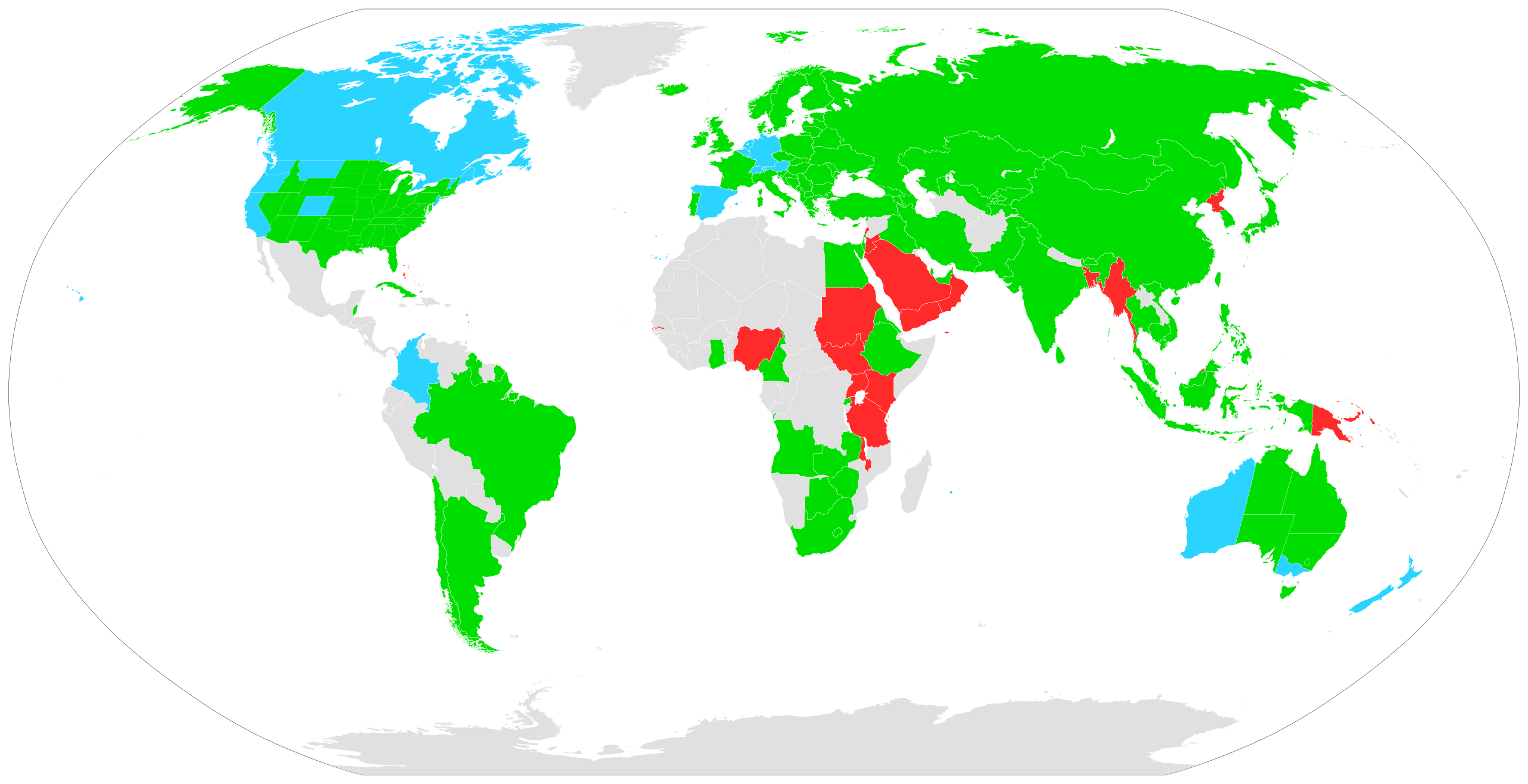
Laws concerning suicide around the world
]]
Suicide is a crime in some parts of the world. However, while suicide has been decriminalized in many countries, the act is almost universally stigmatized and discouraged. In some contexts, suicide could be utilized as an extreme expression of liberty, as is exemplified by its usage as an expression of devout dissent towards perceived tyranny or injustice which occurred occasionally in cultures such as ancient Rome, medieval Japan, or today's Tibet Autonomous Region.
While a person who has died by suicide is beyond the reach of the law, there can still be legal consequences regarding treatment of the corpse or the fate of the person's property or family members. The associated matters of assisting a suicide and attempting suicide have also been dealt with by the laws of some jurisdictions. Some countries criminalise suicide attempts.
History
Main article: Suicide#History
In ancient Athens, a person who had died of suicide (without the approval of the state) was denied the honours of a normal burial. The person would be buried alone, on the outskirts of the city, without a headstone or marker.
A criminal ordinance issued by Louis XIV in 1670 intended to be far more severe in its "punishment" ritual of an obviously-already-dead body: their corpse was drawn through the streets, face down, and then hung or thrown on a garbage heap. Additionally, all of the person's property was confiscated; this measure was intended to deter suicide by punishing their heirs financially.
The Interments (felo de se) Act 1882 abolished the legal requirement in England of burying suicides at crossroads.
Assisted suicide
Main article: Assisted suicide

]] In many jurisdictions, it is a crime to assist others, directly or indirectly, in taking their own lives. Such legislation requires manufacturers of weapons to refuse sales to those deemed at potential risk of suicide. In some jurisdictions, it is also illegal to encourage people to attempt suicide, though the classification of the crime and its punishment varies. Sometimes an exception applies for physician assisted suicide, under strict conditions.
Laws in individual jurisdictions (table)
Africa
| Country/region | Legality | Penalty | Notes | Suicide | Physician-assisted suicide | Voluntary euthanasia |
|---|---|---|---|---|---|---|
| Algeria | ||||||
| Angola | Article 141. (Instigation or help to murder) | # Whoever instigates another person to commit suicide and this is consummated or actually tried shall be punished with imprisonment penalty up to 3 years. | ||||
| Botswana | Article 207. Suicide pacts | (1) It shall be manslaughter, and shall not be murder, for a person acting in pursuance of a suicide pact between him and another to kill the other or be a party to the other killing himself or being killed by a third person. | ||||
| Burkina Faso | Article 512–28. (French) | Le fait de provoquer ou d'aider au suicide d'autrui est puni d'une peine d'emprisonnement de un an à cinq ans et d'une amende de deux cent cinquante mille (250 000) à un million (1 000 000) de francs CFA, lorsque la provocation a été suivie du suicide ou d'une tentative de suicide. | ||||
| Burundi | ||||||
| Cameroon | Article 275. Murder | Whoever causes another's death shall be punished with imprisonment for life. | ||||
| Cape Verde | Article 127. Prompting or assistance to suicide | # Whoever intentionally determine another person to commit suicide shall be punished with imprisonment up to three years, if suicide is attempted or fulfill itself. |
| |- | Central African Republic | | | | | |- | Comoros | | | | | |- | Djibouti | | | | {{hidden |Comment |No mention of suicide in the criminal code except against juveniles. Article 460 | {{cite web |url=https://sherloc.unodc.org/cld/document/dji/code_penal.html? |- | Egypt | | | | |Article 47. |The felonies whereof the attempt is liable to punishment and also the penalty for that attempt shall be legally defined. | |- | Equatorial Guinea | | | | | |- | Eritrea | | | | {{hidden |Art. 280. – Assisting Suicide. |(1) A person who, for any selfish or base motive, intentionally helps, advises or incites another person to commit suicide, is, where the suicide is attempted, guilty of assisting suicide, a Class 9 serious offence, punishable with a definite term of imprisonment of not less than 1 year and not more than 3 years. (2) Where death results from a person‟s actions under sub-Article (1), or knew that the person who attempted to commit suicide is partially or completely irresponsible, sick or a minor person, is guilty of assisting suicide, a Class 8 serious offence, punishable with a definite term of imprisonment of not less than 3 years and not more than 5 years. | |- | Eswatini | | | | {{hidden |s.4 Homicide Act 44 of 1959 |(1) It shall be culpable homicide, and not murder, for a person acting in pursuance of a suicide pact between him and another to kill such other or to be a party to such other being killed by a third person. (2) If it is shown that a person charged with the murder of another killed such other or was a party to his being killed, it shall be for the defence to prove that the person charged was acting in pursuance of a suicide pact between him and such other. (3) In this section "suicide pact" means a common agreement between two or more persons having for its object the death of both or all of them, whether or not each is to take his own life: Provided that nothing done by a person who enters into a suicide pact shall be treated as done by him in pursuance of such pact unless it is done while he has the settled intention of dying in pursuance of such pact. | |- | Ethiopia | | | | {{hidden |Art. 542. – Instigating or Aiding another to commit Suicide. |(1) Whoever instigates another to commit suicide, or aids him to do so, is punishable with simple imprisonment where the suicide is attempted, and with rigorous imprisonment not exceeding five years where it is consummated. (2) Where the person who has been instigated or aided to commit suicide had not attained the age of majority, or had no capacity because of mental illness or senility, the punishment to be imposed upon the instigator or assistant shall be rigorous imprisonment not exceeding five years, where the suicide is attempted, and rigorous imprisonment not exceeding ten years, where it is consummated. | |- | Gabon | | | | | |- | Gambia | | | | | |- | Ghana | | | |
| Suicide attempts decriminalized in March 2023. |
|---|
| Guinea-Bissau |
| | | | | |- | Kenya | | | | |209. Suicide pacts |(1) It shall be manslaughter, and shall not be murder, for a person acting in pursuance of a suicide pact between him and another to kill the other or be a party to the other killing himself or being killed by a third person. (2) Where it is shown that a person charged with the murder of another killed the other or was a party to his killing himself or being killed, it shall be for the defence to prove that the person charged was acting in pursuance of a suicide pact between him and the other. (3) For the purposes of this section, "suicide pact" means a common agreement between two or more persons having for its object the death of all of them, whether or not each is to take his own life, but nothing done by a person who enters into a suicide pact shall be treated as done by him in pursuance of the pact unless it is done while he has the settled intention of dying in pursuance of the pact. |225. Aiding suicide |Any person who— :(a) procures another to kill himself; or :(b) counsels another to kill himself and thereby induces him to do so; or :(c) aids another in killing himself, is guilty of a felony and is liable to imprisonment for life. |226. Attempting suicide |Any person who attempts to kill them self is guilty of a misdemeanour. | |- | Lesotho | | | | {{hidden |37. Counseling and assisting suicide |Subject to any written law, a person who – :(a)counsels another to kill himself or herself and thereby causes that person to take or attempt to take his or her own life; or :(b)assists another in the taking of his or her own life, commits an offence. | |- | Libya | | | | | |- | Malawi | | | | {{hidden |228. Aiding suicide |Any person who— :(a) procures another to kill himself; or :(b) counsels another to kill himself and thereby induces him to do so; or :(c) aids another in killing himself, is guilty of a felony and is liable to imprisonment for life. |229. Attempting suicide |Any person who attempts to kill himself shall be guilty of a misdemeanour. | |- | Mali | | | | | |- | Mauritius | | | | | |- | Morocco | | | | | |- | Mozambique | | | | | |- | Namibia | | | | | |- | Niger | | | | | |- | Nigeria | | | | Section 327 of the Criminal Code Act in Nigeria (Attempting to commit suicide) says, "Any person who attempts to kill himself is guilty of a misdemeanor and is liable to imprisonment for one year." | |- | Republic of the Congo | | | | | |- | Rwanda | | | | {{hidden |147. Suicide |Suicide shall not be punishable. However, any person who:
- induces another person to commit suicide;
- helps other person to commit suicide;
- provokes another person to commit suicide by inflicting persecution on him/her; shall be liable to a term of imprisonment of two (2) years to five (5) years. | |- | Senegal | | | | | |- | Seychelles | | | | | |- | Somalia | | | | | |- | South Africa | | | | | |-
| South Sudan | | | | |Article 213. Abetment of Suicide. |Subject to the provisions of section 214 of this Act, whoever abets any person to commit suicide, commits the offence of abetment of suicide, and upon conviction, shall be sentenced to imprisonment for a term not exceeding ten years or with a fine or with both. |Article 214. Abetment of Suicide by a Child or an Insane Person. |Whoever, abets any person under eighteen years of age, any insane person, delirious person, an idiot or any person in a state of intoxication, to commit suicide, commits an offence, and upon conviction, shall be sentenced to imprisonment for life or with a fine or with both. |Article 215. Attempt to Commit Suicide. |Whoever, attempts to or engages in any act towards committing suicide, commits an offence, and upon conviction, shall be sentenced to imprisonment for a term not exceeding one year or with a fine or with both. | |- | Sudan | | | | {{hidden |Article 213. Abetment of suicide. |Subject to the provisions of section 214 of this Act, whoever abets any person to commit suicide, commits the offence of abetment of suicide, and upon conviction, shall be sentenced to imprisonment for a term not exceeding ten years or with a fine or with both. |Article 215. Attempt to Commit Suicide. |Whoever, attempts to or engages in any act towards committing suicide, commits an offence, and upon conviction, shall be sentenced to imprisonment for a term not exceeding one year or with a fine or with both. | |- | Tanzania | | | | |Article 216. Aiding suicide |Any person who— :(1) procures another to kill himself; or :(2) counsels another to kill himself and thereby induces him to do so; or :(3) aids another in killing himself, is guilty of a felony, and is liable to imprisonment for life. |Article 217. Attempting suicide. |Any person who attempts to kill himself is guilty of a misdemeanour. | |- | Togo | | | | | |- | Tunisia | | | | | |- | Uganda | | | | |Article 195. Suicide pacts. |It shall be manslaughter and shall not be murder for a person acting in pursuance of a suicide pact between him or her and another to kill the other or be a party to the other killing himself or herself or being killed by a third person. |Article 209. Aiding suicide. |Any person who—
procures another to kill himself or herself;
counsels another to kill himself or herself and thereby induces him or her to do so; or (c) aids another in killing himself or herself, commits a felony and is liable to imprisonment for life. |Article 210. Attempting suicide. |Any person who attempts to kill himself or herself commits a misdemeanour. | |- | Western Sahara | | | | | |- | Zambia | | | | |Article 200. Murder |Any person who of malice aforethought causes the death of another person by an unlawful act or omission is guilty of murder. | |- | Zimbabwe | | | | |Article 50. Inciting or assisting suicide |Any person who incites, induces, aids, counsels, procures or provides the means for the suicide or attempted suicide of another person, knowing that the other person intends to commit suicide or realising that there is a real risk or possibility that the other person may commit suicide, shall be guilty of inciting or assisting suicide and liable to a fine up to or exceeding level fourteen, or imprisonment for life or any shorter period, or both such fine and such imprisonment. | |}
North and South Americas
| Country/region | Legality | Penalty | Notes | Suicide | Physician-assisted suicide | Voluntary euthanasia | |||||||
|---|---|---|---|---|---|---|---|---|---|---|---|---|---|
| Anguilla | Article 158. Abetment of suicide | (1) Any person who aids, abets, counsels or procures the suicide of another, or the attempt by another to commit suicide, shall be guilty of an offence and liable to imprisonment for fourteen years. | |||||||||||
| Antigua and Barbuda | |||||||||||||
| Argentina | |||||||||||||
| Bahamas | {{hidden | Article 294. Abetment of suicide. | Whoever attempts to commit suicide is guilty of a misdemeanour, and whoever abets the commission of suicide by any person shall, whether or not the suicide be actually committed, be liable to imprisonment for life. | ||||||||||
| Barbados | {{hidden | Article 12. Aiding suicide. | 1) Any person who a) procures another to kill himself; or b) counsels another to kill himself and thereby induces him to do so; or c) ids another in killing himself, is guilty of an offence and is liable on conviction on indictment to imprisonment for a term of 14 years. 2) No proceedings shall be instituted for an offence under this section except by or with the consent of the Director of Public Prosecutions. | headerstyle=background:#ccccff | |||||||||
| Belize | {{hidden | Article 109. Abetment of suicide. | Every person who abets the commission of suicide by any person shall, whether or not the suicide be actually committed, be liable to imprisonment for twenty years. | ||||||||||
| Bermuda | {{hidden | Article 297. Suicide pacts | (1) It is manslaughter and not murder for a person acting in pursuance of a suicide pact between him and another to kill the other or be a party to the killing himself or being killed by a third person. | ||||||||||
| Bolivia | |||||||||||||
| Brazil | {{hidden | Article 122. Induction, instigation or suicide aid. | Penal Code - Law Decree nº 2.848 December 07 1940 | ||||||||||
| British Virgin Islands | |||||||||||||
| Canada | |||||||||||||
| Cayman Islands | {{hidden | Article 187. Suicide pacts | (1) It shall be manslaughter and not murder for a person acting in pursuance of a suicide pact between him and another to kill the other or to be a party to the other killing himself or being killed by a third person. | ||||||||||
| Chile | {{cite web | title=Proyectos de Ley | access-date=2 October 2019}} | ||||||||||
| Colombia | |||||||||||||
| Costa Rica | |||||||||||||
| Cuba | |||||||||||||
| Dominican Republic | |||||||||||||
| Ecuador | |||||||||||||
| El Salvador | |||||||||||||
| Falkland Islands | |||||||||||||
| Grenada | |||||||||||||
| Guatemala | |||||||||||||
| Guyana | Suicide attempts decriminalized in 2022. | ||||||||||||
| Haiti | |||||||||||||
| Honduras | |||||||||||||
| Jamaica | |||||||||||||
| Mexico | |||||||||||||
| Nicaragua | |||||||||||||
| Panama | |||||||||||||
| Paraguay | |||||||||||||
| Peru | |||||||||||||
| Puerto Rico | |||||||||||||
| Trinidad and Tobago | |||||||||||||
| Turks and Caicos Islands | |||||||||||||
| United States | |||||||||||||
| (50 states and integral territories) | |||||||||||||
| United States Virgin Islands | |||||||||||||
| Uruguay | {{hidden | Article 315 Penal Code. Induction or aiding to suicide | Any person who induce another to suicide or aid him or her to commit it, if the death occurred, shall be punished with six months to six years of imprisonment. | url=https://www.impo.com.uy/bases/codigo-penal/9155-1933/315 | title=Artículo 315 (Determinación o ayuda al suicidio) | work=Código Penal de Uruguay | language=es | publisher=IMPO | access-date=14 November 2019}} | ||||
| Venezuela |
Asia
| Country/region | Legality | Penalty | Notes | Suicide | Physician-assisted suicide | Voluntary euthanasia |
|---|---|---|---|---|---|---|
| Afghanistan | ||||||
| Azerbaijan | {{hidden | Article 125. Bringing to suicide | Bringing a person, who is taking place in material, service or other dependence from guilty, to suicide or to attempt at suicide by threats, cruel treatment or regular humiliation of his dignity "shall be punished by restriction of freedom for the term up to three years or imprisonment for the term from three up to seven years. | |||
| Bangladesh | {{hidden | Article 305. Abetment of suicide of child or insane person | If any person under eighteen years of age, any insane person, any delirious person, any idiot, or any person in a state of intoxication commits suicide, whoever abets the commission of such suicide shall be punished with death or 110[ imprisonment] for life, or imprisonment for a term not exceeding ten years, and shall also be liable to fine. | |||
| Bhutan | {{hidden | Article 150. Complicity in suicide | A defendant shall be guilty of the offence of complicity in suicide, if the defendant aids, abets, counsels or procures the suicide of another person. | |||
| Brunei | {{hidden | Article 305. Abetment of suicide of child or insane person | If any person under 18 years of age, any insane person, any delirious person, any idiot, or any person in a state of intoxication commits suicide, | |||
| Cambodia | ||||||
| China | Suicide in China | |||||
| Hong Kong | {{hidden | CAP 212 OFFENCES AGAINST THE PERSON ORDINANCE | Section 33A Suicide to cease to be a crime | |||
| The rule of law whereby it is a crime for a person to commit suicide is hereby abrogated.(Added 71 of 1967 s. 2)[cf. 1961 c. 60 s. 1 U.K.] | ||||||
| India | Mental Healthcare Act, 2017 (Decriminalisation of Suicide) | 115. (1) Notwithstanding anything contained in section 309 of the Indian Penal Code, any person who attempts to commit suicide shall be presumed, unless proved otherwise, to have severe stress and shall not be tried and punished under the said Code. | ||||
| Indonesia | {{hidden | Article 345. Causing a Suicide to be Committed | Any person whowith deliberate intent instigates another to commit suicide, aids him thereby or provides him with the means thereto, shall, if the suicide ensues, be punished by a maximum imprisonment of four years. | |||
| Iran | See reference | |||||
| Iraq | {{hidden | Article 408. | # Any person who incites a person to commit suicide or assists him in any way to do so is punishable by a term of imprisonment not exceeding 7 years if that person commits suicide on the basis of such incitement or assistance. The penalty will be detention if the person does not commit suicide but attempts to do so. | |||
| Israel | {{hidden | Article 302. Inducing or abetting suicide | If a person causes a person to kill himself by inducement or advice or if he assists a person in killing himself, then he is liable to twenty years imprisonment. | |||
| Japan | {{hidden | Article 202. (Inducing or Aiding Suicide; Homicide with Consent) | A person who induces or aids another to commit suicide, or kills another at the other's request or with other's consent, shall be punished by imprisonment with or without work for not less than 6 months but not more than 7 years. | |||
| Jordan | {{hidden | Article (339) | a. Whoever incites a person to commit suicide or assists him/her in any of the ways stipulated in article (80), he/she shall be punished by temporary detention. | |||
| Kazakhstan | {{hidden | Article 102. Driving Someone to Suicide | 1. Driving a person to suicide or to make a suicide attempt by way of threatening, cruel treatment or systematic humiliation of the human dignity of a victim, shall be punished by restriction of freedom for a period up to three years, or by deprivation of freedom for the same period. | |||
| Kuwait | ||||||
| Kyrgyzstan | {{hidden | Article 102. Reducing to Suicide | (1) Reducing a person to suicide or attempted suicide by threats, abuse or systematic humiliation -shall be sentenced by 2 to 5 years of imprisonment. | |||
| Laos | ||||||
| Lebanon | Penalty for an attempted suicide: 3 months up to 5 years' imprisonment. | |||||
| Macau | ||||||
| Malaysia | Section 306. Abetment of suicide | If any person commits suicide, whoever abets the commission of such suicide shall be punished with imprisonment for a term which may extend to ten years, and shall also be liable to fine. | ||||
| Maldives | ||||||
| Mongolia | {{hidden | Article 95. Bringing to suicide | 95.1. Bringing to suicide of the victim who is in a material dependence, subordination or another inferiority to the culprit through brutal treatment or systematic humiliation of his/her honor and dignity shall be punishable by imprisonment for a period of 2 to 5 years. | |||
| Myanmar | {{hidden | 309. Attempting suicide | Whoever attempts to commit suicide, and does any act towards the commission of such offence, shall be punished with imprisonment of either description for a term which may extend to one year, or with fine, or with both. | |||
| Nepal | {{hidden | Article 185. Abetment to Suicide | Nepal government endorsed the new Criminal Code Act in 2018. Section 185 of the act has criminalised abetment to suicide, which reads: "Prohibition of abetment of suicide: (1) No person shall abet the commission of suicide by another, or create, or cause to be created, such circumstances as likely to lead towards the commission of such act. (2) A person who commits the offence referred to in subsection (1) shall be liable to a sentence of imprisonment for a term not exceeding five years and a fine not exceeding fifty thousand rupees". | |||
| North Korea | According to Radio Free Asia on 5 June 2023, the North Korean regime declared suicide an "act of treason against socialism". | |||||
| Oman | ||||||
| Pakistan | {{hidden | Sec. 325. Repealed 2022. Attempt to commit suicide: | Whoever attempts to commit suicide and does any act towards the commission of such offence, shall be punished with simple imprisonment for a term which may extend to one year, or with fine, or with both. | |||
| Palestine | ||||||
| Philippines | {{hidden | Art. 253. Giving assistance to suicide. | Any person who shall assist another to commit suicide shall suffer the penalty of prision mayor; if such person leads his assistance to another to the extent of doing the killing himself, he shall suffer the penalty of reclusion temporal. However, if the suicide is not consummated, the penalty of arresto mayor in its medium and maximum periods, shall be imposed. | |||
| Qatar | {{hidden | Article (305) | Anyone who incites or helps a person anyhow to commit suicide, if suicide is committed accordingly, is convicted to no more than seven years in prison. If the victim is under sixteen or unwilled, the culprit is convicted to no more than ten years in prison. If the victim has no choice or is unaware, this is considered a premeditated murder and the culprit is convicted to no more than seven years in prison if the victim's parents forgive or accept the wergild. | |||
| Saudi Arabia | Unknown | Unknown | ||||
| Singapore | {{hidden | Section 305. Abetment of suicide of child or insane person | If any person under 18 years of age, any insane person, any delirious person, any idiot, or any person in a state of intoxication, commits suicide, whoever abets the commission of such suicide shall be punished with death or imprisonment for life, or with imprisonment for a term not exceeding 10 years, and shall also be liable to fine. | |||
| South Korea | {{hidden | Article 252 (Murder upon Request or with Consent) | CRIMINAL ACT 53 | |||
| Sri Lanka | {{hidden | 299. Abetment of suicide | If any person commits suicide, whoever abets the commission of such suicide shall be punished with death. | |||
| Syria | ||||||
| Taiwan | {{hidden | Article 275 | (1) A person who causes the death of another person upon his request or with his consent shall be sentenced to imprisonment for not less than one year but not more than seven years. | |||
| Tajikistan | {{hidden | Article 109. Driving to Suicide | (1) Driving an individual to suicide or attempt upon suicide by threat, cruel treatment, or systematic degrading the dignity of a victim is punishable by imprisonment for a period of 3 to 5 years. | |||
| Thailand | {{hidden | Section 292 | Whoever, practicing the cruelty or employing the similar factor on the person to have depended on him for subsistence or any other activities so as to that person shall commit the suicide, if suicide to have occurred or to have been attempted, shall be imprisoned not out seven years and fined not out of fourteen thousand Baht. | |||
| Turkmenistan | ||||||
| United Arab Emirates | {{hidden | Article 335 | 1. Whoever instigates or helps in any way other person to suicide, and the other person starts or commits suicide based on such instigation or help, shall be subject to the punishment of incarceration. Should the suiciding person is under 18 years of age or of a limited mental capacity, this shall constitute an aggravating circumstance. The instigator shall be sentenced to the punishment prescribed for mediated murder or attempted murder, as applicable, in case the suiciding person or attempting suicide lacks mental capacity. | |||
| Uzbekistan | {{hidden | Article 103. Bringing to Suicide | Bringing to suicide or attempt thereat by cruel treatment or persistent degrading of honor and dignity of a person, who was not in financial or other dependence on a guilty person shall be punished with correctional labor up to three years or imprisonment up to five years. | |||
| Vietnam | {{hidden | Article 130. Coercing suicide | 1. Any person who cruelly treats, constantly intimidates, illtreats or humiliates a person dependent on him/her, inducing the latter to commit suicide, shall be sentenced to between two and seven years of imprisonment. | |||
| Yemen |
Europe
| Country/region | Legality | Penalty | Notes | Suicide | Physician-assisted suicide | Voluntary euthanasia |
|---|---|---|---|---|---|---|
| Albania | {{hidden | Article 99 Causing suicide | Causing suicide or a suicide attempt by a person because of the systematic maltreatment or other systematic misbehaviors which seriously affect the dignity [of the person], committed by another person under whose material dependence or any other dependence the former person is subject, is punishable by a fine or up to five years of imprisonment. | |||
| Armenia | {{hidden | Article 110. Causing somebody to commit suicide. | 1. Causing somebody to commit suicide or make an attempt at a suicide by indirect willfulness or by negligence, by means of threat, cruel treatment or regular humiliation of one's dignity, is punished with imprisonment for the term of up to 3 years. | |||
| Austria | Killing a person on request by such person, or aiding or helping another person to commit suicide is punished with imprisonment of 6 months up to 5 years. | |||||
| Azerbaijan | {{hidden | Article 125. Bringing to suicide | Bringing a person, who is taking place in material, service or other dependence from guilty, to suicide or to attempt at suicide by threats, cruel treatment or regular humiliation of his dignity – shall be punished by restriction of freedom for the term up to three years or imprisonment for the term from three up to seven years. | |||
| Belarus | {{hidden | Article 105. Bringing to Suicide | Bringing to suicide or to an attempted suicide through brutal treatment of the sufferer or systematic humiliation of his personal dignity - shall be punishable with the deprivation of freedom for a term of up to three years. The same action committed in relation to a person who has been materially or otherwise dependent on the culprit - shall be punishable with the deprivation of freedom for a term of up to five years. | |||
| Belgium | ||||||
| Bosnia and Herzegovina | ||||||
| Bulgaria | {{hidden | Art. 127. | (1) Who, in any way whatsoever, helps or prevails upon a suicide and suicide or attempted suicide takes place, shall be punished by imprisonment of up to three years. | |||
| Croatia | {{hidden | Article 96 Participating in Suicide | (1) Whoever induces or assists another in committing suicide which is accomplished or attempted shall be punished by imprisonment for six months to five years. | |||
| Cyprus | {{hidden | 214. Attempt to murder. | Any person who - | |||
| Czech Republic | {{hidden | Section 144 Accessory to Suicide | (1) Whoever encourages another person to commit suicide or assists another person in committing suicide, shall be sentenced, if at least an attempted suicide occurred, to imprisonment for up to three years. | |||
| Denmark | {{hidden | § 240 | Any person who assists another person in committing suicide shall be liable to a fine or to imprisonment for any term not exceeding three years. | |||
| Estonia | ||||||
| Finland | ||||||
| France | ||||||
| Georgia | A suicide attempt is punished by a fine of 500 Lari. | Article 115 - Incitement to suicide | Incitement to suicide or attempted suicide accompanied with intimidation or cruel treatment of the victim or by degrading of the victim's honour or dignity, – | |||
| Germany | ||||||
| Gibraltar | {{hidden | 158. Suicide pacts. | (1) A person who, in pursuance of a suicide pact between him and another person– | |||
| Greece | ||||||
| Hungary | {{hidden | Section 162 | (1) Any person who persuades another to commit suicide, or provides aid for suicide is guilty of a felony punishable by imprisonment between one to five years, if the suicide is attempted or committed. | |||
| Iceland | {{hidden | Art. 214 | In case a person be conducive to another person's committing suicide he/she shall be subject to [imprisonment for up to 1 year] 1) or fines. In case this be done for a selfish purpose the penalty shall be imprisonment for up to 3 years. | |||
| Ireland | ||||||
| Italy | ||||||
| Kosovo | {{hidden | Article 183 Inciting suicide and assisting in suicide | 1.Whoever incites or assists another person to commit suicide, and the suicide is committed, shall be punished by imprisonment of one (1) to five (5) years. | |||
| Latvia | {{hidden | Section 124. Causing a Suicide to be Committed | (1) For a person who commits causing a person to commit suicide or attempt suicide by cruel treatment of the victim or systematic demeaning of his or her personal dignity, if such person has not been in financial or other dependence upon the offender, the applicable sentence is deprivation of liberty for a term not exceeding three years. | |||
| Liechtenstein | Killing somebody on request, or aiding somebody to commit suicide is punishable with imprisonment from six months up to five years. | |||||
| Lithuania | {{hidden | Article 133. Incitement of suicide or leading a person to suicide. | Who has incited a person to kill themselves or in a cruel or treacherous way lead a person to suicide, | |||
| Luxembourg | ||||||
| Malta | {{hidden | 213. | Whosoever shall prevail on any person to commit suicide or shall give him any assistance, shall, if the suicide takes place, be liable, on conviction, to imprisonment for a term not exceeding twelve years. | |||
| Moldova | ||||||
| Montenegro | {{hidden | Article 149 Incitement to suicide and aid in the commission of suicide | (1) Anyone who incites other person to suicide or aid him in committing suicide, and should suicide be committed or attempted, shall be | |||
| Netherlands | ||||||
| North Macedonia | {{hidden | Article 128 Instigation to suicide and helping in suicide | (1) A person who instigates another to suicide or helps him in committing suicide, and this was committed, shall be punished with imprisonment of three months to three years. | |||
| Norway | Assisted suicide is considered as murder. In the Norwegian Penal Code, this goes under the § 275., which states that anyone who kills another person, is punished with imprisonment for 8-21 years. | |||||
| Poland | {{hidden | Articles 150. and 151. | Art. 150. § 1. Whoever kills a human on his own request and driven by compassion towards him, shall be subject to the penalty of imprisonment for a term of between 3 months and 5 years. | |||
| Portugal | {{hidden | Article 134 and 135 | Article 134. Homicide requested by the victim §1 Whoever ceases the live of another determined by a serious, instant and express request by the victim shall be punished with imprisonment for no more than 3 years. §2 An attempt is punishable. |
| |- | Romania | | | | {{hidden |Article 191. Determining or facilitating suicide |(1). An act of determining or facilitating the suicide of an individual, if the suicide has taken place, shall be punishable by no less than 3 and no more than 7 years of imprisonment. (2).When the act specified by par. (1) was committed against a juvenile between 13 and 18 years of age or against a person having a reduced competence, the penalty shall be no less than 5 and no more than 10 years of imprisonment. (3). Determining or facilitating the suicide of an underage person who did not reach the age of 13 or of a person who was unable to realize the consequences of their actions or inactions or to control them, if suicide has taken place, shall be punishable by no less than 10 and no more than 20 years of imprisonment and a ban on the exercise of certain rights. (4). If actions of determining or facilitating suicide set under par. (1) - (3) were followed by a suicide attempt, the special limits of the penalty shall be reduced down to half. | |- | Russia | | | | {{hidden |Article 110. Incitement to Suicide |Incitement of a person to commit or attempt to commit suicide by means of threats, cruel treatment of a person, or systematic denigration of the human dignity of the victim - Shall be punishable by restraint of liberty for a term of up to three years or by deprivation of liberty for a term of up to five years. | |- | Serbia | | | | {{hidden |Article 119 Incitement to Suicide and Aiding in Suicide |(1) Whoever incites another to suicide or aids in committing suicide and this is committed or attempted, shall be punished with imprisonment of from six months to five years. (2) Whoever assists another in committing suicide under provisions of Article 117 hereof, and this is committed or attempted, shall be punished with imprisonment from three months to three years. (3) Whoever commits the act specified in paragraph 1 of this Article against a juvenile or person in a state of substantially diminished mental capacity, shall be punished with imprisonment from two to ten years. (4) If the act specified in paragraph 1 of this Article is committed against a child or mentally incompetent person, the offender shall be punished in accordance with Article 114 hereof. (5) Whoever cruelly or inhumanely treats another who is in a position of subordination or dependency and due to such treatment the person commits or attempts suicide that may be attributed to negligence of the perpetrator, shall be punished with imprisonment from six months to five years. | |- | Slovakia | | | | {{hidden |Section 154 Participating in a Suicide |(1) Any person who incites another person to committing suicide, or helps him to commit suicide, shall, if at least a suicide attempt takes place, be liable to a term of imprisonment of between six months and three years. (2) The offender shall be liable to a term of imprisonment of three to eight years if he commits the offence referred to in paragraph 1 a) acting in a more serious manner, b) against a protected person, or c) by reason of specific motivation. | |- | Slovenia | | | | {{hidden |Article 120 Solicitation to and Assistance in Suicide |(1) Whoever intentionally solicits another person to kill himself or assists him in doing so, resulting in that person indeed committing suicide, shall be sentenced to imprisonment for not less than six months and not more than five years. (2) Whoever commits the offence under the preceding paragraph against a minor above fourteen years of age or against a person whose ability to understand the meaning of his act or to control his conduct was substantially diminished shall be sentenced to imprisonment for not less than one and not more than ten years. (3) In the event of the offence under paragraph 1 of this Article being committed against a minor under fourteen years of age or against a person who was not capable of understanding the meaning of his act or of controlling his conduct shall be punished according to the prescription for murder. (4) Whoever treats his subordinate or a person depending on him in a cruel or inhumane manner, resulting in this person's suicide, shall be sent enced to imprisonment for not less than six months and not more than five years. (5) Whoever, under particularly mitigating circumstances, assists another person to commit suicide, and if that person indeed commits suicide, shall be sentenced to imprisonment for not more than three years. (6) If, relating to a criminal offence under the above paragraphs, the suicide has only been attempted, the Court may reduce the punishment of the perpetrator. | |- | Spain | | | | {{hidden |Article 143 |1. Whoever induces another to suicide shall be punished with a sentence of imprisonment from four to eight years. 2. A sentence of imprisonment of two to five years shall be imposed on whoever co-operates in the necessary acts for a person to commit suicide. 3. Punishment shall involve a sentence of imprisonment from six to ten years if such co-operation were to reach the point of death ensuing. 4. Whoever causes or actively co-operates in the necessary, direct acts causing the death of another, at the specific, serious, unequivocal request of that person, in the event of the victim suffering a serious disease that would unavoidably lead to death, or that causes permanent suffering that is hard to bear, shall be punished with a punishment lower by one or two degrees to those described in Sections 2 and 3 of this Article. | |- | Sweden | | | | {{hidden |Penal Code, Chapter 3 § 1 Murder |A person who takes the life of another shall be sentenced for murder to imprisonment for a fixed period of at least ten and at most eighteen years, or, if there are aggravating circumstances, for life. | |- | Switzerland | | | | | |- | Turkey | | | | {{hidden |ARTICLE 84 Suicide |(1) Any person who solicits, encourages a person to commit suicide, or supports the decision of a person for suicide or helps the suicide action in any manner whatsoever, is punished with imprisonment from two years to five years.
(2) In case of commission of suicide, the person who is involved in such act is sentenced to imprisonment from four years to ten years.
(3) Any person who openly encourages others to commit suicide is punished with imprisonment from three years to eight years.
(5) Persons who encourage others, lack of ability to understand the meaning and consequences of the executed act, to commit suicide, or force a person to commit suicide under threat, are convicted of felonious homicide. | |- | Ukraine | | | | | |- | United Kingdom | | | | {{hidden |Criminal liability for complicity in another's suicide. |[F1(1) A person ("D") commits an offence if—
::(a) D does an act capable of encouraging or assisting the suicide or attempted suicide of another person, and
::(b) D's act was intended to encourage or assist suicide or an attempt at suicide.
(1A) The person referred to in subsection (1)(a) need not be a specific person (or class of persons) known to, or identified by, D.
(1B) D may commit an offence under this section whether or not a suicide, or an attempt at suicide, occurs.
(1C) An offence under this section is triable on indictment and a person convicted of such an offence is liable to imprisonment for a term not exceeding 14 years.]
(2) If on the trial of an indictment for murder or manslaughter [F2of a person it is proved that the deceased person committed suicide, and the accused committed an offence under subsection (1) in relation to that suicide, the jury may find the accused guilty of the offence under subsection (1). ]
(3) The enactments mentioned in the first column of the First Schedule to this Act shall have effect subject to the amendments provided for in the second column (which preserve in relation to offences under this section the previous operation of those enactments in relation to murder or manslaughter).
(4). . . . . . . . . . . . . . . . . . . . . . . . . . . . . . . . F3no proceedings shall be instituted for an offence under this section except by or with the consent of the Director of Public Prosecutions. | |}
Oceania
| Country/region | Legality | Penalty | Notes | Suicide | Physician-assisted suicide | Voluntary euthanasia |
|---|---|---|---|---|---|---|
| American Samoa | {{hidden | 46.3506 Promoting suicide. | (a) A person is guilty of promoting suicide when he intentionally causes or aids another person to attempt suicide, or when he intentionally aids another person to commit suicide. | |||
| Australia | ||||||
| Fiji | {{hidden | 199. | (1) Any person who of malice aforethought causes the death of another person by an unlawful act or omission is guilty of murder: | |||
| Guam | ||||||
| New Zealand | ||||||
| Northern Mariana Islands | ||||||
| Palau | ||||||
| Papua New Guinea | {{hidden | 310. AIDING SUICIDE. | A person who– | |||
| Samoa | ||||||
| Solomon Islands | ||||||
| Tokelau | {{hidden | 9. Counselling Suicide | Any person who counsels or procures a person to commit suicide, or aids or abets a person in the commission of suicide commits an offence. |
| |- | Tonga | | | | | |- | Tuvalu | | | | | |- | Vanuatu | | | | | |}
Laws in individual jurisdictions
Australia
Summary of current laws
| Jurisdiction | Name | Laws passed | Commencement date |
|---|---|---|---|
| Victoria | Voluntary Assisted Dying Act 2017 | 29 November 2017 | 19 June 2019 |
| Western Australia | Voluntary Assisted Dying Act 2019 | 19 December 2019 | 1 July 2021 |
| Tasmania | End-of-Life Choices (Voluntary Assisted Dying) Act 2021 | 4 March 2021 | 23 October 2022 |
| Queensland | Voluntary Assisted Dying Act 2021 | 16 September 2021 | 1 January 2023 |
| South Australia | Voluntary Assisted Dying Act 2021 | 23 June 2021 | 31 January 2023 |
| New South Wales | Voluntary Assisted Dying Act 2022 | 19 May 2022 | 28 November 2023 |
| Australian Capital Territory | Voluntary Assisted Dying Act 2024 | 5 June 2024 | 3 November 2025 |
| Northern Territory | No |
Past laws
| Jurisdiction | Laws passed | Commencement date | Nullified |
|---|---|---|---|
| Northern Territory | 25 May 1995 | 1 July 1996 | 27 June 1997 |
Australian Capital Territory
Australian Capital Territory (ACT) governments had regularly advocated for the right to legalise euthanasia-related schemes between 1997 and 2022, when the federal ban was in practice. Shortly after the federal ban was repealed, the ACT government confirmed it would seek to introduce legislation into the ACT Legislative Assembly in 2023 to permit voluntary assisted dying. A formal consultation period was opened by the government in February 2023, which culminated in a report endorsing the establishment of a voluntary assisted dying scheme, published on 29 June 2023. On 31 October 2023, the Voluntary Assisted Dying Bill 2023 was introduced into the Legislative Assembly. Under the legislation, a person would be eligible for voluntary assisted dying if they are aged over 18, seeking it voluntarily with decision-making capability, intolerably suffering an advanced-progressive condition expected to cause death, and lives local to the ACT for at least 12 months or with a significant Canberra connection. The committee recommended several alterations to the bill including clarifying terms such as 'advanced' and 'last stages of life'. Liberals committee members Leanne Castley and Ed Cocks recommended that the bill not be passed, describing it as "the most ideological and extreme assisted dying legislation in the country", while Greens member Andrew Braddock supported the bill and recommended it be expanded to include people with dementia who had lost individual decision-making capacity.
The legislation returned for debate in the Assembly and was passed by the chamber on 5 June 2024, with 20 votes in favour and five against. Under the finalised legislation, people will become eligible to begin the process of accessing the scheme if they are at least 18 years old and seeking voluntary assisted dying voluntarily with decision-making capability. Further, they will have to show that they are intolerably suffering an advanced, progressive condition expected to cause death and that they have been local to the ACT for at least 12 months, or have a significant Canberra connection. The scheme differs from the tenets of other state-based schemes, namely; patients do not need to have a specific time frame until they are expected to die, one of the two health practitioners who assess someone's eligibility may be a nurse practitioner, and patients who receive treatment in institutions (such as hospitals) that object to voluntary assisted dying will have a greater ability to access it than in the states. The legislation was notified on 19 June 2024 and will go into effect on 3 November 2025.
| Party | Votes for | Votes against | Total (25) | 20 | 5 | |
|---|---|---|---|---|---|---|
| (10) | {{collapsible list | title=10 | 1= Andrew Barr | 2= Yvette Berry | 3= Joy Burch | 4= Tara Cheyne |
| (9) | {{collapsible list | title=4 | 1= Leanne Castley | 2= Nicole Lawder | Elizabeth Lee]] | 4= Mark Parton}} |
| (6) | {{collapsible list | title=6 | Andrew Braddock]] | 2= Jo Clay | 3= Emma Davidson | 4= Laura Nuttall |
New South Wales
Main article: Voluntary Assisted Dying Act 2022 (New South Wales)
On 21 September 2017 National Party MLC Trevor Khan introduced the Voluntary Assisted Dying Bill 2017 into the New South Wales Parliament. The Bill was modelled on the Oregon Death With Dignity Act, and was developed by a cross party working group that considered 72 "substantial" submissions. The Bill contained what advocates labelled a "raft of safeguards" including a seven-person oversight board to review all assisted deaths. The upper house debated the bill throughout several sittings in November 2017, and on 16 November the bill was voted down 20 votes to 19.
In October 2021 independent MLA Alex Greenwich introduced the Voluntary Assisted Dying Bill into the lower house of the Parliament. The legislation was subjected to a cross-party conscience vote, after Premier and Liberal Party leader Dominic Perrottet indicated he would grant Liberal members a conscience vote. The legislation was passed in the Legislative Assembly on 26 November 2021 by 52 votes to 32, and proceeded to the Legislative Council. The bill passed the Legislative Council by 23 votes to 15 on 19 May 2022, with amendments attached, that were agreed to by the Assembly that same day. The legislation received royal assent on 27 May 2022, and went into effect 18 months thereafter (i.e: 28 November 2023).
Under the provisions of the legislation, a person may make a request for a voluntary assisted death to a specialist doctor, which is lodged with the Voluntary Assisted Dying Board. If the doctor is satisfied that the person has the capacity to make the decision and is doing so voluntarily and determines that the person meets the criteria (i.e: they have a terminal illness that will result in death within six months, or a neurodegenerative condition that will result in death within 12 months, and whose suffering is such that it creates a painful condition that cannot be tolerably relieved), they can approve the request.
Northern Territory
Main article: Rights of the Terminally Ill Act 1995
Euthanasia was legalised in Australia's Northern Territory, by the Rights of the Terminally Ill Act 1995. It passed the Northern Territory Legislative Assembly by a vote of 15 to 10. In August 1996 a repeal bill was brought before the Parliament but was defeated by 14 votes to 11. The law was later voided by the federal Euthanasia Laws Act 1997, which is a federal law that was in effect until 13 December 2022
| Party | Votes for | Votes against | Total (25) | 15 | 10 | |
|---|---|---|---|---|---|---|
| (17) | {{collapsible list | title=10 | 1= Loraine Braham | 2= Barry Coulter | 3= Fred Finch | 4= Daryl Manzie |
| (7) | {{collapsible list | title=4 | John Bailey]] | 2= Brian Ede | 3= Maggie Hickey | 4= Wes Lanhupuy}} |
| (1) | {{collapsible list | title=1 | 1=Noel Padgham-Purich}} | – |
Following the repeal of the federal ban on territory-based euthanasia legislation, the Northern Territory government announced the formation of a community consultation process "for developing a framework for voluntary assisted dying", submissions for which closed in February 2024. The process culminated in the release of a report by an independent expert advisory panel, co-chaired by the Hon Vicki O'Halloran AO CVO and Duncan McConnel SC, which recommended a voluntary assisted dying scheme be established in the Northern Territory. No legislation was brought to the parliament prior to the 2024 general election, at which the incumbent Labor government committed to tabling an assisted dying bill in the next parliament and the opposition Country Liberal Party was noncommittal on the issue.
Queensland
Main article: Voluntary Assisted Dying Act 2021 (Queensland)
In November 2018, the Premier of Queensland, Annastacia Palaszczuk, launched an inquiry considering the possible legalisation of voluntary assisted dying in the state. The inquiry also took into account care of the aged, end of life, and palliative care.
In May 2021, Palaszczuk announced that voluntary assisted dying legislation would be introduced to the Queensland Parliament for consideration. The bill would allow euthanasia, if the patient meets the following criteria:
- Has an eligible condition that is advanced and progressive, with the potential for death within the subsequent 12 months;
- Is capable of making a decision with sound mind;
- Is acting voluntarily and without coercion;
- Is at least 18 years old; and
- Is a resident of Australia and has lived in Queensland for at least twelve months.
On 16 September 2021, the Queensland Legislative Assembly passed the Voluntary Assisted Dying Act 2021 with 61 votes in favour and 31 opposed. The legislation was subject to a conscience vote. It received royal assent on 23 September 2021 went into effect on 1 January 2023.
| Party | Votes for | Votes against | Abstained/Absent | Total (93) | 61 | 30 | 2 | |
|---|---|---|---|---|---|---|---|---|
| (52) | {{collapsible list | title=48 | Mark Bailey]] | 2= Nikki Boyd | 3= Jonty Bush | Glenn Butcher]] | Craig Crawford]] | 6= Yvette D'Ath |
| (34) | {{collapsible list | title=10 | 1= Mark Boothman | 2= Michael Crandon | Michael Hart]] | 4= Dale Last | 5= Brent Mickelberg | 6= Steve Minnikin |
| (3) | – | {{collapsible list | title=3 | 1= Nick Dametto | 2= Robbie Katter | 3= Shane Knuth}} | – | |
| (2) | {{collapsible list | title=2 | 1= Michael Berkman | 2= Amy MacMahon}} | – | – | ||
| (1) | – | {{collapsible list | title=1 | 1= Stephen Andrew}} | – | |||
| Independent (1) | {{collapsible list | title=1 | 1= Sandy Bolton}} | – | – |
South Australia
Main article: Voluntary Assisted Dying Act 2021 (South Australia)
In November 2016, the South Australian House of Assembly narrowly rejected a private member's bill which would have legalised a right to request voluntary euthanasia in circumstances where a person is in unbearable pain and suffering from a terminal illness. The bill was the first ever euthanasia bill to pass a second reading stage (27 votes to 19) though the bill was rejected during the clauses debate of the bill (23 votes all, with the Speaker's casting vote against the bill).
In late June 2021, a voluntary euthanasia bill similar to that of other states passed the Parliament of South Australia. The legislation mirrors most of the provisions of the Victorian law, though also allows private hospitals and individual practitioners to conscientiously object from participating in the scheme, provided they refer patients to a place where they can access the scheme. Residents in aged care and retirement villages can also access the scheme in their own homes or units.
| Party | Votes for | Votes against | Total (22) | 14 | 7 | ||
|---|---|---|---|---|---|---|---|
| (8) | {{collapsible list | title=4 | 1= Jing Lee | 2= Michelle Lensink | David Ridgway]] | Stephen Wade]]}} | |
| (8) | {{collapsible list | title=6 | 1=Emily Bourke | 2=Justin Hanson | Ian Hunter]] | 4=Kyam Maher (teller) | |
| (2) | {{collapsible list | title=1 | 1=Connie Bonaros}} | {{collapsible list | title=1 | 1=Frank Pangallo}} | |
| (2) | {{collapsible list | title=2 | 1=Tammy Franks | Robert Simms]]}} | – | ||
| (1) | {{collapsible list | title=1 | John Darley]]}} | – |
| Party | Votes for | Votes against | Total (47) | 33 | 11 | ||
|---|---|---|---|---|---|---|---|
| (23) | {{collapsible list | title=15 | 1=David Basham | 2=Vickie Chapman | 3=Matt Cowdrey | John Gardner]] | |
| (19) | {{collapsible list | title=15 | 1=Zoe Bettison | 2=Leon Bignell | 3=Blair Boyer | 4=Susan Close | |
| (5) | {{collapsible list | title=3 | 1= Frances Bedford | Troy Bell]] | 3= Fraser Ellis}} | {{collapsible list | title=1 |
Tasmania
Main article: End-of-Life Choices (Voluntary Assisted Dying) Act 2021
Tasmania came close to legalising voluntary euthanasia in November 2013, when a Greens-initiated voluntary euthanasia bill was narrowly defeated in the House of Assembly by a vote of 13–12. The bill would have allowed terminally ill Tasmanians to end their lives 10 days after making three separate requests to their doctor. Although both major parties allowed a conscience vote, all ten Liberals voted against the legislation, with Labor splitting seven in favour and three against, and all five Greens voting in favour.
In December 2019, independent Legislative Council member Mike Gaffney announced he would introduce a private member's bill to legalise voluntary assisted dying the following year. The End of Life Choices (Voluntary Assisted Dying) Bill was introduced to the Council on 27 August and was passed on 10 November 2020, without a formal vote being recorded. It proceeded to the Legislative Assembly, where it was passed with amendments attached on 4 March 2021 by 16 votes to 6. After the Council approved of the Assembly's amendments, the legislation received royal assent on 22 April 2021. The legislation went into effect on 23 October 2022.
Under the provisions of the legislation, in order to access the scheme a person must be at least 18 years of age, have decision-making capacity, be acting voluntarily and be suffering intolerably from a medical condition that is advanced, incurable, irreversible and will cause the person's death in the next six months, or 12 months for neurodegenerative disorders. The person must also be an Australian citizen or have resided in the country for at least three continuous years, and for at least 12 months in Tasmania immediately before making their first request. In total three separate requests must be made to access the scheme, each of which comes with progressively more stringent checks and balances.
| Party | Votes for | Votes against | Abstained/Absent | Total (25) | 16 | 6 | 3 | ||
|---|---|---|---|---|---|---|---|---|---|
| (13) | {{collapsible list | title=5 | 1= Sarah Courtney | 2= Peter Gutwein | 3= Roger Jaensch | 4= Jeremy Rockliff | 5= Nic Street}} | {{collapsible list | title=6 |
| (9) | {{collapsible list | title=8 | 1= Shane Broad | 2= Jen Butler | 3= Ella Haddad | 4= David O'Byrne | 5= Michelle O'Byrne | 6= Alison Standen | |
| (2) | {{collapsible list | title=2 | 1= Cassy O'Connor | 2= Rosalie Woodruff}} | – | – | |||
| Independent (1) | {{collapsible list | title=1 | 1= Madeleine Ogilvie}} | – | – |
Victoria
Main article: Voluntary Assisted Dying Act 2017 (Victoria)
Since 19 June 2019, Victoria permits assisted dying. On 20 September 2017, the Voluntary Assisted Dying Bill 2017 was introduced into the Victorian Parliament by the Andrews Labor Government, permitting assisted suicide. The bill was modelled on the recommendations of an expert panel chaired by former Australian Medical Association president Professor Brian Owler. The bill passed the parliament, with amendments made in the Legislative Council, on 29 November 2017. The upper house voted in favour 22 votes to 18. The lower house voted in favour 47 votes to 37. In passing the bill, Victoria became the first state to legislate for voluntary assisted dying (VAD). The law received royal assent on 5 December 2017 and came into effect on 19 June 2019. Implementation of the legislation was an ongoing process which took approximately 18 months. Challenges identified with implementation which were by noted by the Medical Journal of Australia included restricting access to those who were eligible, while ensuring it did not unfairly prevent those who were eligible from accessing it and translating the legislation into appropriate clinical practice, as well as supporting and managing doctors with conscientious objections.
Under the provisions of the legislation, assisted suicide (otherwise referred to as voluntary assisted dying) may be available in Victoria under the following conditions:
- A person must be suffering from an incurable, advanced and progressive disease, illness or medical condition, and experiencing intolerable suffering.
- The condition must be assessed by two medical practitioners to be expected to cause death within six months (an exception exists for a person suffering from a neurodegenerative condition, where instead the condition must be expected to cause death within 12 months).
- A person must be over the age of 18 and have lived in Victoria for at least 12 months and have decision-making capacity.
- Though mental illness or disability are not grounds for access, people who meet all other criteria and who have a disability or mental illness will not be denied access to assisted dying.
Other processes and safeguards associated with the scheme are in place.
| Voluntary Assisted Dying Bill 2017 – Third Reading in Legislative Assembly | Party | Votes for | Votes against | Abstained/Absent | Total (88) | 47 | 37 | 4 | |||
|---|---|---|---|---|---|---|---|---|---|---|---|
| (45) | |||||||||||
| (30) | |||||||||||
| (7) | – | ||||||||||
| (2) | – | – | |||||||||
| (3) | – | ||||||||||
| (1) | – | – |
| Voluntary Assisted Dying Bill 2017 – Third Reading in Legislative Council | Party | Votes for | Votes against | Absent | Total (40) | 22 | 18 | 0 | |||
|---|---|---|---|---|---|---|---|---|---|---|---|
| (14) | – | ||||||||||
| (14) | – | ||||||||||
| (2) | – | – | |||||||||
| (5) | – | – | |||||||||
| (2) | – | – | |||||||||
| (1) | – | – | |||||||||
| (1) | – | – | |||||||||
| (1) | – | – |
Western Australia
Main article: Voluntary assisted dying in Western Australia
In November 2018 the McGowan Government announced it would introduce an assisted dying bill early in the new year.
On 10 December 2019, the Voluntary Assisted Dying Act 2019 passed the Western Australian Parliament. The legislation had passed the Legislative Council by 24 votes to 11, having previously passed the Legislative Assembly 45 votes to 11. Under the legislation, an eligible person would have to be terminally ill with a condition that is causing intolerable suffering and is likely to cause death within six months, or 12 months for a neurodegenerative condition. The person would have to make two verbal requests and one written request, with each request signed off by two independent doctors. Self-administration of lethal medication is then permitted, though in a departure from the Victorian system, a patient can choose for a medical practitioner to administer the drug. The legislation goes into effect on a day to be fixed by proclamation, though the government has advised of an 18-month implementation period. The law went into effect on 1 July 2021.
Legislation decriminalizing suicide in Australian States and Territories
| Jurisdiction | Legislation |
|---|---|
| Australian Capital Territory | Crimes Act 1900 (ACT) s 16 |
| New South Wales | Crimes Act 1900 (NSW) s 31A |
| Northern Territory | Criminal Code (NT) s 186 (repealed) |
| Queensland | Criminal Code 1899 (Qld) s 312 (repealed by Criminal Law Amendment Act (1979) s 4) |
| South Australia | Criminal Law Consolidation Act 1932 (SA) s 13A |
| Tasmania | Criminal Code 1924 (Tas) s 163 |
| Victoria | Crimes Act 1958 (Vic) s 6A |
| Western Australia | Criminal Code 1899 (WA) s 289 (repealed by Criminal Code Amendment Act 1972 s 10) |
Canada
The common-law crimes of attempting suicide and of assisting suicide were codified in Canada when Parliament enacted the Criminal Code in 1892. It carried a maximum penalty of 2 years' imprisonment. Eighty years later, in 1972, Parliament repealed the offence of attempting suicide from the Criminal Code based on the argument that a legal deterrent was unnecessary. The prohibition on assisting suicide remained, as s 241 of the Criminal Code:
:Counselling or aiding suicide :241. Every one who
::(a) counsels a person to commit suicide, or
::(b) aids or abets a person to commit suicide,
: whether suicide ensues or not, is guilty of an indictable offence and liable to imprisonment for a term not exceeding fourteen years.
However, the law against assisted suicide, including physician-assisted suicide, was the subject of much debate including two reports of the Law Reform Commission of Canada in 1982 and 1983, though these did not support changing the law.
In 1993, the offence of assisted suicide survived a constitutional challenge in the Supreme Court of Canada, in the case of Rodriguez v. British Columbia (Attorney General). The plaintiff, Sue Rodriguez, had been diagnosed with amyotrophic lateral sclerosis (ALS) in early 1991. She wished to be able to die of suicide at a time of her own choosing but would require assistance to do so because her physical condition prevented her from doing so without assistance. By a 5-4 majority, the Court held that the prohibition on assisted suicide did not infringe s 7 of the Canadian Charter of RIghts and Freedoms, which provides constitutional protection for liberty and security of the person. The majority held that while the law did affect those rights, it did so in a manner consistent with the principles of fundamental justice. The majority also held that the prohibition on assisted suicide did not infringe the Charter's prohibition against cruel and unusual treatment or punishment. Assuming the prohibition did discriminate on basis of disability, the majority held that the infringement was a justifiable restriction under s 1 of the Canadian Charter of Rights and Freedoms.
In 1995 the Senate issued a report on assisted suicide entitled Of Life and Death. In 2011, the Royal Society of Canada published its report on end-of-life decision-making. In the report it recommended that the Criminal Code be modified so as to permit assistance in dying under some circumstances. In 2012, a Select Committee on Dying with Dignity of the Quebec National Assembly produced a report recommending amendments to legislation to recognize medical aid in dying as being an appropriate component of end-of-life care. That report resulted in An Act respecting end-of-life care, which came into force on December 10, 2015.
On June 15, 2012, in Carter v Canada (AG), the British Columbia Supreme Court ruled that the criminal offence prohibiting physician assistance of suicide was unconstitutional on the grounds that denying people access to assisted suicide in hard cases was contrary to the Charter of Rights and Freedoms guarantee of equality under Section 15. This decision was subsequently overturned by the majority of the British Columbia Court of Appeal (2:1) on the basis that the issue had already been decided by the Supreme Court of Canada in the Rodriguez case, invoking stare decisis.
A landmark Supreme Court of Canada decision on February 6, 2015 overturned the 1993 Rodriguez decision that had ruled against this method of dying. The unanimous decision in the further appeal of Carter v Canada (AG), stated that a total prohibition of physician-assisted death is unconstitutional. The court's ruling limits exculpation of physicians engaging physician-assisted death to hard cases of "a competent adult person who clearly consents to the termination of life and has a grievous and irremediable medical condition, including an illness, disease or disability, that causes enduring suffering that is intolerable to the individual in the circumstances of his or her condition." The ruling was suspended for 12 months to allow the Canadian parliament to draft a new, constitutional law to replace the existing one.
Specifically, the Supreme Court held that the current legislation was overbroad in that it prohibits "physician‑assisted death for a competent adult person who (1) clearly consents to the termination of life and (2) has a grievous and irremediable medical condition (including an illness, disease or disability) that causes enduring suffering that is intolerable to the individual in the circumstances of his or her condition." The court decision includes a requirement that there must be stringent limits that are "scrupulously monitored." This will require the death certificate to be completed by an independent medical examiner, not the treating physician, to ensure the accuracy of reporting the cause of death.
The federal government of 2015 subsequently requested a six-month extension for implementation; the arguments for this request were scheduled to be heard by the Supreme Court in January 2016.
The Canadian Medical Association (CMA) reported that not all doctors would be willing to help a patient die. The belief in late 2015 was that no physician would be forced to do so. The CMA was already offering educational sessions to members as to the process that would be used after the legislation had been implemented.
India
The Indian penal code 309 deals with punishment for attempted suicide. The Mental Health Care Act 2017 greatly limits the scope for the code to be implemented. The bill states, "Any person who attempts to commit suicide shall be presumed, unless proved otherwise, to have severe stress and shall not be tried and punished under the said Code". State governments are required to provide adequate care and rehabilitation for such individuals as to prevent a recurrence of an attempt to suicide.
Iran
The act of suicide has not been criminalized in the penal law of the Islamic Republic of Iran. However, no one is allowed to ask another to kill him/her. In addition, threatening to kill oneself is not an offense by the law, however if this act of threatening is done by a prisoner in a prison, then that would be considered as violation of the prisons' regulations and the offender may be punished according to penal law.
According to the Act. 836 of the civil law of the Islamic Republic of Iran if a suicidal person prepares for suicide and writes a testament, if he/she dies, then by law the will is considered void and if he/she does not die, then the will is officially accepted and can be carried out.
According to the theory of "borrowed crime", suicide itself is not a crime in penal law and thus any type of assistance in an individual's suicide is not considered a crime and the assistant is not punishable. Assisting in suicide is considered a crime only when it becomes the "cause" of the suicidal person's death; for example when someone takes advantage of someone else's unawareness or simplicity and convince him/her to kill him/herself. In such cases assisting in suicide is treated as murder and the offender is punishable accordingly. In addition, assisting in suicide is considered a crime under section 2 of the Act. 15 of the cyber crimes law of the Islamic Republic of Iran which was legislated on June 15, 2009. According to the mentioned act, any type of encouragement, stimulation, invitation, simplification of access to lethal substances and/or methods and teaching of suicide with the help of computer or any other media network is considered assisting in suicide and thus, is punishable by imprisonment from 91 days up to one year or fines from five to 20 million Iranian Rials or both.
Ireland
Attempted suicide is not a criminal offence in Ireland and, under Irish law, self-harm is not generally seen as a form of attempted suicide. It was decriminalized in 1993. Assisted suicide and euthanasia are illegal. This has been challenged in the High Court in 2012. , assisted suicide remains illegal in Ireland.
Malaysia
Attempted suicide has been officially decriminalised in Malaysia since 10 September 2025, when the Penal Code (Amendment) (No. 2) Act 2023 came into force on that day.
Previously under section 309 of the Penal Code of Malaysia, "whoever attempts to commit suicide, and does any act towards the commission of such offence, shall be punished with imprisonment for a term which may extend to one year or with fine or with both".
Before attempted suicide was officially decriminalised in 2025, there has been multiple calls from rights groups and non-governmental organisations to decriminalise attempted suicide, although Befrienders in 2022 has noted that the progress has been slow in Malaysia. Proponents of decriminalisation has argued section 309 may deter people from seeking help, and may even strengthen the resolve of would-be suicides to end their lives to avoid prosecution.
In October 2021, deputy health minister Aaron Ago Dagang under the Ismail Sabri's administration announced that the Home Ministry and the Attorney General's Chambers (AGC) have agreed to the repeal of section 309, which received widespread praise from health experts and civil societies. In December 2021, law minister Wan Junaidi revealed that a study by AGC to decriminalise suicide is underway. In March the following year, Wan Junaidi said the study is nearing completion and will be submitted to the Cabinet for consideration soon.
On 4 April 2023, the Penal Code (Amendment) (No. 2) Bill 2023 was tabled by the Anwar Ibrahim's administration in the Malaysian Parliament to repeal section 309 of the Penal Code. A moratorium on the enforcement of section 309 was also imposed until the amendment went into effect. The bill was unanimously passed by the Dewan Rakyat on 22 May and the Dewan Negara on 21 June the same year.
The bill received royal assent on 5 August 2023 and was subsequently gazetted on 11 August 2023 as Penal Code (Amendment) (No.2) Act 2023. Two years later, the law officially went into effect on 10 September 2025, thereby ending the criminalisation of attempted suicide in Malaysia, in conjunction with the World Suicide Prevention Day.
Netherlands
In the Netherlands, being present and giving moral support during someone's suicide is not a crime; neither is supplying general information on suicide techniques. However, it is a crime to participate in the preparation for or execution of a suicide, including supplying lethal means or instruction in their use.
New Zealand
As with many other western societies, New Zealand has, since the 1961 Crimes Act, had no laws against suicide in itself, as a personal and unassisted act. Assisted suicide and voluntary euthanasia will be legal in certain circumstances as from 7 November 2021.
Norway
Neither suicide nor attempted suicide is illegal in Norway. However, complicity is.
Romania
Suicide itself is not illegal in Romania, however encouraging or facilitating the suicide of another person is a criminal offense and is punishable by maximum 20 years imprisonment, depending on circumstances.
Russian Federation
In Russia, a person whose mental disorder "poses a direct danger to themself" can be put into a psychiatric hospital. In addition, after hospitalization in a psychiatric hospital, such a citizen of the Russian Federation may be subject to medical restrictions in the form of a driver's license or non-admission to obtain them, as well as such citizens are not allowed to serve in the army, police and other law enforcement agencies and many other restrictions on employment.
In practice, this happens as follows: A failed suicider, detained by the police, for example, is taken to the department, then a psychiatric ambulance is called, a psychiatrist on duty who arrives at the scene decides whether a citizen detained by the police needs hospitalization. In case of hospitalization in a psychiatric hospital, the patient is placed in a ward of enhanced supervision for the first three days, then transferred to the suicidology department. In most cases, such citizens are kept in hospital for no more than one month, in rare cases longer, but very rarely they are discharged less than a month after hospitalization.
Incitement to suicide:
Inciting someone to suicide by threats, cruel treatment, or systematic humiliation is punishable by up to 5 years in prison. (Article 110 of the Criminal Code of the Russian Federation)
Federal law of Russian Federation no. 139-FZ of 2012-07-28 prescribes censorship of information about methods of suicide on the Internet. According to a website created by the Pirate Party of Russia, some pages with suicide jokes have been blacklisted, which may have led to blocking of an IP address of Wikia.{{Cite news |script-title=ru:Пиратская партия России обещает открыть доступ к "неправомерно заблокированным" сайтам из "черного списка" |access-date = 2013-01-16
Singapore
Suicide has been decriminalized since 5 May 2019, with the passing of the Criminal Law Reform Act, which repealed Section 309 of the Singapore Penal Code. The law took effect on 1 January 2020.
South Africa
South African courts, including the Appellate Division, have ruled that suicide and attempted suicide are not crimes under the Roman-Dutch law, or that if they ever were crimes, they have been abrogated by disuse. Attempted suicide was from 1886 to 1968 a crime in the Transkei, a former bantustan, under the Transkeian Territories Penal Code.
United Kingdom
England, Wales and Northern Ireland
Suicide was never a statutory criminal offence. English common law perceived suicide as an immoral, criminal offence against God and also against the Crown. The common law offence of felo de se was used to punish people who had attempted suicide and their surviving relatives. A person who had died by suicide could have been denied burial, or their estate forfeited to the Crown, while survivors of suicide attempts could be punished by probation orders (by far the most common sanction) imprisonment or, more rarely, a fine. Posthumous punishment stopped in 1823, and appetite for punishing survivors of suicide attempts waned until this was decriminalized by the passing of the Suicide Act 1961 and the Criminal Justice Act (Northern Ireland) 1966; these same acts made it an offence to assist in a suicide.
With respect to civil law the simple act of suicide is lawful but the consequences of dying by suicide might turn an individual event into an unlawful act, as in the case of Reeves v Commissioners of Police of the Metropolis [2000] 1 AC 360, where a man in police custody hanged himself and was held equally liable with the police (a cell door defect enabled the hanging) for the loss suffered by his widow; the practical effect was to reduce the police damages liability by 50%. In 2009, the House of Lords ruled that the law concerning the treatment of people who accompanied those who died of assisted suicide was unclear, following Debbie Purdy's case that this lack of clarity was a breach of her human rights. (In her case, as someone with multiple sclerosis, she wanted to know whether her husband would be prosecuted for accompanying her abroad where she might eventually wish to die of assisted suicide, if her illness progressed).
Scotland
Suicide was never a statutory criminal offence. Under Scots Law, survivors of suicide attempts may be arrested and prosecuted for associated common law offences such as breach of the peace or culpable and reckless conduct. Although the Scottish Government has never legislated to formally decriminalize suicide, a 2009 Appeal Court case, which found that a breach of the peace must have an element of disruption to the community, substantially reduced the likelihood of securing a successful prosecution for suicide attempts. Subsequently the Crown Office and Procurator Fiscal Service instructed Police Scotland to deal with cases of attempted suicide which come to their notice by means other than arrest, even where an offence such as breach of the peace may have been committed. Police Scotland has advised officers: Despite these recommendations, occasional arrests and prosecutions for suicide attempts continue. Consequential liability upon a person attempting suicide (or if dead, his/her estate) might arise under civil law where it parallels the civil liabilities recognized in the (English Law) Reeves case mentioned above.
Assisting a suicide in Scotland can in some circumstances constitute murder, culpable homicide, or no offence depending upon the facts of each case. No modern examples of cases devoid of direct application of intentional or unintentional harm (such as helping a person to inject themselves) seem to be available; it was noted in a consultation preceding the introduction of the Assisted Suicide (Scotland) Bill that "the law appears to be subject to some uncertainty, partly because of a lack of relevant case law".
United States
In the United States, some topics are determined by federal law whereas others differ across states. The information on suicide prevention legislation will be discussed at the federal level first and will be followed by those states that have some form of legislation.
Federal legislation
In 2004, Congress passed the Garrett Lee Smith Memorial Act (GLSMA). The GLSMA made federal funding available for the first time to states, tribes, and colleges across the nation to implement community-based youth and young adult suicide prevention programs. Many of these programs had goals based on the National Suicide Prevention Strategy that was designed in 2001, including increased community-based prevention and stigma reduction among others.
In October 2020, the National Suicide Hotline Designation Act came into effect. This law states that there was to be a transition from a 10-digit hotline number to a universal 3-digit hotline number, which should be familiar and recognizable to everyone. On top of that, in May 2021, the Suicide Prevention Act passed the House, and was being considered by the Senate. This Act would authorize a pilot program to intensify surveillance of self-harm and establish a grant program to provide more self-harm and suicide prevention services across the country.
On July 16, 2022, the US transitioned the National Suicide Hotline from the former 10-digit number into the 988 Suicide & Crisis Lifeline, linking both the National Suicide Hotline, the Veterans Crisis Line, and a network of more than 200 state and local call centers run through SAMHSA, the Substance Abuse and Mental Health Services Administration.
State legislation
Historically, various states listed the act of suicide as a felony, but these policies were sparsely enforced. In the late 1960s, 18 U.S. states had no laws against suicide. By the late 1980s, 30 of the 50 states had no laws against suicide or suicide attempts, but every state had laws declaring it to be a felony to aid, advise, or encourage another person to suicide. By the early 1990s only two states still listed suicide as a crime, and these have since removed that classification. In some U.S. states, suicide is still considered an unwritten "common law crime," as stated in Blackstone's Commentaries. (So held the Virginia Supreme Court in 1992. Wackwitz v. Roy, 418 S.E.2d 861 (Va. 1992)). As a common law crime, suicide can bar recovery for the late suicidal person's family in a lawsuit unless the suicidal person can be proven to have been "of unsound mind." That is, the suicide must be proven to have been an involuntary act of the victim in order for the family to be awarded monetary damages by the court. This can occur when the family of the deceased sues the caregiver (perhaps a jail or hospital) for negligence in failing to provide appropriate care. Some American legal scholars look at the issue as one of personal liberty. According to Nadine Strossen, former President of the ACLU, "The idea of government making determinations about how you end your life, forcing you...could be considered cruel and unusual punishment in certain circumstances, and Justice Stevens in a very interesting opinion in a right-to-die [case] raised the analogy."
As of 2019 suicide is illegal in Maryland, and has been prosecuted at least ten times between 2009 and 2019.
In New York State in 1917, while suicide was "a grave public wrong", an attempt to commit suicide was a felony, punishable by a maximum penalty of two years' imprisonment.
A 2018 bill in Virginia to decriminalize suicide attempts failed to pass, and has not been reintroduced as of 2019.
Physician-assisted suicide is legal in ten states (Oregon, Washington, Montana, Vermont, California, Colorado, Hawaii, New Jersey, Maine, and New Mexico) and Washington D.C. as of 2024. For the terminally ill, it is legal in the state of Oregon under the Oregon Death with Dignity Act. In Washington state, it became legal in 2009, when a law modeled after the Oregon act, the Washington Death with Dignity Act was passed. A patient must be diagnosed as having less than six months to live, be of sound mind, make a request orally and in writing, have it approved by two different doctors, then wait 15 days and make the request again. A doctor may prescribe a lethal dose of a medication but may not administer it.
California
The State of California has introduced several bills related to suicide over the last couple of years, most of which are related to youth. In 2016, Assembly Bill 2246 was passed, which required school districts to have a suicide prevention policy that addresses the needs of their highest-risk pupils in grades 7 to 12. Since then, the Bill has been amended twice. First, in 2018, AB 2639 was passed, which required school districts to update their policy once every five years. Then, in 2019, AB 1767 was passed. Because of this amendment, districts serving kindergarten to 6th grade will also have to have a suicide prevention policy.
Lastly, also in 2019, the governor signed AB 984. This Bill allows people to send their excess tax payments to a special Suicide Prevention Fund. This fund is supposed to award grants and help fund crisis centers. In California, medical facilities are empowered or required to commit anyone whom they believe to be suicidal for evaluation and treatment.
Utah
The State of Utah has passed the most bills relating to suicide prevention as of 2021, with a total of 21 suicide-related bills. A large number of these bills have been for school-based suicide prevention, including suicide prevention training for all school staff (HB 501), grant awards for programs in elementary schools to increase peer-to-peer suicide prevention (HB 346), and an expanded scope to specifically include the suicide risk of youth not accepted by family, especially LGBTQ youth (HB 393). Other bills have included topics such as increased attention for suicide prevention in substance use treatment (HB 346), bereavement services (HB 336), and suicide prevention programs related to firearm use (HB 17). Moreover, the Utah Division of Substance Abuse and Mental Health (DSAMH) has Zero Suicides as one of their policies, using this as a framework to guide their actions.
Notes
References
References
- (2011). "Smith & Hogan's criminal law". Oxford Univ. Press.
- [[Plato]]. ''Laws'', [http://classics.mit.edu/Plato/laws.9.ix.html Book IX]
- [[Émile Durkheim. Durkheim, Émile]] (1897). ''[[Suicide (Durkheim book). Suicide]]''. New York: The Free Press (reprint, 1997), 327. {{ISBN. 0-684-83632-7.
- James Fitzjames Stephen. (2014). "A History of the Criminal Law of England". Cambridge University Press.
- "Penal Code Article 141.". Ministério do Interior.
- "Anti-Suicide Laws in Nine African Countries: Criminalization, Prosecution and Penalization".
- "Penal Code Article 207. & 222.". Government of Botswana.
- "Penal Code 512-28". Police academy of Burkina Faso.
- "Penal Code Article 275.". Government of Cameroon.
- "Penal Code Article 127.". International committee of the Red Cross.
- "Penal Code Article 47.". Government of Egypt.
- "الشروع في الانتحار وفقا للقانون المصرى".
- "Penal Code Article 280". Government of Eritrea.
- "Penal Code Article 206". Government of Gambia.
- (13 October 1993). "Decreto-Lei no. 4/93 Aprova Codigo Penal".
- [https://www.theguardian.com/global-development/2021/aug/10/concern-grows-in-kenya-after-alarming-rise-in-suicide-cases Concern grows in Kenya after alarming rise in suicide cases] The Guardian, 2021
- "Section 327 of the Criminal Code Act in Nigeria. Attempting to commit suicide".
- "Penal Code Article 213, 214 and 215.". Government of Southern Sudan.
- "Penal Code Article 216 and 217.". Government of Tanzania.
- "Penal Code Article 195, 209 and 210.". Government of Uganda.
- "Penal Code Article 200.". Government of Zambia.
- "Penal Code Article 50.". Government of Zimbabwe.
- "Penal Code Article 158, 159.". Government of Anguilla.
- (7 July 2015). "Qué dice la ley de muerte digna". [[La Voz del Interior]].
- Przygoda P. (1999). "Euthanasia and physician-assisted suicide in Argentina and in other countries". Medicina (B Aires).
- "Penal Code Sec. 294". Government of the Bahamas.
- "Offences against the person Sec. 12". Government of Barbados.
- "Penal Code Sec. 109". Government of Belize.
- "Penal Code Sec. 297, 300". Government of Bermuda.
- "Artigo 122 Código Penal". Jusbrasil.
- "Código Penal". Government of Brazil.
- (January 2001). "Carter v. Canada (Attorney General)". Government of Canada.
- Dehaas, Josh. (January 15, 2016). "Supreme court gives Parliament 4-month extension on doctor-assisted dying law".
- "Penal Code Sec. 187". Government of the Cayman Islands.
- "Colombia just legalized euthanasia. Here's why that's a big deal". Public Radio International.
- Correa Montoya, Lucas. (2021). "Muerte digna. Lugar constitucional y núcleo esencial de un derecho humano emergente". Opinión Jurídica.
- (2009). "Oxford Textbook of Suicidology and Suicide Prevention". Oxford University Press.
- (18 March 2015). "My Take on Assisted Suicide".
- [https://www.aljazeera.com/opinions/2023/9/10/from-ghana-to-guyana-hope-mounts-in-fight-against-suicide-criminalisation From Ghana to Guyana, hope mounts in fight against suicide criminalisation], 10 September 2023
- "Penal Code Sec. 125".
- "Penal Code Sec. 305, 306 and 309". Government of Bangladesh.
- "Penal Code Sec. 150 and 151". Government of Bhutan.
- "Penal Code Sec. 305, 306 and 309". Government of Brunei.
- "Penal Code Sec. 215". Government of Cambodia.
- {{Cite Hong Kong ordinance. 212. 33A
- (17 February 2012). "Hong Kong needs legal clarity on assisted suicide". South China Morning Post.
- "Attempt to suicide no more an offence in India ~ Learning the Law".
- (2017-03-27). "Mental health bill decriminalising suicide passed by Parliament". The Indian Express.
- (7 April 2017). "THE MENTAL HEALTHCARE ACT, 2017". The Gazette of India.
- "Criminal Code Article 345". Government of Indonesia.
- "Criminal Code". Government of Iran.
- "Criminal Code Article 302.". Government of Israel.
- "Criminal Code Article 202.". Government of Japan.
- "Criminal Code Article 339.". Government of Jordan.
- "Criminal Code Article 96 & 102.". Government of Kazakhstan.
- "Criminal Code Article 102 & 103.". Government of Kyrgyzstan.
- (29 July 2020). "Suicide is still treated as a crime in many Southeast Asian countries. Here are the laws".
- "Criminal Code Article 553". Government of Lebanon.
- (4 July 2023). "Penal Code Section 305, 306 and 309". The Commissioner of Law Revision, Malaysia.
- (21 June 2023). "Malaysia passes 3 Bills in parliament to decriminalise suicide attempts".
- (10 June 2023). "Moratorium on suicide penalties still in effect - Ramkarpal".
- "Criminal Code Article 95". Government of Mongolia.
- (7 February 2019). "Establishment of abetment to suicide no easy task". The Himalayan Times.
- (5 June 2023). "Suicide spike in North Korea prompts Kim Jong Un to issue prevention order". U.S. Agency for Global Media.
- "Criminal Code Article 325". Government of Pakistan.
- "Criminal Code Article 253". Government of the Philippines.
- "Criminal Code Article 305". Government of Qatar.
- (6 May 2019). "Criminal Law Reform Bill: A look at key changes in the Penal Code".
- (27 December 2019). "Watch that cigarette butt and BBQ embers - firestarters to feel more heat from the law from Jan 1".
- "Penal Code".
- (2019). "Criminal Law Reform Act".
- "Criminal Code Article 252". Government of South Korea.
- "Criminal Code Article 299". Government of Sri Lanka.
- "Criminal Code of the Republic of China". Laws & Regulations Database of The Republic of China (Taiwan).
- "Criminal Code Article 109". Government of Tajikistan.
- (2020-11-07). "UAE announces relaxing of Islamic laws for personal freedoms".
- (27 September 2020). "Federal Decree Law No. (15) of 2020, Amending Certain Provisions of the Federal Law No. (3) of 1987 Concerning the Penal Code". [[Ministry of Justice (United Arab Emirates).
- Syed, Armani. (2024-07-10). "Irish Woman Charged With Attempted Suicide in Dubai".
- "Criminal Code Section 103". Government of Uzbekistan.
- "Criminal Code Section 130 and 131". Government of Vietnam.
- "Criminal Code Article 99". Government of Albania.
- "Criminal Code Article 110 and 111". Government of Armenia.
- "Criminal Code Article 77 and 78". Government of Austria.
- (2021-12-17). "Austria to allow tightly limited right to assisted suicide".
- "Criminal Code Article 125". Government of Azerbaijan.
- "Criminal Code Article 105". Government of Belarus.
- (2018). "Kill First, Ask Questions Later: The Rule of Law and the Belgian Euthanasia Act of 2002". Statute Law Review.
- (2003). "Belgium (Euthanasia)". European Journal of Health Law.
- "Criminal Code Article 127". Government of Bulgaria.
- "Criminal Code Article 96". Government of Croatia.
- "Criminal Code Article 214, 288 and 219". Government of Cyprus.
- "Criminal Code Section 244". Government of the Czech Republic.
- "Criminal Code § 240". Government of Denmark.
- "Criminal Code". Government of Estonia.
- "Law of Georgia Article 2937". Legislative Herald of Georgia.
- (27 August 2013). "Unsuccessful suicide is punishable by a fine of 500 Lari". Ambebi.ge.
- (December 2014). "Suicidal citizen who tried to drown himself into the Kura river was fined 500 GEL.". Kvira.ge.
- "Criminal Code Article 115". Government of Georgia.
- "German Federal Court rules patients should have access to life-ending drugs". Deutsche Welle.
- "Germany overturns ban on professionally assisted suicide".
- "Criminal Code Article 158, 159". Government of Gibraltar.
- "Criminal Code Section 162". Government of Hungary.
- "Criminal Code Art. 214". Government of Iceland.
- "Criminal Code Art. 183". Government of Kosovo.
- "Criminal Code Section 124". Government of Latvia.
- "Criminal Code Section 133". Government of Lithuania.
- (2009). "Loi du 16 mars 2009 sur l'euthanasie et l'assistance au suicide". Journal officiel du Grand-Duché de Luxembourg.
- "Criminal Code Article 213". Government of Malta.
- "Criminal Code Article 149". Government of Montenegro.
- "wetten.nl - Regeling - Wetboek van Strafrecht - BWBR0001854".
- "Criminal Code Article 128". Government of Macedonia.
- "Criminal Code". Government of Poland.
- "Penal Code Article 191". Government of Romania.
- "Criminal Code Article 110". Government of Russia.
- "Criminal Code Article 119". Government of Serbia.
- "Criminal Code Section 154". Government of Slovakia.
- "Criminal Code Article 120". Government of Slovenia.
- "Criminal Code Article 143". Government of Spain.
- "Criminal Code". Government of Switzerland.
- "Criminal Code Article 84". Government of Turkey.
- "Suicide Act 1961". Government of the United Kingdom.
- (30 July 2018). "UK Supreme Court Backs Ruling Allowing Vegetative State Patients to Die".
- "Criminal Code 46.3506". Government of American Samoa.
- "Criminal Code 46.3506". Government of Fiji.
- "Criminal Code 310, 311". Government of Papua New Guinea.
- "Crimes, Procedure and Evidence Rules 2003".
- Alex Morgan. (2 December 2022). "Canberra pushes ahead with Euthanasia laws". The Canberra Times.
- Tahlia Roy. (7 February 2023). "Canberra's voluntary assisted dying laws could differ significantly from other jurisdictions". ABC News.
- "Voluntary assisted dying". ACT Government.
- "Voluntary Assisted Dying Bill 2023". legislation.act.gov.au.
- Tahlia Roy & Patrick Bell. (31 October 2023). "ACT government introduces voluntary assisted dying bill, revealing how Canberra's laws could differ to other jurisdictions". ABC News.
- (31 October 2023). "Hansard: Edited proof copy". hansard.act.gov.au.
- (January 2003). "Select Committee on Voluntary Assisted Dying Bill 2023". parliament.act.gov.au.
- (29 February 2024). "Inquiry into the Voluntary Assisted Dying Bill 2023". Legislative Assembly for the Australian Capital Territory.
- Nicholas Fuller. (1 March 2024). "Report into ACT voluntary assisted dying bill published". Canberra Daily.
- Dominic Giannini. (5 June 2024). "ACT passes voluntary assisted dying laws". The Canberra Times.
- Tahlia Roy and Patrick Bell. (31 October 2023). "ACT government introduces voluntary assisted dying bill, revealing how Canberra's laws could differ to other jurisdictions". ABC News.
- (26 August 2024). "Making choices about the end of life". act.gov.au.
- Ben White, Linda Willmott and Madeleine Archer. (6 June 2024). "Voluntary assisted dying laws have been passed in the ACT. Here's what happens next". The Conversation.
- Oliver Jacques. (5 June 2024). "Voluntary assisted dying legalised in ACT after 30-year battle". Riotact.
- (21 September 2017). "Emotions high as assisted dying bill lands".
- Nicholls, Sean. (19 September 2017). "Oversight safeguard added to proposed assisted dying laws in NSW".
- (17 November 2017). "Euthanasia debate: NSW Parliament rejects bill on voluntary assisted dying". ABC News.
- "Voluntary Assisted Dying Bill 2021". parliament.nsw.gov.au.
- (12 October 2021). "Shooters party MPs back euthanasia bill as NSW parliament gears up for crucial vote". The Guardian.
- (19 October 2021). "NSW voluntary assisted dying bill delayed until 2022 after referral to Upper House committee". ABC News.
- Ashleigh Raper. (26 November 2021). "Voluntary assisted dying bill passes lower house of NSW parliament". ABC News.
- "Voluntary Assisted Dying Act 2022 No 17". legislation.nsw.gov.au.
- "Voluntary assisted dying". NSW Government.
- (28 November 2023). "NSW becomes final state to legalise voluntary assisted dying for terminally ill people". SBS News.
- Ashleigh Raper. (20 November 2021). "This is what people in NSW will need to do before they end their life if voluntary assisted dying becomes legal". ABC News.
- Jesse Hyland. (27 November 2023). "How voluntary assisted dying laws will work in New South Wales". ABC News.
- "Euthanasia and Assisted Suicide in Australia". The World Federation of Right to Die Societies.
- (2017-11-03). "NT ACT euthanasia law ban must go: senator".
- (31 July 2024). "Voluntary assisted dying". cmc.nt.gov.au.
- "Report into Voluntary Assisted Dying in the Northern Territory". cmc.nt.gov.au.
- Suzanne James. (15 August 2024). "Support grows for voluntary assisted dying in the NT". Green Left Weekly.
- (14 November 2018). "Premier launches inquiry into the legalisation of voluntary euthanasia".
- (2021-05-18). "'It's going to be an option there for people': Assisted dying legislation to be introduced to Queensland Parliament".
- "Explanatory Notes: Voluntary Assisted Dying Bill 2021". parliament.qld.gov.au.
- (2021-09-16). "Queensland parliament votes to legalise voluntary assisted dying".
- (2021-09-16). "Applause in Queensland Parliament gallery as historic bill passed, legalising voluntary assisted dying".
- "Voluntary Assisted Dying Act 2021". legislation.qld.gov.au.
- (16 September 2021). "Legislative Assembly – Record of Proceedings – First Session Of The Fifty Seventh Parliament".
- (16 September 2021). "Voluntary euthanasia laws set to be passed by parliament". In Queensland.
- (16 November 2016). "Voluntary euthanasia: South Australian Parliament knocks back Death With Dignity euthanasia bill".
- (2021-06-24). "Voluntary assisted dying to become law in South Australia as euthanasia bill passes Parliament".
- Isabel Dayman. (31 January 2023). "Voluntary assisted dying scheme becomes available to eligible patients in South Australia". ABC News.
- "Voluntary Assisted Dying in South Australia". sahealth.sa.gov.au.
- Richards, Stephanie. (12 August 2022). "SA euthanasia laws effective from January". [[InDaily]].
- "Voluntary Assisted Dying Act 2021". legislation.sa.gov.au.
- (5 May 2021 }} {{Webarchive). "Voluntary Assisted Dying Bill 2021 – as passed in Legislative Council".
- (9 June 2021 }} {{Webarchive). "Voluntary Assisted Dying Bill 2021 – as passed with amendments in the House of Assembly".
- (26 November 2013). "Voluntary euthanasia law defeated by two votes". ABC News (Australia).
- (12 December 2019). "Voluntary Assisted Dying Tasmania 2020 campaign to step up in new year".
- (4 March 2021). "House Assembly – Votes and Proceedings".
- "End Of Life Choices (Voluntary Assisted Dying) Bill 2020 (30 of 2020)". parliament.tas.gov.au.
- (24 March 2021). "Tasmania has legalised voluntary assisted dying. What happens now and how will it work?". ABC News (Australia).
- {{Cite Legislation AU. Tas. num_act. ecada20211o2021470. End-of-Life Choices (Voluntary Assisted Dying) Act (2021)
- Will Murray. (23 October 2022). "Tasmania's voluntary assisted dying laws come into effect today. Here's how they will work". ABC News.
- Edwards, Jean. (19 September 2017). "Victoria's assisted dying bill to hit Parliament, to be voted on by end of year". Australian Broadcasting Corporation.
- (29 November 2017). "Euthanasia: Victoria becomes the first Australian state to legalise voluntary assisted dying". ABC News.
- "Voluntary Assisted Dying Act 2017".
- Melissa Cunningham. (19 June 2019). "'We're on the right side of history': Victoria's assisted dying laws come into effect for terminally ill". The Age.
- (2019-02-25). "Victoria's voluntary assisted dying law: clinical implementation as the next challenge". The Medical Journal of Australia.
- "Voluntary Assisted Dying". Health.vic.
- "Overview: voluntary assisted dying". Health.vic.
- (19 October 2017). "Voluntary Assisted Dying Bill 2017 – Third Reading".
- (21 November 2017). "Voluntary Assisted Dying Bill 2017 – Third Reading".
- (12 November 2018). "McCusker drafted to write WA government's voluntary assisted dying law".
- Perpitch, Nicolas. (10 December 2019). "Voluntary euthanasia becomes law in WA in emotional scenes at Parliament".
- (5 December 2019). "Voluntary euthanasia bill passes WA Upper House with laws set to take hold within days". ABC.
- "Voluntary assisted dying". Western Australia Department of Health.
- "Voluntary Assisted Dying".
- "Voluntary Assisted Dying".
- "The criminal code, 1892, 55-56 Victoria, chap. 29, together with an ace to ...". Printed by S.E. Dawson, 1892.
- ''Criminal Code'', RSC 1985, c C-46, s 241, as amended by RSC 1985, c 27 (1st Supp), s 7.
- "Euthanasia, Aiding Suicide and Cessation of Treatment, Report # 20, 1983. Law Reform Commission of Canada".
- "Suicide". [[The Canadian Encyclopedia]].
- "Rodriguez v. British Columbia (Attorney General) - SCC Cases".
- "Of Life and Death - Table of Contents".
- "Royal Society of Canada:End-of-Life Decision Making. 2011".
- (January 2001). "Carter v. Canada (Attorney General) - SCC Cases (Lexum)".
- (5 June 2014). "Quebec passes landmark end-of-life-care bill".
- [http://www2.publicationsduquebec.gouv.qc.ca/dynamicSearch/telecharge.php?type=5&file=2014C2A.PDF ''An Act respecting end-of-life care'', SQ 2014, c 2, s 78]; [http://www2.publicationsduquebec.gouv.qc.ca/dynamicSearch/telecharge.php?type=2&file=/S_32_0001/S32_0001_A.html CQLR, c. S-32.0001].
- (15 June 2012). "CanLII - 2012 BCSC 886 (CanLII)".
- "Assisted-suicide ban struck down by B.C. court - British Columbia - CBC News". cbc.ca.
- Payton, Laura. (February 6, 2015). "Supreme Court says yes to doctor-assisted suicide in specific cases". CBC/Radio Canada.
- no by-line.-->. (February 6, 2015). "Supreme Court Judgments". SCC/CSC.
- [https://www.theglobeandmail.com/news/national/supreme-court-rules-on-doctor-assisted-suicide/article22828437/ Supreme Court rules Canadians have right to doctor-assisted suicide] Sean Fine, Globe and Mail 6 Feb. 2015
- Juliet Guichon. (December 28, 2015). "Assisted dying: Four problems, one simple solution". Globe and Mail.
- The Canadian Press. (December 27, 2015). "Canadian doctors express mixed opinions on assisted dying". Bell Media.
- Kaul, Rhythma. (27 March 2017). "Mental Healthcare Bill decriminalising suicide attempt passed by Parliament". Hindustan Times.
- "The Mental Health Care Act, 2017". Government of India.
- "Freewill termination: A look into psychological and legislative aspects of suicide in Iran".
- (September 12, 2015). "Suicide from the point of view of law". [[Mohsen Rezaee.
- Amir Sharifi Khezarati. (December 29, 2013). "Suicide in law and fiqh". [[Ettela'at]].
- (1993-06-09). "Criminal Law (Suicide) Act, 1993". Irishstatutebook.ie.
- (9 September 2025). "Appointment of Date of Coming into Operation [P.U. (B) 328/2025]". Attorney General's Chambers.
- Zack, Justin. (10 September 2025). "Amended law to decriminalise suicide now in effect". [[The Star (Malaysia).
- Mohd Rashidi, Qirana Nabilla. (10 September 2025). "Law repealed, suicide attempts no longer criminal". [[The Sun (Malaysia).
- (10 September 2025). "Government Enforces Three Acts To Address Suicide". [[BERNAMA]].
- (4 July 2023). "Penal Code [Act 574]".
- Ragu, Dineskumar. (19 June 2022). "Why so long to decriminalise suicide, says Befrienders".
- Yusof, Amir. (28 September 2022). "Decision on decriminalising suicide attempts in Malaysia lie with cabinet: Khairy".
- (27 December 2020). "Malaysia's Pathway to the Decriminalisation of Suicides: Students' Opinion and Discussions". Malaysian Students' Global Alliance.
- (7 October 2021). "Home Ministry, AGC agree to decriminalise attempt to commit suicide".
- Chung, Nicholas. (7 October 2021). "Home ministry, AGC agree to decriminalise suicide attempts".
- (2 December 2021). "Amendments to decriminalise suicide may be tabled this month".
- (1 December 2021). "Jawapan-Jawapan Bagi Pertanyaan-Pertanyaan Jawab Lisan Yang Tidak Dijawab Dalam Dewan".
- (8 March 2022). "Decriminalising suicide: Proposed legal amendments to be submitted to Cabinet soon, says Wan Junaidi".
- (7 April 2023). "As decriminalisation nears, a brief look at how suicide became a crime in Malaysia".
- (May 22, 2023). "Parliament Passes Bill To Decriminalise Attempted Suicide In Historic Move".
- "Malaysia passes 3 Bills in parliament to decriminalise suicide attempts".
- (11 August 2023). "Penal Code (Amendment) (No. 2) Act 2023 [Act A1691]".
- Palmer, Geoffrey. (2016). "Law and Life (Occasional Paper No 21) New Zealand Centre for Public Law".
- "New Zealand euthanasia: Assisted dying to be legal for terminally ill people".
- [http://www.regjeringen.no/nb/dep/jd/dok/regpubl/otprp/2008-2009/otprp-nr-22-2008-2009-/6/5/1.html?id=540447 Justis- og politidepartementet: Ot.prp. nr. 22 (2008-2009) Om lov om endringer i straffeloven 20. mai 2005 nr. 28]. Chapter 6.5.1, page 183.
- "Penal Code of Romania, art. 191".
- "RUBLACKLIST.NET | РОСКОМСВОБОДА". rublacklist.net.
- "Sweeping law reforms to outlaw marital rape, penalise voyeurism passed".
- "Criminal Law Reform Bill - Singapore Statutes Online".
- "Penal Code - Singapore Statutes Online".
- Milton, John. (1996). "South African Criminal Law and Procedure: Common-law crimes". Juta.
- SM Canick. (1997). "Constitutional Aspects of Physician-Assisted Suicide After Lee v. Oregon". Am. JL & Med..
- Holt, Gerry. (2011-08-03). "BBC News - When suicide was illegal". Bbc.co.uk.
- Moore, Sheila. (2000). "The decriminalisation of suicide". London School of Economics.
- "House of Lords - Commissioners of Police for the Metropolis v. Reeves (A.P.) (Joint Administratix of the Estate of Martin Lynch, Deceased)". Parliament.the-stationery-office.co.uk.
- Millard, Chris. (2015). "A history of self-harm in Britain: A genealogy of cutting and overdosing". Palgrave Macmillan.
- . (9 January 2019). ["Suicidal ex-footballer 'felt like a criminal' when she faced jail after threatening to jump off bridge"](https://www.dailyrecord.co.uk/news/scottish-news/suicidal-ex-footballer-felt-like-13832666). *Daily Record*.
- {{cite court. (2009). link
- Police Scotland. (2018). "Mental health and place of safety standard operating procedure".
- Hunt, Ruth. (22 April 2021). "Why are the police punishing the ill?". Morning Star.
- "Assisted Suicide (Scotland) Bill: Consultation by Margo MacDonald MSP Member for the Lothians".
- Dodd, Christopher J.. (2004-10-21). "S. 2634–108th Congress (2003-2004): Garrett Lee Smith Memorial Act".
- Gardner, Cory. (2020-10-17). "Text - S. 2661–116th Congress (2019-2020): National Suicide Hotline Designation Act of 2020".
- Stewart, Chris. (2021-05-13). "Text - H.R.2955 - 117th Congress (2021-2022): Suicide Prevention Act".
- Administration (SAMHSA), Substance Abuse and Mental Health Services. (2022-07-15). "U.S. Transition to 988 Suicide & Crisis Lifeline Begins Saturday".
- Litman, Robert E.. (1966–1967). "Medical-Legal Aspects of Suicide". Washburn L.J..
- ES Shneidman. (1989). "Suicide and Its Prevention: The Role of Attitude and Imitation". Suicide and its prevention.
- (2005). "On Sound and Unsound Mind: The Role of Suicide in Tort and Insurance Litigation". [[Journal of the American Academy of Psychiatry and the Law]].
- [[n:ACLU President Strossen on religion, drugs, guns and impeaching George Bush#Gun rights. Interview with Nadine Strossen]], David Shankbone, ''[[Wikinews]]'', October 30, 2007.
- Hernández, Arelis R.. (4 February 2019). "Attempted suicide can be prosecuted in Maryland. Del. Moon wants to change that.". [[Washington Post]].
- York (State), New. (May 27, 1917). "McKinney's Consolidated Laws of New York Annotated". West Publishing Company.
- (2001). "Legal Medicine". Mosby.
- (March 2024). "Physician-Assisted Suicide". [[Cornell Law School]].
- Goldstein, Jacob. (March 5, 2009). "Washington's Physician-Assisted Suicide Law Takes Effect". [[The Wall Street Journal]].
- "Bill Text - AB-2246 Pupil suicide prevention policies.".
- "Bill Text - AB-2639 Pupil suicide prevention policies: reviews: updates.".
- "Bill Text - AB-1767 Pupil suicide prevention policies.".
- (2019). "Bill Text - AB-984 Personal income taxes: voluntary contributions: Suicide Prevention Voluntary Tax Contribution Fund".
- See [[Code 5150. California Welfare and Institutions Code section 5150]], for example.
- (2021). "State and Legislative Commitment to Suicide Prevention".
- "Zero Suicide Framework". Utah Department of Health and Human Services.
This article was imported from Wikipedia and is available under the Creative Commons Attribution-ShareAlike 4.0 License. Content has been adapted to SurfDoc format. Original contributors can be found on the article history page.
Ask Mako anything about Suicide legislation — get instant answers, deeper analysis, and related topics.
Research with MakoFree with your Surf account
Create a free account to save articles, ask Mako questions, and organize your research.
Sign up freeThis content may have been generated or modified by AI. CloudSurf Software LLC is not responsible for the accuracy, completeness, or reliability of AI-generated content. Always verify important information from primary sources.
Report