From Surf Wiki (app.surf) — the open knowledge base
Suceava County
County of Romania

County of Romania
| Field | Value | |
|---|---|---|
| <!-- See Template:Infobox settlement for additional fields and descriptions --> | name | Suceava County |
| native_name | Județul Suceava | |
| native_name_lang | ro | |
| settlement_type | County | |
| image_skyline | {{multiple image | |
| total_width | 300px | |
| perrow | 2/2/2/2 | |
| border | infobox | |
| caption_align | center | |
| image1 | Cetatea de Scaun a Sucevei9.jpg | |
| caption1 | Suceava Fortress | |
| image2 | Mănăstirea Voroneț vedere laterala 08.jpg | |
| caption2 | Voroneț Monastery | |
| image5 | Rădăuți Great Synagogue.jpg | |
| caption5 | Rădăuți Jewish Temple | |
| image3 | Cazinou-Vatra-Dornei.jpg | |
| caption3 | Vatra Dornei Casino | |
| image4 | Humor Monastery, church.jpg | |
| caption4 | Humor Monastery | |
| image6 | "Mănăstirea Putna".JPG | |
| caption6 | Putna Monastery | |
| image7 | Bukovina History Museum frontal view.jpg | |
| caption7 | Bukovina Museum | |
| image8 | Palatul Administrativ din Suceava2.jpg | |
| caption8 | Suceava Administrative Palace | |
| image_flag | Suceava flag.webp | |
| image_shield | [[File:Actual Suceava county CoA.png | 65px]] |
| image_map | Suceava in Romania.svg | |
| map_alt | Administrative map of Romania with Suceava county highlighted | |
| coordinates | ||
| subdivision_type | Country | |
| subdivision_name | Romania | |
| subdivision_type1 | Development region | |
| subdivision_name1 | Nord-Est | |
| subdivision_type2 | Historical region | |
| subdivision_name2 | Southern Bukovina | |
| seat_type | Seat | |
| seat | Suceava | |
| leader_party | PSD | |
| leader_title | President of the County Board | |
| leader_name | Gheorghe Șoldan | |
| leader_title1 | Prefect | |
| leader_name1 | ||
| unit_pref | Metric | |
| area_total_km2 | 8,553 | |
| area_rank | 2nd | |
| population_total | ||
| population_as_of | ||
| population_footnotes | ||
| population_density_km2 | auto | |
| population_rank | 8th | |
| area_code_type | Telephone code | |
| area_code | (+40) 230 or (+40) 330 | |
| iso_code | RO-SV | |
| website | County Council | |
| Prefecture | ||
| blank1_name | GDP (nominal) | |
| blank1_info | US$3.188 billion (2015) | |
| blank2_name | GDP per capita | |
| blank2_info | US$5,022 (2015) |
Suceava County () is a county (**) of Romania. Most of its territory lies in the southern part of the historical region of Bukovina, while the remainder forms part of Western Moldavia proper. The county seat and the most populous urban settlement of the county is Suceava.
Demographics
| 1948 | 439,751 | 1956 | 507,674 | 1966 | 572,781 | 1977 | 633,899 | 1992 | 700,799 | 2002 | 688,435 | 2011 | 634,810 | 2022 | 642,551
In 2011, as per the official census conducted that year, Suceava County had a population of 634,810, with a population density of 74/km2. The proportion of each constituent ethnic group is displayed below as follows, according to how they were officially recorded:
- Romanians – 96.14%
- Romani – 1.92%
- Ukrainians (including Hutsuls and Rusyns) – 0.92%
- Lipovans – 0.27%
- Germans (namely Bukovina Germans, Zipser Germans/Saxons, and Regat Germans) – 0.11%
- West Slavs (i.e. Poles, Slovaks, and Czechs) as well as minor other ethnic groups (including Hungarians or Szekelers, more specifically the Székelys of Bukovina) – 0.5%
Historical population in the 20th and 21st centuries
In the recent past, during the early 20th century, Suceava County used to be more ethnically heterogenous or mixed (due to the ethnic legacy and heritage of the former Austro-Hungarian times when most of the territory of the county was part of the Duchy of Bukovina), with sizeable minority populations of Germans (more specifically Bukovina Germans, including Zipsers), Jews, Ukrainians, Poles, or Hungarians (more specifically Székelys of Bukovina). These minority communities gradually dwindled throughout much of the 20th century.
With regard to the Jewish population, according to Encyclopaedia Judaica, in reference to the old (pre-1950), smaller Suceava County: "The local Jews were persecuted by the Nazi German and Romanian authorities between 1940 and 1941. When deported to Transnistria in 1941, they numbered 3,253. Only 27 remained in the town." The total number of Jews deported to Transnistria from Suceava County in October 1941 was 5,942. A Romanian official document from 1946 suggests that most Jews in Suceava County survived the Holocaust. The broader context is that 70% or more than 70% of the southern Bukovinian Jews deported to Transnistria survived the ordeal.
In addition, small German minority groups/communities existed (and still exist) on the territory of Suceava County which forms part of Western Moldavia as well, more specifically Regat Germans () inhabiting the small town of Fălticeni () for example.
Nowadays, during the early 21st century, the county is inhabited mostly by Romanians with very few minority ethnic groups, therefore making it very ethnically homogenous. Additionally, the primary language of the majority of the population is Romanian and the main religion is Eastern Orthodoxy represented by the Romanian Orthodox Church.
Geography
Two-thirds of the county lies within the southern part of the historical region of Bukovina, while the rest of it incorporates territories from Western Moldavia proper.
In terms of total area, it covers a surface of 8553 km², making it thus the second in Romania in this particular regard, just after Timiș County in Banat.
The western side of the county consists of mountains from the Eastern Carpathians group: the Rodna Mountains, the Rarău Mountains, the Giumalău Mountains, and the Ridges of Bukovina, the latter with lower heights.
The county's elevation decreases towards the east, with the lowest height in the Siret River valley. The rivers crossing the county are the Siret River with its tributaries: the Moldova, Suceava, and Bistrița rivers.
Neighbours
The county of Suceava is bordered by the following other territorial units:
- Ukraine to the north – Chernivtsi Oblast.
- Mureș County, Harghita County, and Neamț County to the south.
- Botoșani County and Iași County to the east.
- Maramureș County and Bistrița-Năsăud County to the west.
Economy
The predominant industries/economic sectors in the county are as follows:
- Lumber – producing the greatest land mass of forests in Romania;
- Food and Cooking;
- Mechanical components;
- Construction materials;
- Mining;
- Textile and leather;
- Tourism.
Suceava occupies the first place among the Romanian cities with the most commercial spaces per inhabitant. Notable supermarket chains correlated with the aforementioned economic areas: Metro, Carrefour, Auchan, Selgros, Kaufland, and Lidl (some of the biggest supermarket chains in Romania).
In June 2022, it was reported that there are projects worth 1 billion EUR for the Suceava County from the PNRR/Next Generation EU plan by County Council president Gheorghe Flutur, former acting/ad interim president of the National Liberal Party (PNL).
Tourism
In 2017, Suceava was ranked 3rd in Romania regarding the total tourist accommodation capacity, after Brașov and Constanța counties. Furthermore, one year later in 2018, Suceava County was designated "European destination of excellence" by the European Commission (EC).
The main tourist attractions of the county are:
- The town of Suceava with its medieval fortifications;
- The Painted churches of northern Moldavia and their monasteries:
- The Voroneț Monastery;
- The Putna Monastery;
- The Moldovița Monastery;
- The Sucevița Monastery;
- The Bogdana Monastery from Rădăuți;
- The Humor Monastery;
- The Arbore Monastery;
- The Probota Monastery;
- The Dragomirna Monastery;
- The medieval salt mine of Cacica ();
- Mocăniță narrow-gauge steam train network, built during Austrian times, in the Moldovița commune and other rural parts of the county;
- The Vatra Dornei resort;
- The cities and towns of Rădăuți, Fălticeni, Câmpulung Moldovenesc, Gura Humorului, and Siret;
- The Via Transilvanica long-distance hiking and biking trail, which crosses the county.
File:Moldovita forest railway 2013-07-12 04.jpg|Mocănița-Huțulca-Moldovița narrow-gauge steam train in Moldovița commune (July 2013), a popular touristic attraction of Suceava County. File:Fundu Moldovei town hall.jpg|Example of picturesque rural landscape of the countryside of Suceava County in Fundu Moldovei () File:Muzeul Arta Lemnului Câmpulung Moldovenesc 2022.jpg|Câmpulung Moldovenesc () File:Slatioara, Ostteil.JPG|Slătioara secular forest, a UNESCO World Heritage Site, with a waldhufendorf (i.e. forest village) in the background.
Politics and local administration
1992–1996
The elected President of the County Council was Constantin Sofroni (FSN). The Suceava County Council, elected at the 1992 local elections, consisted of 45 councillors, with the following party composition:
| Party | Seats | Current County Council | |
|---|---|---|---|
| National Salvation Front (FSN) | 17 | ||
| Romanian Democratic Convention (CDR) | 13 | ||
| Democratic Agrarian Party of Romania (PDAR) | 8 | ||
| Ecological Movement of Romania (MER) | 2 | ||
| National Liberal Party – Youth Wing (PNL-AT) | 1 | ||
| National Ecologist Party (PNE) | 1 | ||
| Greater Romania Party (PRM) | 1 | ||
| Romanian Social Democratic Party (PSDR) | 1 | ||
| Independent (IND) | 1 |
1996–2000
The elected President of the County Council was Gavril Mârza (PDSR). The Suceava County Council, elected at the 1996 local elections, consisted of 45 councillors, with the following party composition:
| Party | Seats | Current County Council | |
|---|---|---|---|
| Romanian Democratic Convention (CDR) | 8 | ||
| Social Democratic Union (USD) | 7 | ||
| Party of Social Democracy in Romania (PDSR) | 7 | ||
| Democratic Agrarian Party (PDAR) | 3 | ||
| Socialist Party of Labour (PSM) | 2 | ||
| Greater Romania Party (PRM) | 2 | ||
| Democratic Pensioners' Party From Romania And Diaspora (PDPRD) | 2 | ||
| Civic Alliance Party (PAC) | 2 | ||
| National Party of Free Producers in Romania (PNPLR) | 1 | ||
| Ecological Movement of Romania (MER) | 1 | ||
| National Drivers' Party (PNAR) | 1 | ||
| Pensioners' Party (PP) | 1 | ||
| Socialist Party (PS) | 1 | ||
| National Democratic Christian Party (PNDC) | 1 | ||
| Romanian Party for the New Society (PRNS) | 1 | ||
| Romanian National Unity Party (PUNR) | 1 | ||
| Union of Poles of Romania (UPR) | 1 | ||
| Liberal Party '93 (PL '93) | 1 | ||
| National Liberal Party-Câmpeanu (PNL-C) | 1 | ||
| Movement For European Integration (MIE) | 1 |
2000–2004
The elected President of the County Council was Gavril Mârza (PDSR). The Suceava County Council, elected at the 2000 local elections, consisted of 45 councillors, with the following party composition:
| Party | Seats | Current County Council | |
|---|---|---|---|
| Party of Social Democracy in Romania (PDSR) | 16 | ||
| Greater Romania Party (PRM) | 4 | ||
| Alliance for Romania (ApR) | 4 | ||
| Democratic Party (PD) | 4 | ||
| Romanian Democratic Convention (CDR 2000) | 4 | ||
| National Liberal Party (PNL) | 3 | ||
| National Christian Democratic Alliance (ANCD) | 2 | ||
| Romanian Social Democratic Party (PSDR) | 2 | ||
| Romanian National Party (PNR) | 2 | ||
| Pensioners' Party in Romania (PPR) | 2 | ||
| Romanian National Unity Party (PUNR) | 2 |
2004–2008
The elected President of the County Council was Gavril Mârza (PSD). The Suceava County Council, elected at the 2004 local elections, consisted of 37 councillors, with the following party composition:
| Party | Seats | Current County Council | |
|---|---|---|---|
| Social Democratic Party (PSD) | 17 | ||
| Justice and Truth Alliance (DA) | 14 | ||
| Greater Romania Party (PRM) | 3 | ||
| Humanist Party (PUR) | 3 |
2008–2012
The elected President of the County Council was Gheorghe Flutur (PDL). The Suceava County Council, elected at the 2008 local elections, consisted of 36 councillors, with the following party composition:
| Party | Seats | Current County Council | |
|---|---|---|---|
| Democratic Liberal Party (PDL) | 18 | ||
| Social Democratic Party (PSD) | 14 | ||
| National Liberal Party (PNL) | 4 |
2012–2016
The elected President of the County Council was Cătălin Nechifor (PSD/USL). The Suceava County Council, elected at the 2012 local elections, consisted of 36 councillors, with the following party composition:
| Party | Seats | Current County Council | |
|---|---|---|---|
| Social Liberal Union (USL) | 18 | ||
| Democratic Liberal Party (PDL) | 15 | ||
| People's Party – Dan Diaconescu (PP-DD) | 3 |
2016–2020
The elected President of the County Council was Gheorghe Flutur (PNL). The Suceava County Council, elected at the 2016 local elections, consisted of 37 councillors, with the following party composition:
| Party | Seats | Current County Council | |
|---|---|---|---|
| National Liberal Party (PNL) | 21 | ||
| Social Democratic Party (PSD) | 16 |
2020–2024
The elected President of the County Council was Gheorghe Flutur (PNL). The Suceava County Council, renewed at the 2020 local elections, consisted of 36 county councillors, with the following party composition:
| Party | Seats | Current County Council | |
|---|---|---|---|
| National Liberal Party (PNL) | 18 | ||
| Social Democratic Party (PSD) | 13 | ||
| People's Movement Party (PMP) | 5 |
2024–Present
The elected President of the County Council is (PSD). The Suceava County Council, renewed at the 2024 local elections, consists of 36 county councillors, with the following party composition:
| Party | Seats | Current County Council | |
|---|---|---|---|
| Social Democratic Party (PSD) | 17 | ||
| National Liberal Party (PNL) | 15 | ||
| Alliance for the Union of Romanians (AUR) | 4 |
Administrative divisions
_from_Fortess.jpg)

.jpg)


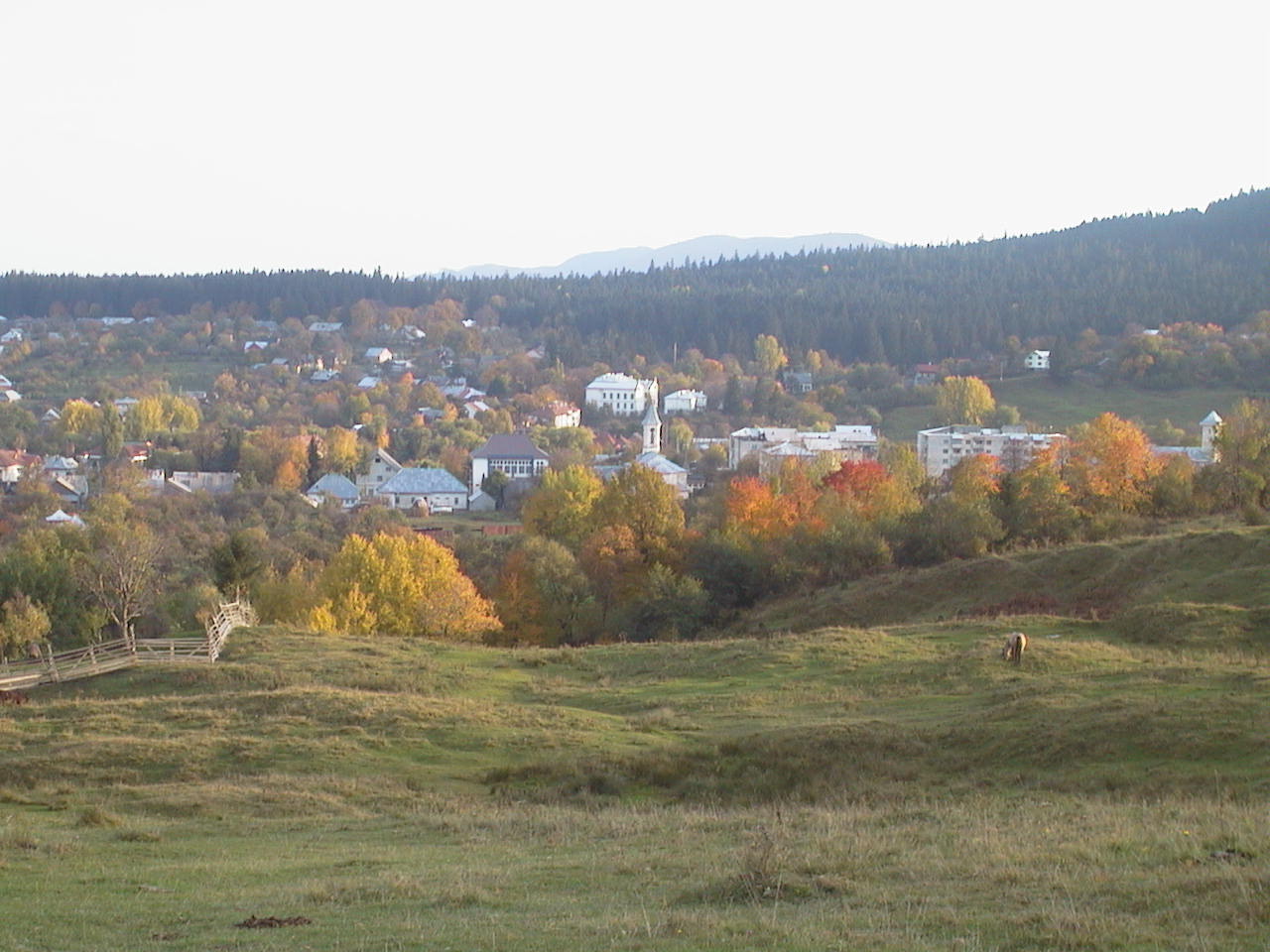
.JPG)

.JPG)

Suceava County has 5 municipalities, 11 towns, and 98 communes.
-
Municipalities
- Câmpulung Moldovenesc
- Fălticeni
- Rădăuți
- Suceava – county seat (); population within town limits: 124,161 (as of 2018)
- Vatra Dornei
-
Towns
- Broșteni
- Cajvana
- Dolhasca
- Frasin
- Gura Humorului
- Liteni
- Milișăuți
- Salcea
- Siret
- Solca
- Vicovu de Sus
-
Communes
- Adâncata
- Arbore
- Baia
- Bălăceana
- Bălcăuți
- Berchișești
- Bilca
- Bogdănești
- Boroaia
- Bosanci
- Botoșana
- Breaza
- Brodina
- Bunești
- Burla
- Cacica
- Calafindești
- Capu Câmpului
- Cârlibaba
- Ciocănești
- Ciprian Porumbescu
- Comănești
- Cornu Luncii
- Coșna
- Crucea
- Dărmănești
- Dolhești
- Dorna-Arini
- Dorna Candrenilor
- Dornești
- Drăgoiești
- Drăgușeni
- Dumbrăveni
- Fântâna Mare
- Fântânele
- Forăști
- Frătăuții Noi
- Frătăuții Vechi
- Frumosu
- Fundu Moldovei
- Gălănești
- Grămești
- Grănicești
- Hănțești
- Hârtop
- Horodnic de Jos
- Horodnic de Sus
- Horodniceni
- Iacobeni
- Iaslovăț
- Ilișești
- Ipotești
- Izvoarele Sucevei
- Mălini
- Mănăstirea Humorului
- Marginea
- Mitocu Dragomirnei
- Moara
- Moldova-Sulița
- Moldovița
- Mușenița
- Ostra
- Păltinoasa
- Panaci
- Pârteștii de Jos
- Pătrăuți
- Poiana Stampei
- Poieni-Solca
- Pojorâta
- Preutești
- Putna
- Rădășeni
- Râșca
- Sadova
- Șaru Dornei
- Satu Mare
- Șcheia
- Șerbăuți
- Siminicea
- Slatina
- Straja
- Stroiești
- Stulpicani
- Sucevița
- Todirești
- Udești
- Ulma
- Vadu Moldovei
- Valea Moldovei
- Vama
- Vatra Moldoviței
- Verești
- Vicovu de Jos
- Voitinel
- Volovăț
- Vulturești
- Zamostea
- Zvoriștea
-
Villages
- Probota
- Solonețu Nou
2010 floods
During June 2010, Gheorghe Flutur, at that time (as now) the president of Suceava County Council, stated in a Mediafax interview that his county was one of the worst hit in the country. In the morning of June 29, relief work was coordinated to deal with the flooding that killed 21 people and caused hundreds to be evacuated from their homes.
Gallery
File:Piatra Fântânele 1.jpg|Tihuța Pass – connecting Bukovina to neighbouring westward Transylvania File:Prislop pass08.jpg|Prislop Pass File:Bukovina.JPG|Ciumârna (Palma) Pass File:Pietrosu Bistriței - panoramio.jpg|Pietrosul Bistriței peak, Bistrița Mountains (1791 m) File:Conacul Andreica - panoramio.jpg|Traditional Romanian inn by a countryside road File:Bucovina1.cristibur.jpg|Hills covered in fog in the countryside File:Forest in Bukovina's Hearth (Ciocanesti, Romania).jpg|Part of the forested Carpathian Mountains near Ciocănești File:Aprilie - panoramio (1).jpg|Crucea Commune File:Biserica Alba din Baia9.jpg|Romanian Orthodox white church in Baia () File:Catedrala Catolică din Baia3.jpg|15th century Roman Catholic cathedral ruins built by the Transylvanian Saxons in Baia () File:Rumunia, Kaczyka, kościół rzymskokatolicki DSCF7626.jpg|Cacica () File:SolonetuNou.jpg|Solonețu Nou () village File:Biserica Preasfanta Inima a lui Isus din Poiana Micului.jpg|Poiana Micului () File:RO SV Iacobeni (46).JPG|The town hall of Iacobeni () File:Biserica romano-catolica din Prisaca Dornei1.jpg|Prisaca Dornei () File:RO SV Valea Putnei (4).JPG|Valea Putnei () File:Straja.JPG|Straja () File:Romania Putna Biserica Coborârea Duhului Sfânt din Putna.jpg|Roman Catholic church in Gura Putnei () File:Adam si Eva - panoramio.jpg|Mountainous landscape near Câmpulung Moldovenesc File:Mocanita Hutulca - Moldovita - panoramio.jpg|Mocăniță narrow-gauge railway steam train File:Dumbraveni - Suceva (557456324).jpg|Dumrăveni File:Defense walls.jpg|Mitocu Dragomirnei () File:Humor monastery5.jpg|Mănăstirea Humorului () File:Manastirea putna1.jpg|Putna Monastery File:Weidelandschaft bei Moldovita.JPG|Moldovița () File:Karpatenlandschaft bei Slatioara.JPG|Slătioara secular forest, UNESCO World Heritage Site File:RO SV Panaci meadow.jpg|Meadows in Panaci File:Biserica romano-catolica din Falticeni14.jpg|Downtown Fălticeni () File:Gara Veresti1.jpg|Verești File:Conacul Sturdza din Salcea.jpg|Sturdza manor in Salcea
Notable natives and residents
- Anca Parghel – Romanian-Romani musician and jazz singer
- Matei Vișniec – Romanian-French playwright
- Nichita Danilov – Lipovan poet
- Iulian Vesper – Romanian poet and writer
- Nicolae Labiș – Romanian poet
- Grigore Vasiliu Birlic – Romanian actor
- Ion G. Sbiera – Romanian folklorist
- Ion Costist – Romanian 16th century Roman Catholic monk
- Liviu Giosan – Romanian-American marine geologist
- Elisabeta Lipă – Romanian Olympic rower
- Dorin Goian – Romanian football player
- Constantin Schumacher – Romanian-German footballer
- Józef Weber – German Roman Catholic archbishop
- Elisabeth Axmann – German writer
- Otto Babiasch – German Olympic boxer
- Lothar Würzel – German linguist, journalist, and politician
- George Ostafi – German abstract painter
- Hugo Weczerka – German historian and academician
- Anton Keschmann – German politician in the Imperial Austrian Parliament
- Olha Kobylianska – Ukrainian-German writer
- Ludwig Adolf Staufe-Simiginowicz – Ukrainian-German writer and educator
- – Romanian painter and stage designer
Historical county
In the Kingdom of Romania, between the early 20th century up to the end of the 1940s, the county had a smaller size and population.
The contemporary Suceava county is the result of the merger of other smaller former Romanian counties from the historical regions of Bukovina and Western Moldavia that were functional mostly throughout the interwar period (e.g. Rădăuți County, Câmpulung County) and part of Baia County). As per the administrative reform of 1938 under King Carol II, the whole counties which divided Bukovina in the Kingdom of Romania were united into a bigger land called Ținutul Suceava. Later, during World War II, Suceava County was part of the Bukovina Governorate of Romania.
As for the historical interwar Suceava County, this administrative unit was located in the northern part of Greater Romania and the southern part of the historical region of Bukovina respectively. Its territory was situated entirely within the borders of the current Suceava County, constituting thus the central-eastern part of the contemporary namesake county. During the interwar period, it was the smallest county of Greater Romania by area, covering 1309 sqkm.
It was bordered on the east by the counties of Dorohoi and Botoșani, to the north by Rădăuți County, to the west by Câmpulung County, and to the south by Baia County.
During the communism period, Suceava County was at some point dissolved (as were all other counties in Romania as per the law no. 5 from 6 September 1950), then changed into the Suceava Region and then re-organized once again as county starting from 1968.
File:Tinutul Suceava CoA.png|The coat of arms of Ținutul Suceava (1938–1940) File:RSR Jud Suceava.png|The communist coat of arms of Suceava County File:CoASuceavaCounty.png|Alternative contemporary coat of arms of Suceava County
Administrative organization
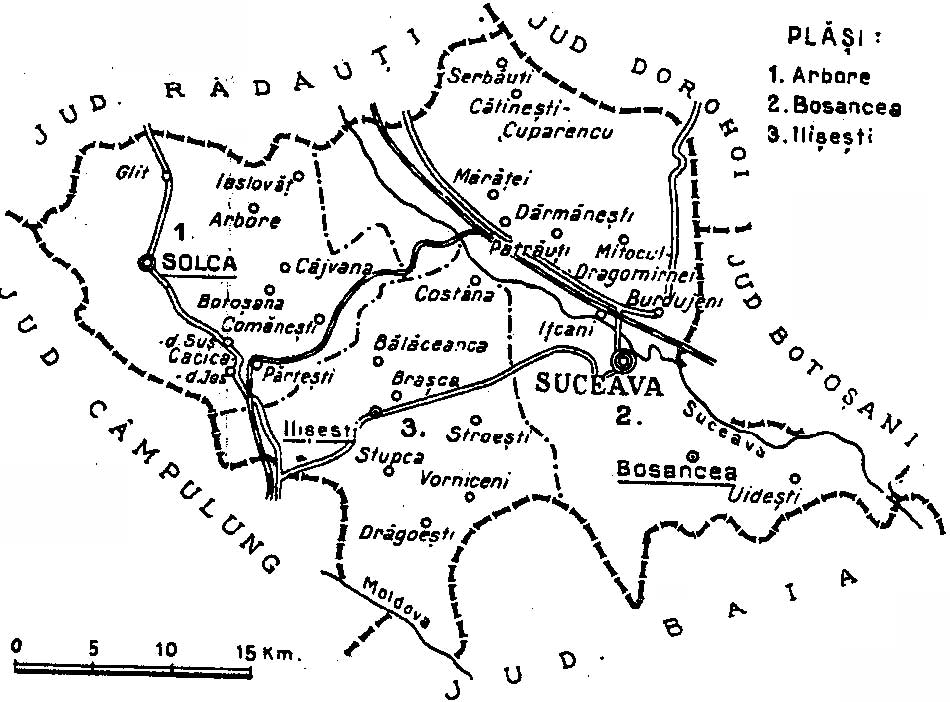
As of 1930, the county was administratively subdivided into three districts (plăși):
- Plasa Arbore, headquartered at Arbore
- Plasa Dragomirna, headquartered at Dragomirna
- Plasa Ilișești, headquartered at Ilișești
In 1938, the county was administratively reorganized into the following districts:
- Plasa Arbore, headquartered at Solca (containing 15 villages)
- Plasa Bosancea, headquartered at Bosancea (including 36 villages)
- Plasa Ilișești, headquartered at Ilișești (including 17 villages)
Population
According to the 1930 census data, the county population was 121,327, ethnically divided among Romanians (79.5%), Germans (primarily Bukovina Germans but also Zipsers) (8.2%), Jews (5.5%), Poles (2.7%), Ukrainians (1.7%), as well as other ethnic minorities.
By language the county was divided among Romanian (76.5%), German (9.4%), Ukrainian (5.5%), Yiddish (4.3%), Polish (2.5%), as well as other languages. From the religious point of view, the population consisted of Eastern Orthodox (80.1%), Roman Catholic (8.4%), Jewish (5.5%), Evangelical Lutheran (3.3%), Greek Catholic (1.4%), as well as other minor religions.
Urban population
The county's urban population consisted of 19,850 inhabitants (17,028 in Suceava and 2,822 in Solca), ethnically divided among Romanians (61.5%), Jews (18.7%), Germans (13.9%), Poles (2.6%), as well as other ethnic minorities.
As a mother tongue in the urban population, Romanian (60.4%) predominated, followed by German (18.7%), Yiddish (13.8%), Ukrainian (3.2%), Polish (2.2%), as well as other minor spoken languages. From the religious point of view, the urban population consisted of 60.6% Eastern Orthodox, 18.8% Jewish, 15.3% Roman Catholic, 2.0% Greek Catholic, 1.7% Evangelical Lutheran, 0.7% Baptist as well as other confessional minorities.
Notes
References
References
- The number used depends on the numbering system employed by the phone companies on the market.
- National Institute of Statistics, ''[http://www.insse.ro/rpl2002rezgen/18.pdf "Populația la recensămintele din anii 1948, 1956, 1966, 1977, 1992 și 2002"]''
- (2022). "Rezultate definitive: Caracteristici demografice". INSSE.
- National Institute of Statistics, ''[http://www.recensamant.ro/pagini/tabele/t40a.pdf "Populația după etnie"] {{Webarchive. link. (2009-08-16 '')
- (2007). "Encyclopaedia Judaica.". Gale Group.
- Jean Ancel, ''The History of the Holocaust in Romania'' (Lincoln, University of Nebraska Press and Jerusalem, Yad Vashem, 2011) p. 539.
- "Situatie Numerica de evreii ucisi sub regimul de dictatura din Romania de la data de 6 decembrie 1940, pana la 23 august 1944, precum si acelor deportati in acelasi interval de timp si nereintorsi la domiciliu", in "Nota Ministerului Afacerilor Interne, Directia Generala a Politiei, Directia Politiei de Siguranta, Sectia Nationalitati Nr. 780-S din 6 Main 1946 Catre M.A.S.", in Ion Calafeteanu, Nicolae Dinu and Teodor Gheorghe, ''Emigrarea Populatiei Evreiesti din Romania in 1940-1944, Culegere de Documente din Arhiva Ministerului Afacerilor Externe al Romaniei'' (Bucuresti, Silex - Casa de Editura, Presa si IMpresariat S.R.L., Bucuresti, 1993), p. 246.
- Goldenshteyn, Maksim Grigoriyevich, ''So they remember: a Jewish family's story of surviving the Holocaust in Soviet Ukraine'' (Norman: University of Oklahoma Press, 2022), p. 86.
- Gali Mir-Tibon, "Am I My Brother's Keeper? Jewish Committees in the Ghettos of the Mogilev District and the Romanian Authorities in Transnistria, 1941-1944", in Wendy Z. Goldman and Joe William Trotter, Jr., ''The Ghetto in Global History, 1500 to the Present'' (London and New York: Routledge, 2018), p. 139.
- Sandrinio Neagu. (4 May 2018). "Suceava pe primul loc la nivel național în privința spațiilor comerciale". Monitorul de Suceava.
- Monica Bonea. (10 June 2022). "Gheorghe Flutur: Proiecte de un miliard de euro din PNRR pentru Suceava". Digi24.ro.
- (22 October 2017). "Județul Suceava pe locul trei ca număr de structuri de primire turistică după Brașov și Constanța (in Romanian)". News Bucovina.
- Dan Coman. "Flutur a primit, la Bruxelles, premiul "Suceava, destinație europeană de excelență" (in Romanian)". Radio România Internațional.
- Dan Coman. (26 April 2017). "Consiliul Judeţean Suceava a împlinit 25 de ani de la înfiinţare". Monitorul de Suceava.
- Biroul Electoral Central (BEC). (10 August 1992). "Comunicat din 9 februarie 1992 cu privire la rezultatul alegerilor locale din România, care au avut loc la data de 9 februarie 1992". Monitorul Oficial nr. 191 din 10 august 1992.
- "Alegeri locale 1996, Voturi pe județul Suceava". Autoritatea Electorală Permanentă.
- "Voturi pe județul SUCEAVA". Autoritatea Electorală Permanentă.
- (10 June 2016). "Mandate de CJ pe județe și competitori". Biroul Electoral Central.
- "Rezultatele finale ale alegerilor locale din 2020". Autoritatea Electorală Permanentă.
- "ALEȘII JUDEȚENI – Mandat 2024-2028".
- (6 May 2019). "HARTĂ INTERACTIVĂ – Câți mai suntem în România? Populația în fiecare județ și în fiecare municipiu din țară". [[National Institute of Statistics (Romania).
- "Romania floods kill 21- Hindustan Times".
- [http://romaniainterbelica.memoria.ro/judete/suceava/ Portretul României Interbelice – Județul Suceava]
- Recensământul general al populației României din 29 decemvrie 1930, Vol. II, pag. 434–437
- Recensământul general al populației României din 29 decemvrie 1930, Vol. II, pag. 738–739
This article was imported from Wikipedia and is available under the Creative Commons Attribution-ShareAlike 4.0 License. Content has been adapted to SurfDoc format. Original contributors can be found on the article history page.
Ask Mako anything about Suceava County — get instant answers, deeper analysis, and related topics.
Research with MakoFree with your Surf account
Create a free account to save articles, ask Mako questions, and organize your research.
Sign up freeThis content may have been generated or modified by AI. CloudSurf Software LLC is not responsible for the accuracy, completeness, or reliability of AI-generated content. Always verify important information from primary sources.
Report