From Surf Wiki (app.surf) — the open knowledge base
Student accommodation
Building where students reside

Building where students reside
Student accommodation is a building or buildings used to house students, particularly in higher education. These are known by different names around the world, such as halls of residence, residence halls, accommodation blocks (particularly within residential colleges) or student hostels. Student accommodation may be managed by educational institutions, religious bodies or other charities, student associations, private companies, or agencies of local or national governments.
History
Student accommodation is thought to date back to the 5th century Nalanda mahavihara, sometimes referred to as "the world's first residential university". Student accommodation appeared in the Islamic world as part of the 10th century masjid-khan (mosque-inn), the forerunner of the madrasa. In China, student accommodation was introduced during the Song dynasty (10th to 13th centuries), with students having combined sleeping and study rooms. Students were permitted to stay overnight at the Taixue from the 1050s, on the initiative of lecturers Hu Yuan and Sun Fu, possibly to avoid students being distracted by the entertainments available in Kaifeng. When a new campus for the institution was built by Li Jie in 1102, it contained 100 halls of residence housing 30 students each.

The first college at a European university was the Collège des Dix-Huit, established at the University of Paris in the late 12th century. However, the early European colleges were only for postgraduate students. Undergraduates were housed from the 12th century onwards in university-approved accommodation known as halls in Oxford, hostels in Cambridge and pedagogies in Paris. These were run by a principal but were not endowed or incorporated. By the mid 15th century there were around 50 halls at Oxford, but following the admission of undergraduates to colleges and the rise of tutorial teaching at the expense of lectures, half of these had closed by the start of the 16th century and this declined further to seven or eight by the mid 16th century.
Colleges flourished most strongly in England and France, with comparatively few medieval colleges in Spain and Italy. In Germany and other lands of the Holy Roman Empire, colleges developed as accommodation for masters rather than students and the non-collegiate halls remained until after the Reformation. Even in Paris, Oxford and Cambridge, where the colleges were strongest, they only accommodated 10 to 20 per cent of students.
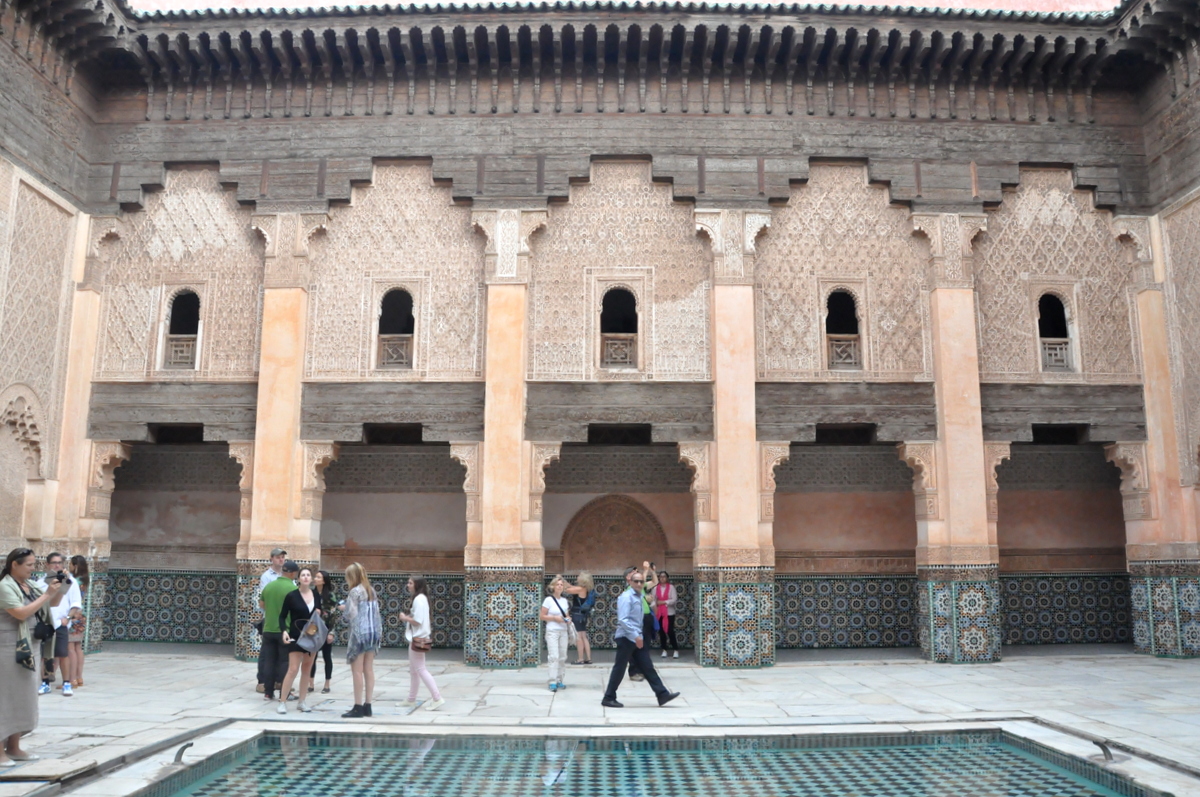
In Islamic lands, madrasas offered student accommodation within the main building. Examples include the 13th century Mustansiriyya Madrasa in Baghdad, where students were housed in individual cells, and the 14th century Al-Attarine Madrasa in Fez, Morocco, which had over 30 rooms housing around 60 students. The Madrasa Ben Youssef, built in the 16th century in Marrakesh, Morocco, had 134 student rooms arranged around 13 small courtyards to accommodate its student population. These had a reading area near the window, in the brightest part of the room, and a wooden alcove enclosing a sleeping area in the darker interior.
In the early modern period, residence in college became the norm in England and France, and was even made a legal requirement at French universities in the mid 16th century. Colleges were also important in Spain, although a majority of students there rented privately until the mid 17th century. Jesuit-run colleges drove a growth in residence in Spain in the 17th and 18th centuries. However, in Germany, Poland, Austria, the Netherlands and Bohemia, the halls fell away after the Reformation in both Catholic and Protestant regions. With the exception of the Jesuit colleges, there was a tendency for colleges to cater increasingly for wealthier students, which drove an increase in the number of colleges in Italy in the 16th and 17th century.
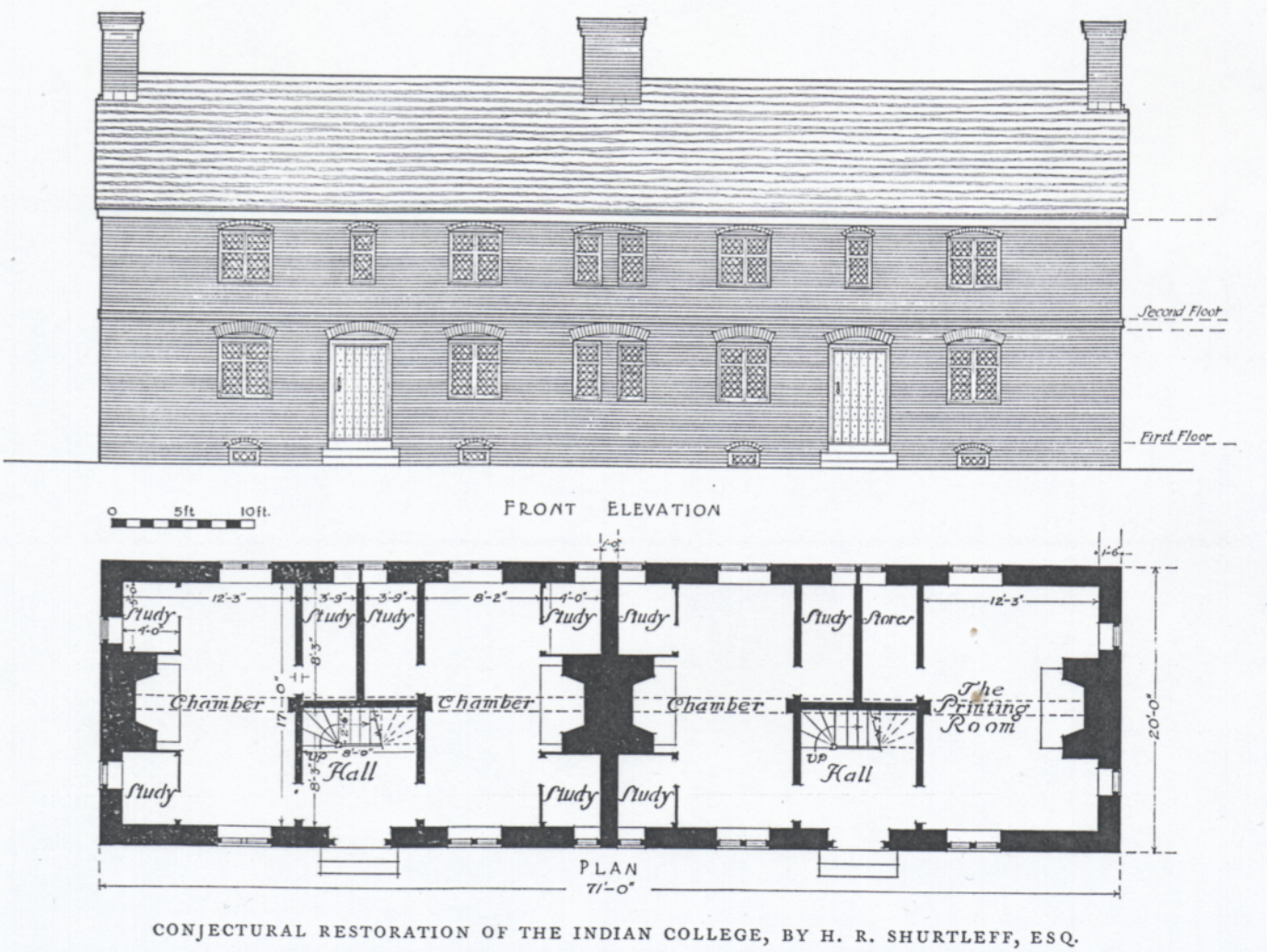
In the US colonial colleges, accommodation was often provided within the main college building in the 17th and 18th centuries. The first residential building was the Harvard Indian College in 1650. The early halls had a (normally shared) bedroom with a small study or closet off it for each student. These small rooms off a bedroom had become fashionable in Tudor England and had remained popular in the US. These could be rather small, with The Harvard Book of 1875 referring to the ones in Massachusetts Hall as "(so called) studies, or closets".
The French Revolution and the subsequent Napoleonic Wars saw the suppression of colleges in France and Spain, although some survived in Italy. In the US, Thomas Jefferson's "academical village" at the University of Virginia in the 1820s attempted to break away from the model of a large hall for student accommodation, with student rooms being directly off a classical arcade. However, the cost of building this made the university the most expensive in America, resulting in only the sons of the wealthiest families in the American South being able to attend.

In England, the expense of the colleges of Oxford and Cambridge similarly acted as a barrier to entry to those universities. This was initially replicated at Durham University, established in 1832, but a much more economical residential system was initiated there at Bishop Hatfield's Hall in 1846, with rooms let furnished and with shared servants, all meals provided in hall, and prices for both rooms and meals set in advance. It also pioneered the use of single-room study bedrooms rather than the "set" (suite) of rooms with a separate study and bedroom found in the older colleges. The study bedroom was a recent innovation at that time, with the term first recorded in 1842. These innovations inspired the foundation of private halls (later permanent private halls) at Oxford and private hostels at Cambridge in the later 19th century and were taken up by Keble College, Oxford and Selwyn College, Cambridge, subsequently becaming the standard model for residential accommodation at universities around the world.
The second half of the 19th century saw the development of fraternity and sorority housing in the US. The first residential chapter house was established in 1864 by the Kappa Alpha Society at Williams College. At many US universities, fraternities provided the only organised student accommodation.
Student accommodation was established at the Victorian redbrick universities in England in the late 19th and early 20th centuries for a number of reasons, including philanthropy, provision for female undergraduates, attracting students from outside of the local region, and because it was seen as an essential part of university life. It was not until after the first world war that university-funded halls of residence brought residential life back to continental Europe. In the UK, the University Grants Committee also identified building halls of residence as a priority for growing the provincial universities, while the inter-war period in the US saw the revitalisation of residential life with the construction of the house system at Harvard and the residential colleges at Yale.
Types
Fraternity and sorority housing
Main article: North American fraternity and sorority housing
Only found in North America, these are houses owned by student social societies known as fraternities and sororities. They are a major component of student accommodation in the US, but are also linked with reputational risk to universities and have been criticised for attracting alumni donations that might otherwise have gone to institutional projects.
Halls

Known in different countries as halls, halls of residence, residences, residence halls, dormitories or hostels, this is the basic type that describes most student accommodation. Halls are distinguished from residential colleges by students being residents for the period they live in a hall rather than members throughout their time at university, whether in residence or not. Residential colleges may have multiple residential buildings, which may be referred to as accommodation blocks or halls of residence.
Accommodation in halls is often in traditional single or multiple occupancy study-bedrooms, which may be catered or self-catered (with a shared kitchen) and have either a shared bathroom or an en suite bathroom. Studio apartments are uncommon in university-owned halls and are mainly found in private halls.
Residential colleges
Main article: Residential college
Skyscraper dormitories
.JPG)
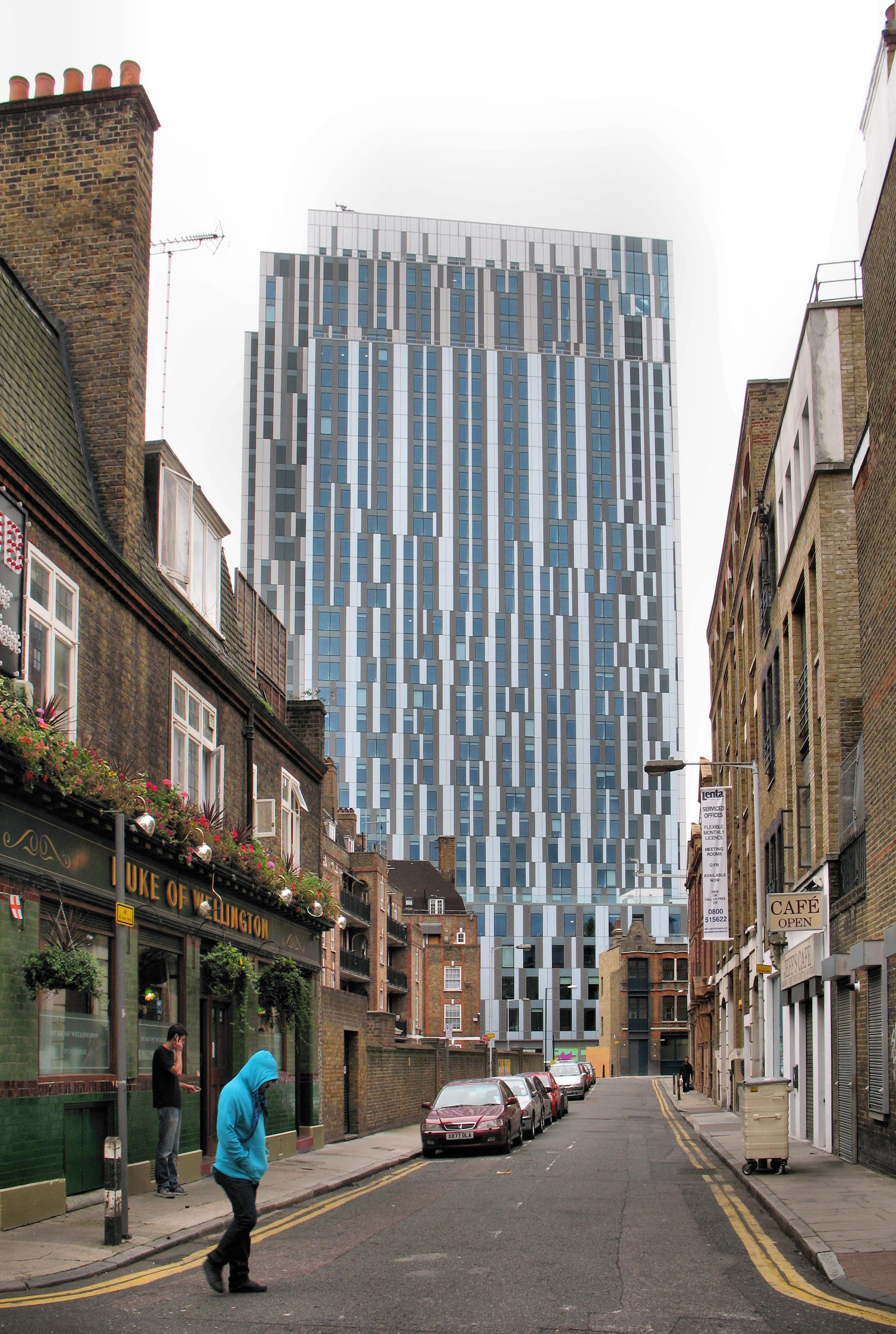
Skyscraper dormitories, termed dormitowers, have included the 93 m Fenwick Tower at Dalhousie University in Halifax, Canada, built in 1971, the 103 m Sky Plaza in Leeds, UK, built in 2009, and the 112 m Chapter Spitalfields in London, built in 2010, all of which held the title of the world's tallest purely student accommodation building when built. Some taller buildings include student accommodation among other uses, including the 132 m Het Strijkijzer in The Hague, Netherlands, the 143 m Roosevelt Tower at Roosevelt University in Chicago, and the 144 m Capri at Marymount Manhattan College in New York. The 33 Beekman Street tower at Pace University in New York, completed in 2015, was also claimed to be the world's tallest student residence, at 340 ft. Altus House in Leeds, UK, built in 2021, was described as the tallest student accommodation building in northern Europe at 116 m. The 50-storey, 485 ft 99 Washington Street tower in Manhattan, New York, originally built as a 492-room hotel, was re-opened in 2025 as the world's tallest student accommodation tower, housing 650 students. A 48-storey, 156 m tall building housing 1,068 students is planned for 30 Marsh Wall in London's Canary Wharf district, and is expected to be the tallest student accommodation building in the world when completed (planned for 2028 ).
The proposed Munger Hall dormitory at the University of California, Santa Barbara would have been the largest university dormitory in the world with 4,500 students over 12 floors. The building, nicknamed "Dormzilla", was cancelled in 2023 after controversy over the design, including that 94% of the rooms would be windowless and that there were only two exits.
Student villages

A student village refers to an area of student accommodation, normally consisting of multiple halls, which may be at a distance from the campus. Notable student villages include Turku Student Village in Finland, Cheney Student Village in the UK and Studentendorf Schlachtensee in Germany.
Townhouses

University-built townhouses, normally either on campus or in student villages, typically have the ground floor given over to shared facilities, such as a lounge and kitchen, with the upper two or three floors housing eight to twelve students.
By country
France
In France, student accommodation is provided by the state in "university residences" managed by the centres régional des œuvres universitaires et scolaires (regional centres for university and school works) for holders of government scholarships. For other students, accommodation is provided through private "student residences" or through private rental. In Paris, the Cité Internationale Universitaire de Paris provides accommodation for around 6,000 postgraduate students from around the world.
Germany

In Germany, student accommodation is called Studentenwohnheim (plural: Studentenwohnheime). Many of these are run by Studentenwerke (student services organisations), which have around 195,000 spaces across the country in over 1,700 halls, or by Studierendenwerke (students' unions). Some Studentenwohnheime are run by social organisations or by Catholic or Protestant churches; many of these take students of any denomination or religion. These facilities are sometimes single-sex. At either church or social organisation residences students may be required to participate in service activities. Private halls normally cost more than church or social organisation halls, or students' union halls.
India
In India, student accommodation is called "student hostels". Many colleges and universities have hostels on-campus, but this is frequently insufficient for the number of students enrolled. Most students prefer to stay off-campus in private "paying guest" (PG) accommodation and private hostels as these usually have better amenities and services. For example, in 2015 an estimated 180,000 students enrolled with Delhi University, there are only about 9,000 beds available in its hostels for both undergraduate and postgraduate students. The university admits an average of 54,000 students every year. This leaves a majority of students having to find accommodation off-campus. This has led to a lot of student hostel or student PG chains being established near Delhi University.
United Kingdom
Historical development

Until the mid 19th century, students at residential universities in England lived in colleges, where they rented a set of unfurnished rooms, paid their own servants, and bought their own meals. The first change from this came with the foundation of Bishop Hatfield's Hall (now Hatfield College) by David Melville at Durham University in 1846. This introduced three key concepts: rooms would be let furnished, all meals would be taken communally, and all expenses would be reasonable and fixed in advance, which combined to make the cost of accommodation in the hall much lower than in colleges. Melville also introduced single room study-bedrooms and, in 1849, opened the first purpose-built hall of residence in the country at Hatfield. The Oxford University Commission of 1852 found that "The success that has attended Mr. Melville's labours in Hatfield Hall at Durham is regarded as a conclusive argument for imitating that institution in Oxford"; this report led to a requirement in the Oxford University Act 1854 that Oxford allow the establishment of private halls, although these halls were never very successful.
The 19th century London colleges were originally non-residential. King's College London established a hall for theological students in a house adjacent to the college in 1847, although this only lasted until 1858.{{cite book|chapter-url=http://www.british-history.ac.uk/vch/middx/vol1/pp345-359#h3-0005|pages=345–349|chapter=The University of London: The Constituent Colleges|title=A History of the County of Middlesex|via=British History Online|date=1969|author1=J S Cockburn|author2= H P F King |author3=K G T McDonnell| publisher=Victoria County History}} University Hall was opened in 1849 by a group of mainly Unitarian Dissenters for students at University College London. This also struggled until taken over by Manchester New College in 1881, after which it flourished for a period but was subsequently closed when that college moved to Oxford in 1890. Bedford College, London, at the time the only women's college in Britain, opened a residence in 1860. College Hall, London was established in 1882 for women students at University College London (which had become mixed a few years earlier) and the London School of Medicine for Women. Like the other London halls (with the exception of the Bedford College residence) this was initially private, but was taken over by the University of London in 1910.
The provincial university colleges that became the redbrick universities were established as non-residential institutions in the 19th century, but later became the universities most closely associated with the development of halls of residence (as distinct from the residential colleges of the older universities). William Whyte identifies four main drivers for the building of halls of residence in the late 19th and early 20th centuries. These were: firstly, for philanthropic reasons (often linked to religion), such as the Anglican St Anselm Hall (1872/1907) and the Quaker Dalton Hall (1881), both at Owens College (now the University of Manchester); secondly, to provide safe accommodation for female undergraduates, who it was felt at that time could not live in lodgings; thirdly, to attract students from more distant parts of the country, particularly for university colleges in smaller urban areas such as Reading, Exeter and Leicester; and fourthly, because residential provision was becoming seen as an essential element of university life, allowing for the development of community.
In 1925, the University Grants Committee identified the need for more halls of residence as the most urgent of its priorities. A report for the Committee of Vice Chancellors and Principals in 1948 found that, in 1937–38, the highest percentages of students in colleges and halls of residence (outside of Oxford and Cambridge) were at Exeter (79 per cent), Reading (76 per ent), Southampton (65 per cent), Nottingham (42 per cent), Bristol (36 per cent) and Durham (32 per cent across both Durham and Newcastle divisions); all other universities were below 25 per cent. Funding in the post-war period led to the construction of many new halls, with 67 built between 1944 and 1957. Yet the expansion of higher education in this same period meant that the proportion of students in halls hardly increased: while between 1943 and 1963 the number of students living at home fell from 42 per cent to 20 per cent, the number in private lodgings increased from 33 per cent to 52 per cent, leading to the Robbins Report identifying a need for "a very great increase in the housing provided by universities".
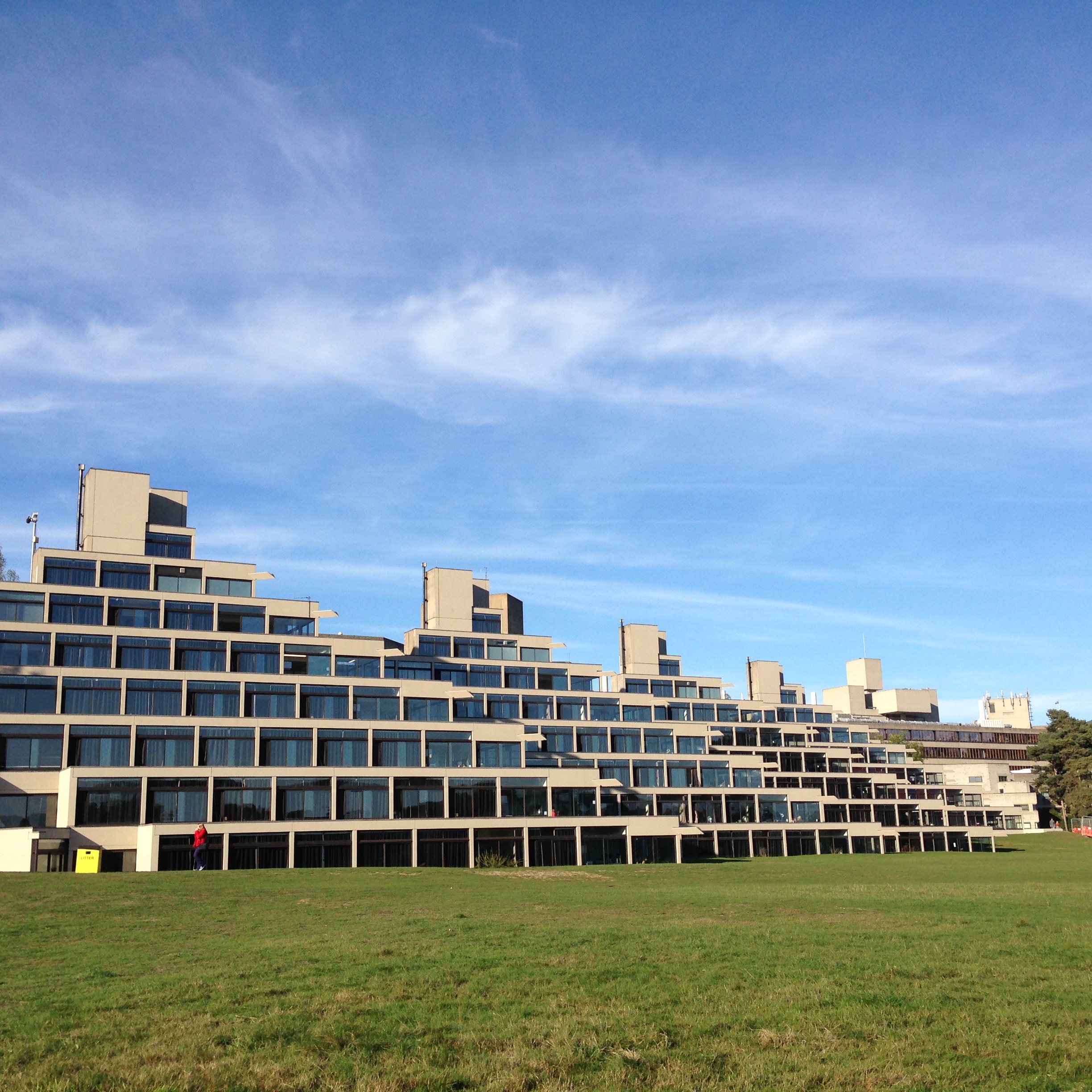
The post-war expansion in halls of residence meant universities looked for relatively cheap and quick construction, turning to functional modern architecture rather than the more traditional designs of earlier halls. Notable architects involved in designing halls of residence in this period included Basil Spence, who designed the University of Southampton's Highfield Campus and the University of Sussex, Denys Lasdun's "five minute university" at the University of East Anglia, including its 'ziggurat' halls of residence, and James Stirling's Andrew Melville Hall at the University of St Andrews, "one of the most significant post-war buildings in Scotland" according to Historic Environment Scotland.
Current halls of residence
Most UK universities provide accommodation in halls for first year students who make a firm acceptance of their offer, although this may not extend to students who enter via clearing. Halls accommodation most commonly consists of shared flats, but rooms may also be arranged 'dorm-style' along corridors. Rooms may be en suite or there may be a shared bathroom for the flat or corridor. Halls may be catered, part-catered or self-catered. Most universities offer single-sex flats within halls and there are a few halls (such as Aberdare Hall at Cardiff University) that are entirely single-sex, but others (such as University College London) offer only mixed accommodation. Most university or college-managed halls of residence are covered by Universities UK and Guild HE's accommodation code of practice.

Private halls of residence, also known as purpose-built student accommodation (PBSA), are available in many university towns and cities. Many are covered by the Accreditation Network UK Code of Standards for Larger Developments, and housing services at some universities (such as the University of London) will only list accredited PBSAs. Many halls are delivered in partnership between educational establishments and private developers, and both codes include the same methodology for defining whether a hall counts as "managed and controlled by an educational establishment", making it a university hall, or is a private hall. Private halls may include facilities such as common rooms, gyms and study spaces. Private halls are often the most expensive accommodation option available in university towns. Some of the companies which have developed such accommodation are based offshore, which has led to concerns about tax avoidance and evasion of sanctions on Russian owners.
In the 2021/22 academic year, 347,680 (16 per cent) of the UK's 2,185,665 students were living in accommodation maintained by their higher education provider (either halls or colleges) and 200,895 (nine per cent) were in private-sector halls.
Within London, the London Plan that was adopted in 2021 specified that PBSAs had to have a minimum of 35 per cent of rooms rented at 55 per cent or less of the maximum student loan for London. However, this has had the effect of making PBSAs not financially viable in more expensive areas of London, so development of new PBSAs has been primarily in outer London. A majority of rooms, including all of the affordable rooms, also had to be linked to a university via a contractural nomination agreement. As this puts financial risks on the institutions, particularly with uncertainties over international student recruitment, this has led to the four richest institutions (Imperial College London, King's College London, London School of Economics and University College London) dominating the supply of new halls. Analysis of student numbers in London has shown that, as of 2024, 111,000 students are guaranteed a place in halls (including contracted private halls) by their universities but that there were only around 100,000 beds in university halls and private PBSAs. This has led University College London to remove their housing guarantee for incoming students and replace it with a system of priority groups.
Studies in Australia, New Zealand and the UK have shown that international students prefer to live in PBSAs while domestic students prefer houses in multiple occupation, raising concerns that PBSAs drive geographies of exclusion, with international and domestic students becoming segregated.
United States
.jpg)


In the early colonial colleges, residence was often provided for students within the main college building, such as the Wren Building at the William & Mary (1705) and Nassau Hall at Princeton (1756); these went on to inspire other "Old Main" buildings, combining academic functions with accommodation. The first primarily residential building was the Harvard Indian College (1650), which also contained a printing press, while the first exclusively residential building was Stoughton Hall (1698), also at Harvard.
Most colleges and universities provide single or multiple occupancy rooms for their students, usually at a cost. These buildings consist of many such rooms, like an apartment building. The largest dormitory building in the US is said to be Bancroft Hall at the United States Naval Academy, housing 4,400 midshipmen in 1,700 multiple occupancy rooms.
Many colleges and universities no longer use the word "dormitory" and staff are now using the term residence hall (analogous to the United Kingdom "hall of residence") or simply "hall" instead. Outside academia however, the word "dorm" or "dormitory" is commonly used without negative connotations. Indeed, the words are used regularly in the marketplace as well as routinely in advertising.
Typically, a United States residence hall room holds two students with no toilet. This is usually referred to as a "double". Often, residence halls have communal bathroom facilities. In the United States, residence halls are sometimes segregated by sex, with men living in one group of rooms, and women in another. Some dormitory complexes are single-sex with varying limits on visits by persons of each sex. For example, the University of Notre Dame in Indiana has a long history of parietals, or mixed visiting hours. Most colleges and universities offer coeducational dorms, where either men or women reside on separate floors but in the same building or where both sexes share a floor but with individual rooms being single-sex. In the early 2000s, dorms that allowed people of opposite sexes to share a room became available in some public universities. Some colleges and university coeducational dormitories also feature coeducational bathrooms. Many newer residence halls offer single rooms as well as private bathrooms, or suite-style rooms.
Most residence halls are much closer to campus than comparable private housing such as apartment buildings. This convenience is a major factor in the choice of where to live since living physically closer to classrooms is often preferred, particularly for first-year students who may not be permitted to park vehicles on campus. Universities may therefore provide priority to first-year students when allocating this accommodation.
Hall councils
Halls may have student representative organisations, often connected to the residence life department, known as hall councils, area councils (for multiple halls in an area) or hall governments. At the campus level, there may be a residence hall association or an inter-hall council. These organise events and provide advocacy for resident students as opposed to the wider student body.
References
- "Student accommodation". Collins Dictionary.
- Sugato Mukherjee. (23 February 2023). "Nalanda: The university that changed the world". BBC News.
- Bhattacharya, Debaditya. (3 September 2018). "The Idea of the University: Histories and Contexts". Taylor & Francis.
- Fındıklı, Burhan. (19 March 2021). "Rethinking ancient centers of higher learning: madrasa in a comparative-historical perspective". British Journal of Educational Studies.
- Yang Tingting. (13 September 2024). "Why Are Chinese College Students Shunning Dorm Living?".
- Ming-kin Chu. (2020). "The Politics of Higher Education: The Imperial University in Northern Song China". Hong Kong University Press.
- "History of the Hall".
- Alfred Brotherston Emden. (1927). "An Oxford Hall in Medieval Times". Clarendon Press.
- Rainer Christoph Schwinges. (1992). "[[A History of the University in Europe]]". Cambridge University Press.
- "Madrasa al-Mustansiriyya". Massachusetts Institute of Technology.
- "‘Attarin Madrasa". [[Museum with No Frontiers]].
- "Architecture of the Madrasa Ben Youssef".
- "The History of the Madrasa Ben Youssef".
- Rainer A. Müller. (1996). "[[A History of the University in Europe]]". Cambridge University Press.
- [[Samuel Eliot Morison]]. (1936). "Harvard College in the Seventeenth Century". [[Harvard University Press]].
- Mary R. Springer. (Spring 2020). "Review of Living on Campus: An Architectural History of the American Dormitory, by Carla Yanni". Panorama: Journal of the Association of Historians of American Art.
- [[Andrew Burnaby]]. (1775). "Travels through the Middle Settlements in North-America. In the years 1759 and 1760. With observations upon the state of the colonies".
- "Diary of John Quincy Adams".
- [[Bill Bryson]]. (2011). "At Home: A Short History of Private Life". [[Doubleday (publisher).
- Megan Lane. (12 April 2011). "The story of our rooms". BBC News Magazine.
- (1875). "The Harvard Book".
- "Historia de los Colegios Mayores Universitarios".
- (2023). "Colegio Ghislieri International Students Handbook".
- "Thomas Jefferson's Plan for the University of Virginia: Lessons from the Lawn (Teaching with Historic Places)".
- Nicole Penn. (26 June 2022). "The Contradictions of Jefferson’s Vision for an American University". [[The Bulwark (website).
- Matthew Andrews. (June 2018). "Universities in the Age of Reform, 1800–1870". Springer International Publishing.
- "Brief History of Hatfield".
- (7 May 2005). "Building renamed in founder's honour". [[The Northern Echo]].
- (15 December 2023). "Hatfield College".
- "Glossary of Cambridge-related terminology: Set".
- "Study bedroom". Oxford English Dictionary.
- (1852). "Report of Her Majesty's Commissioners Appointed to Inquire Into the State, Discipline, Studies, and Revenues of the University and Colleges of Oxford". [[HMSO]].
- W. W. Grave. (1983). "Fitzwilliam College Cambridge, 1869-1969". Fitzwilliam Society.
- H. J. R.. (7 October 1909). "College reform under the Cambridge University Act of 1856". St. John's College, Cambridge.
- John William Adamson. (1919). "A Short History of Education". Cambridge University Press.
- Matthew Andrews. (June 2018). "Universities in the Age of Reform, 1800–1870". Springer International Publishing.
- Phyllis Weliver. (2017). "Mary Gladstone and the Victorian Salon: Music, Literature, Liberalism". Cambridge University Press.
- Josceline Dimbleby. (2007). "May and Amy". Crown Publishing Group.
- (2022). "Durham Weather and Climate". Oxford University Press.
- John Robson. (1963). "Baird's Manual of American College Fraternities". The George Banta Company, Inc..
- [[William Whyte (historian). (6 October 2015). "Residential Institutions in Britain, 1725–1970: Inmates and Environments". Routledge.
- Paul Getbod. (2004). "[[A History of the University in Europe]]". Cambridge University Press.
- (January 2003). "Housing Students: Fraternities and Residential Colleges". The Annals of the American Academy of Political and Social Science.
- "Hall".
- "Hall of residence".
- "Ursula Hall Main Wing".
- "Accommodation".
- "Residence Halls".
- "Dormitory".
- Grunebaum, Jason. (2013). "[[In Translation: Translators on Their Work and what it Means]]". [[Columbia University Press]].
- "Hall of residence". Merriam-Websteraccess-date=31 August 2025.
- "Residence hall". Merriam-Webster.
- Robert J. O'Hara. "How to Build a Residential College".
- (25 May 2022). "Cambridge University student digs voted regional building of the year". BBC News.
- "Accommodation & Meals".
- Sarah Wood. (24 April 2023). "Living on Campus: A Guide to College Housing". US News.
- (August 2020). "Student Accommodation: The Facts". Higher Education Policy Institute.
- (2010). "Talking Tall: Dormitowers". [[Council on Tall Buildings and Urban Habitat]].
- Amy DiLuna. (22 October 2015). "33 Beekman: Take a Peek Inside the World's Tallest College Dorm". NBC News.
- Miran Rahman. (19 August 2021). "Tallest student accommodation building in northern Europe is completed". The Business Desk.
- Vicentiu Fusea. (13 November 2025). "FOUND Study Debuts Hotel-to-Student Housing Conversion". Multi-Housing News.
- "Marsh Wall".
- (5 August 2022). "Tide wins full permission for 48-storey modular tower". Housing Today.
- Aaron Morby. (27 February 2025). "Funding deal for £237m Tide Construction student tower". Construction Enquirer.
- Ramishah Maruf. (1 November 2021). "Warren Buffett's billionaire partner bankrolls windowless dorm. An architect quit". CNN Business.
- Daniel Jonas Roche. (9 August 2023). "University of California abandons plans to build "windowless dorm" Munger Hall". The Architect's Paper.
- (August 2020). "Student Accommodation: The Facts". Higher Education Policy Institute.
- (19 June 2024). "Where to live during your stay".
- Emma Ruffenach. (9 September 2001). "Le marché des résidences étudiantes marque le pas". [[Le Figaro]].
- Gérard Courtois. (25 February 1988). "Malaise dans les cités universitaires". [[Le Monde]].
- "Accommodation".
- "Student halls of residence".
- "Privately run student halls of residence".
- (28 May 2017). "Is Delhi University ready for 2017-18?". The New Indian Express.
- (14 April 2017). "Hostels with AC rooms, free wi-fi, housekeeping: Student housing has arrived". Hindustan Times.
- Sai Rama Raju Marella. (12 August 2025). "Recognising PGs as homes may solve Bengaluru’s rental housing crisis". Deccan Herald.
- (14 June 2015). "With Hostel Shortage in Delhi University, Students Demand Implementation of Rent Act". NDTV.com.
- (15 June 2015). "Hostel crunch has Delhi University students clamouring for living space". The Hindu.
- (26 May 2016). "CoHo Dorms offer alternatives to Hostels and PGs in DU". DU Beat.
- L. W. B. Brockliss. (15 April 2016). "The University of Oxford: A History". Oxford University Press.
- "University Hall".
- "Bedford College Papers".
- "College Hall".
- William Whyte. (November 2019). "Somewhere to live: Why British students study away from home – and why it matters". HEPI.
- (1948). "The Planning of University Halls of Residence". Clarendon Press.
- "Back to School in the Mid-20th Century: Modernist Student Accommodation".
- "Chamberlain Hall of Residence, Highfield Campus, University of Southampton: the Junior Common Room".
- "Halls of Residence, University of Sussex, Falmer".
- {{National Heritage List for England
- {{Historic Environment Scotland
- "Student halls and houses".
- "Aberdare Hall".
- (30 October 2018). "Frequently asked questions".
- "Types of contracts, halls and rooms".
- "Your right to a quality home". Universities UK and Guild HE.
- "Registered Independent Halls of Residence".
- "National Code".
- Annex A of the UUK/Guild HE code; Annex 1 of the ANUK code
- "10 things to consider when choosing student accommodation in the UK".
- (16 January 2018). "How to find the right student accommodation for you".
- "Student accommodation guide #3: private halls".
- (28 May 2018). "Revealed: the developers cashing in on privatisation of student housing". The Guardian.
- Jim Armitage. (27 February 2022). "Feeble property rules keep Russian owners' identities in the shadows". The Times.
- "Table 57 - Full-time and sandwich HE student enrolments by HE provider and term-time accommodation 2014/15 to 2021/22".
- David Tymms. (3 June 2024). "The London Plan and Purpose Built Student Accommodation Three Years On – Panacea for Growth or Painful Progress?".
- (2024). "Exploring Student Housing Demand, Supply Side and Planning Policy Responses in a Small University City: Studentification in Durham, UK". Housing Policy Debate.
- "U.S. Naval Academy, Bancroft Hall, Annapolis, Anne Arundel County, MD".
- "Bancroft Hall (Dorms)".
- (2002-02-26). "In student housing, is the coed room the wave of the future?". Pittsburgh Post-Gazette.
- (2010-04-18). "Considering Unisex Bathrooms in College Decision". The New York Times.
- "Advising RHA, NRHH, & Hall Council".
This article was imported from Wikipedia and is available under the Creative Commons Attribution-ShareAlike 4.0 License. Content has been adapted to SurfDoc format. Original contributors can be found on the article history page.
Ask Mako anything about Student accommodation — get instant answers, deeper analysis, and related topics.
Research with MakoFree with your Surf account
Create a free account to save articles, ask Mako questions, and organize your research.
Sign up freeThis content may have been generated or modified by AI. CloudSurf Software LLC is not responsible for the accuracy, completeness, or reliability of AI-generated content. Always verify important information from primary sources.
Report