From Surf Wiki (app.surf) — the open knowledge base
Studebaker President
| Field | Value |
|---|---|
| name | Studebaker President |
| manufacturer | Studebaker |
| production | 1926–1942 |
| 1955–1958 | |
| class | Full-size (1926-1942) (1955-58) |
| layout | FR layout |
| image | 1957 Studebaker President (40273012080).jpg |
| caption | 1957 Studebaker President |
| assembly | Studebaker Automotive Plant, South Bend, Indiana, United States |
| predecessor | Studebaker Big Six (1926) |
1955–1958
The Studebaker President was the premier automobile model manufactured by the Studebaker Corporation of South Bend, Indiana (US) from 1926 until 1942. The nameplate was reintroduced in 1955 and used until the end of the 1958 model when the name was retired.
First generation
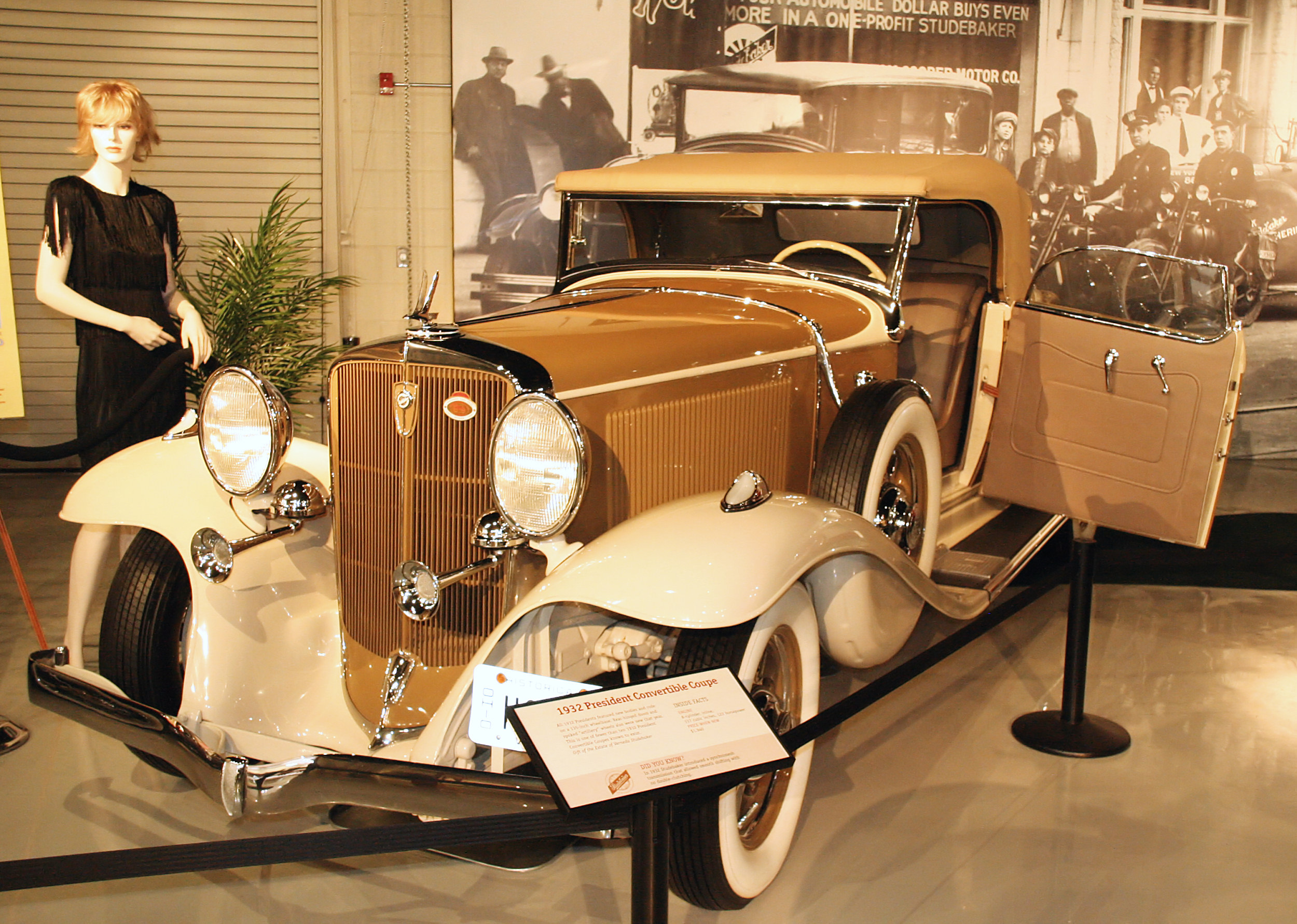
4-door sedan 312.5 cuin I8 Prior to mid-1926, Studebaker's premium model was the Studebaker Big Six. The first automobile bearing the name President was unveiled on July 23, 1926, designated as the ES model in internal Studebaker memos. It was powered by a 354 cuin six-cylinder engine until the appearance in January 1928 of the smaller and smoother straight-eight engine of 312.5 cuin. Albert Russel Erskine, Studebaker's president, spared no expense in his goal of making the President the finest automobile on the American road, with prices ranging from $1,985 to $2,485 ($ to $ in dollars ). Presidents produced from 1928 to 1933 established land speed records, some of which went unbroken for 35 years. The President benefited from engineering improvements once the company took control of Pierce-Arrow in 1928.
The primary advances of the 1931 engine was the increase in displacement to 337 cuin and the crankshaft was drilled for oil passage to each of its nine large main bearings. At this time, the straight-eight engines of many other firms had only five bearings; connecting the crank throws of every pair of cylinders between said bearings, their crankshafts had a heavy diagonal beam to take the stress, and the lubrication of the bearings was not as effective. Other advances for performance were that the valves had spring dampers and the muffler was a straight-through type. With these improvements the engine achieved 122 hp. It also had modern filters for air, oil, and fuel, an improved thermostat, and a Lanchester vibration damper.
In 1931, Studebaker introduced "Ovaloid" headlights which were oblong in shape and made identification of the President and other "senior" Studebaker models easier. Presidents manufactured in this era were considered to rival more expensive marques such as Cadillac, Packard, Lincoln, and Chrysler's Imperial model range. Studebaker went into receivership during 1933–34, Albert Erskine committed suicide, and the era of the big, impressive President came to an abrupt end.
Second generation
2-door sedan 4-door sedan
For 1934, Studebaker trimmed its model lineup and streamlined its vehicles. The company designed a new body, the Land Cruiser, which was offered on the Dictator, Commander and President. The Land Cruiser models were easily identified by their extreme streamlining features, unusual 4-piece rear window, trunk and the full fender skirts on the rear of the vehicle. The new Presidents were smaller and less impressive than their predecessors, though still fine automobiles, priced at $1,245, ($ in dollars ).
For 1935, Presidents and Commanders offered an optional wood sliding roof similar to sunroofs common on vehicles today. In 1936, all Studebaker cars featured the "Planar" suspension system, and offered the "Startix" automatic engine-starting system as an optional accessory. Vehicles manufactured from 1936 also showed the influence of industrial designer Raymond Loewy, who was hired as Studebaker's design consultant, and Helen Dryden who specialised in interior styling. Studebaker made its Hill-Holder device (an anti-rollback brake system) standard on the President in that year.
In 1938, the company offered a remote-controlled "Miracle-Shift" transmission which featured a dashboard-mounted shifter. The unit was discontinued in 1939 when the transmission shift lever was moved to the steering column.
Third generation
Third generation 4-door sedan For 1941, the President received a new body style, a four-door sedan with rear-opening rear doors, as opposed to the then-conventional front-opening (suicide) rear doors. This vehicle was designated the Land Cruiser, recognizable by its concealed running-boards and lack of rear quarter-windows. The Land Cruiser was available in the beginning of 1941, in the Custom and DeLuxetone series. In mid year 1941, the Skyway series was introduced, with a Land Cruiser included. The Skyway had an upgrade in upholstery, and lacked the double strip of chrome down the side of the car. This style continued for the shortened 1942 model, after which the President was discontinued. The Skyway designation was, however, used for shortened 1946 Studebaker Champions.
Fourth generation
Studebaker Commander Studebaker Champion Packard Clipper 4-door sedan 2-door coupe 2-door hardtop 2-door station wagon 4-door station wagon Studebaker reintroduced the President nameplate in 1955 when it was applied to all premium-trimmed vehicles. The most noteworthy of these later Presidents was the 1955 Studebaker Speedster. The President name was discontinued after the 1958 model year, when Studebaker began focusing on the compact Studebaker Lark. The final editions of Packard automobiles (1957–58) were based on this platform.
File:1955 Studebaker President (36631949524).jpg|1955 Studebaker President State Ultra Vista 4-door Sedan File:Studebaker President State Hard-top.jpg|1955 Studebaker President State Hard-top File:1956 Studebaker President Sedan (47416698902).jpg|1956 Studebaker President 4-Door Sedan File:1957 Studebaker President (14458381196).jpg|1957 Studebaker President 4-door Sedan File:1958 Studebaker President Starlight Hardtop (27769493434).jpg|1958 Studebaker President Starlight
Motorsports
The President set 118 stock car records in 1928. It also came in third in the 1932 Indianapolis 500.
Classic car status
The Classic Car Club of America, regarded as the American authority for accreditation of "classic car" status, recognizes only the 38,403 8-cylinder FA & FB model Studebaker Presidents produced in 1928 and those produced between 1929 and 1933 as “full classics”.
References
References
- (1926-01-01). "Studebaker President". Studebaker (1926).
- An example was presented to [http://acms.sl.nsw.gov.au/item/itemLarge.aspx?itemID=6458 Miss Australia in Sydney] Photo: State Library of New South Wales
- Maurice D. Hendry ''Studebaker: One can do a lot of remembering at South Bend'' in Automobile Quarterly, Vol X, No 3, 1972, p. 239
- (25 March 2014). "1928 Studebaker vehicles advertisement".
- Betts, Charles. "Studebaker as Gladiator: On the boards, the bricks and the salt". Automobile Quarterly.
- [http://www.flickriver.com/photos/autohistorian/4753771397/ ''1940 Studebaker President Club Sedan'', www.flickriver.com] Retrieved on 10 October 2014
- "1935 Ad President Studebaker Automobile Vintage Car - ORIGINAL ADVERTI".
- [http://www.tocmp.com/pix/Studebaker/images/Studebaker_1936_02_10.jpg Studebaker Dictator advertisement] {{Webarchive. link. (2016-03-03 (Feb 1936) at The Old Car Manual Project website)
- "Directory Index: Studebaker/1957 Studebaker/1957_Studebaker_Sedans_Brochure".
- Katz, John F.. (November 12, 2012). "The Governor's President". [[Autoweek]].

This article was imported from Wikipedia and is available under the Creative Commons Attribution-ShareAlike 4.0 License. Content has been adapted to SurfDoc format. Original contributors can be found on the article history page.
Ask Mako anything about Studebaker President — get instant answers, deeper analysis, and related topics.
Research with MakoFree with your Surf account
Create a free account to save articles, ask Mako questions, and organize your research.
Sign up freeThis content may have been generated or modified by AI. CloudSurf Software LLC is not responsible for the accuracy, completeness, or reliability of AI-generated content. Always verify important information from primary sources.
Report