From Surf Wiki (app.surf) — the open knowledge base
STS-98
2001 American crewed spaceflight to the ISS
2001 American crewed spaceflight to the ISS
| Field | Value |
|---|---|
| name | STS-98 |
| names_list | Space Transportation System-98 |
| image | ISS Destiny Lab.jpg |
| image_caption | Atlantis Canadarm grapples Destiny, prior to the module's installation on the ISS |
| insignia | Sts-98-patch.png |
| spacecraft | |
| mission_type | ISS assembly |
| operator | NASA |
| COSPAR_ID | |
| SATCAT | |
| orbits_completed | 171 |
| distance_travelled | 8500000 km |
| mission_duration | 12 days, 21 hours, 21 minutes, 0 seconds |
| launch_mass | 115529 kg |
| landing_mass | 90225 kg |
| payload_mass | 14515 kg |
| launch_site | Kennedy, LC-39A |
| launch_date | UTC |
| landing_date | UTC |
| landing_site | Edwards, Runway22 |
| crew_size | 5 |
| crew_members | |
| crew_photo | STS-98_crew.jpg |
| crew_photo_caption | L-R: Robert Curbeam, Mark Polansky, Marsha Ivins, Kenneth Cockrell and Thomas Jones |
| docking | {{Infobox spaceflight/Dock |
| docking_target | ISS |
| docking_type | dock |
| docking_port | PMA-3 |
| (Unity nadir) | |
| docking_date | 9 February 2001, 16:51 UTC |
| undocking_date | 16 February 2001, 14:05 UTC |
| time_docked | 6 days, 21 hours, 14 minutes |
| apsis | gee |
| orbit_reference | Geocentric |
| orbit_regime | Low Earth |
| orbit_periapsis | 365 km |
| orbit_apoapsis | 378 km |
| orbit_period | 92 minutes |
| orbit_inclination | 51.6 degrees |
| programme | Space Shuttle program |
| previous_mission | STS-97 (101) |
| next_mission | STS-102 (103) |
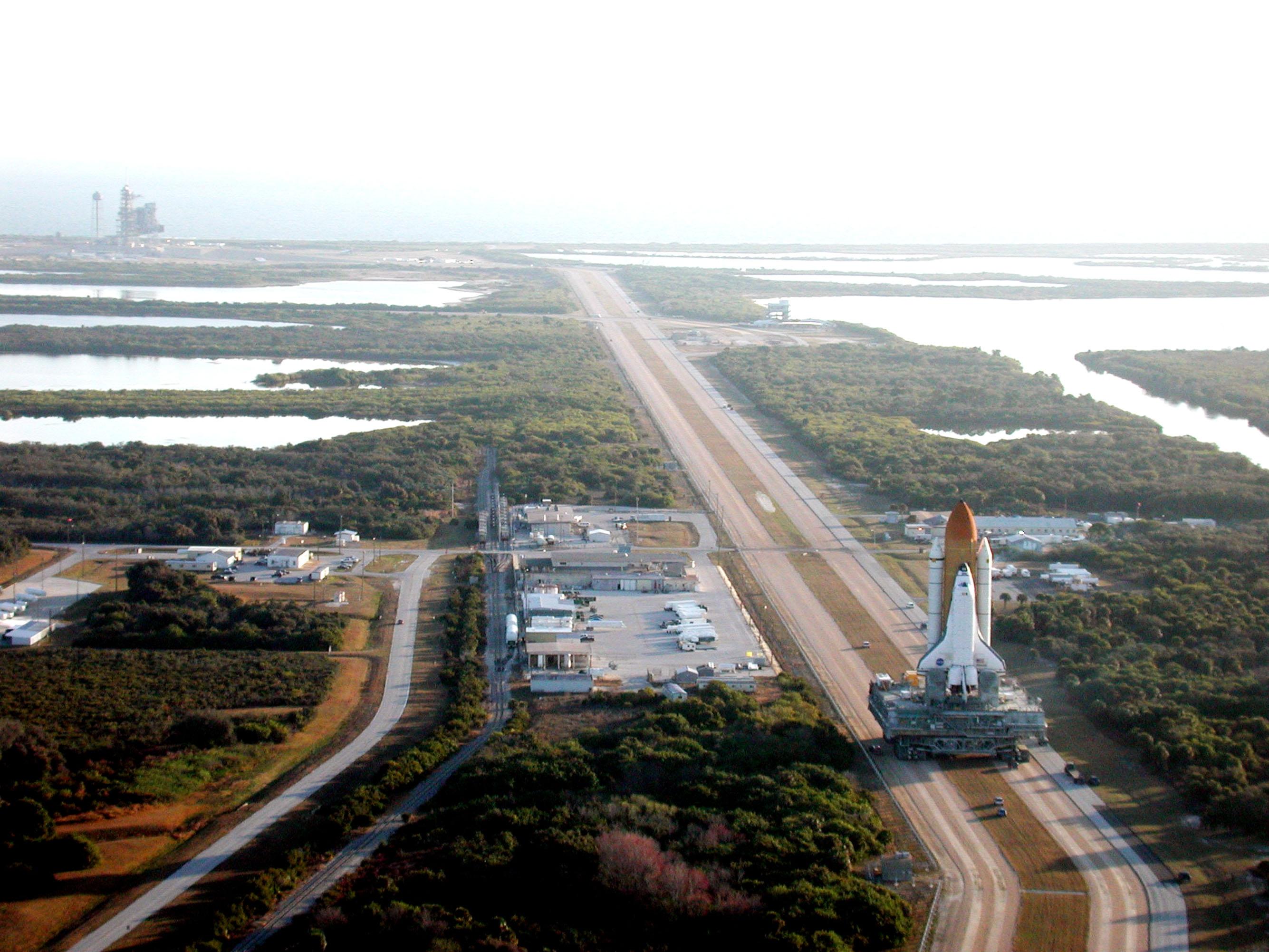
(Unity nadir) STS-98 was a 2001 Space Shuttle mission to the International Space Station (ISS) flown by Space Shuttle * Atlantis*. It was the first human spaceflight launch of the 21st century. STS-98 delivered to the station the Destiny Laboratory Module. All mission objectives were completed and the shuttle reentered and landed safely at Edwards Air Force Base on 20 February 2001, after twelve days in space, six of which were spent docked to the ISS.
Crew
Flight Engineer
Crew seat assignments
| Seat | Launch | Landing | 1 | 2 | 3 | 4 | 5 | 6 | 7 |
|---|---|---|---|---|---|---|---|---|---|
| [[File:Space Shuttle seating plan.svg | 150px]] | ||||||||
| Seats 1–4 are on the flight deck. | |||||||||
| Seats 5–7 are on the mid-deck. | |||||||||
| Cockrell | |||||||||
| Polansky | |||||||||
| Curbeam | Jones | ||||||||
| Ivins | |||||||||
| Jones | Curbeam | ||||||||
| Unused | |||||||||
| Unused |
Launch attempts
Mission highlights


The crew continued the task of building and enhancing the International Space Station by delivering the U.S. Destiny Laboratory Module. It was the first NASA lab to be permanently used since the days of Skylab nearly three decades earlier. It was manufactured by Boeing at the Michoud Assembly Facility and the Marshall Space Flight Center in 1997. Upon transport to Kennedy Space Center's industrial buildings, it was fitted with equipment, machines, racks and cables at the Operations and Checkout Building and Space Station Processing Facility. The U.S. laboratory module is 28 ft long and 14 ft wide. It is made from aluminum, and comprises three cylindrical sections and two end-cones that contain the hatch openings through which astronauts enter and exit the module. The ends are colored blue and white respectively for the crew to navigate easily. A 20 in-diameter window is located on one side of the center module segment.
During the mission, the shuttle docked to PMA 3 located on the nadir of Node 1. The crew relocated PMA 2 to the holding area on the Z1 truss temporarily, before using the Shuttle's robotic arm to lift out the 14.5 ton steel module out of the Shuttle's payload bay, and permanently berthed it on the forward hatch of Node 1. Spacewalks conducted by Thomas Jones and Robert Curbeam reattached electrical cables to the aluminum hull and connecting ports on Destiny, and also checked the laboratory's nadir window. PMA 2 was replaced to the forward hatch of Destiny.
The Shuttle spent six days docked to the station while the laboratory was attached and three spacewalks were conducted to complete its assembly. The mission also saw the 100th spacewalk in U.S. spaceflight history. STS-98 occurred while the first station crew was aboard the new space station.
Space walks
| EVA | Spacewalkers | Start (UTC) | End | Duration |
|---|---|---|---|---|
| EVA 1 | Thomas D. Jones | |||
| Robert L. Curbeam | 10 February 2001 | |||
| 15:50 | 10 February 2001 | |||
| 23:24 | 7 hours 34 minutes | |||
| Jones and Curbeam went to the payload bay of Atlantis where they disconnected cables and removed protective covers from the outside hatch of Destiny. Once at the installation site and after Destiny had been securely installed, the pair began connecting power and data cables. | ||||
| EVA 2 | Jones | |||
| Curbeam | 12 February 2001 | |||
| 15:59 | 12 February 2001 | |||
| 22:49 | 6 hours 50 minutes | |||
| The pair of spacewalkers went outside and assisted the robot arm operator with removing the Pressurized Mating Adapter 2 (PMA-2) from the Z1 Truss segment and installing it onto the forward end of the Destiny laboratory. Once that task was complete Jones and Curbeam moved to a location on the Destiny lab and installed a Power Data and Grapple fixture and video signal converter, to be used with the Canadarm2. | ||||
| EVA 3 | Jones | |||
| Curbeam | 14 February 2001 | |||
| 14:48 | 14 February 2001 | |||
| 20:13 | 5 hours 25 minutes | |||
| During the third and final spacewalk, the two spacewalkers attached a spare communications antenna to the International Space Station's exterior. They also double-checked connections between the Destiny lab and its docking port, released a cooling radiator on the station, inspected solar array connections at the top of the station and tested the ability of a spacewalker to carry an immobile crew member back to the shuttle airlock. |
Wake-up calls
NASA began a tradition of playing music to astronauts during the Gemini program, which was first used to wake up a flight crew during Apollo 15. Each track is specially chosen, often by their families, and usually has a special meaning to an individual member of the crew, or is applicable to their daily activities. | access-date = 13 August 2007 | archive-url = https://web.archive.org/web/20010215010751/http://spaceflight.nasa.gov/gallery/audio/shuttle/sts-98/html/ndxpage1.html | url-status = dead | archive-date = 15 February 2001 | access-date = 31 July 2009
| Flight Day | Song | Artist/Composer | Played for | Links |
|---|---|---|---|---|
| Day 2 | "Where You At" | Zoot Sims | Mark Polansky | WAV |
| Day 3 | "Who Let the Dogs Out" | Baha Men | Kenneth Cockrell | WAV |
| Day 4 | "Girl's Breakdown" | Alison Brown | Marsha S. Ivins | WAV |
| Day 5 | "Blue Danube Waltz" | Johann Strauss Jr. | WAV | |
| Day 6 | "Fly Me to the Moon" | Frank Sinatra | WAV | |
| Day 7 | "For Those About to Rock" | AC/DC | WAV | |
| Day 8 | "To the Moon and Back" | Savage Garden | WAV | |
| Day 9 | "Sally Ann" | New Grange | WAV | |
| Day 10 | "The Trail We Blaze" | Elton John | WAV | |
| Day 11 | "Blue (Da Ba Dee)" | Eiffel 65 | WAV | |
| Day 12 | "Fly Away" | Lenny Kravitz | WAV | |
| Day 13 | "Bad To The Bone" | George Thorogood and the Destroyers | WAV | |
| Day 14 | "Should I Stay or Should I Go" | The Clash | Entire crew | WAV |
Popular culture and media
STS-98 was the designation for the fictional NASA mission to destroy an asteroid in Armageddon (1998 film).
References
References
- Jergler, Don. (21 February 2001). "A textbook touchdown–Atlantis pays unexpected visit to desert". Antelope Valley Press.
- (23 February 2001). "Welcome Home".
- "STS-98". Spacefacts.
- "NASA assesses booster wiring repair". CBS News.
- "Shuttle count on track; good weather expected". CBS News.
- (November 1997). "U.S. Laboratory Module (Destiny) for the International Space Station".
This article was imported from Wikipedia and is available under the Creative Commons Attribution-ShareAlike 4.0 License. Content has been adapted to SurfDoc format. Original contributors can be found on the article history page.
Ask Mako anything about STS-98 — get instant answers, deeper analysis, and related topics.
Research with MakoFree with your Surf account
Create a free account to save articles, ask Mako questions, and organize your research.
Sign up freeThis content may have been generated or modified by AI. CloudSurf Software LLC is not responsible for the accuracy, completeness, or reliability of AI-generated content. Always verify important information from primary sources.
Report