From Surf Wiki (app.surf) — the open knowledge base
STS-73
1995 American crewed spaceflight

1995 American crewed spaceflight
| Field | Value |
|---|---|
| name | STS-73 |
| image | Columbia with Spacelab Module LM1.jpg |
| image_caption | Spacelab Module LM1 in Columbia payload bay, serving as the United States Microgravity Laboratory |
| insignia | Sts-73-patch.png |
| spacecraft | |
| mission_type | Microgravity research |
| operator | NASA |
| COSPAR_ID | |
| SATCAT | |
| orbits_completed | 255 |
| distance_travelled | 10600000 km |
| mission_duration | 15 days, 21 hours, 53 minutes, 16 seconds |
| payload_mass | 15250 kg |
| launch_site | Kennedy, LC-39B |
| launch_date | UTC |
| landing_date | UTC |
| landing_site | Kennedy, SLF Runway 33 |
| crew_size | 7 |
| crew_members | |
| crew_photo | STS-73_crew.jpg |
| crew_photo_caption | Left to right - Seated: Sacco, Rominger, Lopez-Alegria; Standing: Coleman, Bowersox, Leslie, Thornton |
| apsis | gee |
| orbit_reference | Geocentric |
| orbit_regime | Low Earth |
| orbit_periapsis | 241 km |
| orbit_apoapsis | 241 km |
| orbit_period | 89.7 min |
| orbit_inclination | 39.0 degrees |
| programme | Space Shuttle program |
| previous_mission | STS-69 (71) |
| next_mission | STS-74 (73) |
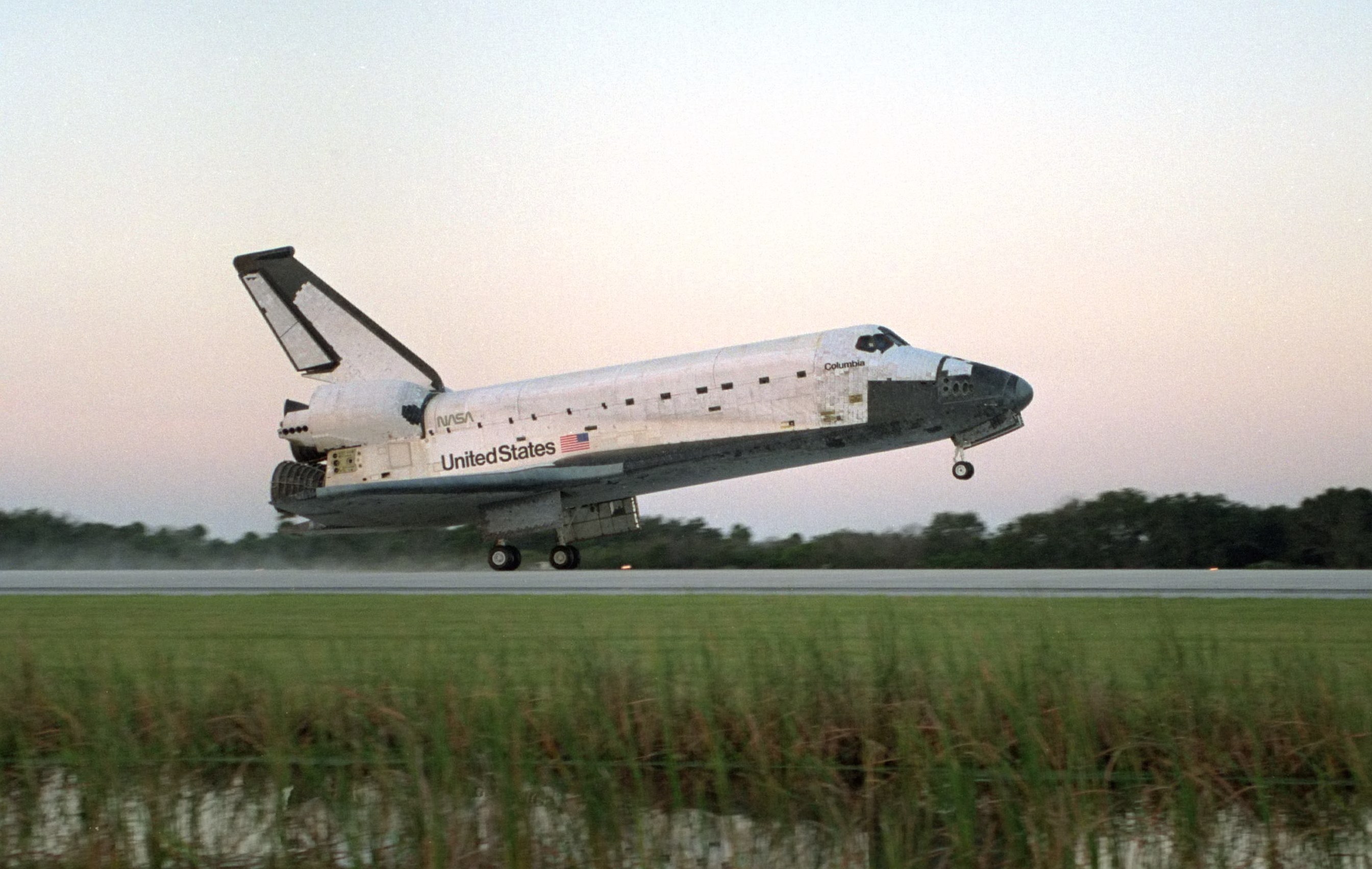
STS-73 was a Space Shuttle program mission, during October–November 1995, on board the Space Shuttle Columbia. The mission was the second mission for the United States Microgravity Laboratory. The crew, who spent 16 days in space, were broken up into 2 teams, the red team and the blue team. The mission also included several Detailed Test Objectives or DTO's.
Crew
Flight Engineer
Backup crew
Crew seat assignments
| Seat | Launch | Landing | 1 | 2 | 3 | 4 | 5 | 6 | 7 |
|---|---|---|---|---|---|---|---|---|---|
| [[File:Space Shuttle seating plan.svg | 150px]] | ||||||||
| Seats 1–4 are on the flight deck. | |||||||||
| Seats 5–7 are on the mid-deck. | |||||||||
| Bowersox | |||||||||
| Rominger | |||||||||
| Coleman | Thornton | ||||||||
| Lopez-Alegria | |||||||||
| Thornton | Coleman | ||||||||
| Leslie | |||||||||
| Sacco |
Mission highlights
The second United States Microgravity Laboratory (USML-2) Spacelab mission was the prime payload on STS-73. The 16-day flight continued a cooperative effort of the U.S. government, universities and industry to push back the frontiers of science and technology in "microgravity", the near-weightless environment of space.
On October 26, through pre-recorded video, Mission Commander Ken Bowersox threw out the first pitch for Game 5 of the 1995 World Series between the Cleveland Indians and the Atlanta Braves from orbit.
Some of the experiments carried on the USML-2 payload were suggested by the results of the first USML mission that flew aboard Columbia in 1992 during STS-50. The USML-1 mission provided new insights into theoretical models of fluid physics, the role of gravity in combustion and flame spreading, and how gravity affects the formation of semiconductor crystals. Data collected from several protein crystals grown on USML-1 enabled scientists to determine the molecular structures of those proteins.
USML-2 built on that foundation. Technical knowledge gained was incorporated into the mission plan to enhance procedures and operations. Where possible, experiment teams refined their hardware to increase scientific understanding of basic physical processes on Earth and in space, as well as to prepare for more advanced operations aboard the International Space Station and other future space programs.
USML-2 Flight controllers and experiment scientists directed science activities from NASA's Spacelab Mission Operations Control facility at the Marshall Space Flight Center. In addition, science teams at several NASA centers and universities monitored and supported operations of a number of experiments.
Other payloads on board included the Orbital Acceleration Research Experiment (OARE), Space Acceleration Measurement System (SAMS), Three Dimensional Microgravity Accelerometer (3DMA), Suppression of Transient Accelerations By Levitation Evaluation (STABLE) and the High-Packed Digital Television Technical Demonstration system.
Launch was originally scheduled for 25 September 1995 but endured six scrubbed launch attempts before its 20 October 1995 lift off. STS-73 and STS-61C both carry the distinction of being tied for the most scrubbed launches, each having launched on their seventh attempt.
After the mission, five of the crew members, namely, Bowersox, Coleman, Thornton, Leslie, and Sacco appeared on the 13 February 1996 episode of Home Improvement, "Fear of Flying", on a segment of Tool Time. It was Bowersox's second time on the show.
References
References
- "STS-73". Spacefacts.
- (1995-09-27). "September 27, 1995 Shuttle Status Report".
- (1995-09-28). "September 28, 1995 Shuttle Status Report".
- Katnik, Gregory N.. (1995-12-01). "Debris/ice/TPS assessment and integrated photographic analysis of Shuttle mission STS-73". NASA.
- (1995-10-03). "October 3, 1995 Shuttle Status Report".
- (1995-10-04). "October 4, 1995 Shuttle Status Report".
- (1995-10-05). "October 5, 1995 Shuttle Status Report".
- (1995-10-06). "October 6, 1995 Shuttle Status Report".
- (1995-10-07). "October 7, 1995 Shuttle Status Report".
- (1995-10-12). "October 12, 1995 Shuttle Status Report".
- (1995-10-13). "October 13, 1995 Shuttle Status Report".
- (1995-10-14). "October 14, 1995 Launch Status Update".
- (1995-10-15). "October 15, 1995 Shuttle Status Report".
- (1995-10-19). "October 19, 1995 Shuttle Status Report".
- (1995-10-20). "October 20, 1995 Shuttle Status Report".
- Fricke, Robert W.. (1995-12-01). "STS-73 Space Shuttle Mission Report". NASA.
- (September 1, 2011). "Space Shuttle Missions Summary". NASA.
- "First Pitch From Space". NASA.
- "Mission Archives".
- (13 February 1996). "Fear of Flying".
This article was imported from Wikipedia and is available under the Creative Commons Attribution-ShareAlike 4.0 License. Content has been adapted to SurfDoc format. Original contributors can be found on the article history page.
Ask Mako anything about STS-73 — get instant answers, deeper analysis, and related topics.
Research with MakoFree with your Surf account
Create a free account to save articles, ask Mako questions, and organize your research.
Sign up freeThis content may have been generated or modified by AI. CloudSurf Software LLC is not responsible for the accuracy, completeness, or reliability of AI-generated content. Always verify important information from primary sources.
Report