From Surf Wiki (app.surf) — the open knowledge base
STS-51-F
1985 American crewed spaceflight

1985 American crewed spaceflight
| Field | Value |
|---|---|
| name | STS-51-F |
| names_list | Space Transportation System-19 |
| Spacelab 2 | |
| image | STS-51-F Instrument Pointing System.jpg |
| image_caption | Experiments in Challengers payload bay |
| mission_type | Astronomical observations |
| operator | NASA |
| COSPAR_ID | |
| SATCAT | |
| mission_duration | |
| distance_travelled | 5284350 km |
| orbits_completed | 127 |
| spacecraft | |
| launch_mass | 114693 kg |
| landing_mass | 98309 kg |
| payload_mass | 16309 kg |
| crew_size | 7 |
| crew_members | |
| launch_date | (5:00pmEDT) |
| launch_site | Kennedy, LC-39A |
| launch_contractor | Rockwell International |
| landing_date | UTC (12:45:26pmPDT) |
| landing_site | Edwards, Runway23 |
| orbit_reference | Geocentric orbit |
| orbit_regime | Low Earth orbit |
| orbit_periapsis | 312 km |
| orbit_apoapsis | 320 km |
| orbit_inclination | 49.49° |
| orbit_period | 90.90 minutes |
| apsis | gee |
| instruments | |
| insignia | STS-51-F patch.svg |
| insignia_caption | STS-51-F mission patch |
| crew_photo | STS-51-F crew.jpg |
| crew_photo_caption | Front row (seated): C. Gordon Fullerton, Roy D. Bridges Jr. |
| Back row (standing): Anthony W. England, Karl G. Henize, F. Story Musgrave, Loren W. Acton, John-David F. Bartoe | |
| programme | Space Shuttle program |
| previous_mission | STS-51-G (18) |
| next_mission | STS-51-I (20) |
Spacelab 2 Back row (standing): Anthony W. England, Karl G. Henize, F. Story Musgrave, Loren W. Acton, John-David F. Bartoe
STS-51-F (also known as Spacelab 2) was the 19th flight of NASA's Space Shuttle program and the eighth flight of Space Shuttle Challenger. It launched from Kennedy Space Center, Florida, on July 29, 1985, and landed eight days later on August 6, 1985.
While STS-51-F's primary payload was the Spacelab 2 laboratory module, the payload that received the most publicity was the Carbonated Beverage Dispenser Evaluation, which was an experiment in which both Coca-Cola and Pepsi tried to make their carbonated drinks available to astronauts. A helium-cooled infrared telescope (IRT) was also flown on this mission, and while it did have some problems, it observed 60% of the galactic plane in infrared light.
During launch, Challenger experienced multiple sensor failures in its Engine 1 Center SSME engine, which led to it shutting down. As a result, the shuttle had to perform an "Abort to Orbit" (ATO) emergency procedure. It is the only Shuttle mission to have carried out an abort after launching. As a result of the ATO, the mission was carried out at a slightly lower orbital altitude.
Crew
Flight Engineer
As with previous Spacelab missions, the crew was divided between two 12-hour shifts. Acton, Bridges and Henize made up the "Red Team" while Bartoe, England and Musgrave comprised the "Blue Team"; commander Fullerton could take either shift when needed. Challenger carried two Extravehicular Mobility Units (EMU) in the event of an emergency spacewalk, which would have been performed by England and Musgrave.
Crew seat assignments
| Seat | Launch | Landing | 1 | 2 | 3 | 4 | 5 | 6 | 7 |
|---|---|---|---|---|---|---|---|---|---|
| [[File:Space Shuttle seating plan.svg | 150px]] | ||||||||
| Seats 1–4 are on the flight deck. | |||||||||
| Seats 5–7 are on the mid-deck. | |||||||||
| Fullerton | |||||||||
| Bridges | |||||||||
| Henize | |||||||||
| Musgrave | |||||||||
| England | |||||||||
| Acton | |||||||||
| Bartoe |
Launch

STS-51-F's first launch attempt on July 12, 1985, was halted with the countdown at T−3 seconds after main engine ignition, when a malfunction of the number two RS-25 coolant valve caused an automatic launch abort. Challenger launched successfully on its second attempt on July 29, 1985, at 17:00 p.m. EDT, after a delay of 1 hour 37 minutes due to a problem with the table maintenance block update uplink.
At 3 minutes 31 seconds into the ascent, one of the center engine's two high-pressure fuel turbopump turbine discharge temperature sensors failed. Two minutes and twelve seconds later, the second sensor failed, causing the shutdown of the center engine. This was the only in-flight RS-25 failure of the Space Shuttle program. Approximately 8 minutes into the flight, one of the same temperature sensors in the right engine failed, and the remaining right-engine temperature sensor displayed readings near the redline for engine shutdown. Booster Systems Engineer Jenny M. Howard acted quickly to recommend that the crew inhibit any further automatic RS-25 shutdowns based on readings from the remaining sensors, preventing the potential shutdown of a second engine and a possible abort mode that may have resulted in the loss of crew and vehicle (LOCV).
The failed RS-25 resulted in an Abort to Orbit (ATO) trajectory, whereby the shuttle achieved a lower-than-planned orbital altitude. The plan had been for a 385 km by 382 km orbit, but the mission was carried out at 265 km by 262 km.
Mission summary
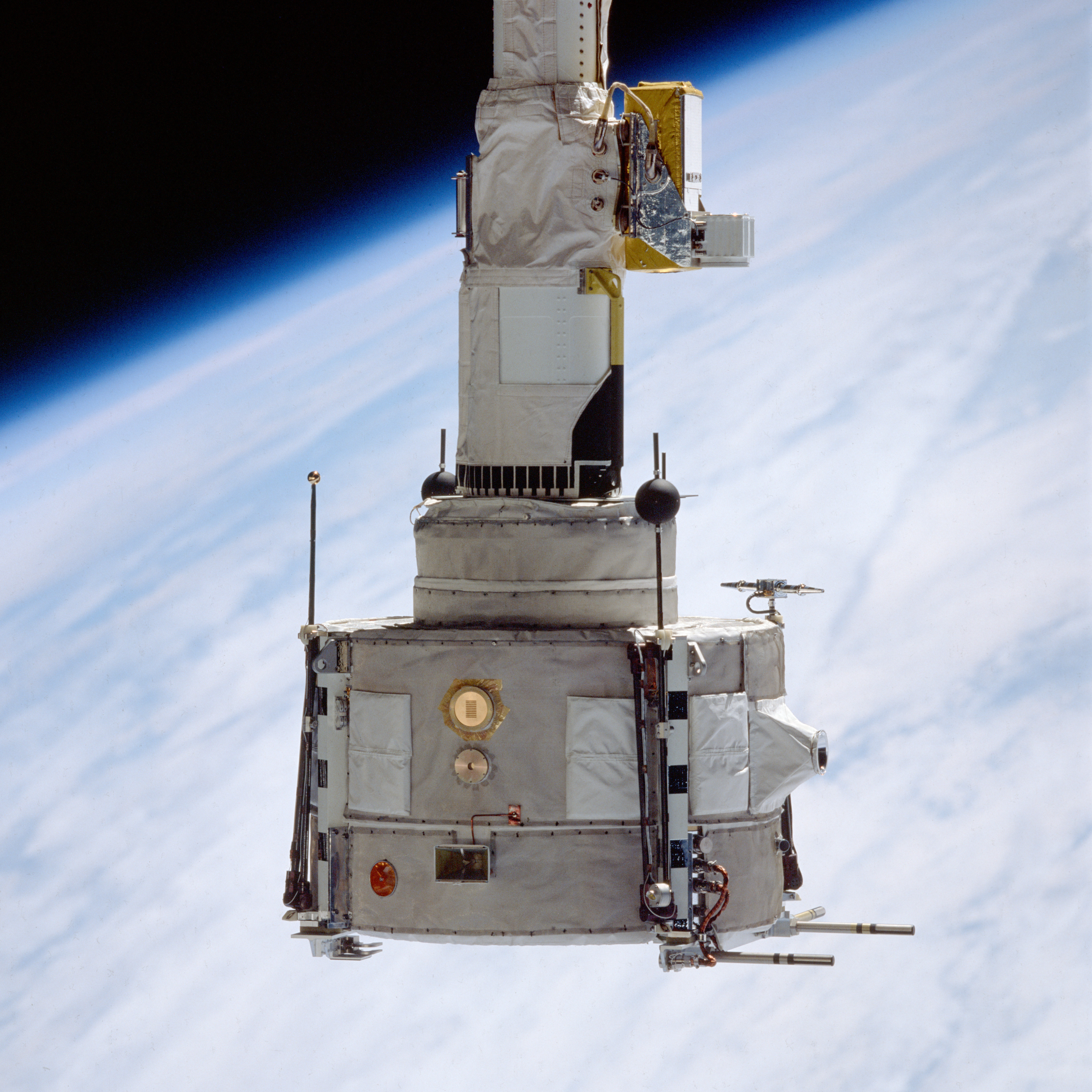


STS-51-F's primary payload was the laboratory module Spacelab 2. A special part of the modular Spacelab system, the "igloo", which was located at the head of a three-pallet train, provided on-site support to instruments mounted on pallets. The main mission objective was to verify performance of Spacelab systems, determine the interface capability of the orbiter, and measure the environment created by the spacecraft. Experiments covered life sciences, plasma physics, astronomy, high-energy astrophysics, solar physics, atmospheric physics and technology research. Despite mission replanning necessitated by Challengers abort to orbit trajectory, the Spacelab mission was declared a success.
The flight marked the first time the European Space Agency (ESA) Instrument Pointing System (IPS) was tested in orbit. This unique pointing instrument was designed with an accuracy of one arcsecond. Initially, some problems were experienced when it was commanded to track the Sun, but a series of software fixes were made and the problem was corrected. In addition, Anthony W. England became the second amateur radio operator to transmit from space during the mission.
Spacelab Infrared Telescope
The Spacelab Infrared Telescope (IRT) was also flown on the mission. It was thought heat emissions from the Shuttle would corrupt long-wavelength data, however it still returned useful astronomical data.
Carbonated Beverage Dispenser Evaluation
In a heavily publicized marketing experiment, astronauts aboard STS-51-F drank carbonated beverages from specially designed cans from Cola Wars competitors Coca-Cola and Pepsi. According to Acton, after Coke developed its experimental dispenser for an earlier shuttle flight, Pepsi insisted to American president Ronald Reagan that Coke should not be the first cola in space. The experiment was delayed until Pepsi could develop its own system, and the two companies' products were assigned to STS-51-F.
Blue Team tested Coke, and Red Team tested Pepsi. As part of the experiment, each team was photographed with the cola logo. Acton said that while the sophisticated Coke system "dispensed soda kind of like what we're used to drinking on Earth", the Pepsi can was a shaving cream can with the Pepsi logo on a paper wrapper, which "dispensed soda filled with bubbles" that was "not very drinkable". Acton said that when he gives speeches in schools, audiences are much more interested in hearing about the cola experiment than in solar physics. Post-flight, the astronauts revealed that they preferred Tang, in part because it could be mixed on-orbit with existing chilled-water supplies, whereas there was no dedicated refrigeration equipment on board to chill the cans, which also fizzed excessively in microgravity.
Other payloads
The Plasma Diagnostics Package (PDP), which had been previously flown on STS-3, made its return on the mission, and was part of a set of plasma physics experiments designed to study the Earth's ionosphere. During the third day of the mission, it was grappled out of the payload bay by the Remote Manipulator System (Canadarm) and released for six hours. During this time, Challenger maneuvered around the PDP as part of a targeted proximity operations exercise. The PDP was successfully grappled by the Canadarm and returned to the payload bay at the beginning of the fourth day of the mission.
In an experiment during the mission, thruster rockets were fired at a point over Tasmania and also above Boston to create two "holes" – plasma depletion regions – in the ionosphere. A worldwide group of geophysicists collaborated with the observations made from Spacelab 2.
An eggshell and the bone of a baby Maiasaura (a hadrosaurid dinosaur from Cretaceous North America), were brought along on the mission by Acton. They became the first dinosaur fossils to have ever been brought into space.
Landing
Challenger landed at Edwards Air Force Base, California, on August 6, 1985, at 12:45:26 p.m. PDT. Its rollout distance was 2612 m. The mission had been extended by 17 orbits for additional payload activities due to the Abort to Orbit. The orbiter arrived back at Kennedy Space Center on August 11, 1985.
Mission insignia
The mission insignia was designed by Houston, Texas, artist Skip Bradley. is depicted ascending toward the heavens in search of new knowledge in the field of solar and stellar astronomy, with its Spacelab 2 payload. The constellations Leo and Orion are shown in the positions they were in relative to the Sun during the flight. The nineteen stars indicate that the mission is the 19th shuttle flight.
Legacy
One of the purposes of the mission was to test how suitable the Shuttle was for conducting infrared observations, and the IRT was operated on this mission. However, the orbiter was found to have some drawbacks for infrared astronomy, and this led to later infrared telescopes being free-flying from the Shuttle orbiter.
References
References
- (July 7, 2011). "9 Weird Things That Flew on NASA's Space Shuttles - Final Shuttle Missions and NASA's Space Shuttle Souvenirs - NASA Shuttle Program". Space.com.
- "Archived copy of Infrared Astronomy From Earth Orbit".
- "STS-51F". Spacefacts.
- Travis, Matthew. (2012-10-16). "NASA STS-51F space shuttle launch, SSME shutdown and mid-ascent Abort To Orbit (ATO) - July 29, 1985".
- Welch, Brian. (August 9, 1985). "Limits to inhibit". NASA Lyndon B. Johnson Space Center.
- (1985). "Space Shuttle Mission STS-51F Press Kit". NASA.
- (September 1, 2011). "Space Shuttle Missions Summary". NASA Scientific and Technical Information Program Office.
- "STS-51F Launch attempt #1". NASA.
- "Radio Coverage of STS-51F launch attempt 1".
- (1991-09-01). "Galactic Structure from the Spacelab Infrared Telescope. II. Luminosity Models of the Milky Way". The Astrophysical Journal.
- Pearlman, Robert. (May 31, 2001). "A Brief History of Space Marketing". Space.com.
- (November 18, 2010). "Loren Acton: The Coke and Pepsi Flight". [[Smithsonian Institution]].
- (September 1985). "STS-51F National Space Transportation System Mission Report". NASA Lyndon B. Johnson Space Center.
- (2007). "Elizabeth A. Essex-Cohen Ionospheric Physics Papers".
- Chure, D.. (2009). "dino bones in space – was it a PR thing". Cleveland Museum of Natural History.
- (October 16, 2017). "The Space Review: From Skylab to Shuttle to the Smithsonian".
This article was imported from Wikipedia and is available under the Creative Commons Attribution-ShareAlike 4.0 License. Content has been adapted to SurfDoc format. Original contributors can be found on the article history page.
Ask Mako anything about STS-51-F — get instant answers, deeper analysis, and related topics.
Research with MakoFree with your Surf account
Create a free account to save articles, ask Mako questions, and organize your research.
Sign up freeThis content may have been generated or modified by AI. CloudSurf Software LLC is not responsible for the accuracy, completeness, or reliability of AI-generated content. Always verify important information from primary sources.
Report