From Surf Wiki (app.surf) — the open knowledge base
STS-31
1990 American crewed spaceflight to deploy the Hubble Space Telescope

1990 American crewed spaceflight to deploy the Hubble Space Telescope
| Field | Value |
|---|---|
| name | STS-31 |
| names_list | Space Transportation System-31 |
| STS-31R | |
| image | 1990 s31 IMAX view of HST release.jpg |
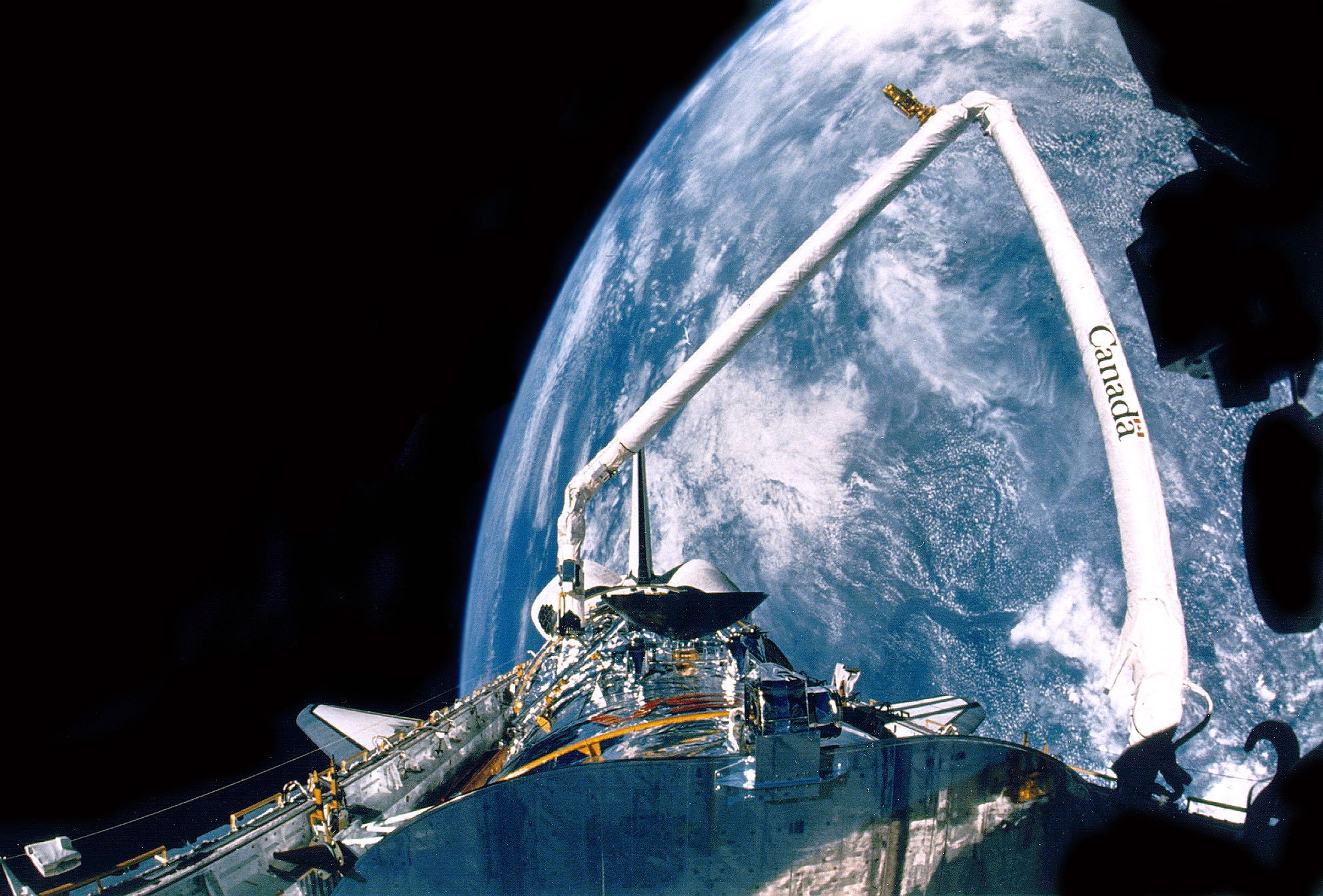
| image_caption | Discovery deploys the Hubble Space Telescope. |
| mission_type | Hubble Space Telescope deployment |
| operator | NASA |
| mission_duration | |
| distance_travelled | 3328466 km |
| orbits_completed | 80 |
| spacecraft | |
| launch_mass | 117586 kg |
| landing_mass | 85947 kg |
| payload_mass | 11878 kg |
| crew_size | 5 |
| crew_members | |
| launch_date | UTC (8:33:51amEDT) |
| launch_site | Kennedy, LC-39B |
| launch_contractor | Rockwell International |
| landing_date | UTC (6:49:57amPDT) |
| landing_site | Edwards, Runway22 |
| orbit_reference | Geocentric orbit |
| orbit_regime | Low Earth orbit |
| orbit_periapsis | 613 km |
| orbit_apoapsis | 615 km |
| orbit_inclination | 28.45° |
| orbit_period | 96.70 minutes |
| apsis | gee |
| instruments | |
| insignia | Sts31 flight insignia.png |
| insignia_caption | STS-31 mission patch |
| crew_photo | Sts-31 crew.jpg |
| crew_photo_caption | From left: Bolden, Hawley, Shriver, McCandless and Sullivan |
| programme | Space Shuttle program |
| previous_mission | STS-36 (34) |
| next_mission | STS-41 (36) |
| programme2 | Hubble Space Telescope missions |
| next_mission2 | STS-61 (SM1) |
STS-31R
STS-31 was the 35th mission of NASA's Space Shuttle program and the tenth flight of the Space Shuttle Discovery. The primary purpose of this mission was the deployment of the Hubble Space Telescope (HST) into low Earth orbit. Discovery lifted off from Launch Complex 39B on April 24, 1990, from Kennedy Space Center, Florida.
Following the Challenger accident clarification was required on mission numbering. As STS-51-L was also designated STS-33, future flights with the previous STS-26 through STS-33 designators would require the R in their documentation to avoid conflicts in tracking data from one mission to another.
Discoverys crew deployed the Hubble Space Telescope on April 25, 1990, and then spent the rest of the mission tending to various scientific experiments in the Shuttle's payload bay as well as operating a set of IMAX cameras to record the mission. Discoverys launch marked the first time since January 1986 that two Space Shuttles had been on the launch pad at the same time – Discovery on 39B and Columbia on 39A.
Crew
Flight Engineer
Crew seat assignments
| last1=Becker | first1=Joachim | title=Spaceflight mission report: STS-31 | url=http://spacefacts.de/mission/english/sts-31.htm | publisher=Spacefacts | access-date=February 26, 2014 | archive-url=https://web.archive.org/web/20210107134356/http://spacefacts.de/mission/english/sts-31.htm | archive-date=January 7, 2021 | url-status=live}} | Launch | Landing | 1 | 2 | 3 | 4 | 5 | 6 | 7 |
|---|---|---|---|---|---|---|---|---|---|---|---|---|---|---|---|---|---|
| [[File:Space Shuttle seating plan.svg | 150px]] | ||||||||||||||||
| Seats 1–4 are on the flight deck. | |||||||||||||||||
| Seats 5–7 are on the mid-deck. | |||||||||||||||||
| Shriver | |||||||||||||||||
| Bolden | |||||||||||||||||
| McCandless | Sullivan | ||||||||||||||||
| Hawley | |||||||||||||||||
| Sullivan | McCandless | ||||||||||||||||
| Unused | |||||||||||||||||
| Unused |
Crew notes
This mission was originally to be flown in August 1986 as STS-61-J using Atlantis, but was postponed due to the Challenger disaster. John W. Young was originally assigned to command this mission, which would have been his seventh spaceflight, but was reassigned to an administrative position and was replaced by Loren J. Shriver in 1988.
Mission highlights
STS-31 was launched on April 24, 1990, at 12:33:51UTC (8:33:51amEDT, local time at the launch site). A launch attempt on April 10, 1990, was scrubbed at T*−4 minutes for a faulty valve in auxiliary power unit (APU) number one. The APU was eventually replaced, and the Hubble Space Telescope's batteries were recharged. On launch day, the countdown was briefly halted at T−*31 seconds when Discoverys computers failed to shut down a fuel valve line on ground support equipment. Engineers manually commanded the valve to close and the countdown continued.
The main purpose of this mission was to deploy Hubble. It was designed to operate above the Earth's turbulent and obscuring atmosphere to observe celestial objects at ultraviolet, visible and near-infrared wavelengths. The Hubble mission was a joint NASA-ESA (European Space Agency) effort going back to the late 1970s. The rest of the mission was devoted to photography and onboard experiments. To launch HST into an orbit that guaranteed longevity, Discovery entered an orbit of around 613 xx. At one point during the mission, Discovery briefly reached an apogee of 621 km, the highest altitude ever reached by a Shuttle orbiter. The record height also permitted the crew to photograph Earth's large-scale geographic features not apparent from lower orbits. Motion pictures were recorded by two IMAX cameras, and the results appeared in the 1994 IMAX film Destiny in Space. Experiments on the mission included a biomedical technology study, advanced materials research, particle contamination and ionizing radiation measurements, and a student science project studying zero-gravity effects on electronic arcs. Discoverys reentry from its higher-than-usual orbit required a deorbit burn of 4 minutes and 58 seconds, the longest in Shuttle history up to that time. Discovery orbited the Earth 80 times during the mission.
During the deployment of Hubble, one of the observatory's solar arrays stopped as it unfurled. While ground controllers searched for a way to command HST to unreel the solar array, Mission Specialists McCandless and Sullivan began preparing for a contingency spacewalk in the event that the array could not be deployed through ground control. The array eventually came free and unfurled through ground control while McCandless and Sullivan were pre-breathing inside the partially depressurized airlock.
Secondary payloads included the IMAX Cargo Bay Camera (ICBC) to document operations outside the crew cabin and a handheld IMAX camera for use inside the orbiter. Also included were the Ascent Particle Monitor (APM) to detect particulate matter in the payload bay; a Protein Crystal Growth (PCG) experiment to provide data on growing protein crystals in microgravity, Radiation Monitoring Equipment III (RME III) to measure gamma ray levels in the crew cabin; Investigations into Polymer Membrane Processing (IPMP) to determine porosity control in the microgravity environment, and an Air Force Maui Optical Site (AMOS) experiment.
The mission marked the flight of an 5 kg human skull, which served as the primary element of "Detailed Secondary Objective 469", also known as the In-flight Radiation Dose Distribution (IDRD) experiment. This joint NASA/DoD experiment was designed to examine the penetration of radiation into the human cranium during spaceflight. The female skull was seated in a plastic matrix, representative of tissue, and sliced into ten layers. Hundreds of thermo-luminescent dosimeters were mounted in the skull's layers to record radiation levels at multiple depths. This experiment, which also flew on STS-28 and STS-36, was located in the shuttle's mid-deck lockers on all three flights, recording radiation levels at different orbital inclinations.
Discovery landed on Runway 22 at Edwards Air Force Base in California on April 29, 1990, at 13:49:57UTC (6:49:57amPDT, local time at the landing site). The landing had a rollout distance of 2705 m, took 61 seconds, and marked the first use of carbon brakes on a shuttle. Discovery was returned to Kennedy Space Center after STS-31 on May 7, 1990.
Wake-up calls
NASA began a tradition of playing music to astronauts during the Project Gemini, which was first used to wake up a flight crew during Apollo 15. Each track is specially chosen, often by their families, and usually has a special meaning to an individual member of the crew, or is applicable to their daily activities.
| Flight Day | Song | Artist/Composer |
|---|---|---|
| Day 2 | "Space is Our World" | Private Numbers |
| Day 3 | "Shout" | Otis Day and the Knights |
| Day 4 | "Kokomo" | Beach Boys |
| Day 5 | "Cosmos" | Frank Hayes |
| Day 6 | "Rise and Shine" | Raffi |
Gallery
File:1990 s31 HST closeout.jpg|Hubble at the pad File:Liftoff STS-31.jpg|Liftoff of Discovery with the Hubble Space Telescope on board File:1990 s31 HST Bay.jpg|Low hover position File:HST over Bahamas.jpg|High over Cuba File:Hubble Solar Array Deployment STS-31.jpg|Solar array deployment File:Scanned highres STS031 STS031-76-39 copy.jpg|Hubble drifts away over Peru. File:Florida from STS-31.jpg|Florida and The Bahamas File:Sts-31 Landing.jpg|Discovery returns home.
References
References
- "Spaceflight mission report: STS-31". Spacefacts.
- (March 1, 1988). "Astronautics and Aeronautics, 1985: A Chronology". United States Government Printing Office.
- (March 17, 1988). "JSC News Release Log 1988". NASA.
- (October 15, 1990). "Misson Safety Evaluation Report for STS-31 – Postflight Edition". NASA Office of Safety, Reliability, Maintainability and Quality Assurance.
- (July 7, 1990). "Design flaw cripples Hubble telescope". New Scientist.
- McDowell, Jonathan. "Here is a comparison of the STS-31 and STS-82 TLE data (apogee and perigee given in 'conventional height', i.e. geocentric radius minus 6378 km). STS-31 clearly a tiny bit higher, as can be seen in the zoomed-in second plot".
- "Camera, ICBC, 70 mm, IMAX". Smithsonian Institution.
- (May 1990). "STS-31 Space Shuttle Mission Report". NASA.
- (January 31, 2009). "Hubble Servicing Challenges Drive Innovation of Shuttle Rendezvous Technique". NASA.
- (December 31, 1991). "Space Year 1991: The Complete Record of the Year's Space Events". Motorbooks International.
- (November 23, 2007). "STS-31". NASA.
- Fries, Colin. (March 13, 2015). "Chronology of Wakeup Calls". NASA.
This article was imported from Wikipedia and is available under the Creative Commons Attribution-ShareAlike 4.0 License. Content has been adapted to SurfDoc format. Original contributors can be found on the article history page.
Ask Mako anything about STS-31 — get instant answers, deeper analysis, and related topics.
Research with MakoFree with your Surf account
Create a free account to save articles, ask Mako questions, and organize your research.
Sign up freeThis content may have been generated or modified by AI. CloudSurf Software LLC is not responsible for the accuracy, completeness, or reliability of AI-generated content. Always verify important information from primary sources.
Report