From Surf Wiki (app.surf) — the open knowledge base
STS-112
2002 American crewed spaceflight to the ISS
_Radiator.jpg)
2002 American crewed spaceflight to the ISS
| Field | Value |
|---|---|
| name | STS-112 |
| names_list | Space Transportation System-112 |
| image | S112 S1 truss is moved from the Payload Bay of Atlantis.jpg |
| image_upright | 0.7 |
| image_caption | Canadarm2 takes the S1 truss out of the payload bay of Atlantis, prior to its installation on the ISS |
| insignia | Sts-112-patch.png |
| spacecraft | |
| mission_type | ISS assembly |
| operator | NASA |
| COSPAR_ID | |
| SATCAT | |
| orbits_completed | 170 |
| distance_travelled | 7200000 km |
| mission_duration | 10 days, 19 hours, 58 minutes, 44 seconds |
| launch_mass | 116538 kg |
| landing_mass | 91390 kg |
| payload_mass | 12572 kg |
| launch_site | Kennedy, LC-39B |
| launch_date | UTC |
| landing_date | UTC |
| landing_site | Kennedy, SLF Runway 33 |
| crew_size | 6 |
| crew_members | |
| crew_photo | STS-112 crew.jpg |
| crew_photo_caption | (L-R): Sandra H. Magnus, David A. Wolf, Pamela A. Melroy, Jeffrey S. Ashby, Piers J. Sellers and Fyodor Yurchikhin |
| docking_target | ISS |
| docking_type | dock |
| docking_port | PMA-2 |
| (Destiny forward) | |
| docking_date | 9 October 2002, 15:16 UTC |
| undocking_date | 16 October 2002, 13:13 UTC |
| time_docked | 6 days, 21 hours, 57 minutes |
| apsis | gee |
| orbit_reference | Geocentric |
| orbit_regime | Low Earth |
| orbit_periapsis | 273 km |
| orbit_apoapsis | 405 km |
| orbit_period | 91.2 minutes |
| orbit_inclination | 51.6 degrees |
| programme | Space Shuttle program |
| previous_mission | STS-111 |
| next_mission | STS-113 |
(Destiny forward)
STS-112 (ISS assembly flight 9A) was an 11-day Space Shuttle mission to the International Space Station (ISS) flown by . Space Shuttle Atlantis was launched on 7 October 2002 at 19:45 UTC from the Kennedy Space Center's launch pad 39B to deliver the 28,000 pound Starboard 1 (S1) truss segment to the Space Station. Ending a 4.5-million-mile journey, Atlantis landed at 15:44 UTC on 18 October 2002 on runway 33 at the Kennedy Space Center's Shuttle Landing Facility.
During the launch, the ET bipod ramp shed a chunk of foam that caused a dent ~4" wide and 3" deep into the metal SRB-ET Attach Ring near the bottom of the left Space Shuttle Solid Rocket Booster. Prior to the next mission (STS-113), an upper-level decision was made at NASA to continue with launches as scheduled. The launch subsequent to that was the Space Shuttle Columbia disaster, the ill-fated STS-107.
Space Shuttle Atlantis had been scheduled to visit the International Space Station (ISS) again on the STS-114 mission in March 2003; however, due to the loss of Columbia, all Space Shuttles, including Atlantis, were temporarily grounded. Due to rescheduling of missions, Atlantis did not fly again until STS-115 on 9 September 2006.
Crew
Flight Engineer
Mission payload
| Location | Cargo | Mass |
|---|---|---|
| Bays 1–2 | Orbiter Docking System | |
| 2 EMU spacesuits | 1800 kg | |
| 240 kg | ||
| Bays 3–13 | S1 Integrated Truss Segment | |
| CETA Cart A | 12572 kg | |
| 283 kg | ||
| Sill | Remote Manipulator System | 410 kg |
| Total: | 15305 kg |
Starboard 1 (S1) truss segment

The S1 truss segment, which provides structural support for the Space Station radiators, was the main payload of STS-112 mission.
The Boeing Company (along with Lockheed Martin) started manufacturing the truss in May 1998 at Michoud. The work was completed in March 1999. The S1 was shipped by aircraft to the KSC Operations and Checkout Building in October 1999 for flight processing. In June 2002, the truss was handed over to NASA for final preparations and pre-flight checks at the Space Station Processing Facility.
Crew Equipment Translation Aid
Atlantis also delivered the Crew Equipment Translation Aid (CETA) Cart to the Space Station. The CETA cart was attached to the Mobile Transporter (launched on STS-110) to be used by assembly crews on later missions.
Mission experiments
STS-112 carried several science experiments to the space station including the Plant Generic Bioprocessing Apparatus (PGBA), Commercial Generic Bioprocessing Apparatus (CGBA), the Protein Crystal Growth Single-locker Thermal Enclosure System housing the Protein Crystallization Apparatus for Microgravity (PCG-STES-PCAM) and samples for the Zeolite Crystal Growth Furnace (ZCG) experiment.
Shuttle processing
Launch preparations for STS-112 mission were sightly delayed due to tiny cracks found within the plumbing of ''Atlantis''' propulsion system on 17 June 2002 by an inspector. The cracks were in metal flow liners inside the main liquid hydrogen fuel lines that feed the shuttle's three main engines. Although there were no cracks in the actual fuel pipes themselves, the concern was that metal pieces from the flow liners might break off and fly into the engines. In such a worst-case scenario, the debris can potentially trigger a catastrophic engine shutdown, which in turn could lead to the loss of the crew and the shuttle. Similar cracks were found in the remaining orbiters and the space shuttle program was temporally grounded so engineers could analyze the problem. The shuttle was cleared to resume flight in September with launch originally scheduled for October 2, but due to concerns that Hurricane Lili could hit Houston, the Johnson Space Center was powered down.
Mission timeline
7 October (Flight Day 1 – Launch)

Space Shuttle Atlantis lifted off from Launch Pad 39B of the Kennedy Space Center at 19:45:51 GMT through mostly clear blue skies. There were no problems reported during the countdown, and the ascent conformed to the standard timeline (see Space Shuttle – Mission Profile – Launch). For the first time in Space Shuttle history, a "rocketcam" video camera mounted to the upper part of ''Atlantis''' external tank returned live video of the flight to NASA flight controllers. The video was near perfect until the two solid rocket boosters were jettisoned. At that point, the exhaust from the separation motors fogged the camera lens and made the rest of the video difficult to see.
Later, NASA announced that it was looking into a problem with explosive bolts that failed to fire properly during the launch. Immediately before the twin solid rocket boosters fired into life, only one set of pyrotechnics in ten explosive bolts exploded when commanded to do so. All 10 nuts exploded as planned, but NASA was interested in finding out an explanation for the unexpected anomaly.
Arguably the most significant event from this launch was the ET bipod ramp shedding a chunk of foam, estimated to be ~4"x5"x12", that broke away and hit the lower left SRB-ET Attach Ring near the Integrated Electronics Assembly (IEA) box causing a dent ~4" wide and 3" deep into the solid metal. Prior to approval for the next mission, the situation was analyzed and NASA decided to press ahead under the justification that "The ET is safe to fly with no new concerns (and no added risk)" of further foam strikes. This fateful decision set the stage for the STS-107 tragedy just two launches later. The CAIB report did not highlight the significance of video data from this being the first flight with the ET Camera.
8 October (Flight Day 2 – Rendezvous and docking preparations)
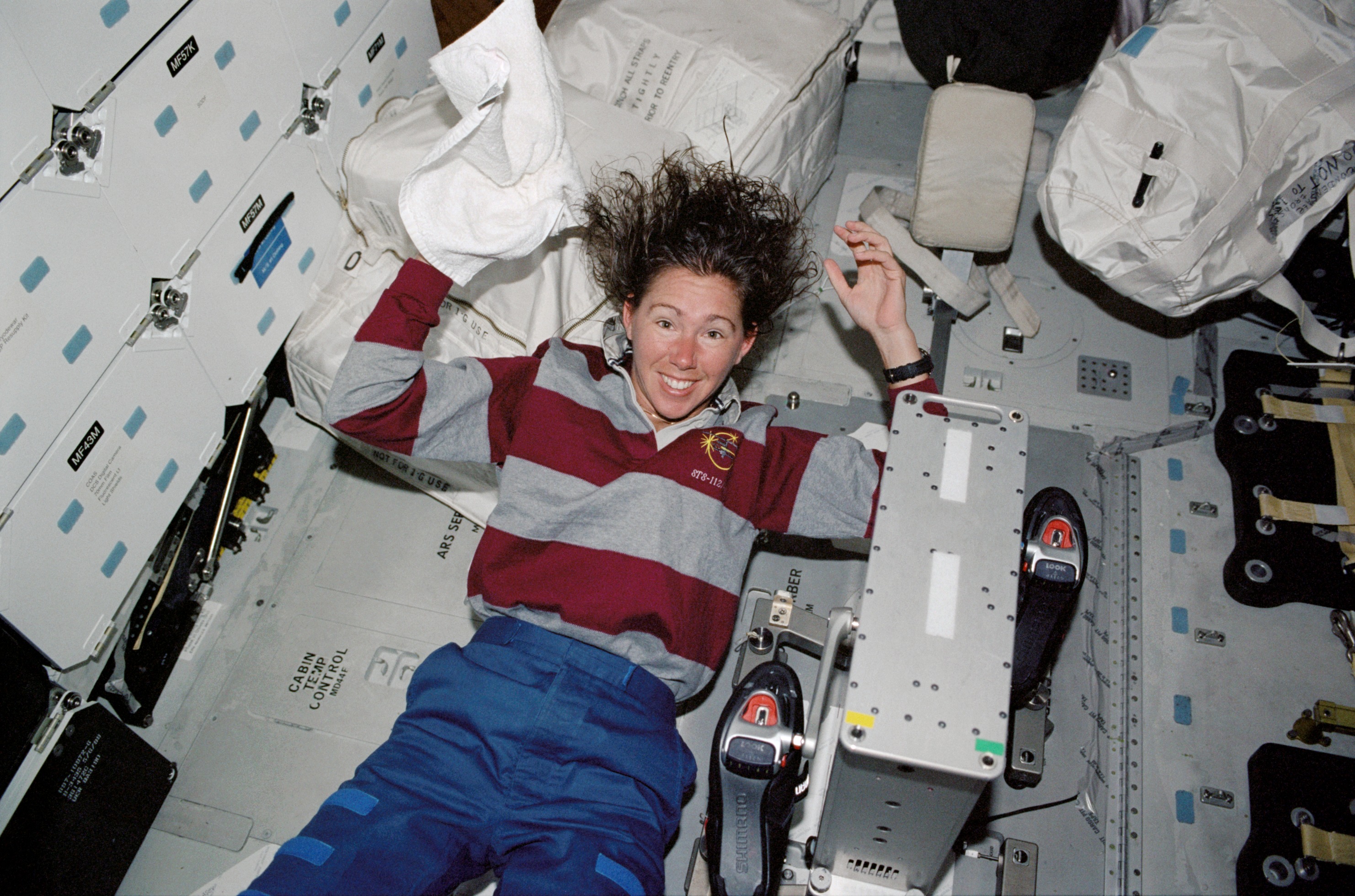
On Flight Day 2, the STS-112 crew settled into preparations for the next day's rendezvous and docking with the International Space Station. After the wake up call went at 4:46 am CDT, the crew began its first full day on orbit. Pilot Pamela Melroy assisted Mission Specialists David Wolf and Piers Sellers in a checkout of spacewalk suits and equipment. Commander Jeff Ashby worked with the prime robotic arm operator, Mission Specialist Sandy Magnus, to verify the arm's readiness. Ashby and Magnus powered up the arm for a video survey of Atlantis' payload bay. The crew also completed the setting up of the orbiter docking system's centerline camera, extended the orbiter's spring-loaded ring that will make first contact, and checked out rendezvous tools.
During the day, the STS-112 crew successfully completed three Orbital Maneuvering System (OMS) burns to boost the shuttle into the station's orbit and refine its approach path to the station.
Astronaut Wolf also checked-out the Spatial Heterodyne Imager for Mesospheric Radicals or the SHIMMER experiment sponsored by the Naval Research Lab. The SHIMMER experiment uses an ultraviolet sensing camera to observe the Earth's atmosphere at 40–90 kilometers looking for possible ozone loss. The experiment proved balky, but with help from Mission Control the crew worked out steps to ready the gear for observations during the mission.
9 October (Flight Day 3 – Docking)
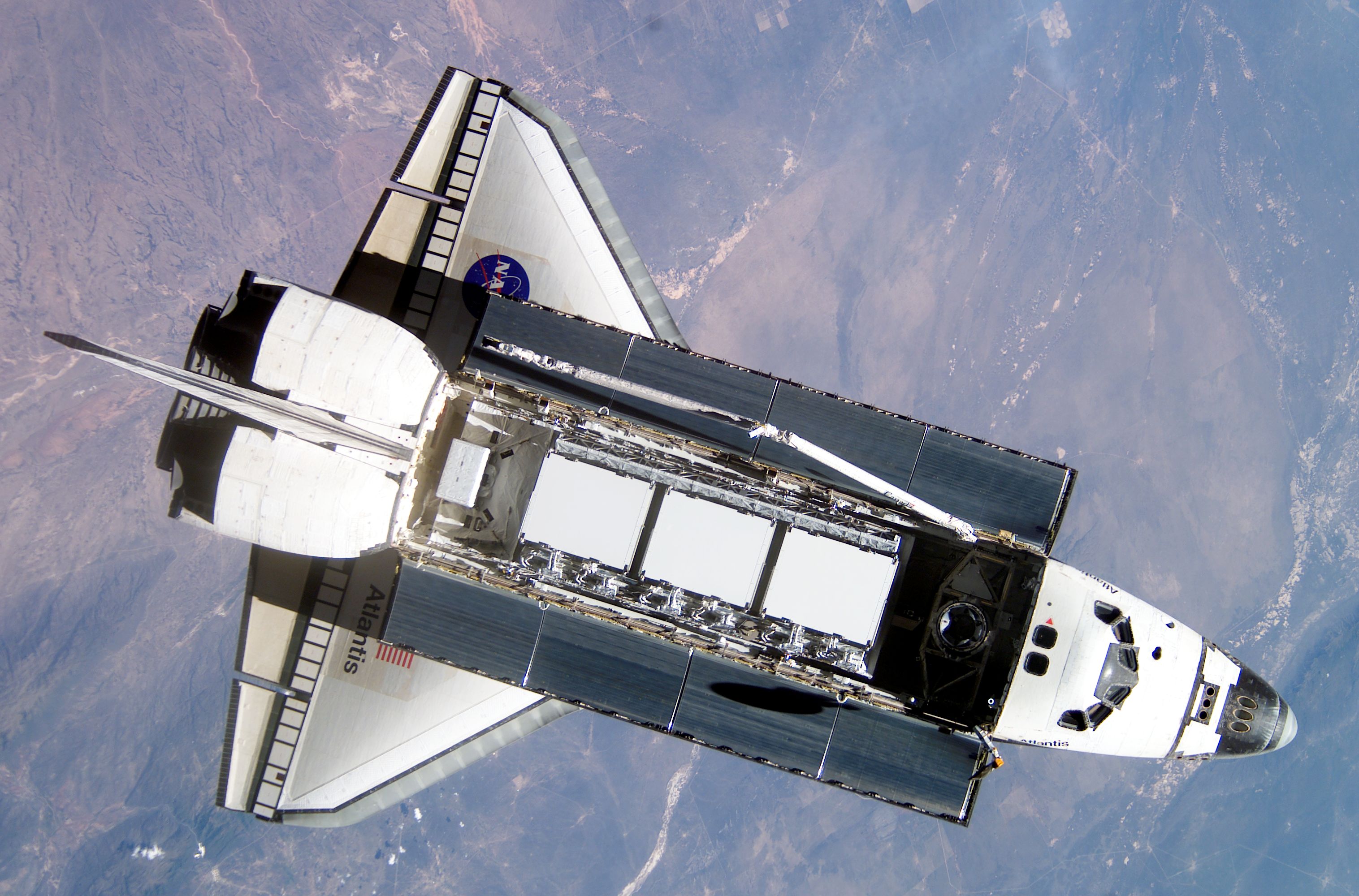
Space Shuttle Atlantis docked to the Space Station at 15:17 GMT to begin a week of joint operations for the STS-112 and Expedition 5 crews. With commander Jeffrey Ashby at the controls, *Atlantis''' docking system engaged the Pressurized Mating Adapter-2 (Destiny Laboratory's forward docking port) in the front of the space station as the two spacecraft sailed 245 miles above central Asia at five miles per second. Crew members of *Atlantis'' were the first visitors for the Expedition 5 station crew who arrived at the outpost the first week of June 2002.
Following pressure checks, station science officer Peggy Whitson asked Commander Ashby if he had brought the salsa that she had asked for. When Ashby replied that he had, Whitson said "OK, we'll let you in". The hatches between Atlantis and the Space Station were opened at 16:51 GMT and astronaut Ashby floated into the Destiny Module and immediately embraced Whitson. Mission Specialist Sandra Magnus followed next, followed by the rest of ''Atlantis''' STS-112 crew members. They were greeted by the three member station crew.
After a safety briefing from station commander Valery Korzun, the combined crews split up and began preparing for a busy day of work. Astronaut Pamela Melroy, cosmonaut Korzun, and Mission Specialists Dave Wolf, Piers Sellers, and Fyodor Yurchikhin configured the spacesuits for EVA 1. Magnus and Whitson reviewed robotic arm operations for moving the new truss segment into place.
Image:Space Station as photographed by a STS-112 crewmember.jpg|Space Station photographed by a STS-112 crew member Image:STS-112 crewmembers in the Zvezda Service Module.jpg|STS-112 crew receives a safety briefing from Station Commander Korzun
10 October (Flight Day 4 – EVA 1)

The workday began at 3 am CDT with a musical wakeup call to Atlantis crew from Mission Control, Houston. Earlier on Flight Day 4 astronauts Whitson and Magnus used the station's Canadarm2 robotic arm to grapple the S1 truss structure, remove it from ''Atlantis''' payload bay, and move it to the starboard end the S0 section. Four remotely operated motorized bolts locked the two truss segments together at 8:36 am CDT.
Simultaneously, Astronauts Dave Wolf and Piers Sellers prepared for the mission's first spacewalk. EVA 1 was the 44th spacewalk staged to support the space station assembly and maintenance. The two astronauts exited the Quest Airlock at about 11:21 am EDT. Wolf's spacesuit had solid red stripes for identification, while Sellers donned an all white spacesuit. As Wolf worked to accomplish to connect power, data and fluid lines between the S0 and the S1 trusses, Sellers, on his first spacewalk, released the locks on three folded-up radiators mounted to the S1, allowing S1's radiators to be oriented for optimal cooling.
The spacewalking astronauts worked for seven hours and one minute outside the space station, 31 minutes longer than expected due to a problem with the Canadarm2. The glitch forced Wolf to complete installation of a television camera system on the far end of the truss without the assistance of the robot arm. The only other problem of EVA 1 came near the end of the spacewalk when Wolf reported his helmet earphones appeared to be losing power.
Throughout the spacewalk, astronaut Melroy offered guidance and advice to the spacewalkers and keeping them on schedule. Shuttle Commander Jeff Ashby operated the shuttle robotic arm, providing camera views for documentation. Following a tool inventory check and cleanup activities, Wolf and Sellers re-entered Quest. The Airlock was re-pressurized at 5:22 pm CDT to end EVA 1.
Image:STS112 Whitson and Magnus operate the controls of Canadarm 2.jpg|Whitson and Magnus works inside the Destiny Lab to remove S1 truss Image:S112 S1 truss is moved from the Payload Bay of Atlantis.jpg|S1 truss is moved from the cargo bay of Atlantis Image:S112_Piers_Sellers_works_on_the_S1_segment.jpg|Piers Sellers works on the S1 truss Image:S112 Pamela Melroy works on the flight deck of Atlantis during EVA 1.jpg|Pamela Melroy looks over a checklist on the flight deck of Atlantis
11 October (Flight Day 5 – Off duty and transfers)

On Flight Day 5, the combined shuttle and space station crew took several hours of off-duty time. Then they began transfer operations between the vehicles and prepared for mission's second spacewalk. The crew moved a number of scientific experiments back and forth between the shuttle and the ISS to return completed experiments to Earth and deploy new experiments at the ISS. Transfer items included a set of liver cell tissue samples from an experiment studying the function of human liver cells in microgravity, moved from the station onto the shuttle for return to Earth.
Payload experiments such as Marshall Space Flight Center's protein crystal growth thermal enclosures for growing high-quality protein crystals in micro-gravity experiments were moved to and from the station. Seven water containers were transferred to the station. Commander Jeff Ashby initiated a Nitrogen transfer process that moved about 15 pounds of the gas from Atlantis to the station by the end of the day.
STS-112 spacewalkers David Wolf and Piers Sellers, assisted by Pilot Pamela Melroy, readied the EVA equipment They recharged water on the extravehicular mobility unit (EMU), configured their tools and prepared the Quest airlock.
The crew also participated in several live media interviews. Astronauts Magnus, Wolf and Sellers discussed about EVA 1 and the first-time experiences in space with CBS Radio Network and Cable News Network (CNN). Speaking to CBS News, Wolf told that manual work Piers and himself did at the end of EVA 1 to install the S1's outboard nadir external camera got their heart rates up to over 170 per minute. The spacewalkers were not able to use the Station's Canadarm 2 as a result of a software glitch.
Russian cosmonauts Valery Korzun, Sergei Treschev and Fyodor Yurchikhin participated in several interviews with the Russian press. Shortly before sleep, the crew reviewed procedures for EVA 2.
12 October (Flight Day 6 – EVA 2)
13 October (Flight Day 7)
14 October (Flight Day 8 – EVA 3)
15 October (Flight Day 9)
16 October (Flight Day 10 – Undocking)
17 October (Flight Day 11 – Landing preparations)
18 October (Flight Day 12 – Landing)
Crew seat assignments
| Seat | Launch | Landing | 1 | 2 | 3 | 4 | 5 | 6 | 7 |
|---|---|---|---|---|---|---|---|---|---|
| [[File:Space Shuttle seating plan.svg | 150px]] | ||||||||
| Seats 1–4 are on the flight deck. | |||||||||
| Seats 5–7 are on the mid-deck. | |||||||||
| Ashby | |||||||||
| Melroy | |||||||||
| Sellers | Wolf | ||||||||
| Magnus | |||||||||
| Wolf | Sellers | ||||||||
| Yurchikhin | |||||||||
| Unused |
Spacewalks
| EVA | Spacewalkers | Start (UTC) | End | Duration |
|---|---|---|---|---|
| EVA 1 | David A. Wolf | |||
| Piers J. Sellers | 10 October 2002 | |||
| 15:21 UTC | 10 October 2002 | |||
| 22:22 UTC | 7 hours, 01 minutes | |||
| Installed lines between S0 and S1 trusses. | ||||
| EVA 2 | David A. Wolf | |||
| Piers J. Sellers | 12 October 2002 | |||
| 14:31 UTC | 12 October 2002 | |||
| 20:35 UTC | 6 hours, 4 minutes | |||
| Installed future EVA hardware. | ||||
| EVA 3 | David A. Wolf | |||
| Piers J. Sellers | 14 October 2002 | |||
| 14:08 UTC | 14 October 2002 | |||
| 20:44 UTC | 6 hours, 36 minutes | |||
| Completed S1 installation. |
Shuttlecam
A camera mounted to the shuttle's external tank captured ''Atlantis''' ascent to orbit. This was the first time such footage was recorded. However, after solid rocket booster separation, the camera was fogged with the propellant, and was rendered unusable. The camera was moved downward after STS-112.
In the response to the Space Shuttle Columbia disaster (STS-107), the camera was also used on all subsequent missions to capture images of the falling debris from the external tank.
Wake-up calls
NASA began a tradition of playing music to astronauts during the Gemini program, which was first used to wake up a flight crew during Apollo 15. Each track is specially chosen, often by their families, and usually has a special meaning to an individual member of the crew, or is applicable to their daily activities.
| Flight Day | Song | Artist | Played for | Links |
|---|---|---|---|---|
| Day 2 | "Venus and Mars" | Paul McCartney and Wings | David Wolf | wav |
| Day 3 | "The Best" | Tina Turner | Jeffrey Ashby | wav |
| Day 4 | "(Theme from) The Monkees", "Rocket Man", "Space Oddity", "I am Woman" | The Monkees, Elton John, David Bowie, Helen Reddy | Sandra Magnus | wav |
| Day 5 | "Oh Thou Tupelo" | Wellesley College Choir | Pamela Melroy | wav |
| Day 6 | "Push It" | Garbage | Piers Sellers | wav |
| Day 7 | "The Aviation March" | Hymn of the Moscow Aviation Institute | Fyodor Yurchikhin | wav |
| Day 8 | "You Gave Me the Answer" | Paul McCartney and Wings | David Wolf | wav |
| Day 9 | "Only an Ocean Away" | Sarah Brightman | Sandra Magnus | wav |
| Day 10 | "Prime Time" | The Alan Parsons Project | Pamela Melroy | wav |
| Day 11 | "These Are Days" | 10,000 Maniacs | Piers Sellers | wav |
| Day 12 | "Someday Soon" | Suzy Bogguss | Jeffrey Ashby | wav |
Media
File:STS-112 launch.ogv|STS-112 launches from the Kennedy Space Center (2 mins 24 secs) File:Sts-112landingc.ogv|STS-112 lands at Kennedy Space Center (1 min 39 secs)
References
References
- NASA. (5 September 2002). "STS-112/9A Shuttle Press Kit – Expanding the Station Backbone/Increasing Crew Capabilities".
- (8 October 2002). "STS-112 MCC Status Report #01".
- Oliu. (10 October 2002). "STS-112 SRB POST FLIGHT/RETRIEVAL ASSESSMENT".
- (August 26, 2003). "Report of Columbia Accident Investigation Board". NASA.
- NASA. (18 October 2002). "STS-112 MCC Status Report #23".
- Harwood, William. (2002-10-01). "Shuttle launch delayed by hurrican [sic] threat to JSC". CBS News.
- Harwood, William. (2002-10-07). "Shuttle Atlantis rockets into orbit". CBS News.
- Blanke. (30 September 2002). "Mission Atlantis: Helping the Station Keep its Cool". SPACE.com.
- Harwood, William. (2002-07-12). "Shuttle flights off until at least September". CBS News.
- Cohen. (2002-10-02). "Hurricane Lili closes shuttle Mission Control".
- Banke. (7 October 2002). "Mission Atlantis: Shuttle Begins Chase of Space Station". SPACE.com.
- Oliu, Armando. (2002-10-07). "Debris/Ice/TPS Assessment and Integrated Photographic Analysis of Shuttle Mission STS-112". NASA.
- (18 October 2002). "NASA investigating bolt problem with Atlantis launch". spacetoday.net.
- Smelser. (31 October 2002). "STS-112/ET-115 Bipod Ramp Foam Loss, Page 4".
- (8 October 2002). "STS-112 Mission Control Center Status Report # 3". NASA.
- Harwood. (10 October 2002). "Atlantis arrives at station for construction mission". Spaceflight NOW.
- Stenger. (9 October 2002). "Shuttle hooks up with space station".
- Catchpole, John E.. (2008). "The International Space Station: Building for the Future". Springer-Praxis.
- Brown. (9 October 2002). "Station crew welcomes first guests". United Press International.
- NASA. (10 October 2002). "STS-112 Mission Control Center Status Report # 5". NASA.
- NASA. (10 October 2002). "STS-112 Mission Control Center Status Report # 7". NASA.
- Harwood. (10 October 2002). "Station backbone grows with new truss segment". Spaceflight NOW.
- NASA. (11 October 2002). "STS-112 Mission Control Center Status Report No. 9". NASA.
- Harwood. (11 October 2002). "Astronauts rested from busy spacewalk, ready for another". Spaceflight NOW.
- "STS-112". Spacefacts.
- NASA. (22 October 2002). "Daily Videos: Flight Day 1".
- Fries, Colin. (25 June 2007). "Chronology of Wakeup Calls". NASA.
- (18 October 2002). "STS-112 Wakeup Calls". [[NASA]].
This article was imported from Wikipedia and is available under the Creative Commons Attribution-ShareAlike 4.0 License. Content has been adapted to SurfDoc format. Original contributors can be found on the article history page.
Ask Mako anything about STS-112 — get instant answers, deeper analysis, and related topics.
Research with MakoFree with your Surf account
Create a free account to save articles, ask Mako questions, and organize your research.
Sign up freeThis content may have been generated or modified by AI. CloudSurf Software LLC is not responsible for the accuracy, completeness, or reliability of AI-generated content. Always verify important information from primary sources.
Report