From Surf Wiki (app.surf) — the open knowledge base
STS-107
2003 failed flight of the Space Shuttle Columbia
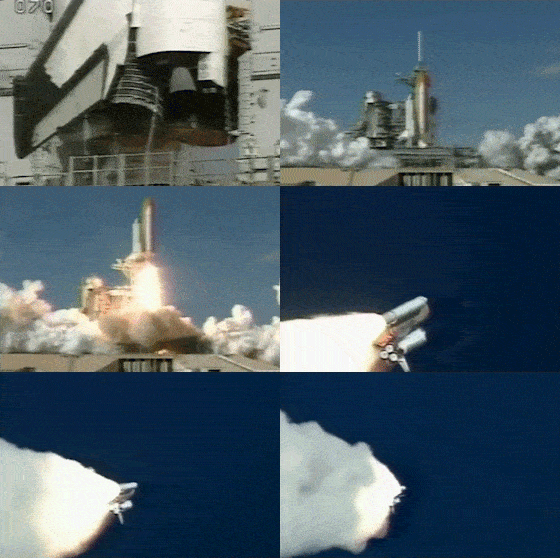
2003 failed flight of the Space Shuttle Columbia
| Field | Value |
|---|---|
| name | STS-107 |
| names_list | Space Transportation System-107 |
| image | Spacehab S107e05359.jpg |
| image_caption | Spacehab's Research Double Module in Columbias payload bay during STS-107 |
| insignia | STS-107 Flight Insignia.svg |
| insignia_caption | STS-107 mission patch |
| spacecraft | |
| mission_type | Microgravity research |
| operator | NASA |
| COSPAR_ID | |
| SATCAT | |
| mission_duration | 15 days, 22 hours, 20 minutes, 32 seconds |
| orbits_completed | 255 |
| distance_travelled | 6600000 mi |
| launch_mass | 263706 lb |
| landing_mass | 232793 lb (expected) |
| payload_mass | 32084 lb |
| crew_size | 7 |
| crew_members | |
| crew_photo | Crew of STS-107, official photo.jpg |
| crew_photo_caption | Rear (L-R): David Brown, Laurel Clark, Michael Anderson, Ilan Ramon; |
| Front (L-R): Rick Husband, Kalpana Chawla, William McCool | |
| launch_site | Kennedy, LC-39A |
| launch_date | UTC |
| decay_date | UTC |
| Disintegrated during reentry | |
| landing_site | Kennedy, SLF Runway 33 (planned) |
| apsis | gee |
| orbit_reference | Geocentric |
| orbit_regime | Low Earth |
| orbit_apoapsis | 177 mi |
| orbit_periapsis | 170 mi |
| orbit_period | 90.1 minutes |
| orbit_inclination | 39.0 degrees |
| programme | Space Shuttle program |
| previous_mission | STS-113 |
| next_mission | STS-114 |
the final mission of the Space Shuttle Columbia
Front (L-R): Rick Husband, Kalpana Chawla, William McCool
Disintegrated during reentry
STS-107 was the 113th flight of the Space Shuttle program, and the 28th and final flight of Space Shuttle Columbia. The mission ended on February 1, 2003, with the Space Shuttle Columbia disaster, in which all seven crew members were killed; the shuttle was destroyed along with most of its scientific payloads.
The flight launched from Kennedy Space Center in Florida on January 16, 2003. It spent 15 days, 22 hours, 20 minutes, 32 seconds in orbit. The crew conducted a multitude of international scientific experiments. The disaster occurred during reentry while the orbiter was over Texas.
Immediately after the disaster, NASA convened the Columbia Accident Investigation Board to determine the cause of the disintegration. The source of the failure was determined to have been caused by a piece of foam that broke off during launch and damaged the thermal protection system (reinforced carbon-carbon panels and thermal protection tiles) on the leading edge of the orbiter's left wing. During re-entry the damaged wing slowly overheated and came apart, eventually leading to loss of control and disintegration of the vehicle. The cockpit window frame is now exhibited in a memorial inside the Space Shuttle Atlantis Pavilion at the Kennedy Space Center.
The damage to the thermal protection system on the wing was similar to that of Atlantis which had also sustained damage in 1988 during STS-27, the second mission after the Space Shuttle Challenger disaster. However, the damage on STS-27 occurred at a spot that had more robust metal (a thin steel plate near the landing gear), and that mission survived the re-entry.
Crew
Flight Engineer
Crew seat assignments
| Seat | Launch | Landing | 1 | 2 | 3 | 4 | 5 | 6 | 7 |
|---|---|---|---|---|---|---|---|---|---|
| [[File:Space Shuttle seating plan.svg | 150px]] | ||||||||
| Seats 1–4 are on the flight deck. | |||||||||
| Seats 5–7 are on the mid-deck. | |||||||||
| Husband | |||||||||
| McCool | |||||||||
| Brown | Clark | ||||||||
| Chawla | |||||||||
| Anderson | |||||||||
| Clark | Brown | ||||||||
| Ramon |
Mission highlights
STS-107 carried the SPACEHAB Research Double Module (RDM) on its inaugural flight, the Freestar experiment (also known as FREESTAR) (mounted on a Hitchhiker Program rack), and the Extended Duration Orbiter pallet. SPACEHAB was first flown on STS-57.
The primary mission focus was multidisciplinary microgravity research.
On the day of the experiment, a video taken to study atmospheric dust may have detected a new atmospheric phenomenon, dubbed a "TIGER" (Transient Ionospheric Glow Emission in Red).
On board Columbia was a copy of a drawing by Petr Ginz, the editor-in-chief of the magazine Vedem, who depicted what he imagined the Earth looked like from the Moon when he was a 14-year-old prisoner in the Terezín concentration camp. The copy was in the possession of Ilan Ramon and was lost in the disintegration. Ramon also traveled with a dollar bill received from the Lubavitcher Rebbe.
An Australian experiment, created by students from Glen Waverley Secondary College, was designed to test the reaction of zero gravity on the web formation of the Australian garden orb weaver spider.
Major experiments
Examples of some of the experiments and investigations on the mission.
In SPACEHAB RDM:
- 9 commercial payloads with 21 investigations;
- 4 payloads for the European Space Agency with 14 investigations;
- 1 payload for ISS Risk Mitigation;
- 18 payloads NASA's Office of Biological and Physical Research (OBPR) with 23 investigations.
In the payload bay attached to RDM:
- Combined Two-Phase Loop Experiment (COM2PLEX);
- Miniature Satellite Threat Reporting System (MSTRS);
- Star Navigation (STARNAV).
FREESTAR
- Critical Viscosity of Xenon-2 (CVX-2);
- Space Experiment Module (SEM-14);
- Mediterranean Israeli Dust Experiment (MEIDEX);
- Low Power Transceiver (LPT);
- Solar Constant Experiment-3 (SOLCON-3);
- Shuttle Ozone Limb Sounding Experiment (SOLSE-2);
Additional payloads
- Shuttle Ionospheric Modification with Pulsed Local Exhaust Experiment (SIMPLEX);
- Ram Burn Observation (RAMBO).
Results and data gained
3 experiments examined combustion, soot production, and fire quenching processes in microgravity which provided new insights into combustion and fire suppression not able to be observed in Earth conditions. Other things included:
- An experiment which aided our understanding of construction techniques.
- Another for biological applications that can be used to combat prostate cancer and another to increase crop yield.
- As well as several other experiments who's results aided in the scientific process.
Data recovery
Because much of the data was transmitted during the mission, there was still large return on the mission objectives even though Columbia was lost on re-entry. NASA estimated that 30% of the total science data was saved and collected through telemetry back to ground stations. Around 5-10% more data was saved and collected through recovering samples and hard drives intact on the ground after the Space Shuttle Columbia disaster, increasing the total data of saved experiments despite the disaster from 30% to 35-40%.
About five or six Columbia payloads encompassing many experiments were successfully recovered in the debris field. Scientists and engineers were able to recover 99% of the data for one of the six FREESTAR experiments, Critical Viscosity of Xenon-2 (CVX-2), that flew unpressurized in the payload bay during the mission after recovering the viscometer and hard drive damaged but fully intact in the debris field in Texas. NASA recovered a commercial payload, Commercial Instrumentation Technology Associates (ITA) Biomedical Experiments-2 (CIBX-2), and ITA was able to increase the total data saved from STS-107 from 0% to 50% for this payload. This experiment studied treatments for cancer, and the micro-encapsulation experiment part of the payload was completely recovered, increasing from 0% data to 90% data after recovering the samples fully intact for this experiment. In this same payload were numerous crystal-forming experiments by hundreds of elementary and middle school students from all across the United States. Miraculously most of their experiments were found intact in CIBX-2, increasing from 0% data to 100% fully recovered data. The BRIC-14 (moss growth experiment) and BRIC-60 (Caenorhabditis elegans roundworm experiment) samples were found intact in the debris field within a 12 mi radius in east Texas. 80-87% of these live organisms survived the catastrophe. The moss and roundworms experiments' original primary mission was not nominal due to the lack of having the samples immediately after landing in their original state (they were discovered many months after the crash), but these samples helped the scientific community greatly in the field of astrobiology and helped form new theories about microorganisms surviving a long trip in outer space while traveling on meteorites or asteroids.
Re-entry
Main article: Space Shuttle Columbia disaster, Columbia Accident Investigation Board

Columbia began re-entry as planned, but the heat shield was compromised due to damage sustained during the ascent during which foam insulation from the external tank struck its left wing. The heat of re-entry was free to spread into the damaged portion of the orbiter, ultimately causing its disintegration and the death of all seven astronauts.
Aftermath
Upon realizing the tragedy, the Mission Control Center was locked and all of the data was saved for the coming investigation. Within 90 minutes a meeting was convened and the Columbia Accident Investigation Board (CAIB) was formed. They confirmed the cause of the accident and criticized NASA for bad organizational and safety culture.
The accident triggered a 7-month investigation and a search for debris, and over 85,000 pieces were collected throughout the initial investigation. This amounted to roughly 38 percent of the orbiter vehicle.
Insignia

The mission insignia itself is the only patch of the shuttle program that is entirely shaped in the orbiter's outline. The central element of the patch is the microgravity symbol, μg, flowing into the rays of the astronaut symbol.
The mission inclination is portrayed by the 39-degree angle of the astronaut symbol to the Earth's horizon. The sunrise is representative of the numerous experiments that are the dawn of a new era for continued microgravity research on the International Space Station and beyond. The breadth of science and the exploration of space is illustrated by the Earth and stars. The constellation Columba (the dove) was chosen to symbolize peace on Earth and the Space Shuttle Columbia. The seven stars also represent the mission crew members and honor the original astronauts who paved the way to make research in space possible. Six stars have five points, the seventh has six points like a Star of David, symbolizing the Israeli Space Agency's contributions to the mission.
An Israeli flag is adjacent to the name of Payload Specialist Ramon, who was the first Israeli in space. The crew insignia or 'patch' design was initiated by crew members Dr. Laurel Clark and Dr. Kalpana Chawla. First-time crew member Clark provided most of the design concepts as Chawla led the design of her maiden voyage STS-87 insignia. Clark also pointed out that the dove in the Columba constellation was mythologically connected to the explorers the Argonauts who released the dove.
Wake-up calls
Throughout the shuttle program, sleeping astronauts were often awakened each morning by songs and short pieces of music chosen by their families, friends, and Mission Control, a tradition dating back to the Gemini and Apollo programs. While the crew of STS-107 worked shifts in "red" and "blue" teams to work around the clock, on this mission each shift was still awoken with a "wake-up call"; the only other two-shift shuttle mission to do so was STS-99.
| Day | Team | Song | Artist/Performer | Played for | Link | |
|---|---|---|---|---|---|---|
| 2 | Blue[[Image:Solid blue.svg | 8px]] | "E'mma" | Touré Kunda | David Brown | WAV |
| Red[[Image:Solid red.svg | 8px]] | "America, the Beautiful" | Texas Elementary Honors Choir | Rick Husband | WAV | |
| 3 | Blue[[Image:Solid blue.svg | 8px]] | "Coming Back to Life" | Pink Floyd | William McCool | WAV |
| Red[[Image:Solid red.svg | 8px]] | "Space Truckin'" | Deep Purple | Kalpana Chawla | WAV | |
| 4 | Blue[[Image:Solid blue.svg | 8px]] | "Cultural Exchange" | Not listed | David Brown | WAV |
| Red[[Image:Solid red.svg | 8px]] | "Hatishma Koli" | The High Windows | Ilan Ramon | WAV | |
| 5 | Blue[[Image:Solid blue.svg | 8px]] | "Fake Plastic Trees" | Radiohead | William McCool | WAV |
| Red[[Image:Solid red.svg | 8px]] | "Amazing Grace" | Black Watch and 51st Highland Brigade Band | Laurel Clark | WAV | |
| 6 | Blue[[Image:Solid blue.svg | 8px]] | "Texan 60" | Not listed | David Brown | WAV |
| Red[[Image:Solid red.svg | 8px]] | "God of Wonders" | Steve Green | Rick Husband | WAV | |
| 7 | Blue[[Image:Solid blue.svg | 8px]] | "The Wedding Song" | Paul Stookey | William McCool | WAV |
| Red[[Image:Solid red.svg | 8px]] | "Prabhati" | Ravi Shankar | Kalpana Chawla | WAV | |
| 8 | Blue[[Image:Solid blue.svg | 8px]] | "Hakuna Matata" | The Baha Men | Michael Anderson | WAV |
| Red[[Image:Solid red.svg | 8px]] | "Ma ata oseh kesheata kam baboker?" | Arik Einstein | Ilan Ramon | WAV | |
| 9 | Blue[[Image:Solid blue.svg | 8px]] | "Burning Down The House" | Talking Heads | To honor combustion experiments | WAV |
| Red[[Image:Solid red.svg | 8px]] | "Kung Fu Fighting" | Carl Douglas | Whole crew | WAV | |
| 10 | Blue[[Image:Solid blue.svg | 8px]] | "Hotel California" | The Eagles / McCool Family | William McCool | WAV |
| Red[[Image:Solid red.svg | 8px]] | "The Prayer" | Celine Dion | Rick Husband | WAV | |
| 11 | Blue[[Image:Solid blue.svg | 8px]] | "I Say a Little Prayer" | Dionne Warwick | Michael Anderson | WAV |
| Red[[Image:Solid red.svg | 8px]] | "Drops of Jupiter" | Train | Kalpana Chawla | WAV | |
| 12 | Blue[[Image:Solid blue.svg | 8px]] | "When Day Is Done" | Django Reinhardt and Stephane Grappelli | David Brown | WAV |
| Red[[Image:Solid red.svg | 8px]] | "Love of My Life" | Queen | Ilan Ramon | WAV | |
| 13 | Blue[[Image:Solid blue.svg | 8px]] | "Slow Boat to Rio" | Earl Klugh | Michael Anderson | WAV |
| Red[[Image:Solid red.svg | 8px]] | "Running to the Light" | Runrig | Laurel Clark | WAV | |
| 14 | Blue[[Image:Solid blue.svg | 8px]] | "I Get Around" | The Beach Boys | David Brown | WAV |
| Red[[Image:Solid red.svg | 8px]] | "Up On the Roof" | James Taylor | Rick Husband | WAV | |
| 15 | Blue[[Image:Solid blue.svg | 8px]] | "Imagine" | John Lennon | William McCool | WAV |
| Red[[Image:Solid red.svg | 8px]] | "Yaar ko hamne ja ba ja dekha" | Abita Parveen | Kalpana Chawla | WAV | |
| 16 | Blue[[Image:Solid blue.svg | 8px]] | "Silver Inches" | Enya | David Brown | WAV |
| Red[[Image:Solid red.svg | 8px]] | "Shalom lach eretz nehederet" | Yehoram Gaon | Ilan Ramon | WAV | |
| 17 | Blue[[Image:Solid blue.svg | 8px]] | "If You've Been Delivered" | Kirk Franklin | Michael Anderson | WAV |
| Red[[Image:Solid red.svg | 8px]] | "Scotland the Brave" | The Black Watch and 51st Highland Brigade Band | Laurel Clark | WAV |
Gallery
STS-107, Space Shuttle Columbia launch.ogg|Launch video. Close-up STS-107 Launch - GPN-2003-00080.jpg|Launch of STS-107 from Launch Pad 39A at Kennedy Space Center. STS-107-sleeping-crew.jpg|Mission STS-107 crew in bunk beds on the middeck of the Space Shuttle. STS-107 Cockpit Video 3.jpg|Reentry video frame. STS107-E-5311.JPG|View of the atmosphere and of the Moon. Mount Fuji from space (shuttle mission).jpg|A view of Mount Fuji and the surrounding area from Columbia Columbia's Main Engine Powerheads - GPN-2003-00076.jpg|Part of one of Columbias main engines later recovered.
Notes
References
Literature
References
- (May 30, 2003). "HSF - STS-107 Science". [[NASA]].
- "STS-107". Spacefacts.
- "STS-107 - NASA".
- Mckee, Maggie. (January 19, 2005). "Columbia crew saw new atmospheric phenomenon".
- Brown, Irene. (January 27, 2003). "Israeli astronaut busy up in space". [[Jewish Telegraphic Agency]].
- (February 2, 2003). "Australian space spiders perish". [[The Sydney Morning Herald]].
- (August 29, 2023). "STS-107". [[NASA]].
- John, Charles. (May 30, 2003). "STS-107 Whole Payload % Science Gained: Code U, ISS RME, SPACEHAB commercial, ESA, FREESTAR".
- Over, A. P.. (January 2004). "STS-107 Mission after the Mission: Recovery of Data from the Debris of ''Columbia''". [[American Institute of Aeronautics and Astronautics]].
- Cenciotti, David. (February 1, 2014). "Space Shuttle Columbia Disaster as seen through AH-64 Apache camera". The Aviationist.
- (2023-01-26). "20 Years Ago: Remembering Columbia and Her Crew - NASA".
- (January 16, 2003). "STS-107".
- "Constellation Columba". coldwater.k12.mi.us.
- Bergin, Chris. (2013-02-01). "STS-107: Remembering the accomplishments of the Columbia crew".
- Fries, Colin. (13 March 2015). "Chronology of Wakeup Calls". NASA History Division.
- (1 February 2003). "STS-107 Wake-up Calls". NASA.
This article was imported from Wikipedia and is available under the Creative Commons Attribution-ShareAlike 4.0 License. Content has been adapted to SurfDoc format. Original contributors can be found on the article history page.
Ask Mako anything about STS-107 — get instant answers, deeper analysis, and related topics.
Research with MakoFree with your Surf account
Create a free account to save articles, ask Mako questions, and organize your research.
Sign up freeThis content may have been generated or modified by AI. CloudSurf Software LLC is not responsible for the accuracy, completeness, or reliability of AI-generated content. Always verify important information from primary sources.
Report