From Surf Wiki (app.surf) — the open knowledge base
Struve function
Mathematical function
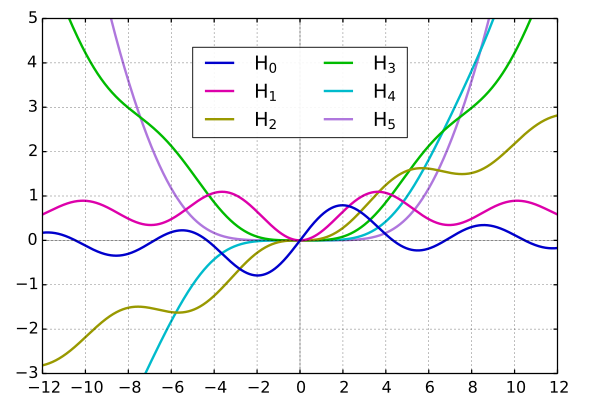
Mathematical function
In mathematics, the Struve functions Hα(x), are solutions y(x) of the non-homogeneous Bessel's differential equation:
: x^2 \frac{d^2 y}{dx^2} + x \frac{dy}{dx} + \left (x^2 - \alpha^2 \right )y = \frac{4\left (\frac{x}{2}\right)^{\alpha+1}}{\sqrt{\pi}\Gamma \left (\alpha+\frac{1}{2} \right )}
introduced by . The complex number α is the order of the Struve function, and is often an integer.
And further defined its second-kind version \mathbf{K}\alpha(x) as \mathbf{K}\alpha(x)=\mathbf{H}\alpha(x)-Y\alpha(x), where Y_\alpha(x) is the Neumann function.
The modified Struve functions Lα(x) are equal to −ie−iαπ / 2Hα(ix) and are solutions y(x) of the non-homogeneous Bessel's differential equation:
: [[File:Plot of the Struve function H n(z) with n=2 in the complex plane from -2-2i to 2+2i with colors created with Mathematica 13.1 function ComplexPlot3D.svg|alt=Plot of the Struve function H n(z) with n=2 in the complex plane from -2-2i to 2+2i with colors created with Mathematica 13.1 function ComplexPlot3D|thumb|Plot of the Struve function H n(z) with n=2 in the complex plane from -2-2i to 2+2i with colors created with Mathematica 13.1 function ComplexPlot3D]]x^2 \frac{d^2 y}{dx^2} + x \frac{dy}{dx} - \left (x^2 + \alpha^2 \right )y = \frac{4\left (\frac{x}{2}\right)^{\alpha+1}}{\sqrt{\pi}\Gamma \left (\alpha+\frac{1}{2} \right )}
And further defined its second-kind version \mathbf{M}\alpha(x) as \mathbf{M}\alpha(x)=\mathbf{L}\alpha(x)-I\alpha(x), where I_\alpha(x) is the modified Bessel function.
Definitions
Since this is a non-homogeneous equation, solutions can be constructed from a single particular solution by adding the solutions of the homogeneous problem. In this case, the homogeneous solutions are the Bessel functions, and the particular solution may be chosen as the corresponding Struve function.
Power series expansion
Struve functions, denoted as Hα(z) have the power series form
: \mathbf{H}\alpha(z) = \sum{m=0}^\infty \frac{(-1)^m}{\Gamma \left (m+\frac{3}{2} \right ) \Gamma \left (m+\alpha+\frac{3}{2} \right )} \left({\frac{z}{2}}\right)^{2m+\alpha+1},
where Γ(z) is the gamma function.
The modified Struve functions, denoted Lα(z), have the following power series form
: \mathbf{L}\alpha(z) = \sum{m=0}^\infty \frac{1}{\Gamma \left (m+\frac{3}{2} \right ) \Gamma \left (m+\alpha+\frac{3}{2} \right )} \left(\frac{z}{2}\right)^{2m+\alpha+1}.[[File:Plot of the modified Struve function L n(z) with n=2 in the complex plane from -2-2i to 2+2i with colors created with Mathematica 13.1 function ComplexPlot3D.svg|alt=Plot of the modified Struve function L n(z) with n=2 in the complex plane from -2-2i to 2+2i with colors created with Mathematica 13.1 function ComplexPlot3D|thumb|Plot of the modified Struve function L n(z) with n=2 in the complex plane from -2-2i to 2+2i with colors created with Mathematica 13.1 function ComplexPlot3D]]
Integral form
Another definition of the Struve function, for values of α satisfying Re(α) − , is possible expressing in term of the Poisson's integral representation:
\mathbf{H}_\alpha(x)=\frac{2\left(\frac{x}{2}\right)^\alpha}{\sqrt\pi\Gamma\left(\alpha+\frac{1}{2}\right)}\int_0^1(1-t^2)^{\alpha-\frac{1}{2}}\sin xt~dt=\frac{2\left(\frac{x}{2}\right)^\alpha}{\sqrt\pi\Gamma\left(\alpha+\frac{1}{2}\right)}\int_0^\frac{\pi}{2}\sin(x\cos\tau)\sin^{2\alpha}\tau~d\tau=\frac{2\left(\frac{x}{2}\right)^\alpha}{\sqrt\pi\Gamma\left(\alpha+\frac{1}{2}\right)}\int_0^\frac{\pi}{2}\sin(x\sin\tau)\cos^{2\alpha}\tau~d\tau
\mathbf{K}_\alpha(x)=\frac{2\left(\frac{x}{2}\right)^\alpha}{\sqrt\pi\Gamma\left(\alpha+\frac{1}{2}\right)}\int_0^\infty(1+t^2)^{\alpha-\frac{1}{2}}e^{-xt}~dt=\frac{2\left(\frac{x}{2}\right)^\alpha}{\sqrt\pi\Gamma\left(\alpha+\frac{1}{2}\right)}\int_0^\infty e^{-x\sinh\tau}\cosh^{2\alpha}\tau~d\tau
\mathbf{L}_\alpha(x)=\frac{2\left(\frac{x}{2}\right)^\alpha}{\sqrt\pi\Gamma\left(\alpha+\frac{1}{2}\right)}\int_0^1(1-t^2)^{\alpha-\frac{1}{2}}\sinh xt~dt=\frac{2\left(\frac{x}{2}\right)^\alpha}{\sqrt\pi\Gamma\left(\alpha+\frac{1}{2}\right)}\int_0^\frac{\pi}{2}\sinh(x\cos\tau)\sin^{2\alpha}\tau~d\tau=\frac{2\left(\frac{x}{2}\right)^\alpha}{\sqrt\pi\Gamma\left(\alpha+\frac{1}{2}\right)}\int_0^\frac{\pi}{2}\sinh(x\sin\tau)\cos^{2\alpha}\tau~d\tau
\mathbf{M}_\alpha(x)=-\frac{2\left(\frac{x}{2}\right)^\alpha}{\sqrt\pi\Gamma\left(\alpha+\frac{1}{2}\right)}\int_0^1(1-t^2)^{\alpha-\frac{1}{2}}e^{-xt}~dt=-\frac{2\left(\frac{x}{2}\right)^\alpha}{\sqrt\pi\Gamma\left(\alpha+\frac{1}{2}\right)}\int_0^\frac{\pi}{2}e^{-x\cos\tau}\sin^{2\alpha}\tau~d\tau=-\frac{2\left(\frac{x}{2}\right)^\alpha}{\sqrt\pi\Gamma\left(\alpha+\frac{1}{2}\right)}\int_0^\frac{\pi}{2}e^{-x\sin\tau}\cos^{2\alpha}\tau~d\tau
Asymptotic forms
For small x, the power series expansion is given above.
For large x, one obtains:
:\mathbf{H}\alpha(x) - Y\alpha(x) = \frac{\left(\frac{x}{2}\right)^{\alpha-1}}{\sqrt{\pi} \Gamma \left (\alpha+\frac{1}{2} \right )} + O\left(\left (\tfrac{x}{2}\right)^{\alpha-3}\right),
where Yα(x) is the Neumann function.
Properties
The Struve functions satisfy the following recurrence relations:
:\begin{align} \mathbf{H}{\alpha -1}(x) + \mathbf{H}{\alpha+1}(x) &= \frac{2\alpha}{x} \mathbf{H}\alpha (x) + \frac{\left (\frac{x}{2}\right)^{\alpha}}{\sqrt{\pi}\Gamma \left (\alpha + \frac{3}{2} \right )}, \ \mathbf{H}{\alpha -1}(x) - \mathbf{H}{\alpha+1}(x) &= 2 \frac{d}{dx} \left (\mathbf{H}\alpha(x) \right) - \frac{ \left( \frac{x}{2} \right)^\alpha}{\sqrt{\pi}\Gamma \left (\alpha + \frac{3}{2} \right )}. \end{align}
Relation to other functions
Struve functions of integer order can be expressed in terms of Weber functions En and vice versa: if n is a non-negative integer then
:\begin{align} \mathbf{E}n(z) &= \frac{1}{\pi} \sum{k=0}^{\left \lfloor \frac{n-1}{2} \right \rfloor} \frac{\Gamma \left (k+ \frac{1}{2} \right) \left (\frac{z}{2} \right )^{n-2k-1}}{\Gamma \left (n- k + \frac{1}{2}\right )} -\mathbf{H}n(z),\ \mathbf{E}{-n}(z) &= \frac{(-1)^{n+1}}{\pi}\sum_{k=0}^{\left \lceil \frac{n-3}{2} \right \rceil} \frac{\Gamma(n-k-\frac{1}{2}) \left (\frac{z}{2} \right )^{-n+2k+1}}{\Gamma \left (k+ \frac{3}{2} \right)}-\mathbf{H}_{-n}(z). \end{align}
Struve functions of order n + where n is an integer can be expressed in terms of elementary functions. In particular if n is a non-negative integer then
:\mathbf{H}{-n-\frac{1}{2}} (z) = (-1)^n J{n+\frac{1}{2}}(z),
where the right hand side is a spherical Bessel function.
Struve functions (of any order) can be expressed in terms of the generalized hypergeometric function 1F2:
:\mathbf{H}_{\alpha}(z) = \frac{z^{\alpha+1}}{2^{\alpha}\sqrt{\pi} \Gamma \left (\alpha+\tfrac{3}{2} \right )} {}_1F_2 \left (1;\tfrac{3}{2}, \alpha+\tfrac{3}{2};-\tfrac{z^2}{4} \right ).
Applications
The Struve and Weber functions were shown to have an application to beamforming in., and in describing the effect of confining interface on Brownian motion of colloidal particles at low Reynolds numbers.
References
References
- K. Buchanan, C. Flores, S. Wheeland, J. Jensen, D. Grayson and G. Huff, "Transmit beamforming for radar applications using circularly tapered random arrays," 2017 IEEE Radar Conference (RadarConf), 2017, pp. 0112-0117, doi: 10.1109/RADAR.2017.7944181
- B. U. Felderhof, "Effect of the wall on the velocity autocorrelation function and long-time tail of Brownian motion." The Journal of Physical Chemistry B 109.45, 2005, pp. 21406-21412
This article was imported from Wikipedia and is available under the Creative Commons Attribution-ShareAlike 4.0 License. Content has been adapted to SurfDoc format. Original contributors can be found on the article history page.
Ask Mako anything about Struve function — get instant answers, deeper analysis, and related topics.
Research with MakoFree with your Surf account
Create a free account to save articles, ask Mako questions, and organize your research.
Sign up freeThis content may have been generated or modified by AI. CloudSurf Software LLC is not responsible for the accuracy, completeness, or reliability of AI-generated content. Always verify important information from primary sources.
Report