From Surf Wiki (app.surf) — the open knowledge base
Strum
Way of playing a stringed instrument
Way of playing a stringed instrument
In music, strumming is a way of playing a stringed instrument such as a guitar, ukulele, or mandolin. A strum or stroke is a sweeping action where a finger or plectrum brushes over several strings to generate sound. On most stringed instruments, strums are typically executed by a musician's designated strum hand (typically the musician's dominant hand, which is often responsible for generating the majority of sound on a stringed instrument), while the remaining hand (referred to as the fret hand on most instruments with a fingerboard) often supports the strum hand by altering the tones and pitches of any given strum.
Strums are often contrasted with plucking, as a means of vibrating an instrument's strings. In plucking, a specific string or designated set of strings are individually targeted to vibrate, whereas in strumming, a less precise targeting is usually used. Compared to other plucking techniques, any group of strings brushed in a single sweep by a plectrum could be considered a strum due to the plectrum's less precise string group targeting (however, a plectrum might simultaneously pluck a small group of strings without being considered a strum). In contrast, a musician could utilize a technique with more precise string group targeting (such as a fingerstyle or fingerpick technique) to pluck all the strings on a stringed instrument at once and this would still be considered a pluck, not a strum.
Notation
Strumming patterns
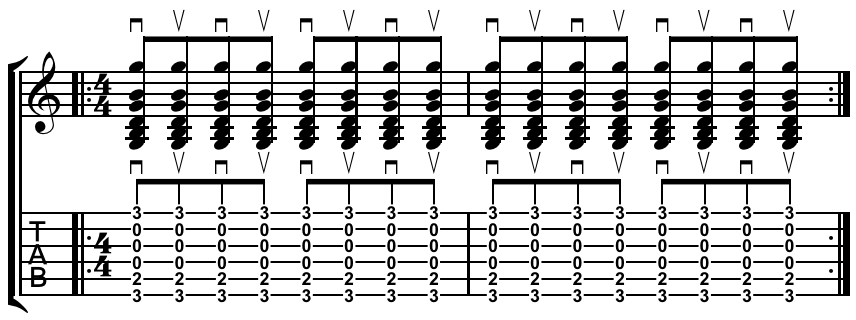
A strumming pattern or strum is a preset pattern used by a rhythm guitar. For example, a pattern in common time or consisting of alternating down and up eighth note strokes may be written: : :
Rock and pop
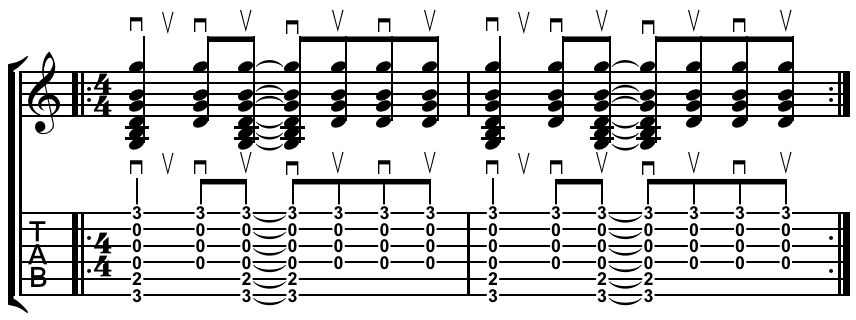
The pattern most typical of rock and related styles is: : :
The final upstroke is sometimes omitted altering the strumming pattern slightly to d du ud. This pattern is often called "Old Faithful", or when played on ukulele, the "Island Strum".
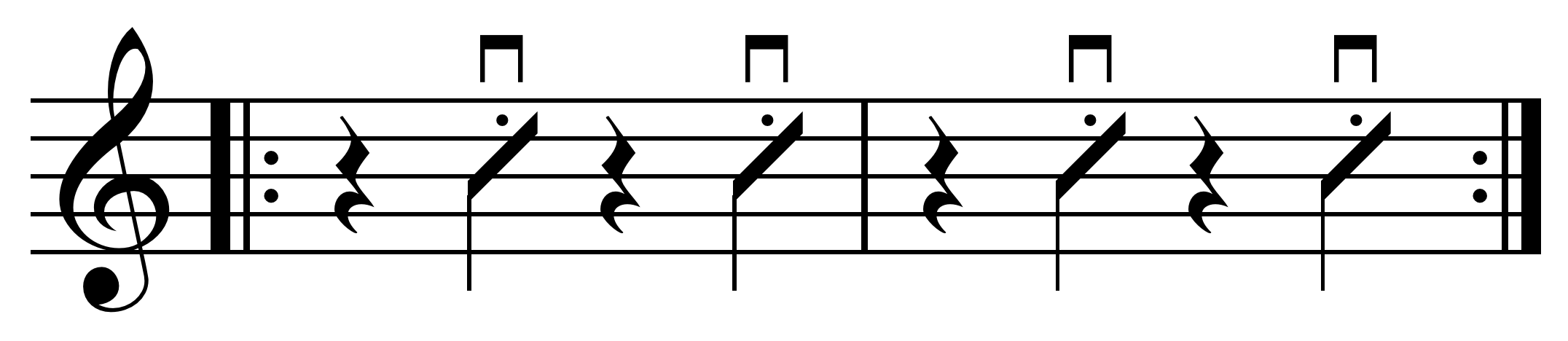
Examples of other strumming patterns include:{{cite book
- Single down strum:
- Elvis' "Burning Love"
- Kathy Mattea's "What Could Have Been"
- Boom-chicka:
- Merle Haggard's "Silver Wings"
Jazz and funk
The simple four-to-a-bar rhythm is associated with jazz guitarists such as Freddie Green, although they may subtly vary the rhythm of a chord on some beats to add interest.
A simple eight-to-a-bar (8 eighth notes) rhythm is known as "straight eights" as opposed "swung eights", in which each pair are played in a rhythm that resembles the first and third notes in a triplet.
The fretting hand can also mute the strings on the fretboard to damp a chord, creating staccato and percussive effects. In reggae and ska, a few staccato "chops" are played per bar. In funk rhythm playing, the strumming hand keeps a fairly steady motion in 16th notes, while the left hand, basically holding down a jazz chord damps some of them in a syncopated pattern.
Fingerstyle strumming strokes
Some of the many possible fingerstyle strums include
- A slow downstroke with the thumb. This is a sforzando or emphatic way of playing a chord.
- Light "brushing" strokes with the fingers moving together at a near-perpendicular angle to the strings. Works equally in either direction and can be alternated for a chord tremolo chord effect.
- Upstrokes with one finger make a change from the standard downstroke strum.
- A "pinch" with the thumb and fingers moving towards each other gives a crisp effect. It is helpful to clearly articulate the topmost and bass note in the chord, as if plucking, before "following through".
- Rasgueado: Strumming is typically done by bunching all the right-hand fingers and then flicking them out in quick succession to get four superimposed strums. The rasgueado or "rolling" strum is particularly characteristic of flamenco.
- Turning p-a-m-i tremolo plucking into a series of downstrokes. This is a lighter version of the classic rasgueado, which uses upstrokes.
References
References
- Snyder, Jerry (1999). ''Jerry Snyder's Guitar School'', p.28. {{ISBN. 0-7390-0260-0.
- "Definition of STRUMMING".
- "Should You Play Left-Handed or Right-Handed? {{!}} Hub Guitar".
- "Fret-Hand Fitness: Four Wicked Workouts to Develop Your Digits". GuitarPlayer.com.
- "Right-handed and Left-handed Vs Right and Left Hand Guitars".
- "Strumming patterns for the Ukulele".
- (2013). "Justinguitar.Com: Rock Songbook". Music Sales Ltd.
This article was imported from Wikipedia and is available under the Creative Commons Attribution-ShareAlike 4.0 License. Content has been adapted to SurfDoc format. Original contributors can be found on the article history page.
Ask Mako anything about Strum — get instant answers, deeper analysis, and related topics.
Research with MakoFree with your Surf account
Create a free account to save articles, ask Mako questions, and organize your research.
Sign up freeThis content may have been generated or modified by AI. CloudSurf Software LLC is not responsible for the accuracy, completeness, or reliability of AI-generated content. Always verify important information from primary sources.
Report