From Surf Wiki (app.surf) — the open knowledge base
Strombolian eruption
Type of volcanic eruption with relatively mild explosive intensity or spattering
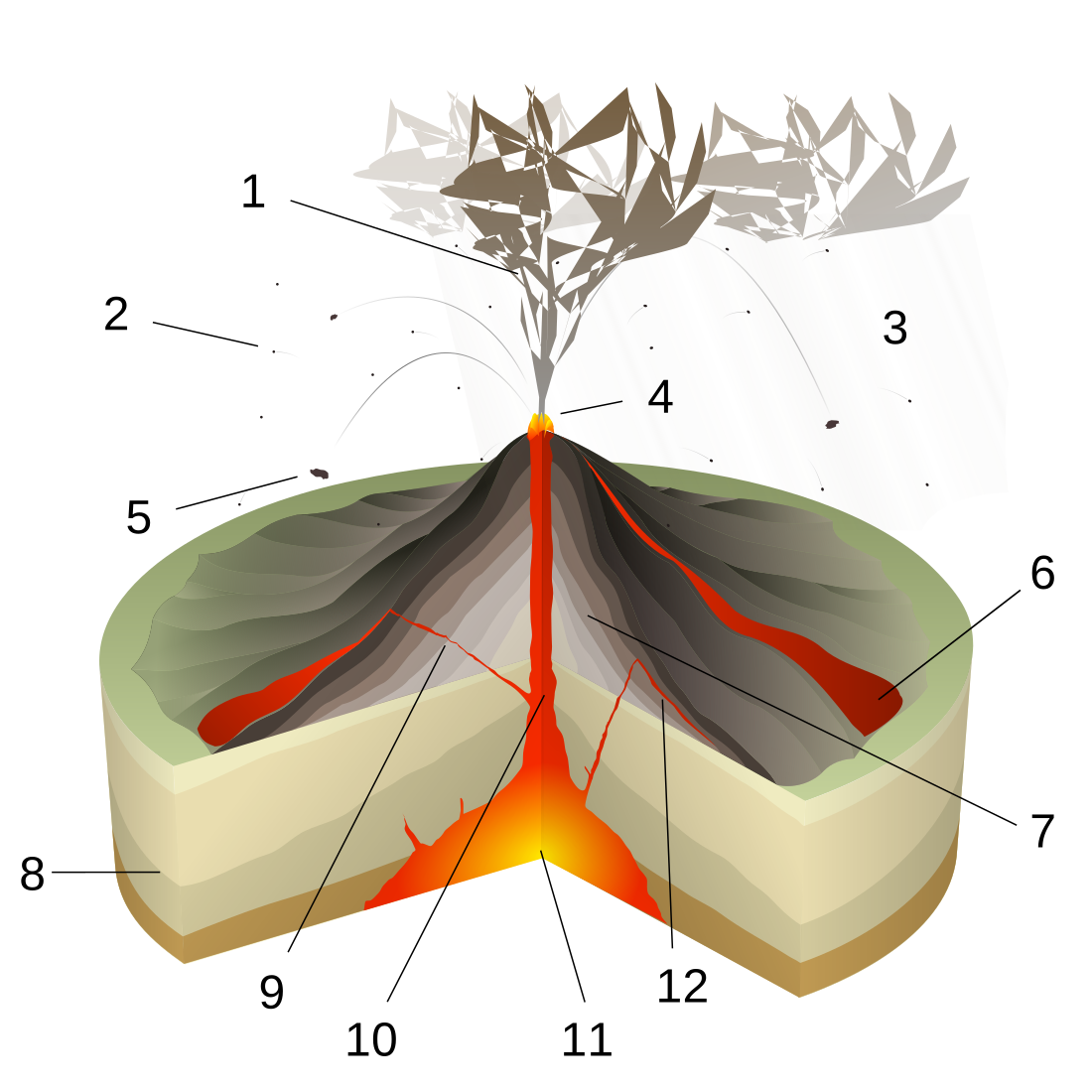
Type of volcanic eruption with relatively mild explosive intensity or spattering
In volcanology, a Strombolian eruption is a type of volcanic eruption with relatively mild blasts, typically having a Volcanic Explosivity Index of 1 or 2. Strombolian eruptions consist of ejection of incandescent scoria which can range from small lapilli, to larger volcanic bombs, to altitudes of tens to a few hundreds of metres. The eruptions are small to medium in volume, with sporadic violence. This type of eruption is named for the Italian volcano Stromboli.
The tephra typically glows red when leaving the vent, but its surface cools and assumes a dark to black color and may significantly solidify before impact. The tephra accumulates in the vicinity of the vent, forming a cinder cone. Scoria is the most common product; the amount of volcanic ash is typically rather minor or absent.
The lava flows are more viscous, and therefore shorter and thicker, than the corresponding Hawaiian eruptions; it may or may not be accompanied by production of pyroclastic rock and lava flows.
Instead the gas coalesces into bubbles, called gas slugs, that grow large enough to rise through the magma column, bursting near the top due to the decrease in pressure and throwing magma into the air. Each episode thus releases volcanic gases, sometimes as frequently as a few minutes apart. Gas slugs can form as deep as 3 kilometers, making them difficult to predict.

Strombolian eruptive activity can be very long-lasting because the conduit system is not strongly affected by the eruptive activity so that the eruptive system can repeatedly reset itself.
Monogenetic cones usually erupt in the Strombolian style. For example, the Parícutin volcano erupted continuously between 1943–1952, Mount Erebus, Antarctica has produced Strombolian eruptions for at least many decades from its lava whicg which periodically explodes, and Stromboli itself has been producing Strombolian eruptions for over two thousand years. The Romans referred to Stromboli as the "Lighthouse of the Mediterranean."
Violent Strombolian
The most energetic Strombolian eruptions are sometimes termed "violent Strombolian" by volcanologists. Such eruptions are associated with higher magma gas content, leading to a turbulent churn flow regime in the conduit, producing stronger and much more frequent explosions.
Violent Strombolian eruptions are more explosive in nature than their regular counterparts (up to VEI 3), and may produce sustained lava fountains, long distance lava flows, eruption columns several kilometres in height, and heavy ash fallout. Rarely, Violent Strombolian eruptions may transition into Subplinian eruptions.
Examples of violent Strombolian activity include the paroxysms of Mt. Etna, the 1943-1952 eruption of Parícutin, the 2021 Cumbre Vieja eruption, and various eruptions of Mt. Vesuvius between 1631 and 1944.
References
References
- (20 February 1982). "The Volcanic Explosivity Index (VEI): An Estimate of Explosive Magnitude for Historical Volcanism". Journal of Geophysical Research.
- (13 July 2007). "Magmatic Gas Composition Reveals the Source Depth of Slug-Driven Strombolian Explosive Activity". Science.
- Clarke, Hamish. (13 July 2007). "Volcanoes belch 'slugs' from deep underground". Cosmos online.
- (2013-06-28). "Infrasound reveals transition to oscillatory discharge regime during lava fountaining: Implication for early warning". Geophysical Research Letters.
- (2008-12-20). "Ash fallout scenarios at Vesuvius: Numerical simulations and implications for hazard assessment". Journal of Volcanology and Geothermal Research.
- (2022). "The 2021 eruption of the Cumbre Vieja volcanic ridge on La Palma, Canary Islands". Geology Today.
- (2023). "Volcanic Ash from the Island of La Palma, Spain: An Experimental Study to Establish Their Properties as Pozzolans". Processes.
- (2015-01-01). "Chapter 29 - Plinian and Subplinian Eruptions". Academic Press.
- (2022). "Quantifying Strombolian Activity at Etna Volcano". Geosciences.
- (2008-03-10). "Persistent activity and violent strombolian eruptions at Vesuvius between 1631 and 1944". Journal of Volcanology and Geothermal Research.
This article was imported from Wikipedia and is available under the Creative Commons Attribution-ShareAlike 4.0 License. Content has been adapted to SurfDoc format. Original contributors can be found on the article history page.
Ask Mako anything about Strombolian eruption — get instant answers, deeper analysis, and related topics.
Research with MakoFree with your Surf account
Create a free account to save articles, ask Mako questions, and organize your research.
Sign up freeThis content may have been generated or modified by AI. CloudSurf Software LLC is not responsible for the accuracy, completeness, or reliability of AI-generated content. Always verify important information from primary sources.
Report