From Surf Wiki (app.surf) — the open knowledge base
Straits of Florida
Strait between Florida, U.S. and Cuba
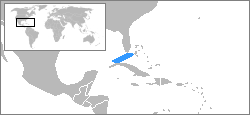
Strait between Florida, U.S. and Cuba
| Field | Value |
|---|---|
| name | Straits of Florida |
| image | Straits of florida.png |
| caption | Florida Straits from space |
| image_bathymetry | Bahamabank-2.jpg |
| caption_bathymetry | Straits and channels around the Bahama Islands. |
| coordinates | |
| catchment | |
| date-built | |
| date-flooded | |
| width | 150 km |
| area | |
| depth | 1800 m |
| max-depth | |
| volume | |
| shore | |
| elevation | |
| temperature_high | |
| temperature_low | |
| pushpin_map | Caribbean |
| pushpin_label_position | right |
| pushpin_relief | 1 |
| date-built = | date-flooded = | max-depth =

The Straits of Florida, Florida Straits, or Florida Strait () is a strait located south-southeast of the North American mainland, generally accepted to be between the Gulf of Mexico and the Atlantic Ocean, and between the Florida Keys (U.S.) and Cuba. It is 93 mi (150 km) wide at the narrowest point between Key West and the Cuban shore, and has been sounded to a depth of 6,000 feet (1,800 m). The strait carries the Florida Current, the beginning of the Gulf Stream, from the Gulf of Mexico.
Oil and gas
Five wells were drilled in state waters south of the Florida Keys from 1947 to 1962. Gulf Oil drilled three wells in federal waters south of the Florida Keys in 1960 and 1961. All the wells were dry holes.
The boundary between the Exclusive Economic Zones of the US and Cuba is halfway between Cuba and Florida, as determined by the 1977 Cuba–United States Maritime Boundary Agreement.
Offshore Cuba
Cuba has three producing offshore oil fields within 5 km of its north coast opposite Florida. The US Geological Survey estimates that the North Cuba Basin contains 5500000000 oilbbl of undiscovered petroleum liquids and 9.8 trillion cubic feet of natural gas, almost all in the offshore part of the basin.
The issue of allowing oil and gas exploration offshore Florida became a hotly contested topic in the 2008 US elections. In a column published 5 June 2008, syndicated columnist George Will wrote that a Chinese oil company was then drilling in Cuban waters 60 mi from the Florida coast, a claim that was repeated by candidates in favor of offshore drilling. In fact, no drilling was then taking place in that part of Cuban waters.
In 2004 the Spanish oil company Repsol drilled in deep Cuban waters between Cuba and the Florida Keys, and found an oil deposit; the deposit was judged noncommercial, and the hole was plugged. In October 2008, Cuba signed an agreement with the Brazilian state oil company Petrobras, which provides for Petrobras to drill for oil and gas in deep waters off the north shore of Cuba. In July 2009, Cuba signed an agreement with the Russian government giving the Russian oil company Zarubezhneft oil exploration rights off the north shore of Cuba. By May 2011 Petrobras had withdrawn from the 2008 agreement due to poor prospects.
Offshore Bahamas
In 2009 the Falkland Islands-registered company Bharat Petroleum Company Ltd. and Norwegian company Statoil announced a joint venture to drill for oil in Bahamian waters north of Cuba and southeast of Florida. The government of the Bahamas has indicated that applications for offshore drilling are on hold pending negotiations with Cuba, the United States, and the Turks and Caicos Islands on the exact boundaries between their respective Exclusive Economic Zones.
Currents
The Gulf Stream is a significant ocean current, it transports an immense volume of seawater, along with heat, carbon, and various other oceanic elements. As a result, the Gulf Stream plays a vital role in shaping weather and climate, affecting phenomena as diverse as sea level along Florida's coastline and temperature and precipitation patterns across continental Europe. Recent studies have shown that climate variability in the tropical Pacific can influence the Florida Current. Changes in equatorial Pacific wind and ocean conditions are transmitted through large-scale, ocean-atmosphere connections, shifting the transport strength of the current in the Straits of Florida. The Gulf Stream has also been studied as a potential renewable energy resource. A thirty-year high-resolution simulation demonstrated consistent energy flow in the Straits, suggesting the region could be a site for marine energy research. On shorter timescales, the current exhibits sub-seasonal variability. Wind stress and boundary interactions cause fluctuations over weeks to months, making transport measurements highly dynamic. Despite this variability, long-term observations reveal remarkable stability. Over the past four decades, the Florida Current’s overall transport has remained steady, emphasizing its essential role in global ocean circulation. Localized features such as mesoscale eddies also shape the Straits. A 2022 study documented a long-lasting cyclonic eddy that increased primary production and redistributed nutrient-rich waters, influencing both marine ecosystems and navigation.
Crossing
The swim across the strait was performed by Australian Susie Maroney (with Shark cage diving) in 1997 and American Diana Nyad (without shark cage) in 2013. Nyad, who was 64 years old at the time of the attempt, took 52 hours and 54 minutes to cover the 106 mi between Havana and Key West .
References
References
- link. (2017-02-02 www.sea-seek.com)
- United Nations, [https://www.un.org/Depts/los/LEGISLATIONANDTREATIES/PDFFILES/TREATIES/USA-CUB1977MB.PDF Maritime boundary - modus vivendi effected by exchange of letters between the United States of America and the Republic of Cuba] {{Webarchive. link. (2015-07-06 , 27 April 1977, PDF file.)
- [http://lanic.utexas.edu/project/asce/pdfs/volume15/pdfs/pinon.pdf University of Texas, Jorge R Pinon Cervera: ''Cuba's energy challenge: a second look''] {{Webarchive. link. (2009-06-12 , PDF file, retrieved 3 March 2009.)
- ''Assessment of Undiscovered Oil and Gas Resources of the North Cuba Basin, Cuba, 2004'', (2005) US Geological Survey, Fact Sheet.
- link. (15 December 2018 , accessed 13 March 2009.)
- [https://www.reuters.com/article/OILINT/idUSN1631398320080416 Reuters (16 April 2008): ''Cuban off-shore drilling put off until 2009''] {{Webarchive. link. (28 January 2021 , accessed 11 March 2009.)
- [https://web.archive.org/web/20081024205441/http://www.time.com/time/world/article/0,8599,1853252,00.html Time (23 October 2008): ''How Cuba's oil could change the US embargo''] Retrieved 17 December 2008.
- "Petrobras signs with Cuba", ''World Oil'', December 2008, p.109.
- BBC News, [https://news.bbc.co.uk/2/hi/americas/8175704.stm ''Russia to drill for oil off Cuba''] , 29 July 2009.
- "Petrobas abandons oil exploration in Cuba". MercoPress.
- Reuters (18 May 2009): [https://archive.today/20130201062533/http://www.reuters.com/article/pressRelease/idUS54466+18-May-2009+PRN20090518 ''BPC Limited and StatoilHydro to reopen Bahamian energy exploration with offshore...''], accessed 28 May 2009.
- BPC website, [http://www.bpcltdgroup.com/index.cfm/Overview%20of%20Assets-95.html Overview of assets] {{Webarchive. link. (2009-07-19 , accessed 15 July 2009.)
- Vernon Clement Jones, [http://www.thenassauguardian.com/bixex/298640522186314.php "Deveaux confirms Cuban oil negotiations"] {{Webarchive. link. (2009-06-29 , ''Nassau Guardian'', 7 July 2009, accessed 15 July 2009)
- Piecuch, C. G., & Beal, L. M. (2023). Robust weakening of the Gulf Stream during the past four decades observed in the Florida Straits. Geophysical Research Letters, 50, e2023GL105170.https://doi.org/10.1029/2023GL105170
- Dong, S., Volkov, D. L., Goni, G., Pujiana, K., Tagklis, F., & Baringer, M. (2022). Remote Impact of the Equatorial Pacific on Florida Current Transport. Geophysical Research Letters, 49(4). https://doi.org/10.1029/2021GL096944
- Park, K., Yang, Z., Haas, K., & Muglia, M. (2025). Characterization of Gulf Stream Energy resources: A 30-year high-resolution simulation study. Renewable Energy https://doi.org/10.1016/j.renene.2025.123822
- Pujiana, K., Volkov, D. L., Dong, S., Goni, G., Baringer, M., Smith, R. H., & Garcia, R. (2023). Genesis of the Gulf Stream Subseasonal Variability in the Florida Straits. Journal of Geophysical Research. Oceans, 128(2). https://doi.org/10.1029/2022JC018555
- Volkov, D. L., Smith, R. H., Garcia, R. F., Smeed, D. A., Moat, B. I., Johns, W. E., & Baringer, M. O. (2024). Florida current transport observations reveal four decades of steady state. Nature Communications, 15(1). https://doi.org/10.1038/s41467-024-51879-5
- Zhang, Y., Hu, C., Kourafalou, V. H., Liu, Y., McGillicuddy, D. J., Barnes, B. B., & Hummon, J. M. (2022). Physical Characteristics and Evolution of a Long-Lasting Mesoscale Cyclonic Eddy in the Straits of Florida. Frontiers in Marine Science, 9. https://doi.org/10.3389/fmars.2022.779450
- (2018-10-18). "Conversation avec Julie-Anne Boudreau autour des études urbaines et de leurs revues (par Éric Charmes)". Métropoles.
- (2018-10-18). "Conversation avec Julie-Anne Boudreau autour des études urbaines et de leurs revues (par Éric Charmes)". Métropoles.
This article was imported from Wikipedia and is available under the Creative Commons Attribution-ShareAlike 4.0 License. Content has been adapted to SurfDoc format. Original contributors can be found on the article history page.
Ask Mako anything about Straits of Florida — get instant answers, deeper analysis, and related topics.
Research with MakoFree with your Surf account
Create a free account to save articles, ask Mako questions, and organize your research.
Sign up freeThis content may have been generated or modified by AI. CloudSurf Software LLC is not responsible for the accuracy, completeness, or reliability of AI-generated content. Always verify important information from primary sources.
Report