From Surf Wiki (app.surf) — the open knowledge base
Straight-line mechanism
Mechanisms generating real or approximate straight line motion
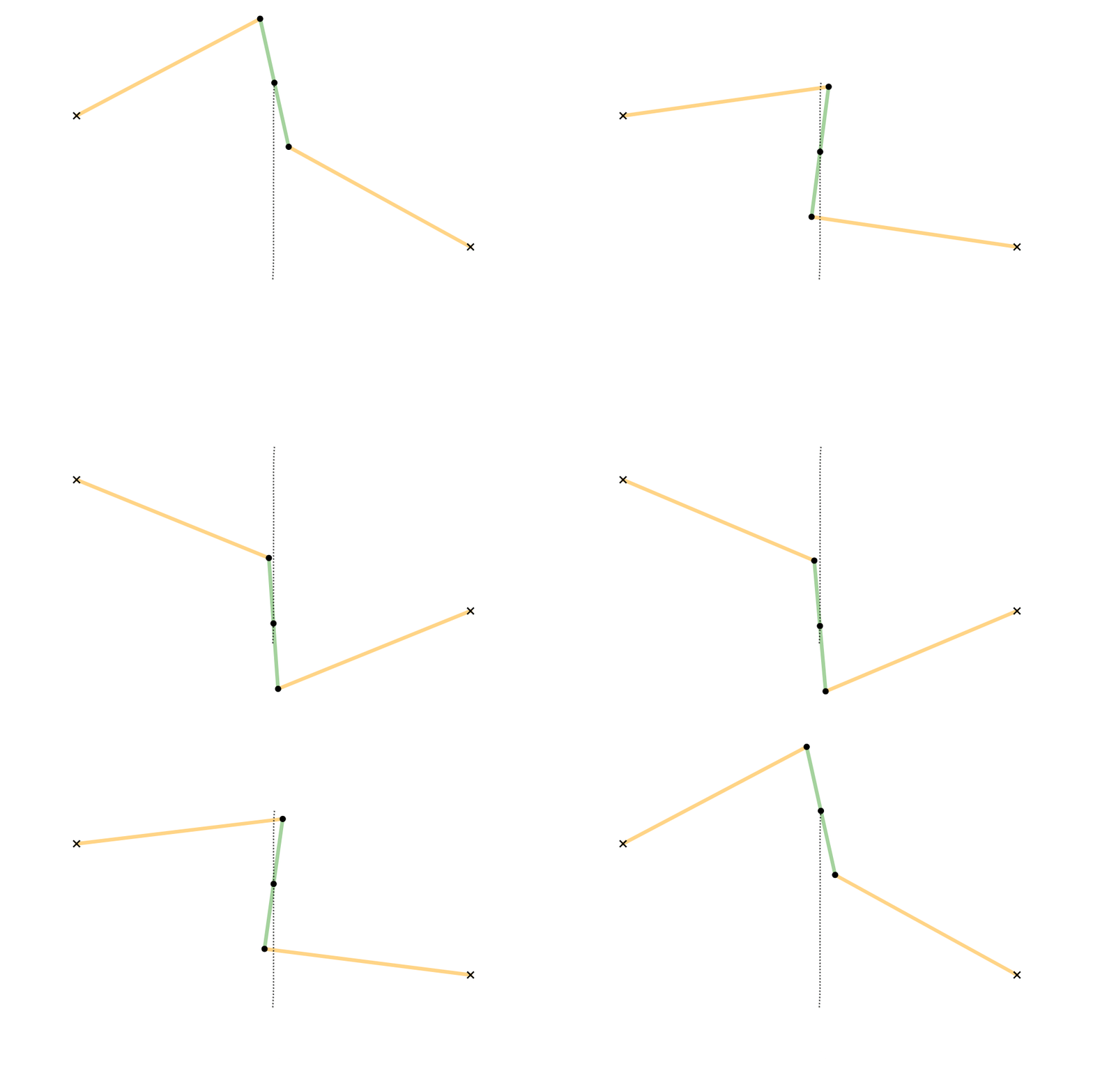
Mechanisms generating real or approximate straight line motion

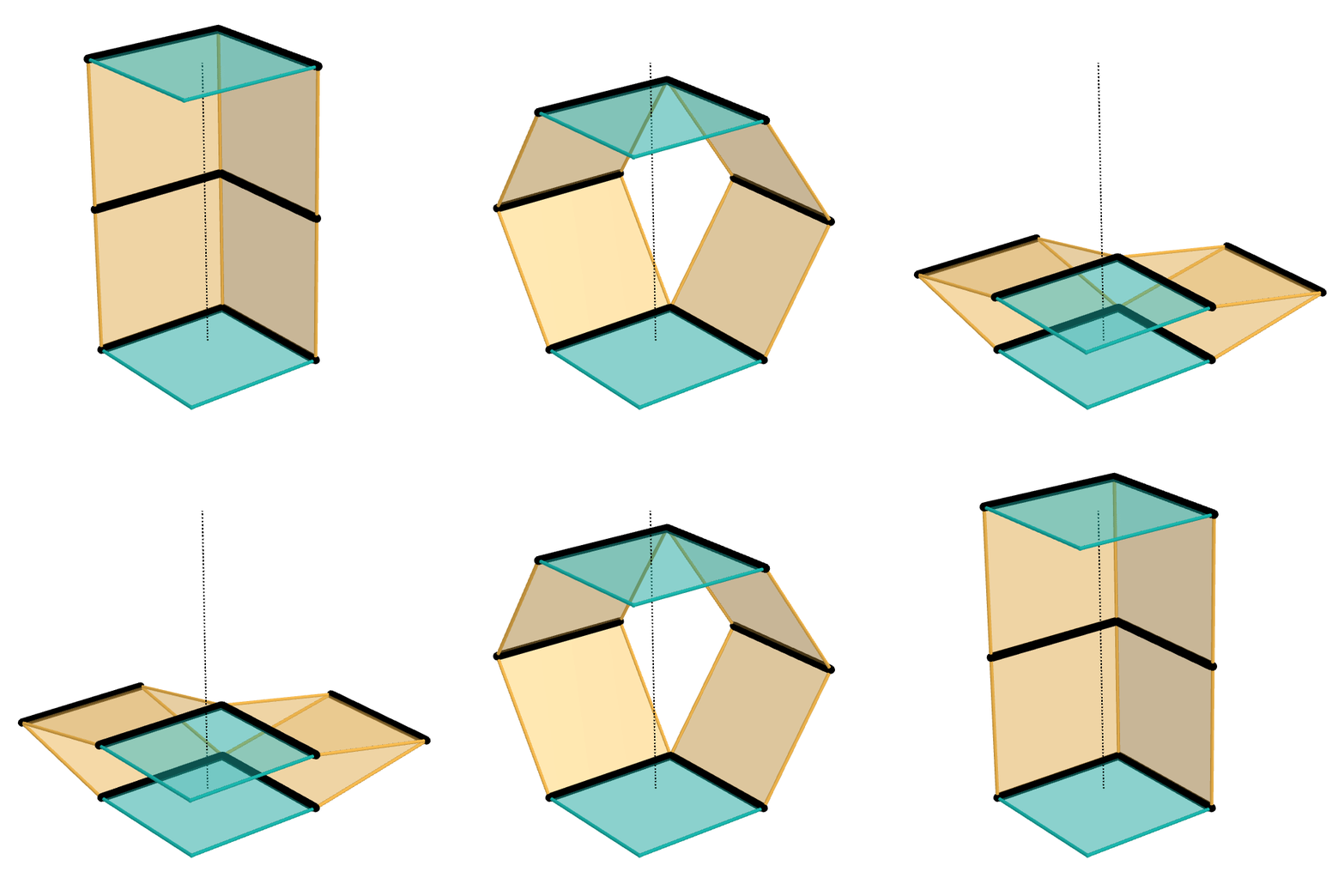

A straight-line mechanism is a mechanism that converts any type of rotary or angular motion to perfect or near-perfect straight-line motion, or vice versa. Straight-line motion is linear motion of definite length or "stroke", every forward stroke being followed by a return stroke, giving reciprocating motion. The first such mechanism, patented in 1784 by James Watt, produced approximate straight-line motion, referred to by Watt as parallel motion.
Straight-line mechanisms are used in a variety of applications, such as engines, vehicle suspensions, walking robots, and rover wheels.
History
In the late eighteenth century, before the development of the planer and the milling machine, it was extremely difficult to machine straight, flat surfaces. During that era, much thought was given to the problem of attaining a straight-line motion, as this would allow the flat surfaces to be machined. To find a solution to the problem, the first straight-line mechanism was developed by James Watt, for guiding the pistons of early steam engines. Although it does not generate an exact straight line, a good approximation is achieved over a considerable distance of travel.
Perfect straight-line linkages were later discovered in the nineteenth century, but they were not as needed, as by then other techniques for machining had been developed.
List of linkages
Approximate straight-line linkages
These mechanisms often use four-bar linkages as they require very few pieces. These four-bar linkages have coupler curves that have one or more regions of approximately perfect straight-line motion. The exception in this list is Watt's parallel motion, which combines Watt's linkage with another four-bar linkage – the pantograph – to amplify the existing approximate straight-line movement.
It is not possible to create perfect straight-line motion using a four-bar linkage, without using a prismatic joint.
- Watt's linkage (1784)
- Watt's parallel motion (1784)
- Evans "Grasshopper" linkage (1801)
- Chebyshev linkage
- Chebyshev lambda linkage (1878), a cognate linkage of the Chebyshev linkage
- Roberts linkage
- Horse-head linkage
- Hoecken linkage (1926) – requires a sliding joint
Perfect straight-line linkages
Eventually, perfect straight line motion was achieved. The Sarrus linkage was the first perfect linear linkage, made in 1853. However, it is a spatial linkage rather than a planar linkage. The first planar linkage would not be made until 1864.
Currently, all planar linkages which produce perfect linear motion utilize the inversion around a circle to produce a hypothetical circle of infinite radius, which is a line. This is why they are called inversors or inversor cells. The simplest solutions are Hart's W-frame–which uses 6-bars–and the quadruplanar inversors–Sylvester-Kempe and Kumara-Kampling, which also use 6-bars.
- Sarrus linkage (1853)
- Peaucellier-Lipkin inversor (1864)
- Hart's first inversor / Hart's antiparallelogram / Hart's W-frame (1874)
- Hart's second inversor / Hart's A-frame (1875)
- Perrolatz inversor
- Kempe's double kite inversors (1875)
- Bricard inversor
- Quadruplanar inversor (1875)
The Scott Russell linkage (1803) translates linear motion through a right angle, but is not a straight-line mechanism in itself. The Grasshopper beam/Evans linkage, an approximate straight-line linkage, and the Bricard linkage, an exact straight-line linkage, share similarities with the Scott Russell linkage and the Trammel of Archimedes.
{{anchor|Rotary straight line mechanisms}}Compound eccentric mechanisms with elliptical motion
These mechanisms use the principle of a rolling curve instead of a coupler curve and can convert continuous, rather than just limited, rotary motion to reciprocating motion and vice versa via elliptical motion. The straight-line sinusoidal motion produces no second-order inertial forces, which simplifies balancing in high-speed machines.
-
Cardan straight-line mechanism. Using the principle of the Tusi couple (1247), a spur gear rolls inside an internally toothed ring gear of twice the diameter. The hypocycloid traced by any point on the pitch circle of the smaller gear is a diameter of the larger gear. The mechanism has been used in Murray's Hypocyclic Engine.
-
Trammel of Archimedes. Originally an ellipsograph. Also known as the double-slider mechanism, it uses the fact that a circle and a straight line are special cases of an ellipse. It is based on much the same kinematic principle as Cardan's straight line mechanism (above) and could be considered as a spur gear with two teeth in a ring gear with four teeth. It has been used in the Baker-Cross engine. It has been used in inverted form in Parsons' steam engine and can still be found today in further inversions as the Oldham coupling and the scotch yoke mechanism.
-
MultiFAZE is an acronym for Multiple Fixed Axis Shaft Compound Eccentric. This eccentric gear train mechanism has been used in the Stiller-Smith engine.
Gallery
Approximate straight-line linkages
Parts/links of the same color are the same dimensions. File:Watts Linkage.gif|Watt's linkage File:Watts Parallel Motion Linkage.gif|Watts parallel-motion linkage File:Evans "Grasshopper" Linkage.gif|Evans "Grasshopper" linkage File:Roberts Linkage.gif|Roberts linkage File:Chebyshev Linkage.gif|Chebyshev linkage File:Chebyshev Lambda Linkage.gif|Chebyshev lambda linkage File:Chebyshev Table Linkage.gif|Chebyshev table linkage File:Hoecken's Linkage.gif|Hoecken's linkage
Perfect straight-line linkages
Parts/links of the same color are the same dimensions. File:Sarrus Linkage - Links Ver.gif|Sarrus linkage (Bars variant) File:Sarrus Linkage.gif|Sarrus linkage (Plates variant) File:Peaucellier-Lipkin Inversor.gif|Peaucellier-Lipkin inversor File:Harts Inversor 1.gif|Harts inversor 1 File:Harts Inversor 2.gif|Harts inversor 2 File:Perrolatz Inversor.gif|Perrolatz inversor File:Kempe Kite Inversor 1.gif|Kempe kite inversor 1 File:Kempe Kite Inversor 2.gif|Kempe kite inversor 2 File:Kempe Kite Inversor 3.gif|Kempe kite inversor 3 File:Scott Russell Linkage.gif|Scott Russell linkage (slider connection) File:Scott Russell Demonstration.gif|Scott Russell linkage (connected to Peaucellier-Lipkin linkage) File:Bricard Inversor.gif|Bricard inversor File:Quadruplanar Inversor 1.gif|Sylvester-Kempe quadruplanar inversor 1 File:Quadruplanar Inversor 2.gif|Sylvester-Kempe quadruplanar inversor 2 File:Quadruplanar Inversor 3.gif|Sylvester-Kempe quadruplanar inversor 3 File:Quadruplanar Inversor 4.gif|Kumara-Kampling inversor
Tusi couple, elliptical motion: versions and inversions
File:T1 Tusi diag 90x20.gif|Tusi couple (1247) according to the diagrams in the translation of the copy of Tusi's original description: Small circle rolls within large circle. File:T2 Tusi descr 90x20.gif|Tusi couple according to the translation of the copy of Tusi's original description: Circles rotate in same direction, speed ratio 1:2. File:Tusi by Copernicus 90x20.gif|Copernicus' (1473-1543) take on the Tusi couple: Direction of rotation and orbit of moving circle are equal and opposite. File:Scotch yoke mechanism.gif|Scotch yoke mechanism File:T9 Inv4 90x20.gif|Inversion No. 4 File:T5 180x20.gif|Inversion No. 5 - speed ratio 1:3 File:T6a 90x20.gif|Inversion No. 6 File:Tusi inside-out150x30.gif|Inside-out Tusi couple. The small circle is split into four fixed quadrants. Two 45° arcs of the large circle form the waist of the trammel. File:Parsons 190x20.gif|Parsons' mechanism (1877) combines Tusi Inversion No. 2 with an Archimedes trammel. Pistons at A and C balance each other. File:Oldham 120x30.gif|Oldham coupling (1821). Slotted ends of two misaligned shafts (black) are coupled by a cross piece (green). Compare with Tusi Inversion No. 4. File:MultiFAZE 150x25.gif|Kinematics of the Multiple Fixed Axis Shaft Compound Eccentric (MultiFAZE) mechanism (1982) characterised by parallelograms ABCD.
Compound eccentric mechanisms with elliptical motion
File:Tusicardmedes 120x40.gif|A spur gear with two teeth rolls inside a ring gear with four teeth: Archimedes, Tusi or Cardano? File:Cardano's hypocyclic gears.gif|Cardano's (1501-1576) hypocyclic gears: the red, green and blue pins reciprocate on diameters of the ring gear. File:Triple trammel of Archimedes.gif|Three Archimedes (287~212 BC) trammels on a triangular rotor showing the circular orbit of the trammel midpoints. File:MultiFAZE_60°_X4 100x40.gif|MultiFAZE mechanism (1982) in a 60° X4 engine with yokes, and rotary counterweights for full balance. File:MultiFAZE 90° X4 90x30.gif|MultiFAZE mechanism (1982) in a 90° X4 engine with crossheads, trammel gears, and reciprocating balance weights/sliders. File:Stiller-Smith 72x50 side view.gif|Stiller-Smith 90° X4 2T floating cantilever crank engine (1984) with MultiFAZE eccentric gear train. Wobble and overshoot exaggerated for effect. File:Balandin MB4.gif|Balandin MB4 cruciform engine with an eccentric crankshaft, 1930's. From a drawing with enigmatic flywheels and no pistons.
Notes
References
- Theory of Machines and Mechanisms, Joseph Edward Shigley
References
- Kempe, Alfred Bray. (1877). "How to Draw a Straight Line: A Lecture on Linkages". Macmillan and Company.
- Artobolevsky, Ivan Ivanovich. "Mechanisms in modern engineering design".
- Four-cylinder, Four-cycle Engine With Two Reciprocating Components, A.J.S Baker, M.E Cross, The Institution of Mechanical Engineers, Automobile Division, Volume 188 38/74
- [http://www.dampf.gniephaus.de/parsons_epicyclic_engine.html Parsons' epicyclic engine]
- Linkage has unstable positions that are not accounted for. Mitigations for said unstable positions are not shown for the sake of clarity.
This article was imported from Wikipedia and is available under the Creative Commons Attribution-ShareAlike 4.0 License. Content has been adapted to SurfDoc format. Original contributors can be found on the article history page.
Ask Mako anything about Straight-line mechanism — get instant answers, deeper analysis, and related topics.
Research with MakoFree with your Surf account
Create a free account to save articles, ask Mako questions, and organize your research.
Sign up freeThis content may have been generated or modified by AI. CloudSurf Software LLC is not responsible for the accuracy, completeness, or reliability of AI-generated content. Always verify important information from primary sources.
Report