From Surf Wiki (app.surf) — the open knowledge base
Stony Brook, New York

| Field | Value |
|---|---|
| official_name | Stony Brook, New York |
| settlement_type | Hamlet and census-designated place |
| motto | |
| image_skyline | {{multiple image |
| border | infobox |
| total_width | 290 |
| image_style | border:1; |
| perrow | 2/2/2 |
| image1 | 石溪大学王嘉廉中心.jpg |
| image2 | Stony Brook Village shops.jpg |
| image3 | LIM's Visitor Center.jpg |
| image4 | Simons Center for Geometry and Physics, Stony Brook University.jpg |
| image6 | Waterfront promenade and Youngs Island, Stony Brook, New York - 20221124.jpg |
| image7 | Stony Brook Hospital.jpg |
| caption1 | Stony Brook University |
| caption2 | Stony Brook Village Center |
| caption3 | Long Island Museums |
| caption4 | Simons Center for Geometry and Physics |
| caption5 | Stony Brook University |
| caption6 | Stony Brook Harbor |
| caption7 | Stony Brook Hospital |
| imagesize | 250px |
| image_seal | |
| pushpin_map | USA New York Long Island#New York |
| pushpin_label | Stony |
| Brook | |
| pushpin_label_position | right |
| image_map | Stony-brook-map.gif |
| mapsize | 250px |
| map_caption | U.S. Census map |
| map_caption1 | |
| subdivision_type | Country |
| subdivision_name | United States |
| subdivision_type1 | State |
| subdivision_name1 | New York |
| subdivision_type2 | County |
| subdivision_name2 | Suffolk |
| established_date | |
| area_footnotes | |
| area_total_km2 | 16.18 |
| area_land_km2 | 15.08 |
| area_water_km2 | 1.10 |
| area_total_sq_mi | 6.25 |
| area_land_sq_mi | 5.82 |
| area_water_sq_mi | 0.42 |
| population_as_of | 2020 |
| population_total | 13467 |
| population_density_km2 | 892.91 |
| population_density_sq_mi | 2312.73 |
| timezone | Eastern (EST) |
| utc_offset | −5 |
| timezone_DST | EDT |
| utc_offset_DST | −4 |
| elevation_m | 27 |
| elevation_ft | 89 |
| coordinates | |
| postal_code_type | ZIP Codes |
| postal_code | 11790, 11794 |
| area_codes | 631, 934 |
| blank_name | FIPS code |
| blank_info | 36-71608 |
| blank1_name | GNIS feature ID |
| blank1_info | 0966524 |
| subdivision_type3 | Town |
| subdivision_name3 | Brookhaven |
| unit_pref | Imperial |
Brook
Stony Brook is a hamlet and census-designated place (CDP) in the Town of Brookhaven in Suffolk County, New York, United States, on the North Shore of Long Island. Begun in the colonial era as an agricultural enclave, the hamlet experienced growth first as a resort town and then to its current state as one of Long Island's major tourist towns and centers of education. Despite being referred to as a village by residents and tourists alike, Stony Brook has never been legally incorporated by the state. The population was 13,740 at the 2010 census.
The CDP is adjacent to the main campus of Stony Brook University, the largest public university in New York by area, and also The Stony Brook School, a private college preparatory school. It is also home to the Long Island Museum of American Art, History, and Carriages and the Stony Brook Village Center, a privately maintained commercial center planned in the style of a traditional New England village.
History
Origins and early history
Stony Brook was first settled in the late 17th century. It was originally known by the native name Wopowog and then as Stony Brook, with both names likely referring to the interconnected bodies of water at the hamlet's western edge. It began as a satellite community of adjacent Setauket, New York, the Town of Brookhaven's first settlement, and its land was included in the initial 1655 purchase from the native Setalcott tribe.
Stony Brook was a remote area through the 18th century aside for a modest amount of commerce near the mill at the intersection of Main Street and Harbor Road. The community's development was stalled by its poorly accessible harbor relative to nearby Setauket and Port Jefferson. In the 1840s, local painter William Sidney Mount led a call for the harbor's dredging. This was completed twice, but after the harbor filled in both times the effort was abandoned. Lacking the resources of its neighboring harbor settlements, Stony Brook based its economy on agriculture and the cordwood industry.
Growth
The Long Island Rail Road reached Stony Brook in the 1870s, creating an easy link between New York City and the citizens of Stony Brook. Stony Brook quickly became a popular summer resort for city dwellers attempting to escape the hazards and stress of urban life. The establishment of the Stony Brook Assembly in 1909 also helped to draw more residents to the local area. A number of these newcomers constructed houses and cottages, many of which were either originally made for year-round use or have since been converted to such.

The history of the unincorporated "village" is closely linked to that of Ward Melville, a local businessman who owned what would become the CVS Corporation. At one point owned much of what his family coined as the Three Village area (consisting of Stony Brook, the hamlet of Setauket, and the incorporated village of Old Field).
Modern development
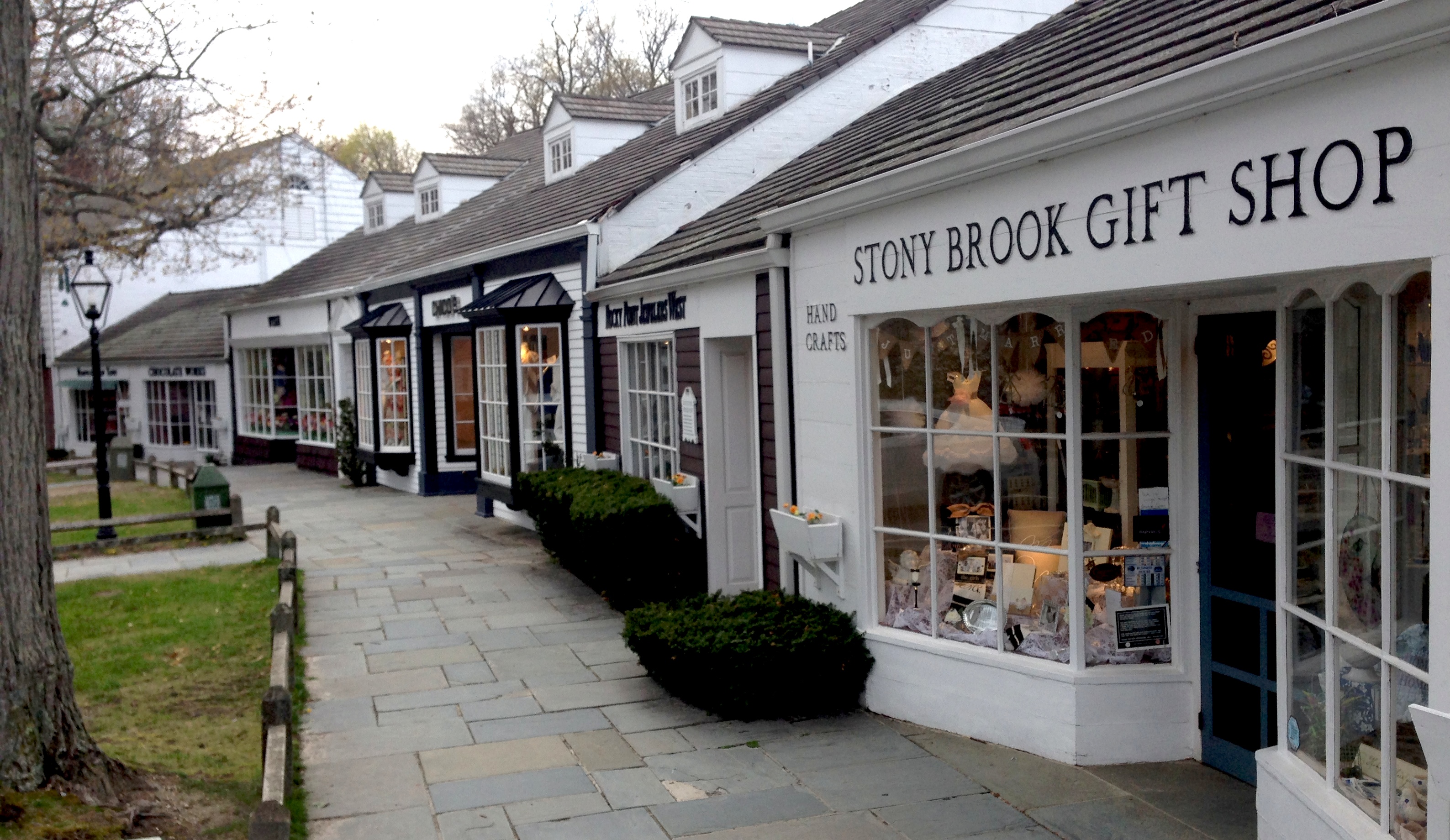
Tourist attractions include the Stony Brook Grist Mill and the Long Island Museum of American Art, History, and Carriages, a large complex of buildings originally known as the Stony Brook Carriage House and Suffolk Museum. Other Stony Brook attractions are the 19th-century William Sidney Mount House, the St. James Episcopal Chapel, and the West Meadow Beach Historic District.
Geography
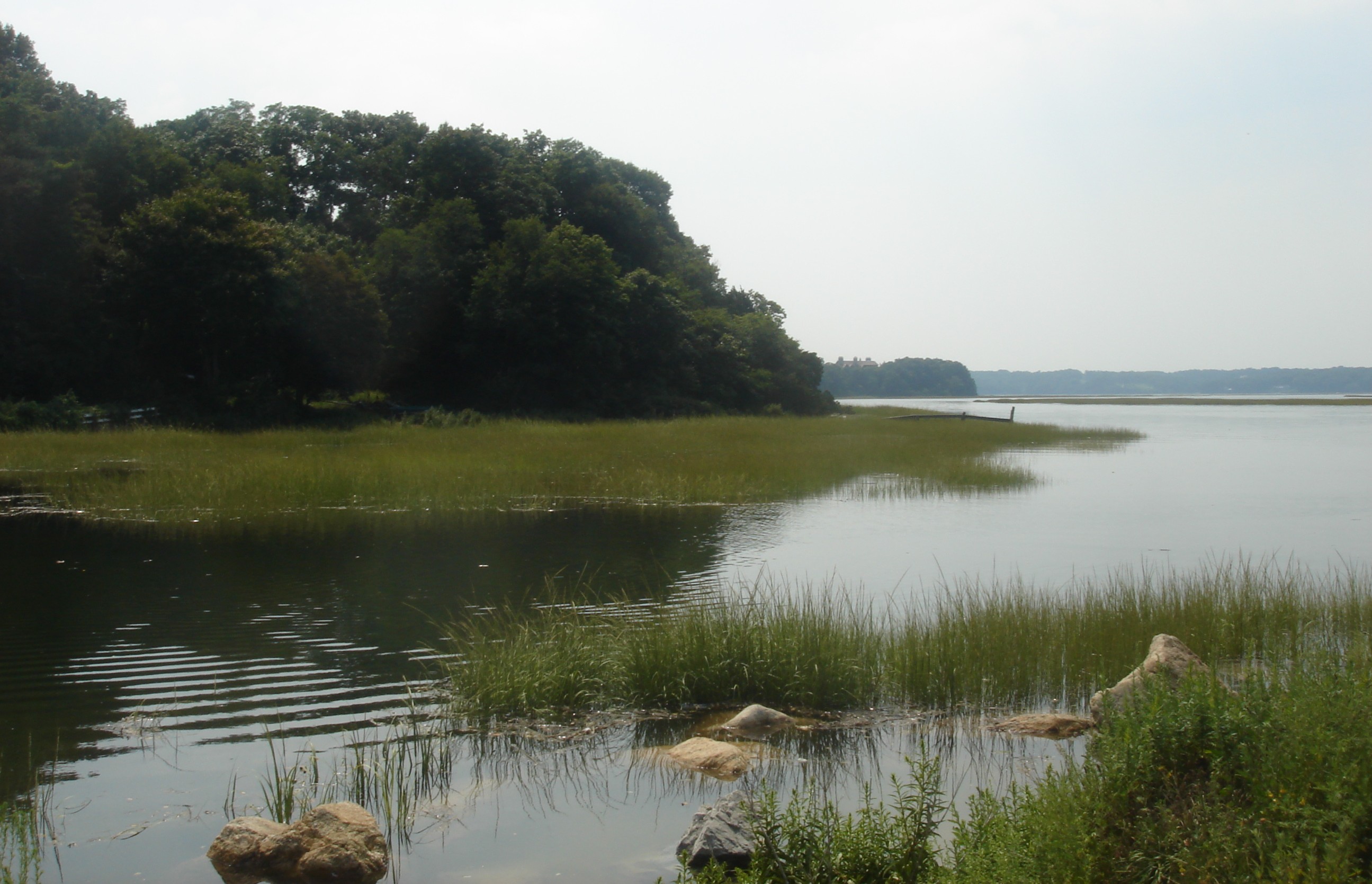
Stony Brook is on the North Shore of Long Island, approximately 55 mi east of the New York City borough of Manhattan. The census-designated place occupies an irregular shape measuring roughly 5 mi north to south and 1 mi east to west.
The historic core of Stony Brook was developed from the 17th century onward at the mouth of Stony Brook Harbor, a narrow inlet of the Long Island Sound. This section of town includes the Stony Brook Village Center, a planned commercial center in the style of New England clapboard architecture that opened in 1941. Nearby are the Long Island Museum, the Three Village Inn, and William Sidney Mount House. A peninsula in this vicinity known as the West Meadow includes a beach and wetlands reserve.
Stony Brook University is within and adjacent to the census-designated place, with its main campus less than 2 mi from Stony Brook's historic center. It is primarily on the eastern side of the census-designated place, with a pedestrian entrance on Route 25a at the Stony Brook station of the Long Island Rail Road and a vehicular entrance on Nicolls Road. The local stretch of Route 25A contains shops and other commercial properties that cater to the university's student body.
The southern (inland) portion of Stony Brook primarily consists of post-war residential development. The Stony Brook University Research and Development Park (in Stony Brook and adjacent St. James) occupies a buffer between this section and the university's central campus. Forming Stony Brook's official southern boundary is Route 347, a corridor with commercial development including an AMC Loews cinema within the CDP boundaries and the Smith Haven Mall nearby.
Education
Stony Brook is well known as the home and namesake of The Stony Brook School, a prep school, and Stony Brook University. The university is in a separate census-designated place and has been since the 2010 U.S. census,
- and page A01
- and up to the 2000 U.S. census the U.S. Census Bureau did not place the university in a census-designated place at all.
- 1990 U.S. census: Index map, with university area on pages 38, 39, 57, and 58
The hamlet is primarily located within the boundaries of (and is thus served by) the Three Village Central School District. However, a small section of the hamlet's southwestern extreme is located within the boundaries of (and is thus served by) the Middle Country Central School District. As such, children who reside within the hamlet and attend public schools go to school in one of these two districts, depending on where they reside within the hamlet.
Transportation
The Stony Brook station of the Long Island Rail Road's Port Jefferson Branch is located within and serves the hamlet. Commute time to Penn Station is approximately 1 hr 48 mins including a transfer in Huntington, Hicksville or Jamaica.
Demographics
As of the census of 2010, there were 13,727 people, 4,758 households, and 3,787 families residing in the CDP. The population density was 2,390.5 PD/sqmi. There were 4,970 housing units at an average density of 865.5 /sqmi. The racial makeup of the CDP was 88.6% White, 14.4% from two or more races, 7.5% Asian, 4.4% Hispanic or Latin of any race, 1.7% African American, 0.25% from other races, 0.1% Native American, and 0.01% Pacific Islander.

In the CDP, the population was spread out, with 26.9% under the age of 18, 5.8% from 18 to 24, 28.1% from 25 to 44, 26.5% from 45 to 64, and 12.7% who were 65 years of age or older. The median age was 39 years. For every 100 females, there were 95.2 males. For every 100 females age 18 and over, there were 91.2 males.
The median income for a household in the CDP was $90,009, and the median income for a family was $95,567. Males had a median income of $68,400 versus $41,770 for females. The per capita income for the CDP was $35,247. About 1.9% of families and 2.9% of the population were below the poverty line, including 1.9% of those under age 18 and 2.9% of those age 65 or over.
Local media
- SBU TV, Stony Brook University Television
- Stony Brook Independent, publication at Stony Brook University
- Stony Brook Press, a newspaper at Stony Brook University.
- The Statesman, the oldest newspaper at Stony Brook University
- The Village Times Herald, a newspaper in Setauket
- WUSB (FM), Stony Brook University Radio at 90.1 FM
Notable people
- Only people who already have a Wikipedia article and a reliable source may appear here. This establishes notability.
- The biographical article must mention how they are associated with [city name], whether born, raised, or residing.
- The fact of their association should have a reliable source cited.
- Alphabetical by last name please
- All others will be deleted without further explanation, even if they have articles. --

- Bud Abbott (1897–1974), comedian
- Cody Arnoux, soccer player
- Awkwafina, actress, rapper
- Ella May Bennett, Universalist minister
- Harold Beverage, inventor
- George Booth, New Yorker cartoonist
- Lars Brownworth, teacher and historian
- Nathan Bruckenthal, U.S. Coast Guardsman and posthumous Bronze Star recipient
- Sarah Drew, actress
- Brooke Ellison, first quadriplegic graduate from Harvard University
- Michael J. Epstein, filmmaker and musician
- Toni Frissell, fashion photographer
- Frank E. Gaebelein, educator
- Manon Gage, actress
- Marci Geller, independent singer-songwriter
- Kevin James, comedian, actor
- Karsh Kale, producer, composer, musician
- Anthony Kay, pitcher for the Toronto Blue Jays of Major League Baseball
- Michael Kimmel, sociologist, scholar
- Steven Matz, pitcher for the St. Louis Cardinals of Major League Baseball
- Evelina Mount, painter
- R.A. the Rugged Man, hip-hop artist
- Cliff Robertson, actor
- Jim Simons, mathematician and hedge-fund manager
- Louis Simpson, Pulitzer Prize poet
- Robert R. Sokal (1925–2012), biological anthropologist and biostatistician
- Gary Valentine, comedian, actor
- Koyo (band), musicians, band
References
References
- "ArcGIS REST Services Directory". United States Census Bureau.
- "Geographic Identifiers: 2010 Demographic Profile Data (G001): Stony Brook CDP, New York". U.S. Census Bureau, American Factfinder.
- Three Village Historical Society. "Images of America: Stony Brook".
- "Long Island Index: Interactive Map".
- "Census of Population and Housing". Census.gov.
- "U.S. Census website". [[United States Census Bureau]].
- (1940). "Fred Allen's Heirs: Costello and Abbott Given Summer Spot". Newsweek.
- "Cody Arnoux".
- O'Donnell, Michelle. (May 8, 2004). "Long Island Native, Killed in Iraq, Is Buried in Arlington". The New York Times.
This article was imported from Wikipedia and is available under the Creative Commons Attribution-ShareAlike 4.0 License. Content has been adapted to SurfDoc format. Original contributors can be found on the article history page.
Ask Mako anything about Stony Brook, New York — get instant answers, deeper analysis, and related topics.
Research with MakoFree with your Surf account
Create a free account to save articles, ask Mako questions, and organize your research.
Sign up freeThis content may have been generated or modified by AI. CloudSurf Software LLC is not responsible for the accuracy, completeness, or reliability of AI-generated content. Always verify important information from primary sources.
Report