From Surf Wiki (app.surf) — the open knowledge base
Stinky tofu
Chinese fermented tofu with a strong odor

Chinese fermented tofu with a strong odor
| Field | Value |
|---|---|
| name | Stinky tofu |
| image | Stinkender Tofu 1.JPG |
| country | China |
| region | East Asia |
| main_ingredient | fermented tofu |
Stinky tofu () is a Chinese form of fermented tofu that has a strong odor. It is usually sold at night markets or roadside stands as a snack, or in lunch bars as a side dish, rather than in restaurants. Traditionally the dish is fermented in a brine with vegetables and meat, sometimes for months. Modern factory-produced stinky tofu is marinated in brine for one or two days to add odor. Generally speaking, stinky tofu is mainly made of tofu. After fermentation of edible mold, tofu can produce a large number of B vitamins, a variety of minerals and trace elements. The flavor of stinky tofu is often mild, despite its strong smell.
Production
Unlike cheese, stinky tofu fermentation does not have a fixed formula for starter bacteria; wide regional and individual variations exist in manufacturing and preparation.
The traditional method of producing stinky tofu is to prepare a brine made from fermented milk, vegetables, and meat; the brine can also include dried shrimp, amaranth greens, mustard greens, bamboo shoots, and Chinese herbs. The brine fermentation can take as long as several months.
Modern factories often use quicker methods to mass-produce stinky tofu. Fresh tofu is marinated in prepared brine for only a day or two, especially for fried or boiled cooking purposes. The process only adds odor to the marinated tofu instead of letting it ferment completely.
Depending on the method of production, some stinky tofu can be linked to food poisoning outbreaks, especially if prepared traditionally and cooked at home.
Preparation
Stinky tofu can be eaten cold, steamed, stewed, or, most commonly, deep-fried, and it is often accompanied by chili sauce or soy sauce. The color varies from the golden, fried Zhejiang-style to the black, typical of Hunan-style stinky tofu.
From a distance, the odor of stinky tofu is said to resemble that of rotten garbage or smelly feet. Some people have compared it to the taste of blue cheese / limburger cheese, while others have compared it to rotten meat. It is said that the more it smells, the better its flavor.
History

According to a Chinese legend, a scholar named Wang Zhihe (王致和) hailing from Huang Shan in Anhui Province invented stinky tofu during the Qing dynasty. After failing the imperial examination, Wang stayed in Beijing and relied on selling tofu to make a living. One day, having a huge quantity of unsold tofu on his hands, he cut the tofu into small cubes and put them into an earthen jar. In a legend, Wang Zhihe also wrote a poem titled "Stinky Tofu, National Fragrance."
The stinky tofu that Wang Zhihe invented gained popularity and was later served at the imperial Qing Dynasty palace. The dish has now become extremely popular in Taiwan.
Chemical analysis
A 2012 chemical analysis found 39 volatile organic compounds that contributed to the unique smell and taste of fermented stinky tofu. The main volatile compound was indole, which has an intense fecal odor, followed by dimethyl trisulfide, phenol, dimethyl disulfide and dimethyl tetrasulfide.
Nevertheless, there have been reported cases of food scandals in China where stinky tofu is made with dead snails, fecal matter and rancid meat for odour enhancement. People who have consumed it reportedly became ill and required hospitalization.
In the town of Pingyao, China, authorities have taken strict enforcement actions against those who sell and consume stinky tofu, due to multiple complaints from tourists and negative traits associated with stinky tofu caused by the unpleasant odour of stinky tofu, as well as possible food poisoning caused by the consumption of ill-prepared stinky tofu.
Around the world


China
Stinky tofu is made and consumed in different ways in various areas of China. For example, the types of dried stinky tofu made in Changsha and Shaoxing are made using different methods, and the resulting flavors are very different. Huo Gong Dian (a stinky tofu shop in Changsha) makes the tofu with yellow soybeans marinated in seasoning. The stinky tofu sold in Tianjin is made mostly in the Nanjing style, with a mild aroma. In Shanghai, stinky tofu is fried and sold on the street, typically served with a spicy or sweet sauce much like the Shaoxing variety. It is also served as a condiment to congee, often as a part of a regular breakfast meal. In Chongqing, stinky tofu on the street is usually fried and dipped in a mixture of, typically, coriander (cilantro) leaves, scallions, chili powder, Sichuan pepper and oil. Stinky tofu is also sometimes dipped in Sichuan spicy hot pot. In Beijing, there is a form that is sold in jar as a curd.[[File:Stinky tofu, Chili Garden (Huogong Palace).jpg|thumb|Changsha-style stinky tofu]]
Hong Kong
In Hong Kong, stinky tofu is a street food. It is deep-fried fresh at hawkers' stalls and at dai pai dongs and sold by the bag. Stinky tofu in Hong Kong is typically served deep-fried and eaten with hoisin sauce.
Anhui
In Anhui, the perceived deliciousness of stinky tofu depends mainly on its spiciness: the spicier it is, the more it suits the local favor. Chinese legend says that stinky tofu was invented by a man from Anhui province, and indeed it is common to attribute the creation of tofu dishes in general to Anhui cuisine, as Anhui is seen as the birthplace of tofu.
Changsha, Hunan
Stinky tofu is a symbol of Changsha street snack, also called chou ganzi (smelly jerky) by local people. Changsha stinky tofu is famous of its spicy flavor. Different than Sichuan stinky tofu, Changsha-style has black crackling. Changsha stinky tofu is made from brine composed of winter bamboo shoots, koji, and shiitake mushrooms. After the surface grows white hair-like filaments, and once it turns grey, the stinky tofu is ready to be fried. Chopped mustard, chili, and shallot are regular toppings on Changsha stinky tofu. Along with Xiangtan lotus seeds and Yongfeng chili sauce, Changsha stinky tofu is known as one of "Hunan Sanbao" or one of Hunan's three treasures.
Nanjing, Jiangsu
There is one famous kind of stinky tofu in Nanjing, called "Gaochun stinky tofu". It has different kinds of brine than Changsha style stinky tofu. The brine needs to be made of rotten pickles and its stinky smell will be very natural. Similar to Changsha-style stinky tofu, it also has black crackling.
Sichuan
In Sichuan, stinky tofu is often flavored with mala, a spicy and numbing seasoning made from chilli and Sichuan peppercorns. Sichuan-style stinky tofu does not need to be deep-fried in the oil, so it does not have black cracklings. It needs to be stir-fried and boiled with different kinds of spices.
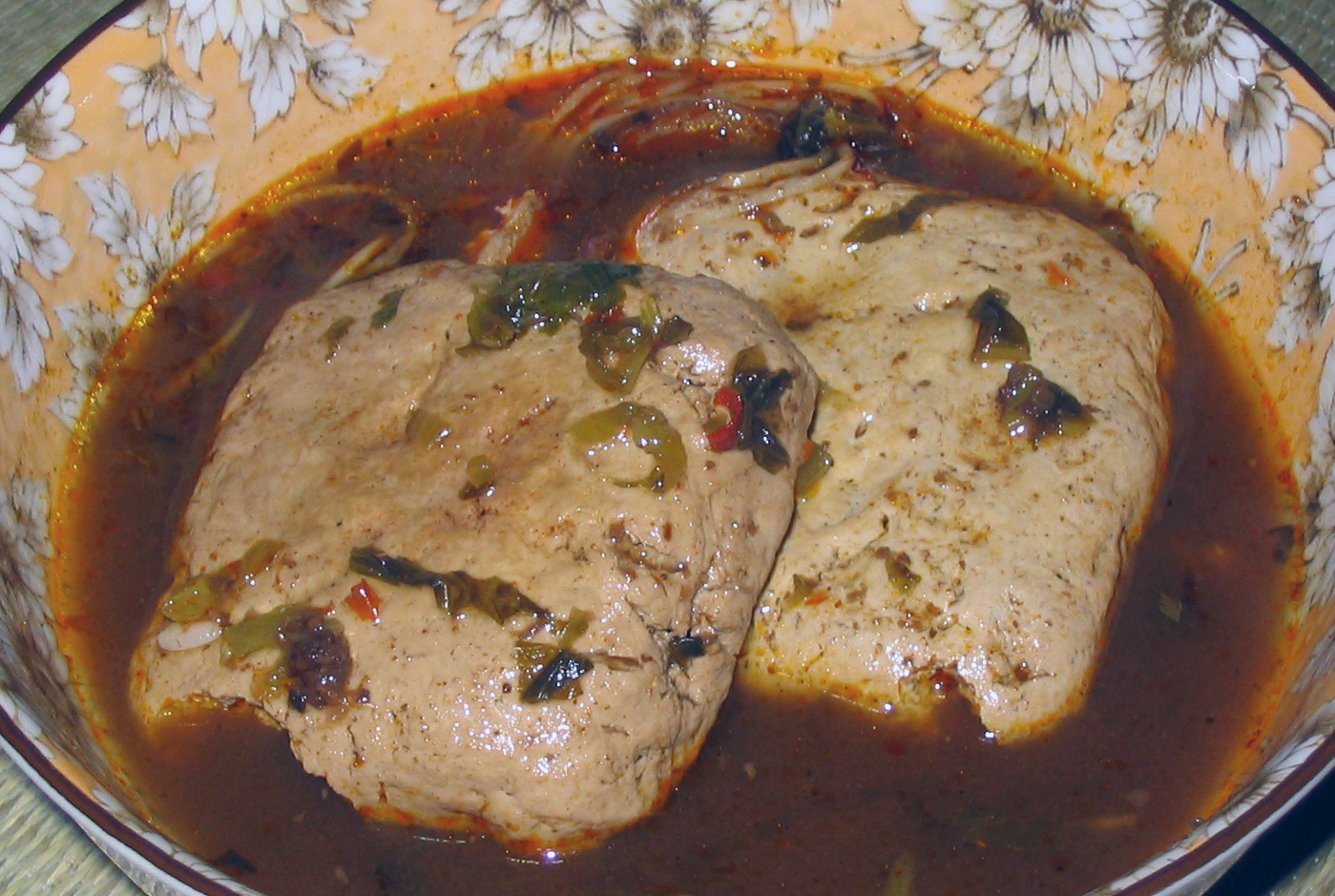
Stewed stinky tofu
Stewed stinky tofu is served in a thick soup. A Sichuan mala base is often used, but can vary. The spicy broth of a mala base is said to be able to mask the smell and taste of the tofu.
Taiwan
In Taiwan, stinky tofu is commonly found at stalls in night markets. Taiwanese stinky tofu is cooked with many methods including frying, steaming, cooking in soup, and barbecuing, but is most commonly found in its fried form. The Shenkeng Old Street in New Taipei's Shenkeng District is known for having an entire boulevard dedicated to eateries serving Taiwanese varieties of stinky tofu.
Fried stinky tofu
Fried stinky tofu is the most common variety found in Taiwanese night markets and is considered to be less pungent than other varieties. It is almost always served with pickled cabbage and garlic sauce.
Steamed stinky tofu
Steamed stinky tofu in Taiwan is considered to be the most pungent variety of stinky tofu available. It is typically served with pickled cabbage, chili sauce, and garlic sauce.
Barbecued stinky tofu
Barbecued stinky tofu is a popular stinky tofu variety believed to have originated in Taipei's Shenkeng District, and is served in many of Taiwan's night markets. It is often described as have a nutty, smooth center and a spongy outer skin. Cubes of stinky tofu are speared on a bamboo skewer are roasted over charcoal with roasted meat sauce. Because of the huge amount of seasonings, the unpleasant odor of barbecued stinky tofu is comparatively weaker. Therefore, barbecued stinky tofu is always recommended for people trying stinky tofu for the first time.
United States
Stinky tofu can also be found in specialty restaurants in some parts of the United States (with preparation methods altered where needed to comply with U.S. food safety laws). Besides restaurants, some grocery stores are starting to carry packaged ones to make easily at home.
References
References
- 臺北市政府產業發展局. (2012-07-12). "臺北市政府產業發展局".
- "中国到底哪里的臭豆腐最香?".
- (2025-10-02). "科学吃臭豆腐,助力孩子营养吸收和健康发育! - 健康生活".
- "【步骤图】【湖北味道2】详解老妈的自制传统臭豆腐的做法_【湖北味道2】详解老妈的自制传统臭豆腐的做法步骤_菜谱_下厨房".
- Xiaomi, Tan. (2 June 2006). "Stand back! Stinky tofu chain stores arrive in Shenzhen". Shenzhen Daily.
- 日本人妻的無限創作. (2019-08-20). "用天然食材自製臭豆腐鹵水,在海外也能吃到台灣味臭豆腐!".
- link. (2009-10-08)
- "Stinky Tofu is unsafe for consumption".
- Nguyen, C. Thi. (2011-11-10). "The Find: Stinky tofu restaurant may find converts". Los Angeles Times.
- Ezrati, Or. (23 October 2012). "This Wonder, This Miracle, This Stinky Tofu".
- "Kaleidoscope: Food Culture: Wang Zhihe Fermented Bean Curd".
- "百年前的王致和“专访”与臭豆腐“国际化”".
- Ku, Henry. (2013-12-13). "Stinky Tofu in Seattle: Why You Should Try This Strange Snack {{!}} Henry's Taiwan Kitchen".
- (26 March 2012). "Analysis of Organic Volatile Flavor Compounds in Fermented Stinky Tofu Using SPME with Different Fiber Coatings". Molecules.
- (26 March 2012). "Analysis of Organic Volatile Flavor Compounds in Fermented Stinky Tofu Using SPME with Different Fiber Coatings". Molecules.
- "Stinky tofu contains fecal matter and causes food poisoning".
- "臭豆腐内幕被曝光:化学卤泡地沟油炸腐烂肉添臭_新闻台_中国网络电视台".
- "Chinese town dwellers ban smelly tofu, warn eateries.".
- "臭豆腐原来是这样做的".
- Maston, Tiana. (2 May 2018). "Stinky Tofu- The Healthy and Easy Way".
- "天津市武清区人民政府".
- "教学臭豆腐的做法_怎么做?".
- "传统酿造小科普{{!}}腐乳篇-江南大学传统酿造食品研究中心".
- (13 June 2018). "Stinky tofu is a celebration of the beautiful stank".
- (November 2024). "Yahoo雅虎香港".
- "Stinky Tofu in Chinese Food Wiki".
- (2017-04-12). "Netizens selected top ten local cultural specialties".
- Yuan, Xiwei. (28 September 2018). "The difference between Changsha stinky tofu and Shaoxing stinky tofu".
- "Yongfeng hot sauce (China Protected Geographical Indication Products)". Government of China 6.
- 网易. (2020-04-20). "没吃过磨小北的臭豆腐,不足以聊南北臭豆腐文化!".
- Lin, M.Paramita. (12 June 2018). "Stinky tofu is a celebration of the beautiful stank".
- "麻和辣是怎样的感官感受?详细解读多种香辛料的麻辣味及使用方法_感官课堂_感官资料_感知网".
- Horton, Chris. (19 November 2017). "Where Stinky Tofu Is at Its Malodorous Best".
- Mulyanto, Randy. "Taipei's tasty 'House of Stink'". BBC.
- (2020-01-29). "Taiwanese Stinky Tofu – Taiwan's Most Iconic Street Food Dish".
- (2008-04-08). "【食譜】碳烤臭豆腐(1):www.ytower.com.tw".
- Kelly, Robert. "A Taiwanese stinky tofu tour". BBC.
- Planet, Lonely. "A Stinky Tofu Tour in Taipei, Taiwan".
- Sakai, Shuji. (2013-07-09). "Tofu King Opens in Irvine". [[OC Weekly]].
This article was imported from Wikipedia and is available under the Creative Commons Attribution-ShareAlike 4.0 License. Content has been adapted to SurfDoc format. Original contributors can be found on the article history page.
Ask Mako anything about Stinky tofu — get instant answers, deeper analysis, and related topics.
Research with MakoFree with your Surf account
Create a free account to save articles, ask Mako questions, and organize your research.
Sign up freeThis content may have been generated or modified by AI. CloudSurf Software LLC is not responsible for the accuracy, completeness, or reliability of AI-generated content. Always verify important information from primary sources.
Report