From Surf Wiki (app.surf) — the open knowledge base
Stewart Menzies
British head of intelligence (1890–1968)

British head of intelligence (1890–1968)
| Field | Value |
|---|---|
| honorific_prefix | Major General Sir |
| honorific_suffix | |
| name | Stewart Menzies |
| image | Stewart Menzies.jpg |
| allegiance | United Kingdom |
| branch | {{ubl |
| rank | Major General |
| battles | |
| birth_name | Stewart Graham Menzies |
| birth_date | 30 January 1890 |
| birth_place | London, England |
| death_date | 29 May 1968 (aged 78) |
| death_place | London, England |
| spouse | |
| children | 1 |
| occupation | Intelligence officer |
| education | Eton College |
| office | Chief of the Secret Intelligence Service |
| order | 3rd |
| term_start | 1939 |
| term_end | 1952 |
| predecessor | Hugh Sinclair |
| successor | John Sinclair |
| unit | {{ubl |
|British Army |Secret Intelligence Service (SIS/MI6)
- First World War
- First Battle of Ypres
- Second World War
- Cold War |Grenadier Guards |Second Life Guards Major General Sir Stewart Graham Menzies, (; 30 January 1890 – 29 May 1968) was Chief of MI6, the British Secret Intelligence Service (SIS), from 1939 to 1952, during and after the Second World War.
Early life, family
Stewart Graham Menzies was born in England in 1890 into a wealthy family as the second son of John Graham Menzies and Susannah West Wilson, daughter of ship-owner Arthur Wilson of Tranby Croft. His grandfather, Graham Menzies, was a whisky distiller who helped establish a cartel and made huge profits. His parents became friends of King Edward VII. Menzies was a nephew of Scottish Liberal Party politician and member of the House of Commons Robert Stewart Menzies. But Menzies's father was dissolute, never established a worthwhile career, and wasted his share of the family fortune; he died of tuberculosis in 1911 in his early 50s, leaving only a minimal estate.
Menzies was educated at Eton College, becoming president of the student society Pop, and left in 1909. He excelled in sports, hunting and cross-country running. He won prizes for his studies of languages, and was considered an all-around excellent student. C: The Life of Sir Stewart Menzies, by Anthony Cave Brown, 1987.
Early military career
Life Guards
From Eton he joined the Grenadier Guards as a second lieutenant. After a year with this regiment, he transferred to the Second Life Guards. He was promoted to lieutenant and appointed adjutant by 1913.
First World War action
During the First World War Menzies served in Belgium. He was wounded at Zandvoorde in October 1914, and fought gallantly in the First Battle of Ypres in November 1914. Menzies was promoted to captain on 14 November, and received the DSO in person from King George V on 2 December.
Menzies's regiment was decimated during fighting in 1915, suffering very heavy casualties in the Second Battle of Ypres. Menzies was seriously injured in a gas attack in 1915, and was honourably discharged from active combat service.
Intelligence service
He then joined the counterintelligence section of Field Marshal Douglas Haig, the British commander. In late 1917, he reported to senior British leadership that Haig's intelligence chief Brigadier John Charteris was fudging intelligence estimates, which soon led to Charteris's removal. This whistle-blowing was apparently done very discreetly. Menzies was promoted to brevet major before the end of the war.
MI6
Following the end of the war, Menzies entered MI6 (also known as SIS). He was a member of the British delegation to the 1919 Versailles Peace Conference. Soon after the war, Menzies was promoted to lieutenant-colonel of the Imperial General Staff, General Staff Officer, first grade. Within MI6, he became assistant director for special intelligence. Admiral Hugh Sinclair became director-general of MI6 in 1924, and he made Menzies his deputy by 1929, with Menzies being promoted to full colonel soon afterwards.
In 1924, Menzies was allegedly involved—alongside Sidney Reilly and Desmond Morton—in the forging of the Zinoviev letter. This forgery is considered to have been instrumental in the Conservative Party's victory in the United Kingdom general election of 1924, which ended the country's first Labour government.
Chief of MI6
In 1939, when Admiral Sinclair died, Menzies was appointed Chief of Secret Intelligence Service (the SIS). He expanded wartime intelligence and counterintelligence departments and supervised codebreaking efforts at Bletchley Park.
Second World War
Main article: Action This Day (memo)
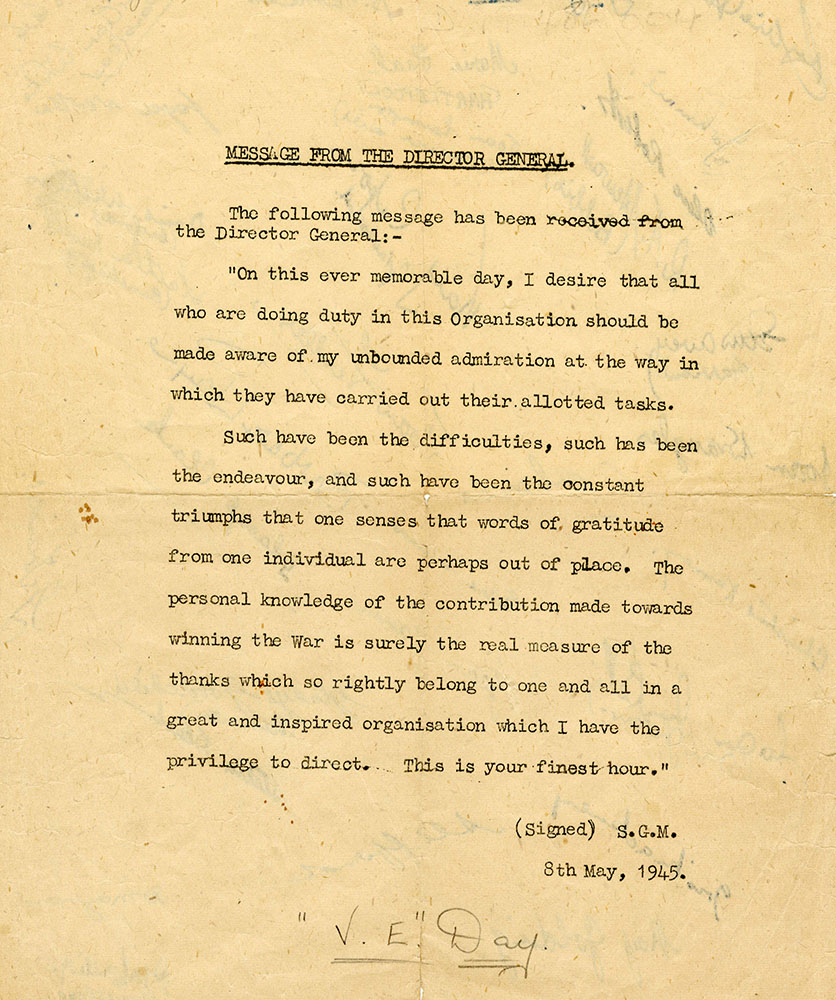
When the Second World War began, SIS expanded greatly. Menzies insisted on wartime control of codebreaking, and this gave him immense power and influence, which he used judiciously. By distributing the Ultra material collected by the Government Code and Cypher School, MI6 became an important branch of the government for the first time. Extensive breaches of Nazi Enigma signals gave Menzies and his team enormous insight into Adolf Hitler's strategy, and this was kept a closely held secret, not only during the war, but until as late as 1974. (Frederick Winterbotham's 1974 book The Ultra Secret lifted the cloak of secrecy at last.) The Nazis had suspicions, but believed Enigma to be unbreakable, and never knew during the war that the Allies were reading a high proportion of their wireless traffic.
Menzies kept Prime Minister Winston Churchill supplied daily with important Ultra decrypts, and the two worked together to ensure that financial resources were devoted toward research and upgrading technology at Bletchley Park, to keep pace with Nazi coding refinements, as well as directing talented workers to the massive effort, which employed nearly 10,000 workers by 1945. Bletchley's efforts were decisive in the battle against Nazi submarine warfare, which was severely threatening trans-Atlantic shipping, particularly in the first half of 1943. Britain, which was cut off from Europe after mid-1940, was almost completely dependent on North American supplies for survival. The access to Ultra was also vitally important in the battle for Normandy, leading up to D-Day in June 1944, and afterward.
Menzies has been suspected as being involved with the assassination, on 24 December 1942, of François Darlan, the Vichy military commander who defected to the Allies in Algeria. British historian David Reynolds noted in his book, In Command of History, that Menzies—who rarely left London during the war—was in Algiers around the period he was killed, making SOE (Special Operations Executive) involvement seem likely.
Menzies, who was promoted to major-general in January 1944, also supported efforts to contact anti-Nazi resistance, including Wilhelm Canaris, the anti-Hitler head of Abwehr, in Germany. Prime Minister Winston Churchill was kept informed of these efforts throughout the war, and information from and about the Nazi resistance was exploited tactically. Menzies coordinated his operations with Special Operations Executive (SOE) (although he reputedly considered them "amateurs"), British Security Coordination (BSC), Office of Strategic Services (OSS) and the Free French Forces. He was awarded the Order of the Yugoslav Crown.
After the Second World War
After the war, Menzies reorganised the SIS for the Cold War. He absorbed most of SOE. He was sometimes at odds with the Labour governments. He also had to weather a scandal inside SIS after revelations that SIS officer Kim Philby was a Soviet spy.
Menzies was already the head of the service when Kim Philby joined in 1941. Nonetheless, Menzies deserved some of the blame for Soviet agents having penetrated MI6, according to Anthony Cave Brown in his book C: The Secret Life of Sir Stewart Graham Menzies, Spymaster to Winston Churchill. Cave Brown insists that Menzies's primary criteria were whether the applicants were upper-class former officers and recommended by another government department, or else were known to him personally. In his New York Times review of Brown's book, novelist Ken Follett makes this conclusion: "Mr Philby outwitted Menzies because Mr Philby was intelligent and professional and cool, where Menzies was an amiable upper-class sportsman who was out of his depth. And British intelligence, except for the code breakers, was like Menzies—amateur, anti-intellectual and wholly outclassed."
After 43 continuous years of service in the British Army, Menzies retired to Bridges Court in Luckington in rural Wiltshire at 62 in mid-1952. His success at SIS was not limited to adeptness at bureaucratic intrigue, a virtual necessity in his position; Menzies's efforts as chief had a major role in winning the Second World War, and certainly earned Churchill's trust, as evidenced by nearly 1,500 meetings with the prime minister during its duration.
Marriages
Menzies's first marriage was in 1918 to Lady Avice Ela Muriel Sackville, younger daughter of Gilbert Sackville, 8th Earl De La Warr, and Lady Muriel Agnes Brassey, daughter of Thomas Brassey, 1st Earl Brassey. They were divorced in 1931.
He next married Pamela Thetis Garton (née Beckett), on 13 December 1932, fourth daughter of Rupert Evelyn Beckett by his wife Muriel Helen Florence Paget, daughter of Lord Berkeley Charles Sydney Paget, himself a younger son of the 2nd Marquess of Anglesey. Garton was an invalid for many years, suffering from clinical depression and anorexia nervosa. She had Menzies's only child.
His third marriage was in 1952 to Audrey Clara Lilian Latham, formerly wife of Sir Henry Birkin, 2nd Bt., Lord Edward Hay, and Niall Chaplin, and daughter of Sir Thomas Paul Latham, 1st Bt. Stewart and Audrey were both over age 50 at the time of their marriage, her fourth. Each had separate estates (his in Wiltshire, west of London, hers in Essex, east of London), and they for the most part lived separately, but they met in London for dinner each Wednesday.
Anthony Cave Brown also reported that Menzies had a long-standing affair with one of his secretaries, which he ended upon retirement (and presumably remarriage) in 1952; the secretary apparently tried to kill herself at that time.
Menzies died on 29 May 1968.
Honours and awards








.png)
| [[File:Ordre_de_la_Couronne_de_Yougoslavie_(Royaume).png | 50x50px]] | Order of the Yugoslav Crown (Yugoslavia) |
|---|
Notes
References
- Anthony Cave Brown, Bodyguard of Lies, 1975.
- Anthony Cave Brown, "C": The Secret Servant: The Life of Sir Stewart Menzies, Spymaster to Winston Churchill (Macmillan Publishing Co., 1987)
- Ken Follett, "The Oldest Boy of British Intelligence", The New York Times, 27 December 1987. Three page review of Brown's biography and Mahl's book.
- Thomas E. Mahl, Desperate Deception: British Covert Operations in the United States, 1939–44, (Brassey's Inc., 1999) .
before=Sir Hugh Sinclair| title=Chief of the SIS | years=1939–1952| after=Sir John Sinclair|
References
- (2007). "Menzies, Maj.-Gen. Sir Stewart Graham, (30 January 1890 – 29 May 1968)".
- (31 May 1968). "Obituary: Sir Stewart Menzies". [[The Times]].
- (2003). "Burke's Peerage, Baronetage & Knighthood". Burke's Peerage & Gentry.
- [[Ken Follett]]. [https://query.nytimes.com/gst/fullpage.html?res=9B0DE2DF1E3EF934A15751C1A961948260 "The Oldest Boy of British Intelligence"] ''[[The New York Times]]'', 27 December 1987.
- ''C: The Secret Life of Sir Stewart Graham Menzies, Spymaster to Winston Churchill'', by [[Anthony Cave Brown]], 1987.
- {{London Gazette. (3 August 1909)
- ''C: The Secret Life of Sir Stewart Graham Menzies, Spymaster to Winston Churchill'', by [[Anthony Cave Brown]], 1987, Macmillan, New York, {{ISBN. 0-02-517390-1, pp. 41–55
- ^ [http://www.london-gazette.co.uk/issues/28743/pages/5573 London Gazette: no. 28743, p. 5573, 5 August 1913. Retrieved on 13 July 2010]
- ''C: The Secret Life of Sir Stewart Graham Menzies, Spymaster to Winston Churchill'', by [[Anthony Cave Brown]], 1987, Macmillan, New York, {{ISBN. 0-02-517390-1, pp. 60–81
- Bennett, Richard. (2001). "Espionage: Spies and Secrets". Diane Publishing Company.
- ''C: The Secret Life of Sir Stewart Graham Menzies, Spymaster to Winston Churchill'', by [[Anthony Cave Brown]], 1987, Macmillan, New York, {{ISBN. 0-02-517390-1, pp. 82–98
- ''C: The Secret Life of Sir Stewart Graham Menzies'', by [[Anthony Cave Brown]], 1987.
- [https://thepoormouth.blogspot.com/2006/10/zinoviev-letter-in-sis-forgery-no.html Zinoviev Letter in SIS forgery (no) Shock], The Poor Mouth.
- Page 121, Michael Kettle, ''Sidney Reilly: The True Story of the World's Greatest Spy'', 1986, St. Martin's Press, {{ISBN. 0-312-90321-9.
- ''Telegraph'', 5 February 1999.
- Bennett, Richard. (2001). "Espionage: Spies and Secrets". Diane Publishing Company.
- (1993). "Codebreakers: The inside story of Bletchley Park". Oxford University Press.
- ''Bodyguard of Lies'', by [[Anthony Cave Brown]], 1975
- Reynolds, David. (2012). "In Command of History". Random House.
- Follett, Ken. (27 December 1987). "THE OLDEST BOY OF BRITISH INTELLIGENCE". The New York Times.
- ''C: The Secret Life of Sir Stewart Graham Menzies, Spymaster to Winston Churchill'', by [[Anthony Cave Brown]], 1987
- Mosley, Charles, editor. Burke's Peerage, Baronetage & Knightage, 107th edition, 3 volumes. Wilmington, Delaware, U.S.: Burke's Peerage (Genealogical Books) Ltd, 2003.
- Cave Brown
- "Page 3063 {{!}} Supplement 39243, 1 June 1951 {{!}} London Gazette {{!}} The Gazette".
- "Page 3 {{!}} Supplement 35399, 30 December 1941 {{!}} London Gazette {{!}} The Gazette".
- "Page 5 {{!}} Issue 35841, 29 December 1942 {{!}} London Gazette {{!}} The Gazette".
- "Page 10188 {{!}} Issue 28992, 1 December 1914 {{!}} London Gazette {{!}} The Gazette".
- "Page 6535 {{!}} Supplement 29215, 2 July 1915 {{!}} London Gazette {{!}} The Gazette".
- (1914–1920). "Medal card of Menzies, S G Corps: Life Guards Rank: Lieutenant Adjutant...".
- (1935). "King's Silver Jubilee Medal: United Kingdom Issue Category 4 (vol. I)".
- "Record Details for S G Menzies".
- (1953–1956). "DECORATIONS AND MEDALS: Coronation Medals (Code 50P): The Queen Elizabeth II Coronation...".
- "Page 1593 {{!}} Supplement 29943, 13 February 1917 {{!}} London Gazette {{!}} The Gazette".
- "Page 5452 {{!}} Supplement 30110, 1 June 1917 {{!}} London Gazette {{!}} The Gazette".
- "Page 3097 {{!}} Supplement 30568, 8 March 1918 {{!}} London Gazette {{!}} The Gazette".
- "Page 4441 {{!}} Supplement 36200, 5 October 1943 {{!}} London Gazette {{!}} The Gazette".
- "Page 324 {{!}} Supplement 37853, 14 January 1947 {{!}} London Gazette {{!}} The Gazette".
- "Page 2922 {{!}} Supplement 38288, 11 May 1948 {{!}} London Gazette {{!}} The Gazette".
- Nationaal Archief, Archive 2.02.32, Dossier 375, Registry Number 759
- "Page 6061 {{!}} Supplement 38459, 16 November 1948 {{!}} London Gazette {{!}} The Gazette".
- "Page 495 {{!}} Supplement 38523, 28 January 1949 {{!}} London Gazette {{!}} The Gazette".
This article was imported from Wikipedia and is available under the Creative Commons Attribution-ShareAlike 4.0 License. Content has been adapted to SurfDoc format. Original contributors can be found on the article history page.
Ask Mako anything about Stewart Menzies — get instant answers, deeper analysis, and related topics.
Research with MakoFree with your Surf account
Create a free account to save articles, ask Mako questions, and organize your research.
Sign up freeThis content may have been generated or modified by AI. CloudSurf Software LLC is not responsible for the accuracy, completeness, or reliability of AI-generated content. Always verify important information from primary sources.
Report