From Surf Wiki (app.surf) — the open knowledge base
Step aerobics
Form of aerobic exercise

Form of aerobic exercise
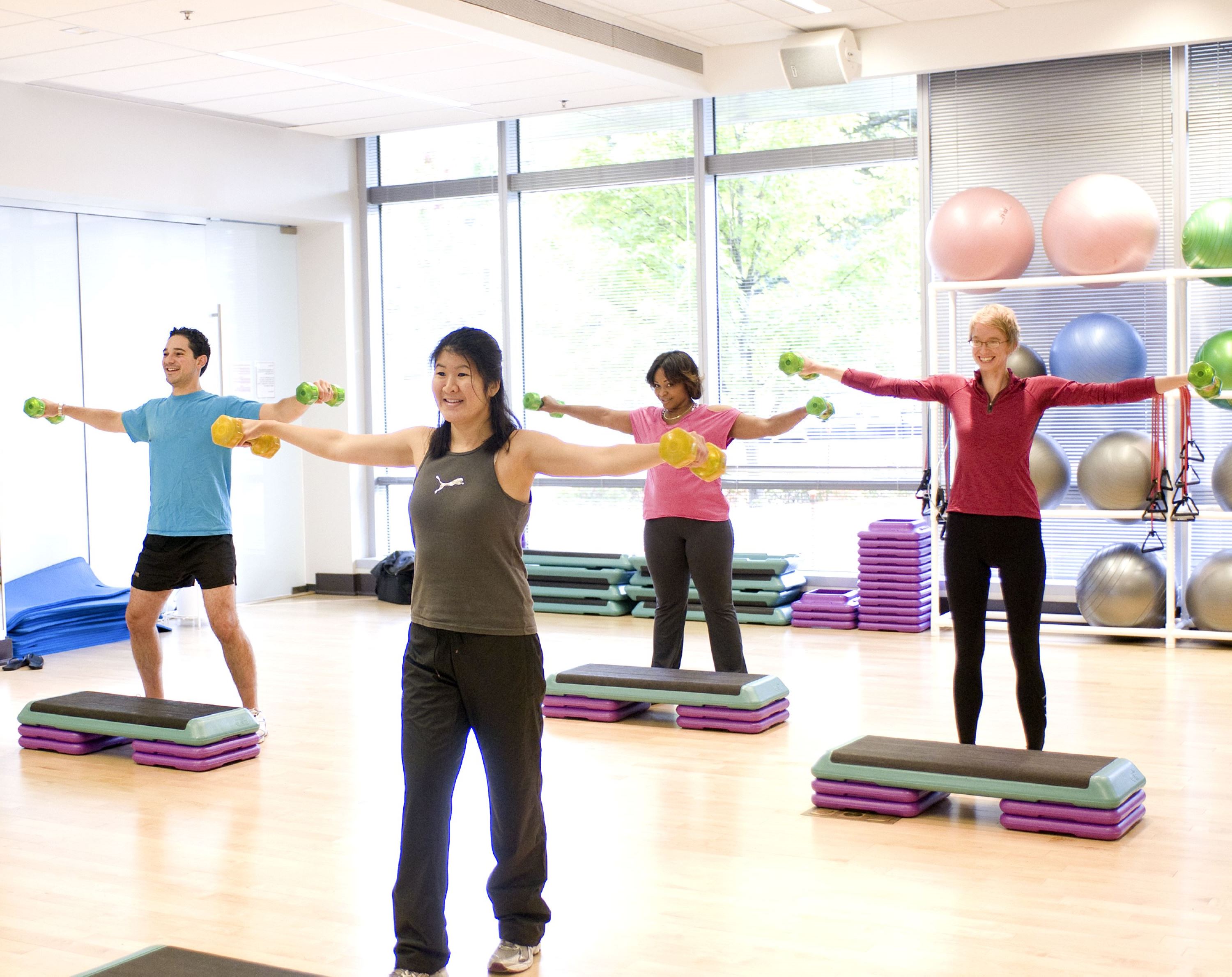
Step aerobics, also known as bench aerobics and step training, is a form of aerobic exercise that involves stepping on and off a small platform.
Step aerobics was studied by physiologists in the 1980s, and in 1990 it swiftly grew in popularity in the U.S. as a style of health club exercise, largely because of promotion by Reebok of the Step Reebok device and associated exercise routines, prominently advocated by Gin Miller. Step aerobics attracted more men to group exercise classes.
Today, step aerobics classes are carried by many health clubs. Exercise routines include weights held in the hands for upper body development. Music with a medium (not fast) tempo often accompanies the routine, and learning a choreography sequence can hold the participants' interest.
History
Background
Main article: Aerobics
Aerobics traces its origin to the 1968 book Aerobics by Dr. Kenneth H. Cooper, which inspired Jacki Sorensen to start her Aerobic Dancing program, combining music and dance routines to create an aerobic exercise pattern. Also in 1969, Judi Missett developed Jazzercise, combining jazz dance with fun exercise in much the same way. Building through the 1970s, Missett's Jazzercise and Sorensen's Aerobic Dancing became very popular in the U.S., such that by 1981–82 they counted 4,000 instructors each, and more than 300,000 students combined.
In 1982, Jane Fonda's Workout video changed the fitness world dramatically, starting a boom in home video exercise instruction through the 1980s and beyond. This same boom benefited health clubs by increasing the number of people who were involved in fitness.
Step development

Stair climbing exercise was already thousands of years old when physiologists started studying its medical characteristics in the 20th century. Climbing stairs was long known to be healthy exercise for the heart. Goss followed this in 1988 with an evaluation of the energy expenditure of step aerobics combined with hand weights.
At the same time, Atlanta-based aerobics competitor Gin Miller was sidelined from high-impact activities in 1986 when she injured her knee. She was advised by her physical therapist to build her strength back up by stepping on and off an upside-down plastic milk crate (11 in tall). The crate was too high, so she used her 8-inch front porch step instead. After a few weeks of therapy, she noticed her increased fitness and realized this would be a good workout method for others. These wooden prototype benches were very long: 24 by, with a choice of heights: 10, 11 and 12 inches. Small weights held in the hands could also be used. Fitness instructor Kathy Smith first experienced the Williams/Miller prototype step aerobics program during its early days, thinking "This is the most cutting-edge workout I’ve ever seen."
Miller and Williams formed a company called Bench Blast in late 1988, making wooden steps from 6 to 12 inches high. The two split in 1989, with Miller leaving for Reebok. Miller's friend and Reebok shoe representative Kelly Watson saw the Bench Blast program, and recommended Miller visit Angel Martinez, Reebok's Director of Business Development. Reebok commissioned physiology trials of the step exercise program, undertaken in 1989 by Doctors Lorna and Peter Francis at San Diego State University. The Francis study showed that 40 minutes of step aerobics was equivalent to running 7 mi in terms of oxygen breathed and calories burnt, but the body stress was much lower, the same as normal walking.
Meanwhile, in New Jersey, fitness trainer Cathe Friedrich had been working with long wooden benches which were 14 in high. Up to six people at a time could perform her leg-strengthening and aerobics movements on one bench. In 1988 when she heard about the Bench Blast project, she put together a video production company with Chris Williams, the owner of Four Seasons Health Spa in Glassboro, forming Step N Motion Videos.
Problems with the Bench Blast wooden benches included difficulty of storage, sideways instability, slippery upper surface when wet with sweat, dangerous sharp corners, and the heights were too challenging.
Early demonstration units were trialed by Step Reebok in select health clubs, including Mezzeplex in West Los Angeles in December 1989. Gin Miller taught the routines to local instructors. Mezzeplex began offering two to three step aerobics classes every day.
Demand for the Step Reebok device quickly rose, requiring Boggs to add two more manufacturing plants in other cities, Combined, the three plants were making 50,000 steps every month. Sports Step extended their reach with manufacturing licenses in Japan and Europe.
Two months after its introduction to the general public, step aerobics classes were attracting major media attention, starting with a March 1990 article published by The New York Times. Miller promoted Step Reebok in person, touring the U.S. and demonstrating it at hundreds of exercise studios. Step aerobics became widely popular, helping the company sell many thousands of step devices, and millions of lightweight, flexible high-top shoes with ankle support. Step aerobics programs were soon developed by Jazzercise, Kathy Smith, Jane Fonda, Molly Fox, and New Zealand health club founder Les Mills. The year 1995 was the peak of step aerobics, with 11.4 million practitioners.
Videos
The first home video of step aerobics was released during the weekend of July 28–30, 1989, by Cathe Friedrich who sold out her supply of tapes at the IDEA International Aerobics Convention in Nashville. Also in town for the convention, Gin Miller appeared on Nashville's TV show Talk of the Town on July 28 to promote Bench Blast. New Jersey fitness instructor Dawn Brown released Step It Out in 1990, one of the earliest adopters of Step Reebok. In 1991, more videos of step aerobics were released by Cher, Stacey Benson, Denise Austin, Victoria Johnson, Jenny Ford, Gilad Janklowicz, Debbie Tellshow, Cory Everson, Karen Flores, Carolyn Brown, and Esquire magazine featuring Marian Ramaikas. A smaller device called Super Step was promoted with a video by Brenda Dykgraaf (later Dygraf) and Kathy Smith.
Miller's Bench Blast colleague and co-developer Connie Collins Williams trademarked "BenchAerobix" in 1990, and at the same time put out a step aerobics video called BenchAerobix. Williams trained instructors in her method, and promoted a smaller molded plastic bench, 36 by, with a fixed height of 8 inches for most students, and 10 inches for advanced levels. to focus on BenchAerobix. Bench Blast trainer Sindy Benson

In March 1992, Reebok designed a new step with angular nesting legs. A new Step Reebok logo was issued, with three horizontal lines representing the 'E' in Step.
Characteristics
Step aerobics is one of several low-impact aerobic exercises, along with water aerobics, dance aerobics and fast walking. Step aerobics is similar to climbing stairs, but performed while staying in one place. The step platform itself is much less expensive and more portable than a StairMaster, and needs no electricity to operate.

Music for step aerobics should be medium tempo, typically 118 to 122 beats per minute (bpm). A rhythm of 126–128 bpm is sometimes used for advanced classes; Reebok defined 128 bpm as the "fastest permissible speed." The style of music should emphasize the beat, for instance a steady four on the floor rather than offbeat syncopation. Choreography requires that the music present a predictable 32-beat, eight-measure sequence.
Step and bench devices are usually molded polyethylene plastic, covered in rubber or other non-slip surface, with the lowest height starting at 4 in. This height can be increased in 2 in increments to 8 in. Studies have been made of 10- and 12-inch benches, but these are not recommended for popular step aerobics classes. Typical steps have a length and width of 43 by. A smaller product called Super Step was 28 by. The step is never approached with the participant's back toward it.
While women were already doing aerobic dance in the 1970s and 1980s, outnumbering men 9 to 1, Mixed-gender step classes were common from the start. Elements of step aerobics can be blended into other exercise styles such as kickboxing or Zumba to create hybrid or combo styles.
References
References
- (November–December 1990). "Bench Aerobics". Strategies: A Journal for Physical and Sport Educators.
- Hua, Vanessa. (April 22, 1999). "Firming Up Revenues". The Courant.
- (November 14, 2016). "Back to the 1980s".
- McCormack, Patricia. (October 16, 1981). "Womans' World: Aerobic Dancing: 'hips, hips' away!". United Press International.
- Hendricks, Nancy. (2018). "Popular Fads and Crazes Through American History". ABC-CLIO.
- Stillwell, Jadie. (November 13, 2019). "That Time Jane Fonda Sculpted Abs to Save the Planet".
- (October 24, 1988). "Energy Cost of Bench Stepping and Pumping Light Handweights in Trained Subjects". Research Quarterly for Exercise and Sport.
- Karageorghis, Costas I.. (2016). "Applying Music in Exercise and Sport". Human Kinetics.
- Lloyd, Barbara. (September 25, 1990). "Approach the Bench: Step Training Is Here". The Orlando Sentinel.
- Hartford, Teresa. (September 23, 2019). "Gin Miller… Meet the Creator of Step Aerobics".
- Smith, Kathy. "Free 10-min Step Aerobics Video".
- Fisher, Laura. (1991). "Step Right Up".
- Evertz, Mary. (June 16, 1991). "Steps in the right direction". Tampa Bay Times.
- Hartford, Teresa. (September 23, 2019). "Step Reebok's Rise To Success… With Angel Martinez".
- Kremer, Wendy Niemi. (1996). "Interview: Cathe Friedrich".
- Dove, Patricia. (March 14, 2011). "Washington Township woman made quest to be healthy, active into full-time business venture". NJ.
- (2011). "Cathe Friedrich: 2011 NFHOF Inductee".
- (September 29, 1994). "Step Co. v. Consumer Direct, Inc., 936 F. Supp. 960 (N.D. Ga. 1994)". Justia.
- Condon, Garret. (September 18, 1991). "One Step Makes Workouts More Strenuous". The Courant.
- (December 29, 1989). "A Modal Robe for Barbra". Los Angeles Times.
- Doheny, Kathleen. (December 26, 1989). "Step Up in Class with New Exercise Program". Los Angeles Times.
- Evertz, Mary. (March 27, 1991). "The circuits are busy". Tampa Bay Times.
- Lloyd, Barbara. (March 26, 1990). "Step Up (and Down) to Sharper Workouts". The New York Times.
- "IDEA Award Winners".
- "Download Step N Motion 1".
- (July 23, 1989). "TV tapings, talks show guests this week". The Tennessean.
- Wallace, Judy. (October 8, 1992). "Where to Step". The Palm Beach Post.
- Melillo, Wendy. (June 11, 1991). "Step Up to the Beat with Bench Aerobics". The Washington Post.
- (1990). "BenchAerobix".
- She sold Bench Blast to Reebok in 1991,Williams, Connie C. (2018). Empowering People to Pause. Media kit brochure from thepowertopause.com.
- Simmons, Drew. (November 11, 1992). "Fitness instructors step up the pace". The Jackson Hole Guide.
- Miller, Gin. (1992). "Step Reebok: The Video".
- (April 10, 1992). "Step Reebok logo".
- (2002). "Fitness Instructor Training Guide". Kendall Hunt.
- (June–July 1997). "Research in Action: Stepping To A New Beat".
- Lawhorn, Chris. (November 9, 2012). "Dance Cardio Music: Your Perfect Playlist".
- Green, Penelope. (September 2, 1990). "Beauty, the Next Step". The New York Times.
- (2012). "Fitness!". Cengage Learning.
- Clark, Cammy. (October 25, 1990). "An exercise on the rise: step aerobics". Tampa Bay Times.
- Dimon, Suzanne E.. (August 20, 1990). "Do Real Men Do Aerobics?". The Daily Press.
- (March 19, 1992). "Low-impact workout draws men as well as women". The Pittsburgh Press.
- Peters, Terri. (June 30, 2020). "This mom lost 75 pounds by taking a hip-hop step aerobics classes". Today.
- "Step Aerobics and Cardio Kickboxing Certification".
- Fleming, Caroline. (2018). "A Brief History of Step Aerobics".
This article was imported from Wikipedia and is available under the Creative Commons Attribution-ShareAlike 4.0 License. Content has been adapted to SurfDoc format. Original contributors can be found on the article history page.
Ask Mako anything about Step aerobics — get instant answers, deeper analysis, and related topics.
Research with MakoFree with your Surf account
Create a free account to save articles, ask Mako questions, and organize your research.
Sign up freeThis content may have been generated or modified by AI. CloudSurf Software LLC is not responsible for the accuracy, completeness, or reliability of AI-generated content. Always verify important information from primary sources.
Report