From Surf Wiki (app.surf) — the open knowledge base
Stellated octahedron
Polyhedral compound
Polyhedral compound
| Field | Value | ||
|---|---|---|---|
| title | Stellated octahedron | ||
| image | [[File:Dual compound 4 max.png | 200px]] | |
| type | Regular compound | ||
| Polyhedral compound UC4 | |||
| W19 | |||
| coxeter | {4,3}[2{3,3}]{3,4}{{citation | ||
| last | Coxeter | first = Harold | author-link = Harold Scott MacDonald Coxeter |
| title-link | Regular Polytopes (book) | ||
| title | Regular Polytopes | ||
| edition | 3rd | ||
| year | 1973 | ||
| publisher | Dover Publications | ||
| isbn | 0-486-61480-8 | ||
| chapter | The five regular compounds | ||
| pages | 47–50, 96–104 | ||
| schläfli | a{4,3}ß{2,4}ßr{2,2} | ||
| faces | 8 triangles | ||
| edges | 12 | ||
| vertices | 8 | ||
| dual | self-dual | ||
| symmetry | octahedral symmetry, pyritohedral symmetry |
Polyhedral compound UC4 W19 | title-link = Regular Polytopes (book)
The stellated octahedron is the only stellation of the octahedron. It is also called the stella octangula (Latin for "eight-pointed star"), a name given to it by Johannes Kepler in 1609, though it was known to earlier geometers. It was depicted in Pacioli's 1509 De Divina Proportione.{{citation
It is the simplest of the five regular polyhedral compounds, and the only regular polyhedral compound composed of only two polyhedra.
It can be seen as a 3D extension of the hexagram: the hexagram is a two-dimensional shape formed from two overlapping equilateral triangles, centrally symmetric to each other, and in the same way, the stellated octahedron can be formed from two centrally symmetric overlapping tetrahedra. This can be generalized to any desired number of higher dimensions; the four-dimensional equivalent construction is the compound of two 5-cells.
Construction and properties
The stellated octahedron is constructed by a stellation of the regular octahedron. In other words, it extends to form equilateral triangles on each regular octahedron's faces.{{citation | doi-access = free
The stellated octahedron is a faceting of the cube, meaning removing part of the polygonal faces without creating new vertices of a cube.{{citation
The stellated octahedron is also a regular polyhedron compound, when constructed as the union of two regular tetrahedra. Hence, the stellated octahedron is also called "compound of two tetrahedra". The two tetrahedra share a common intersphere in the centre, making the compound self-dual.{{citation
The stellated octahedron can be obtained as an augmentation of the regular octahedron, by adding tetrahedral pyramids on each face. This results in its volume being the sum of eight tetrahedra's and one regular octahedron's volume, \frac{3}{2} times the side length.{{citation | editor-first = Jean-François | editor-last = Gabriel | contribution-url = https://books.google.com/books?id=FkM0945nFV8C&pg=PA233 | editor1-last = Emmer | editor1-first = Michele | editor2-last = Abate | editor2-first = Marco | hdl-access = free
It can be seen as a {4/2} antiprism; with {4/2} being a tetragram, a compound of two dual digons, and the tetrahedron seen as a digonal antiprism, this can be seen as a compound of two digonal antiprisms.
It can be seen as a net of a four-dimensional octahedral pyramid, consisting of a central octahedron surrounded by eight tetrahedra.
Related concepts
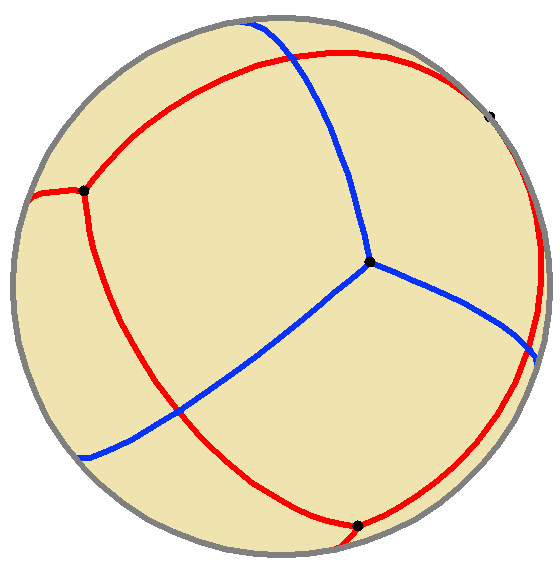
A compound of two spherical tetrahedra can be constructed, as illustrated.
The two tetrahedra of the compound view of the stellated octahedron are "desmic", meaning that (when interpreted as a line in projective space) each edge of one tetrahedron crosses two opposite edges of the other tetrahedron. One of these two crossings is visible in the stellated octahedron; the other crossing occurs at a point at infinity of the projective space, where each edge of one tetrahedron crosses the parallel edge of the other tetrahedron. These two tetrahedra can be completed to a desmic system of three tetrahedra, where the third tetrahedron has as its four vertices the three crossing points at infinity and the centroid of the two finite tetrahedra. The same twelve tetrahedron vertices also form the points of Reye's configuration.
The stella octangula numbers are figurate numbers that count the number of balls that can be arranged into the shape of a stellated octahedron. These numbers are the form of n(2n^2 - 1) for n being the positive integers; the first ten such numbers are: :0, 1, 14, 51, 124, 245, 426, 679, 1016, 1449, 1990, ....
In popular culture
The stellated octahedron appears with several other polyhedra and polyhedral compounds in M. C. Escher's print "Stars", and provides the central form in Escher's Double Planetoid (1949).{{citation
The obelisk in the center of the in Zaragoza, Spain, is surrounded by twelve stellated octahedral lampposts, shaped to form a three-dimensional version of the Flag of Europe.
Mysticism
Some modern mystics have associated this shape with the "merkaba": a "counterrotating field of light" that "transport[s] body and soul to other dimensions." New Age authors have attributed the merkaba to ancient Egyptian origins — traditionally, "mer" stood for pyramid, "ka" for soul, and "ba" for personality or spiritual essence that guides the soul. In a different tradition, Jewish "Merkabah" mysticism details a living chariot in the visions of Ezekiel (in Hebrew, chariot is written מֶרְכָּבָה and pronounced merkābâ, where "rakab" means "to ride" or "to be carried"), used by higher angels for motility.
The resemblance between this shape and the two-dimensional star of David has also been frequently noted.
References
References
- (1996). "The Book of Numbers". Springer.
- Hart, George W.. (1996). "The Polyhedra of M.C. Escher". Virtual Polyhedra.
- "Obelisco". Ayuntamiento de Zaragoza.
- Dannelley, Richard. (1995). "Sedona: Beyond the Vortex: Activating the Planetary Ascension Program with Sacred Geometry, the Vortex, and the Merkaba". Light Technology Publishing.
- Melchizedek, Drunvalo. (2000). "The Ancient Secret of the Flower of Life: An Edited Transcript of the Flower of Life Workshop Presented Live to Mother Earth from 1985 to 1994 -, Volume 1". Light Technology Publishing.
- (26 Dec 1994). "The Teaching On Spherical Breathing (Merkaba Meditation)".
- Marar, Ton. (May 20, 2022). "A Ludic Journey into Geometric Topology". [[Springer Nature]].
- (2010). "Pocket Dictionary of Biblical Studies: Over 300 Terms Clearly & Concisely Defined". InterVarsity Press.
- Brisson, David W.. (1978). "Hypergraphics: visualizing complex relationships in art, science, and technology". Westview Press for the American Association for the Advancement of Science.
This article was imported from Wikipedia and is available under the Creative Commons Attribution-ShareAlike 4.0 License. Content has been adapted to SurfDoc format. Original contributors can be found on the article history page.
Ask Mako anything about Stellated octahedron — get instant answers, deeper analysis, and related topics.
Research with MakoFree with your Surf account
Create a free account to save articles, ask Mako questions, and organize your research.
Sign up freeThis content may have been generated or modified by AI. CloudSurf Software LLC is not responsible for the accuracy, completeness, or reliability of AI-generated content. Always verify important information from primary sources.
Report