From Surf Wiki (app.surf) — the open knowledge base
Stefan Hell
Romanian-German physicist (born 1962)
Romanian-German physicist (born 1962)
| Field | Value |
|---|---|
| name | Stefan Walter Hell |
| image | Stefan W Hell.jpg |
| caption | Hell in 2010 |
| birth_date | |
| birth_place | Arad, Romania |
| citizenship | Germany |
| Romania | |
| fields | Physics, optics |
| workplaces | Max Planck Institute for Multidisciplinary Sciences (1997–) |
| Max Planck Institute for Medical Research (2016–) | |
| German Cancer Research Center (2003–17) | |
| University of Turku (1993–96) | |
| alma_mater | Heidelberg University |
| doctoral_advisor | |
| thesis_title | Imaging of transparent microstructures in a confocal microscope |
| thesis_url | https://katalog.ub.uni-heidelberg.de/titel/2568673 |
| thesis_year | 1990 |
| notable_students | Ilaria Testa (postdoc) |
| Francisco Balzarotti (postdoc) | |
| occupation | Physicist |
| known_for | STED microscopy |
| RESOLFT | |
| GSD microscopy | |
| 4Pi microscope | |
| Minflux | |
| Multifocal multiphoton microscopy | |
| Three photon microscopy | |
| awards | Pour le Mérite (2022) |
| Wilhelm Exner Medal (2016) | |
| Onsager Medal (2016) | |
| Glenn T. Seaborg Medal (2015) | |
| Nobel Prize in Chemistry (2014) | |
| Kavli Prize (2014) | |
| Paul Karrer Gold Medal (2013) | |
| Meyenburg Prize (2011) | |
| Körber European Science Prize (2011) | |
| Otto Hahn Prize (2009) | |
| Lower Saxony State Prize (2008) | |
| Gottfried Wilhelm Leibniz Prize (2008) | |
| German Future Prize (2006) | |
Romania Max Planck Institute for Medical Research (2016–) German Cancer Research Center (2003–17) University of Turku (1993–96) Francisco Balzarotti (postdoc) RESOLFT GSD microscopy 4Pi microscope Minflux Multifocal multiphoton microscopy Three photon microscopy Wilhelm Exner Medal (2016) Onsager Medal (2016) Glenn T. Seaborg Medal (2015) Nobel Prize in Chemistry (2014) Kavli Prize (2014) Paul Karrer Gold Medal (2013) Meyenburg Prize (2011) Körber European Science Prize (2011) Otto Hahn Prize (2009) Lower Saxony State Prize (2008) Gottfried Wilhelm Leibniz Prize (2008) German Future Prize (2006)
Stefan Walter Hell (: born 23 December 1962) is a Romanian-German physicist and one of the directors of the Max Planck Institute for Multidisciplinary Sciences in Göttingen, and of the Max Planck Institute for Medical Research in Heidelberg, both of which are in Germany. He received the Nobel Prize in Chemistry in 2014 "for the development of super-resolved fluorescence microscopy", together with Eric Betzig and William Moerner.
Life
Born 1962 into a Roman Catholic Banat Swabian family in Arad, Romania, he grew up at his parents' home in nearby Sântana. Hell attended primary school there between 1969 and 1977. Subsequently, he attended one year of secondary education at the Nikolaus Lenau High School in Timișoara before leaving with his parents to West Germany in 1978. His father was an engineer and his mother a teacher; the family settled in Ludwigshafen after emigrating.
Hell began his studies at the Heidelberg University in 1981, where he received his doctorate in physics in 1990. His thesis advisor was the solid-state physicist Siegfried Hunklinger. The title of the thesis was "Imaging of transparent microstructures in a confocal microscope". He was an independent inventor for a short period thereafter working on improving depth (axial) resolution in confocal microscopy, which became later known as the 4Pi microscope. Resolution is the possibility to separate two similar objects in close proximity and is therefore the most important property of a microscope.
From 1991 to 1993, Hell worked at the European Molecular Biology Laboratory in Heidelberg, where he succeeded in demonstrating the principles of 4-Pi microscopy. From 1993 to 1996 he worked as a group leader at the University of Turku (Finland) in the department for Medical Physics, where he developed the principle for stimulated emission depletion STED microscopy. From 1993 to 1994 Hell was also for six months a visiting scientist at the University of Oxford (England). He received his habilitation in physics from the University of Heidelberg in 1996. On 15 October 2002, Hell became a director of the Max Planck Institute for Biophysical Chemistry in Göttingen and he established the department of Nanobiophotonics. Since 2003 Hell has also been the leader of the department "Optical Nanoscopy division" at the German Cancer Research Center (DKFZ) in Heidelberg and "non-budgeted professor" (apl. Prof.) in the Heidelberg University Faculty of Physics and Astronomy. Since 2004 he has been an honorary professor for experimental physics at the faculty of physics of the University of Göttingen.
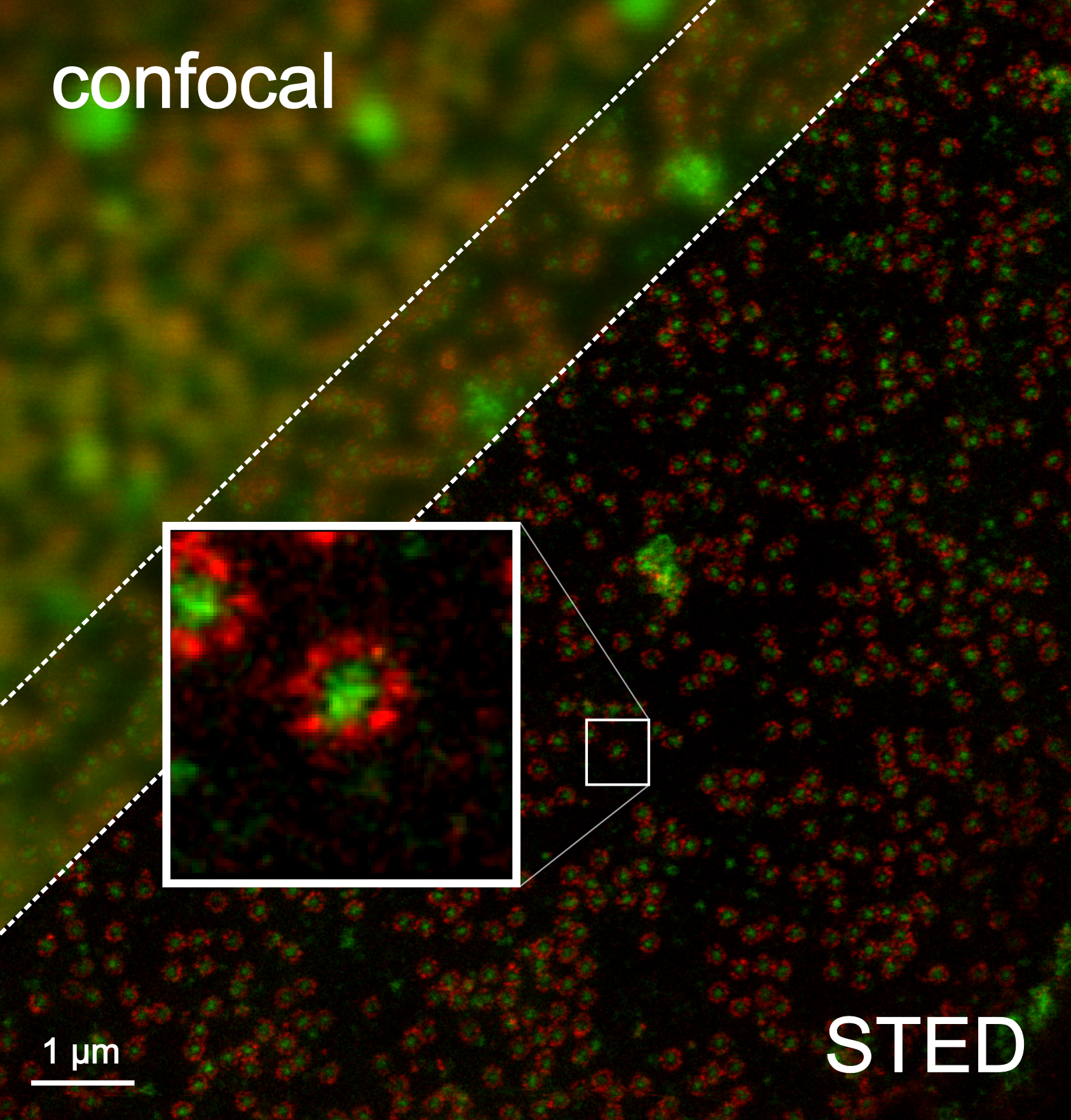
With the invention and subsequent development of Stimulated Emission Depletion microscopy and related microscopy methods, he was able to show that one can substantially improve the resolving power of the fluorescence microscope, previously limited to half the wavelength of the employed light ( 200 nanometers). A microscope's resolution is its most important property. Hell was the first to demonstrate, both theoretically and experimentally, how one can decouple the resolution of the fluorescence microscope from diffraction and increase it to a fraction of the wavelength of light (to the nanometer scale). Ever since the work of Ernst Karl Abbe in 1873, this feat was not thought possible. For this achievement and its significance for other fields of science, such as the life-sciences and medical research, he received the 10th German Innovation Award (Deutscher Zukunftspreis) on 23 November 2006. He received the Nobel Prize in Chemistry in 2014, becoming the second Nobelist born in the Banat Swabian community (after Herta Müller, the 2009 recipient of the Nobel Prize in Literature).
, Hell has an h-index of 148 according to Google Scholar.
Hell serves on the Executive Advisory Board of the World.Minds Foundation, where he contributes to global dialogue on science, technology, and innovation.
Awards
- Prize of the International Commission for Optics, 2000
- Helmholtz-Award for metrology, Co-recipient, 2001
- Berthold Leibinger Innovationspreis, 2002
- Carl-Zeiss Research Award, 2002
- Karl-Heinz-Beckurts-award, 2002
- Berlin-Brandenburg Academy Award – sponsored by the Gottlieb Daimler and Karl Benz Foundation, 2004
- Robert B. Woodward Scholar, Harvard University, Cambridge, MA, USA, 2006
- Innovation Award of the German Federal President, 2006
- Julius Springer Prize for Applied Physics, 2007
- Member of the Akademie der Wissenschaften zu Göttingen, 2007
- Gottfried Wilhelm Leibniz Prize, 2008
- Lower Saxony State Prize, 2008
- Nomination for European Inventor of the Year of the European Patent Office, 2008
- Method of the year 2008 in Nature Methods
- Otto-Hahn-Preis, 2009
- Ernst-Hellmut-Vits-Prize, 2010
- Hansen Family Award, 2011
- Körber European Science Prize, 2011
- The Gothenburg Lise Meitner prize, 2010/11
- Meyenburg Prize, 2011
- Science Prize of the Fritz Behrens Foundation 2012
- Doctor Honoris Causa of Vasile Goldiș Western University of Arad, 2012
- Romanian Academy, Honorary Member, 2012
- Paul Karrer Gold Medal, University of Zürich, 2013
- Member of German National Academy of Sciences Leopoldina, 2013
- of the Leopoldina, 2013
- Kavli Prize, 2014
- Nobel Prize in Chemistry, 2014
- Romanian Royal Family: Knight Commander of the Order of the Crown, 2015
- Romania: Grand Cross of the Order of the Star of Romania, 2015
- Glenn T. Seaborg Medal, 2015
- Wilhelm Exner Medal, 2016
- Foreign associate of the National Academy of Sciences, 2016
- Honorary Fellow of the Royal Microscopical Society (HonFRMS) for his contributions to microscopy, 2017
- Fellow of the Norwegian Academy of Science and Letters.
- Pour le Mérite, 2022
Publications
References
References
- "Department Hell". Max Planck Institute for Multidisciplinary Sciences.
- "Department of Optical Nanoscopy". Max Planck Institute for Medical Research.
- "Nobelprize.org".
- {{in lang. ro Răzvan Băltărețu, [http://adevarul.ro/tech/stiinta/premiul-nobel-chimie-fost-castigat-roman-1_5435107c0d133766a8c357bf/index.html "Un cercetător născut în județul Arad este printre câștigătorii premiului Nobel pentru chimie"], ''[[Adevărul]]'', October 8, 2014
- Andreea Ofițeru, [http://www.gandul.info/stiri/nobel-2014-stefan-w-hell-pentru-gandul-am-avut-profesori-extraordinari-in-romania-13373041 "Stefan W. Hell, pentru Gândul: 'Am avut profesori extraordinari în România'"], ''[[Gândul]]'', October 9, 2014
- {{in lang. ro Andreea Pocotila, [http://www.romanialibera.ro/stiinta-tehnologie/stiinta/fizicianul-premiat-cu-nobelul-pentru-chimie-vorbeste-romaneste-si-tine-legatura-cu-mediul-stiintific-din-tara-noastra-352654 "Fizicianul premiat cu Nobelul pentru chimie vorbește românește și ține legătura cu mediul științific din țara noastră"], ''[[România liberă]]'', October 8, 2014
- {{in lang. ro Ștefan Both, [http://adevarul.ro/locale/timisoara/exclusiv-stefan-whell-castigatorul-nobelului-chimie-fost-elev-liceul-nikolaus-lenau-timisoara-1_54351d5e0d133766a8c39e0e/index.html "Stefan W. Hell, al doilea elev de la Liceul 'Nikolaus Lenau' din Timișoara care a câștigat un Nobel"], ''[[Adevărul]]'', October 8, 2014
- "Curriculum Vitae".
- "NanoBiophotonics – Stefan W. Hell's Personal Profile".
- "Deutscher Zukunftspreis".
- "MPI für biophysikalische Chemie: Hell für Deutschen Zukunftspreis 2006 nominiert".
- "Max film".
- "CV of Stefan Hell". Academy of Sciences Leopoldina.
- "Hell, Stefan, Prof. Dr. Dr. h.c. mult.". Göttingen Graduate School for Neurosciences, Biophysics, and Molecular Biosciences.
- {{Google Scholar id
- "Team – WORLD.MINDS".
- "Preis der Akademie".
- "Mission Impossible: Breaking the Visual Barrier". European Patent Office.
- "Course of science". Bayer Foundation.
- [http://www.koerber-stiftung.de/wissenschaft/koerber-preis-fuer-die-europaeische-wissenschaft/aktueller-preistraeger.html ''Stefan Hell – Körber-Preisträger 2011''] {{webarchive. link. (2014-10-13)
- (16 November 2011). "From microscopy to nanoscopy: 2011 Meyenburg Award goes to Stefan Hell". Deutsches Krebsforschungszentrum.
- (9 October 2014). "STEFAN W. HELL, Doctor Honoris Causa al Universitatii de Vest "Vasile Goldis"". Arad Online.
- "Imagini de la evenimentul dedicat laureatului Premiului Nobel, Ștefan Hell – Familia Regală a României / Royal Family of Romania".
- "Laureat al Premiului Nobel decorat de Regele Mihai – Familia Regală a României / Royal Family of Romania".
- {{in lang. ro Ștefan Pană, [http://www.mediafax.ro/politic/stefan-hell-laureat-al-nobel-a-fost-decorat-de-iohannis-este-ceva-foarte-special-ma-misca-profund-foto-14700413 "Stefan Hell, laureat al Nobel, a fost decorat de Iohannis"], Mediafax, September 4, 2015
- "New Physico-Chemical Tools for New Biology". UCLA.
- "Awardees". Wilmelm Exner Stiftung.
- (May 3, 2016). "National Academy of Sciences Members and Foreign Associates Elected". [[National Academy of Sciences]].
- "Current RMS Honorary Fellows".
- "Group 2: Astronomy, Physics and Geophysics". [[Norwegian Academy of Science and Letters]].
- "Hell".
This article was imported from Wikipedia and is available under the Creative Commons Attribution-ShareAlike 4.0 License. Content has been adapted to SurfDoc format. Original contributors can be found on the article history page.
Ask Mako anything about Stefan Hell — get instant answers, deeper analysis, and related topics.
Research with MakoFree with your Surf account
Create a free account to save articles, ask Mako questions, and organize your research.
Sign up freeThis content may have been generated or modified by AI. CloudSurf Software LLC is not responsible for the accuracy, completeness, or reliability of AI-generated content. Always verify important information from primary sources.
Report