From Surf Wiki (app.surf) — the open knowledge base
Steam motor
Steam engine for use on rail tracks

Steam engine for use on rail tracks
A steam motor is a form of steam engine used for light locomotives and light self-propelled motor cars used on railways.{{Cite web
An early example with the all-in-one (coach, baggage, mail and/or express matter compartments) was photographed working on the Nashville, Chattanooga & St. Louis Railroad during the American Civil War, in Tennessee, circa 1863-64. One American firm, Grice & Long, devised various versions in the mid-1860s for use on suburban and city street railways, using their proprietary mechanical patents. In the 1930s, some highly evolved steam motors represented one of the final developments of the steam locomotive. The concurrent development of internal combustion-powered or electric-motored railway motor cars proved most popular circa 1900-1950s and those obviating the need for steam-powered cars.
Principles
All steam motor cars apparently depended on economical motive equipment and steam source. Ease of maintenance was apparently another important consideration, at least as much as initial manufacturing costs. The principle of the latest versions of the steam motor is to use the developments of the high-speed steam engine, and to apply them to light locomotives. Rather than a large conventional locomotive having only two cylinders, moving at the speed of the driving wheels, the steam motor uses several small cylinders geared to run at high speeds. With all other factors remaining the same, doubling the speed of a piston engine doubles its power. The steam motor allowed small, light engines to be used. As many of the engine's performance losses remain constant, or are also related to the engine size, these small engines could also be more efficient overall.
Essential features
.jpg)
All steam motors had the following characteristics: :; Small size Late model motors were of a standard size, according to the manufacturer's product line. Where greater power was required, multiple motors were used, one per axle or bogie. :; Enclosed crankshaft lubrication In the most modern form of steam motors, the crankshaft and often the valve gear, was enclosed within a crankcase that contained an oil sump. This provided a generous supply of lubrication and also excluded dirt. Much earlier examples, e.g. mid-19th century, employed all manner of mechanisms with manual lubrication through small drip cups. :; Geared drive This allows a high crankshaft speed, encouraging efficiency. Although not all geared steam locomotives made use of this, particularly the US designs such as the Shay and the Climax, it was an essential part of the most modern steam motor concept.
The final drive of early Sentinel-patent locomotives was by chain. Later designs, particularly those by Abner Doble, preferred spur gears. Gear drives required the steam motor to be mounted low-down, alongside the axle. Geared drives appear in some of the earliest steam motor cars used in North America, although more conventional reciprocating drives with either a single power axle or doubled power axles, linked by connecting rods, were quite common. Most of these used conventional Stephenson motion valve gear.
Additional features
Fuel and water consumption savings was one more important consideration in most steam motor cars used around the world. The less overall cost in operation was of great importance to buyers. Fuel could be coal, and in some fewer cases, oil of various types. :; Advanced valve gear Late-manufacture steam motors were usually fitted with poppet valves driven by camshafts. In the steam motors built by Sentinel, the motor was derived from their already advanced steam wagon design. :; Small driving wheels In a conventional steam locomotive, the 'gear ratio' is set by the size of the driving wheels. In steam motors using a geared drive, the wheel size can be reduced. This makes for a lighter and more compact chassis, particularly by reducing the unsprung weight of large wheels. Small wheels also allow the motor to be mounted on a bogie within a passenger coach to form a railcar, rather than the large wheels being the size of a locomotive.
Advantages
These features give advantages: :; Higher efficiency This is mostly owing to the high speed of the latter-day modern engines and the reduction gearing, but also their other advanced design features. :; Reduced servicing The use of oil-bath lubrication reduces the time spent in daily oiling. :; Reduced maintenance The use of oil-bath lubrication reduces the rate of wear, thus reducing the need for periodic maintenance. This is mostly due to the exclusion of dirt, as well as the generous and reliable lubrication. Although other oil-bath systems on steam locomotives, such as the Bulleid chain-driven valve gear, gained a poor reputation for reliability, this was mostly due to the difficulty of sealing such a large container. With the steam motor, only the motor's relatively small crankcase was a sealed box. :; Simpler maintenance Maintenance, when required, involves smaller components. These are easier to work on, requiring less specialised lifting gear. The motor may also easily be removed in one piece for maintenance, either on-shed, or by return to the manufacturer. This also allows a vehicle to be returned to service more quickly by swapping motor units. :; Low manufacturing cost Components are manufactured in greater volume, as many designs of locomotive may be built around standardised motor designs. The machinery required to manufacture steam motors is also smaller, thus less specialised and cheaper. :; Reduced hammer blow The smoother drive of the geared motor, and its multiple cylinders, reduced the dynamic effect of individual cylinder strokes. :; Articulation With multiple motors, there is no need for a single large frame to carry all of the driven wheels. This was an attractive feature for the Colombian locomotives, where a powerful locomotive was provided on a flexible chassis.
As the driving wheels were small and articulated, there was no need for separate carrying axles. All wheels could be powered, so that the locomotive's entire weight could be used for adhesion.
Development
Ganz Works, Hungary

Between 1901 and 1908, Ganz Works of Budapest and de Dion-Bouton of Paris collaborated to build a number of railcars for the Hungarian State Railways together with units with de Dion-Bouton boilers, Ganz steam motors and equipments, and Raba carriages built by the Raba Hungarian Wagon and Machine Factory in Győr. In 1908, the Borzsavölgyi Gazdasági Vasút (BGV), a narrow-gauge railway in Carpathian Ruthenia (today's Ukraine), purchased five railcars from Ganz and four railcars from the Hungarian Royal State Railway Machine Factory with de Dion-Bouton boilers. The Ganz company started to export steam motor railcars to the United Kingdom, Italy, Canada, Japan, Russia and Bulgaria.
Paget locomotive

The first multiple-cylinder locomotive to demonstrate some of the principles of the steam motor was the Midland Railway's Paget locomotive of 1907.{{Cite web
A significant difference between the Paget and a steam motor locomotive is that the Paget valvegear was driven centrally, every cylinder's valve being driven by geared shafts from a single jackshaft that was in-turn driven by the coupling rods.
Although the locomotive achieved its goal of avoiding vibration and hammer blow, and its novel boiler and firebrick firebox was also simple and reliable, it was not considered an overall success. The rotary valvegear absorbed more power to drive it than a conventional design and suffered from problems with thermal expansion. After a mechanical failure of the valvegear seizing and blocked a main line for several hours, the locomotive was withdrawn and later scrapped.
Sentinel
The first locomotives designed around the full steam motor concept were by Sentinel. In 1922 two separate Sentinel-based steam motor projects were put forward. The first, in May 1922, was Sentinel's own concept for a light steam railmotor based on their steam wagon boiler and engine.{{Cite book
In the same year, Kyrle Willans suggested that a worn-out conventional locomotive, a Manning-Wardle named Ancoats, could be rebuilt with the boiler and engine of a Sentinel steam wagon in the locomotive's frames, connected by a roller chain drive. This was the first steam locomotive, and the first example of the steam motor for railway use, to be constructed by Sentinel. Although Sentinel were to become known for gear-driven locomotives, other examples of this conversion of an older coupling rod locomotive continued to be produced; two examples survive, although derelict, at the Coalbrookdale Museum of Iron.
Sentinel's first new-construction locomotive, Nº 5156, was built in July 1923. Like the railmotor design, this used the newly developed engine of the Super-Sentinel wagon, placed horizontally between the frames.{{Cite patent
Production Sentinels achieved a more accessible layout by mounting their engines vertically. The smaller 'Balanced Engine' design had the boiler and engine at opposite ends of the frames, with low bodywork over the water tank, a raised cab and a small cylindrical casing over the engine. The more familiar type was the later 'Central Engine'{{Cite patent

The gear ratio of the final drive depended on the market and the work expected of the locomotive. They varied between a 6:1 and a 1:1 drive. The original steam wagon, using an engine of the same size, might carry a load of around 15 tons. The railway locomotive might achieve a tractive effort of 123,000 lbf and haul a load for slow shunting work of 650 tons. Typical shunting loads were around 350 tons at 5 mph in a level marshalling yard, the weight of a typical goods train.
By 1925 the vertical arrangement of the engine had been taken advantage of to improve steam porting and access for maintenance. The Super-Sentinel engine used two camshafts: inlet and exhaust, placed near the crankshaft in the crankcase and operating the poppet valves through long pushrods. In the original wagon engine, all four valves were mounted at the far end of the cylinder from the crankshaft, requiring long narrow ports to the other end of the cylinder. With the locomotives the easily accessed vertical engine allowed a pair of these valves to be moved to the lower end of the cylinder, allowing for a short, efficient port with less 'dead space'. The crankcase of the engine, together with the crosshead trunk guide, was enclosed and provided with oil splash lubrication. A small plenum was left exposed between the cylinder's piston rod stuffing box and another gland seal into the crankcase. This allowed any steam that did leak past the seals to be vented to the atmosphere, rather than condensing within the crankcase.
Railcars
Following closely on their locomotive developments, Sentinel also produced steam railcars. These were convenient for lightly constructed railways as they were much lighter than conventional locomotive-hauled trains. Even compared to earlier steam railmotors, such as the GWR vertical-boilered examples, the Sentinel design of a lightweight water-tube boiler and a smaller geared steam motor was yet lighter. Petrol railcars and railbuses were appearing by this time, although they were limited in power and so weight, size and carrying capacity. Sentinel's main market for their railcars was for export, although the LNER also operated a number of them.{{Cite web
Doble
Main article: Abner Doble, Doble steam car
The steam motor principle owes much to the work and advocacy of Abner Doble, who was inspired by his earlier work on steam cars. He later worked for Henschel of Germany who built trucks, buses, railcars and even locomotives using his steam motor principle.{{Cite book
Doble also designed for Sentinel, particularly for the development of advanced boiler designs.
Other examples
France
; 221TQ Rebuilt from a 230 class 4-6-0T tank locomotive as a 4-4-2T, with a longitudinal V12 steam motor driving the two driven axles through a driveshaft. This did not follow the usual steam motor practice, in that the entire drive from many cylinders was still united in a single shaft, although it did still use the concept of small cylinders and reduction gearing. The locomotive appears to have been unsatisfactory, possibly because the weight of the motor was now over the leading carrying wheels, reducing adhesive weight over the drivers to only half of the locomotive's total.
; 232.P.1 A 4-6-4 streamlined express passenger locomotive, using a high-pressure boiler. Each of the three driven axles had a pair of three-cylinder double-acting uniflow steam motors, giving 18 cylinders in total.{{Cite web
Switzerland
; High Pressure Locomotive A 2-6-2 high-pressure locomotive of 1927, designed by Buchli. This used a three-cylinder motor to drive the wheels through a 1:2.5 reduction gearbox, then conventional coupling rods. This motor had poppet valves and uniflow admission.{{Cite web
Germany
; Lübeck-Büchener Eisenbahn The Lübeck-Büchener Eisenbahn ordered railcars from Henschel according to the designs of Abner Doble. Similar railcars were also built for Deutsche Reichsbahn. In 1936–1937 these were followed by a 2-6-4T locomotive using three V-twin steam motors.{{Cite web
; V19.1001 The German streamlined express passenger locomotive V19.1001 of the late 1930s. This 2-8-2 or 1'Do1' (UIC) locomotive had four V-twin steam motors, one on each axle.
Egypt

; Steam motor locomotive of 1938 This was an outside-framed 2-4-2, with two Sentinel steam motors, each of 200 bhp. Unusually for Sentinel, it used a conventional locomotive boiler.{{Cite web
In 1951 Egyptian National Railways bought some of the last Sentinel steam railcars, built by Metropolitan-Cammell with Sentinel power bogies. These were ten three-carriage rakes articulated across four Jakobs bogies. One is preserved in England today, by the Quainton Railway Society at the Buckinghamshire Railway Centre, England.{{cite web
South America
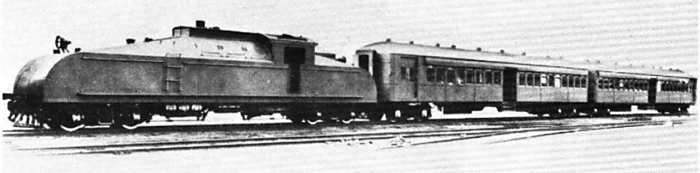
Sentinel built a number of metre gauge locomotives for Argentina, Colombia and also Belgium.
The first of these were in 1931, for the Buenos Aires Midland Railway. The railway was already using Sentinel railcars similar to the LNER pattern, but required a larger multiple unit. Two were built as four-unit rakes: a locomotive based on the previous railcar chassis and three trailer coaches. The B-B locomotive used two four wheel bogies, each driven by a six-cylinder motor based on the railcar, for a total of 250 bhp.{{Cite web
Colombian locomotiveOne of the best-known Sentinel locomotives was the 'Colombian', based on the designs of Abner Doble. These were built as a batch of four, the first of which was sold to Belgium in 1934, followed by three for the Société National des Chemins de Fer en Colombe.{{Cite web
These locomotives have been described as the most sophisticated steam locomotives ever constructed, certainly the most advanced that Sentinel produced. They used a high-pressure Woolnough boiler at 550 psi. The chassis layout was a Co-Co, with each axle independently driven by a two-cylinder compound Doble steam motor. This motor was also used in other Sentinel railcar designs for the Southern Railway. An unusual feature for reliability was that if any motor failed, it could rapidly be disconnected and the locomotive continued on its way.
North America

The steam motor cars of North America reached their popular apex before the 1880s, with most fabricated to custom designs by small specialty builders before 1875. Nearly all examples were unique and purpose-built to order; a few were experimental cars built and marketed by small firms or individuals on a trial basis and often not entirely successful due to their uniqueness or relative costs. The rise of electric traction was one cause for the ultimate demise of American steam motor cars. The development of direct-drive gasoline mechanical railway motor cars circa 1905-15 created new markets, and finally gas-electric and then diesel-hydraulic drive motor cars such as the widely popular Budd RDC [rail diesel car] of the 1950s closed out the need for self-contained motor trains. The Baltimore and Ohio considered (but never built) a fleet of powerful 5,000 hp 4-2-2-2-2-4 express locomotives in the late 1930s, powered by four V4 motors, one per axle.{{Cite journal
References
References
- "Bridge Over Running Water Creek, c.1861-1865".
- Grice & Long trade advertisement; The Scientific American, 26 October 1861.
- Railroad Gazette - Volume 37 - Page 296 (printed in 1904)
- Modern Machinery - Volumes 19-20 - Page 206 (Printed in 1906)
- [[John Robertson Dunlap]], [[Arthur Van Vlissingen]], [[John Michael Carmody]]: Factory and Industrial Management - Volume 33 - Page 1003 (printed in 1907
- {{harvnb. Hughes & Thomas, Sentinel
- Letter K Willans to H Hilton, 18 September 1949, in possession of the Crofton Branch of the [[Kennet and Avon Canal Trust]]
- {{harvnb. Hughes & Thomas, Sentinel
- {{harvnb. Walton, Doble Steam Cars
This article was imported from Wikipedia and is available under the Creative Commons Attribution-ShareAlike 4.0 License. Content has been adapted to SurfDoc format. Original contributors can be found on the article history page.
Ask Mako anything about Steam motor — get instant answers, deeper analysis, and related topics.
Research with MakoFree with your Surf account
Create a free account to save articles, ask Mako questions, and organize your research.
Sign up freeThis content may have been generated or modified by AI. CloudSurf Software LLC is not responsible for the accuracy, completeness, or reliability of AI-generated content. Always verify important information from primary sources.
Report