From Surf Wiki (app.surf) — the open knowledge base
States of the German Confederation
Listing of the states of the German Confederation
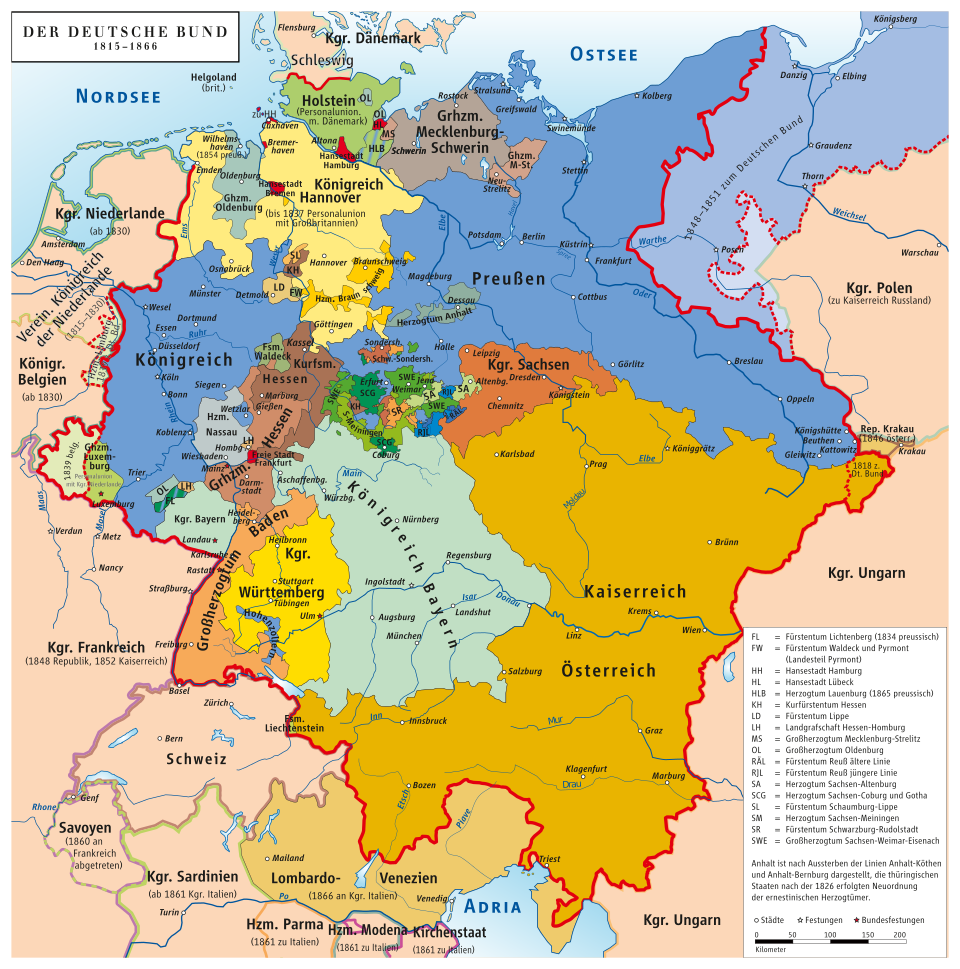
Listing of the states of the German Confederation
The states of the German Confederation were member states of the German Confederation, from 20 June 1815 until 24 August 1866.
On the whole, its territory nearly coincided with that remaining in the Holy Roman Empire at the outbreak of the French Revolution, with the notable exception of Belgium. Except for Austria, Prussia, Holstein, and the western left bank of the Rhine (which France had annexed, with tiny Katzenelnbogen), the other member states (or their precursors) had been within Napoleon's Confederation of the Rhine.
- The Austrian Empire, excluding the Kingdom of Hungary, the Principality of Transylvania, and the Kingdom of Croatia (all of which became parts of the apostolic kingdom of Hungary within the Danubian Dual Monarchy), the Kingdom of Lombardy–Venetia (constituting parts lost to Italy in 1859- viz. 1866), the Duchy of Bukovina, and the kingdoms of Dalmatia and Galicia (but including, from 1818 till 1850, Duchy of Oświęcim and Duchy of Zator)
- Archduchy of Austria (split into Upper Austria and Lower Austria in 1849)
- Kingdom of Bohemia
- Margraviate of Moravia
- Grand Duchy of Salzburg
- Duchy of Carinthia
- Duchy of Carniola
- Duchy of Upper and Lower Silesia
- Duchy of Styria
- Littoral (consisting of Gorizia and Gradisca, Istria and Trieste)
- County of Tyrol
- Vorarlberg
- The Kingdom of Prussia (excluding Posen, East Prussia and West Prussia)
- Brandenburg
- Pomerania
- Rhine Province (until 1822 the Grand Duchy of the Lower Rhine and the Province of Jülich-Cleves-Berg)
- Saxony
- Silesia
- Westphalia
- The Kingdom of Bavaria
- Upper Bavaria
- Upper Franconia
- Swabia
- Upper Palatinate
- Middle Franconia
- Lower Bavaria
- Lower Franconia
- Palatinate
- The Kingdom of Hanover (in personal union with the United Kingdom until 1837)
- The Kingdom of Saxony
- The Kingdom of Württemberg
- The Electorate of Hesse (also known as Hesse-Kassel)
- The Grand Duchy of Baden
- The Grand Duchy of Hesse (also known as Hesse-Darmstadt)
- The Grand Duchy of Luxemburg (in personal union with the United Kingdom of the Netherlands; lost over half of its territory in the west to Belgium in the breakup of the United Kingdom of the Netherlands in 1839, thereby resulting in the Duchy of Limburg becoming a member.)
- The Grand Duchy of Mecklenburg-Schwerin
- The Grand Duchy of Mecklenburg-Strelitz
- The Grand Duchy of Oldenburg
- The Grand Duchy of Saxe-Weimar-Eisenach
- The Duchy of Brunswick (prior Brunswick-Lunenburgian Principality of Wolfenbüttel)
- The Duchy of Holstein (in personal union with the Kingdom of Denmark; not a former member of the Confederation of the Rhine)
- The Duchy of Limburg (became a member in 1839 in personal union with the Netherlands as compensation for territorial losses in the Grand Duchy of Luxemburg that were caused by the breakup of the United Kingdom of the Netherlands.)
- The Duchy of Nassau
- The Duchy of Saxe-Coburg-Saalfeld (Saxe-Coburg and Gotha from 1826)
- The Duchy of Saxe-Gotha-Altenburg (Saxe-Altenburg from 1826)
- The Duchy of Saxe-Hildburghausen (dissolved in 1826; territory merged with Saxe-Meiningen)
- The Duchy of Saxe-Lauenburg (in personal union with the Kingdom of Denmark)
- The Duchy of Saxe-Meiningen
- The Duchy of Anhalt-Bernburg (merged with Anhalt-Dessau in 1863)
- The Duchy of Anhalt-Dessau (Duchy of Anhalt-Dessau-Köthen from 1853; Duchy of Anhalt from 1863)
- The Duchy of Anhalt-Köthen (merged with Anhalt-Dessau in 1853)
- The Principality of Hohenzollern-Hechingen (merged with Kingdom of Prussia in 1850)
- The Principality of Hohenzollern-Sigmaringen (merged with Kingdom of Prussia in 1850)
- The Principality of Liechtenstein
- The Principality of Lippe
- The Principality of Reuss Junior Line
- The Principality of Reuss Senior Line
- The Principality of Schaumburg-Lippe
- The Principality of Schwarzburg-Rudolstadt
- The Principality of Schwarzburg-Sondershausen
- The Principality of Waldeck and Pyrmont
- The Landgraviate of Hesse-Homburg (became a member in 1817; merged with Grand Duchy of Hesse in 1866)
- The Free Hanseatic City of Bremen (still a constitutive state of Germany)
- The Free City of Frankfurt upon Main
- The Free and Hanseatic City of Hamburg (still a constitutive state of Germany)
- The Free and Hanseatic City of Lübeck
The four free cities were republics by constitution, while all the others were monarchies, some constitutional and some absolutist.
The Duchy of Schleswig was never a member state. But Schleswig was traditionally connected to the duchies of Holstein and Lauenburg, which were member states. In 1848-51 (during the First Schleswig War), it was treated by the German states and the short-lived German Empire as a kind of member. In 1864, the Danish king transferred the three duchies to Austria and Prussia (after the Second Schleswig War).
Sources and references
- Westermann, Großer Atlas zur Weltgeschichte (in German, detailed maps)
- WorldStatesmen
This article was imported from Wikipedia and is available under the Creative Commons Attribution-ShareAlike 4.0 License. Content has been adapted to SurfDoc format. Original contributors can be found on the article history page.
Ask Mako anything about States of the German Confederation — get instant answers, deeper analysis, and related topics.
Research with MakoFree with your Surf account
Create a free account to save articles, ask Mako questions, and organize your research.
Sign up freeThis content may have been generated or modified by AI. CloudSurf Software LLC is not responsible for the accuracy, completeness, or reliability of AI-generated content. Always verify important information from primary sources.
Report