From Surf Wiki (app.surf) — the open knowledge base
State Police (Albania)
Main law enforcement agency of Albania
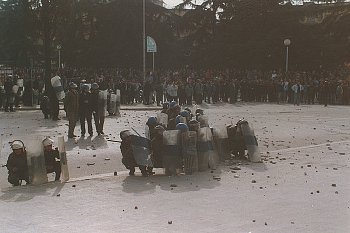
Main law enforcement agency of Albania
| Field | Value | |
|---|---|---|
| agencyname | State Police | |
| nativename | Policia e Shtetit | |
| logo | [[File:Policia_e_Shtetit.svg | 125px]] |
| logocaption | Patch of the State Police | |
| flag | Flamuri i Policisë së Shtetit.svg | |
| flagcaption | Flag of the State Police | |
| commonname | Policia | |
| abbreviation | ASP | |
| motto | Në shërbim të komunitetit | |
| mottotranslated | “In service of the community” | |
| formed | ||
| preceding1 | {{plainlist | |
| employees | 10,777 (2023) | |
| budget | €280 m EUR (2024) | |
| country | Albania | |
| national | Yes | |
| sizearea | 28,748 km2 | |
| sizepopulation | 2,402,113 (2023) | |
| governingbody | Government of Albania | |
| constitution1 | Law on "State Police" | |
| police | Yes | |
| local | Yes | |
| oversightbody | Ministry of Internal Affairs | |
| headquarters | Bajram Curri Boulevard, Tirana | |
| sworntype | Police Employee | |
| sworn | 9,592 | |
| unsworntype | Civilian Staff | |
| unsworn | 1,185 | |
| electeetype | Minister | |
| minister1name | Albana Koçiu | |
| minister1pfo | Internal Affairs Minister | |
| chief1name | Ilir Proda | |
| chief1position | General Director | |
| website |
- Gendarmerie (1925–1939)
- People's Police (1945–1991)}}
The State Police () is the national police and largest law enforcement agency of the Republic of Albania. This agency is responsible for ensuring the safety of citizens, keeping the public order, and serving the people anytime anywhere. The Albanian Police emergency number is 129, or 112 for general emergency services.
History
The original Albanian Police was founded on 13 January 1913 by the government of Ismail Qemali, Albania's first prime minister.
The collapse of the Communist system and the establishment of political pluralism post-1991 brought important changes to the structure of the Albanian Police. The Ministry of Public Order and the General Directorate of Police were established in April 1991, and the new law of July 1991 established the Public Order Police. Nearly 80% of police manpower, i.e. personnel who had served under the previous system, were replaced by new recruits.
On 4 November 1991, the Albanian Police was accepted as a member of Interpol.
The crisis of 1997
Main article: Albanian Rebellion of 1997
Following the collapse of the Albanian economy in January–February 1997 in the wake of the implosion of the Ponzi pyramid banking schemes promoted by the government, increasing insurgency in early March led to the Police and Republican Guard deserting en masse because it became clear they were unlikely to be paid, leaving their armouries unlocked, which were promptly looted by parties unknown, believed to mostly have been the local crime bodies and self-appointed militias: many of the weapons eventually surfaced in the ethnic fighting in Kosovo.
The resulting anarchy led a number of nations to use military forces to evacuate citizens, culminating in the UN authorising Operation Alba ("Daybreak"), a short-term military stabilisation force led by the Italian Army, tasked with facilitating the repatriation of foreigners and laying the foundations for another International Organisation to undertake the longer-term stabilisation. The political debate eventually settled in Europe within the body responsible for the defence diplomatic coordination of the Continent, the Council of the Western European Union. In a 2-hour meeting which convened at 1400 hrs on 2 May 1997, the WEU Council decided on the immediate establishment of the Multinational Advisory Police Element, sending a pathfinder officer, a Norwegian Police Colonel, the same evening. The Italian force in Operation Alba predicated the Command structure of MAPE passing into the Italian Carabinieri, General Pietro Pistolese, previously commanding the Genoa region, bringing his team with him. Four phases followed, assessment, reconstruction, support of the Albanian Police control during the Kosovo Crisis, and finally build-down and handback in early 2001, which was somewhat accelerated ahead of the transfer of the WEU's operational responsibilities to the Council of the EU on 30 June 2001. The reconstruction principally involved the reconstruction of the Judicial system and the training of Police, but the Finance section also accommodated economic specialists acting as the principal feedback into the correction of the Judicial system. The Command Team later formed the core of the European Union Border Assistance Mission Rafah from 2005 onwards.
Public perception

- Public Safety: 82% of respondents reported feeling “safe” or “very safe” when walking alone in their neighborhood after dark.
- Property Crime Concerns: 69% of respondents reported rarely worrying about home burglaries.
- Police Performance Rating: 65% of respondents rated the State Police as performing “good” or “very good,” while 8% rated them as “poor.”
- Treatment by Police: 67% of respondents believe police often or very often treat citizens with respect, while approximately one-third feel that respect is rarely shown.
The 2025 survey provides valuable insights into the public’s perception of the Albanian State Police, indicating progress in safety and government performance, while also identifying areas for further improvement in police-citizen interactions.
Recent developments
From 2014 to 2016, the Albanian State Police conducted several operations in criminally active regions, such as Lazarat, to restore public confidence and encourage support for law enforcement actions. In June 2014, approximately 800 police officers raided Lazarat, a village notorious for large-scale cannabis cultivation, seizing over 10 tonnes of marijuana. During this period, body cameras became an integral tool for the police, extensively used in drug busts and high-profile operations. In February 2016, body cameras were installed on police uniforms to improve police behavior and deter bribery. However, the initiative to use body cameras began to decline due to high operating and maintenance costs, as well as time constraints, ultimately leading to their discontinuation for field policemen.
In response to ongoing challenges, the Ministry of Interior introduced the Public Order Strategy 2015–2020, accompanied by the Action Plan 2015–2017. This comprehensive strategy aimed to modernize the Albanian State Police and align it with European Union standards. Key objectives included enhancing transparency and accountability, improving infrastructure, integrating advanced technologies into police operations, and building partnerships between the police and the public through community policing initiatives.

The 2020s marked significant advancements in the operations of the Albanian State Police, particularly in tourism management. Between 2022 and 2024, the Border & Migration Department, especially the Border & Migration Police Team stationed at Tirana International Airport, effectively managed a yearly influx of 7 to 12 million passengers entering the country. This accomplishment highlighted the department’s efficiency and contribution to Albania’s growing tourism sector.
As part of the draft law, there are plans to integrate artificial intelligence into police operations: installing intelligent camera systems across about 20 cities and along the coastline, aiming for continuous territorial control 24/7. Also changes are proposed to how police leadership is appointed—more transparency and oversight (e.g. police chiefs selected via council rather than only by a general director).
About regular operations, for example in January 2025 saw 121 operations, 19 international, large seizures (drugs, firearms). Then in May 2025 the State Police carried out 99 operations targeting organized crime; over 600 arrests, and international operations to capture high-risk individuals. Lastly, inn August 2025 there were about 90 police operations with ~664 people arrested for various crimes.
Significant Arrests since 2020s
The arrest of Former President of Albania Ilir Meta in October 2024, who was apprehended by DPFO Operatives on orders from SPAK, in the middle of the street, dragged outside of his vehicle and then escorted back to the police commissariat. He was arrested on allegations of corruption, money laundering, hiding assets / failing to declare property and income. He is a significant political figure, since he is in the opposition.
The arrest of Former Prime Minister of Albania and opposition leader Sali Berisha in December 2023, on orders from SPAK, put on house arrest after Parliament of Albania removed his immunity, on charges for passive corruption and abuse of office related to helping his son-in-law in a privatization deal in Tirana. On November 2024, he was released from house arrest, though SPAK appealed. Berisha denies the charges, calling them politically motivated.
The arrest of Former Environment Minister Lefter Koka in December 2021, accused of abuse of office, corruption, money laundering in connection with a concession contract for an incinerator in Elbasan; accused of accepting bribes up to €3.7 million.
The arrest of Former Mayor of Tirana Erion Veliaj in February 2025, on orders from SPAK, apprehended by the State Police at his residence. He faces charges of passive corruption, money laundering, and concealment of assets, linked to the controversial Tirana incinerator project. Veliaj remains in custody while his legal team appeals, and Deputy Mayor Anuela Ristani serves as acting mayor.
The arrest of Former Mayor of Himara Fredi Beleris in March 2024, on orders from SPAK, he was sentenced to two years in prison for vote-buying during the 2023 mayoral election.
The arrest of Former Mayor of Durres Vangjush Dako in June 2023 and 8 other officials of the Municipality of Durres, on orders from SPAK, on charges for abuse of power related to unauthorized construction and inflating project costs, leading to significant financial losses.
The arrest of the "Belgian Most Wanted", also known as Safet Rustemi, considered one of Belgium's most dangerous criminals, Rustemi was involved in several assassinations in Albania and attempted to control prostitution rings in Brussels using violence.
The arrest of Edmond “Edi” Dodaj, an International Drug Trafficker. Dodaj was a fugitive for nearly a decade. He led a network responsible for importing large quantities of cocaine from the Netherlands to Italy. He was apprehended by RENEA operatives following a European arrest warrant issued by Italian authorities.

The arrest of Shkodra's strongman Safet Bajri on February 2025, apprehended by RENEA operatives on orders from SPAK, he was charged with being linked to organized crime activities, including drug trafficking and violent offenses such as the involvement in the 2018 murder of Fatbardh Lici in Shkodra.
The arrest of "The Gambling King" Ervis Martinaj in October 2018, after he was implicated in a deadly shooting in the former Bllok area of Tirana, resulting in the death of Fabian Gaxha. Martinaj was arrested but later released on bail due to insufficient evidence. In 2022, Martinaj went missing under mysterious circumstances. His whereabouts remain unknown, and he is considered a fugitive by Albanian authorities and has an Active Warrant for his arrest.
The arrest of three Internationally Wanted Albanian Criminals. Emirjan Beu, Syrjan Tola, Dorian Beu, all of them were arrested as part of "Operation Highway" which saw the dismantling of an international drug-trafficking criminal group. This also led to the seizure of their assets in Albania estimated to be over €1 million.
The arrest of over 200 Suspects as part of the Operation to counter the drug distribution near schools, led to the large seizures of narcotics of various types (cannabis, heroin, cocaine, ecstasy), showing public safety concern especially near schools.
Rank Structure
In 2015, the State Police underwent reorganizational reforms which were expected to continue for several years. It implemented a new hierarchical structure composed of nine hierarchic ranks.
Unlike many countries in the world where every sworn-in Policeman is called or referred to as a Police Officer, in Albania it works completely differently. Albanian State Police has preserved the way policemen are addressed, keeping them the same as during the Communist Era, when the Albanian Police used Military Ranks. For example: The Military would address Commissioned Officers as Officers and Enlisted men were to be addressed to as Soldiers, this was the same case for the Albanian Police.
Today the State Police’s Senior Ranking Officers and High Ranking Officers are addressed to as Police Officer (Albanian: Oficer Policie) and those that are below Vice Commissar are addressed to as Police Effective (Albanian: Efektiv Policie) or simply Policeman (Albanian: Polic). Officially by law every State Police employee term of addressing is Police Employee (Albanian: Punonjes Policie).
| Police Directors | High Ranking Officer | Police Commissars | Senior Ranking Officer | Policemen | Lower Ranked Policeman |
|---|---|---|---|---|---|
| Flamuri i Policisë së Shtetit.svg Albanian Police | [[File:Gradë ceremoniali, Drejtues Madhor (Policia e Shtetit).svg | 50px]] | [[File:Gradë ceremoniali, Drejtues i Lartë (Policia e Shtetit).svg | 50px]] | |
| [[File:Grada Drejtues Madhor (Policia e Shtetit).svg | 50px]] | [[File:Grada Drejtues i Lartë (Policia e Shtetit).svg | 50px]] | [[File:Grada Drejtues i Parë (Policia e Shtetit).svg | 50px]] |
| Chief director | |||||
| Drejtues Madhor | Senior director | ||||
| Drejtues i Lartë | First director | ||||
| Drejtues i Parë | |||||
| Equivalent to American Police Ranks | Chief of Police | Chief of Department | |||
| Notes | The Director of the Albanian State Police Agency. | The Director of any Albanian State Police Department. |
Branches
| Patch | Branch unit | Type | ||
|---|---|---|---|---|
| [[File:Policia e Rendit.svg | center | 33px]] | Policia e Rendit | |
| The Order Police is tasked to deal with issues of Public Order, assist and help local population. | Regular Field Police | |||
| [[File:Policia Rrugore.svg | center | 33px]] | Policia Rrugore | |
| The Road Police administers road safety and Enforces Traffic Regulations. | Regular Field Police | |||
| [[File:Policia Kufitare.svg | center | 33px]] | Policia Kufitare dhe Migracionit | |
| The Border & Migration Police is in charge of migration and border control. | Regular Field Police | |||
| [[File:Shqiponjat.svg | center | 33px]] | Shqiponjat | |
| The Eagles are a rapid response unit that handles domestic criminal activities. | Special Field Police | |||
| [[File:Forcat e Ndërhyrjes së Shpejtë.svg | center | 33px]] | Forcat e Ndërhyrjes së Shpejtë | |
| The Rapid Intervention Force, also known as FNSH, is a quick intervention unit primarily dealing with cases of violent riots and special operations. | Special Reserve Police | |||
| [[File:RENEA.svg | center | 33px]] | Reparti i Neutralizimit të Elementit të Armatosur | |
| Unit for the Neutralization of the Armed Element, also known as RENEA, is the main counter-terrorism and critical incident response unit. | Special Force Police | |||
| [[File:Drejtoria Forcës Posaçme Operacionale.png | center | 36x36px]] | Drejtoria e Forcës së Posaçme Operacionale | Special Operational Criminal Police Force |
Recruitment & Training
To join the Albanian State Police, you must meet specific eligibility criteria and successfully navigate a multi-step recruitment process before being eligible to join the Albanian Security Academy on the way to become a Police Officer.
Applying for the Security Academy
- Be Albanian citizen.
- Be no older than 30 years.
- Have completed at least secondary education.
- Be in good physical and mental health.
- Be at least 170 cm tall for men and 165 cm for women.
- Have a valid category “B” driver’s license.
- Have no criminal convictions or pending criminal cases.
- Possess a certificate of reliability.
- Not be excluded from the State Police or other national security structures, nor have left civil service.
- Be fluent in spoken and written Albanian.
Additionally, Senior Ranking Officer Positions and above require a university degree in fields such as law, economics, or computer science, along with a minimum GPA of 8.0.
Training & Security Academy
The Albanian State Police is trained through a structured and formal process at the Security Academy of Albania, which is the central institution for police education and training.
New Cadets undergo basic training at the Security Academy, which includes:
Theoretical Education
- Albanian criminal and procedural law
- Human rights and democratic policing
- Police ethics and professional standards
- Use of force and firearms laws
- Public order and crowd management
- Communication and conflict resolution
- Cybercrime and digital evidence (for certain positions)
Physical Training
- Physical fitness and endurance exercises
- Self-defense and arrest techniques
- Firearms training (marksmanship and safety)
- Tactical driving and pursuit operations
- Role-playing and scenario-based simulations
- First aid and emergency response
Basic police training lasts 12–18 months, combining classroom work and field exercises. Cadets must pass final exams to graduate and become full police officers.
Specialized Trainings
After initial training, officers can apply for specialized courses based on their assigned roles or career paths. These may include:
- Criminal Investigation Techniques
- Anti-Terrorism and Organized Crime
- Border and Migration Police
- Cybercrime Investigation
- Forensics and Evidence Handling
- Community Policing Strategies
Special units like RENEA, anti-drug unit, and counter-trafficking units receive advanced tactical training, often in collaboration with international partners.
Equipment
Albanian State Police has had a lot of Communist era equipment in storage, even though a few are still in use today. However, since 2014 the Ministry of Interior has been actively modernizing the State Police's uniforms, vehicles and weaponry, introducing newer modern equipment to replace their outdated Communist era equipment.
Field Police Employees’ Uniforms
The Albanian State Police uniforms have undergone several changes since 1991. Some visible changes to their uniforms and equipments are shown below:


Policemen are equipped with tactical trousers, tactical boots or durable sneakers, and a dark blue T-shirt displaying the branch patch, State Police patch, badge number, and rank. The T-shirt also includes reflective markers and “Police” (Albanian: Policia) printed on the front and back. Over the T-shirt, officers wear a semi-tactical blue vest, with colors varying by branch. The vest includes a large front pocket, reflective markings, “Police” lettering, and the badge number.
In addition, policemen are issued a tactical duty belt, which typically holds the standard-issue firearm, handcuffs, an additional utility pouch, and spare firearm magazines. For headgear, a police cap is provided, bearing an eagle insignia representing the Albanian eagle.

For officers, the uniform differs significantly from the standard policemen uniform. Instead of tactical trousers, boots, or T-shirts, officers wear black polished shoes, black trousers featuring thin red side stripes, and a blue shirt bearing the branch patch, State Police patch, badge number, and rank insignia (also displayed on the shoulder boards). A tactical duty belt may be worn, though its use is not frequent. The uniform is completed with a police hat featuring the Eagle insignia.

Specialized Police Units
The Albanian State Police like all other Police Forces around the world has some of its own Specialized Police Units, responsible for many different operations or missions.


Weaponry
Since 2017, the Government of Albania has contracted with several countries to procure new firearms, replacing the outdated weapons from the Communist era. The list of weaponry used by the State Police below includes all firearms that have been in service with the Albanian State Police since 2010.
| Model | Origin Country | Type | Status |
|---|---|---|---|
| TT-33 | Soviet Union | Semi-automatic pistol | Retired |
| Makarov PM | |||
| Glock 17 | Austria | In service | |
| Beretta 92 | Italy | ||
| Beretta PX4 Storm | |||
| Beretta APX | |||
| Heckler & Koch MP5 | Germany | Sub-machine gun | |
| Heckler & Koch UMP | |||
| Heckler & Koch MP7 | |||
| AKM | Soviet Union | Assault rifle | |
| ASH-78 | Albania | ||
| Beretta ARX 160 | Italy | ||
| HS Produkt VHS | Croatia | ||
| Heckler & Koch G36 | Germany | ||
| Heckler & Koch HK417 | Sniper rifle | ||
| Sako TRG M10 | Finland | ||
| Sako TRG-42 | |||
| RPK machine gun | Soviet Union | Machine gun | |
| RPD machine gun |
Vehicles
Plenty of vehicles have been bought from the Albanian Government, what is most surprising is the diversity when purchasing vehicles.
While many police forces around the world, usually tend to stick with 2-3 car brands in their fleets, Albania has been known to have numerous car brands in their police fleets, with the most popular car brand being Hyundai.

It is worth mentioning that the State Police other than from having brand new purchased vehicles for police use, they also have impounded or confiscated vehicles converted to police vehicles, with those specific brands being Mercedes-Benz, Audi and BMW. They are exclusively mentioned in the list below.
Here is a full list of the vehicles used and currently in use by Albanian State Police since 2010.
Current
| Vehicle | Class | Origin Country |
|---|---|---|
| Ford Focus | Car | United States |
| Hyundai Santa Fe | ||
| Hyundai Kona | ||
| Hyundai Tucson | ||
| Volkswagen e-Golf | Germany | |
| BMW 5 Series | ||
| Mercedes-Benz GLC 63 Coupe | ||
| Mercedes-Benz E-Class | ||
| Mercedes-Benz GLA | ||
| Audi A6 | ||
| Škoda Octavia | Czech Republic | |
| Land Rover Discovery | ||
| Ford Transit Custom | Mini-Van | United States |
| Hyundai i800 | Van | |
| Volkswagen Transporter | Germany | |
| Mercedes-Benz Sprinter | ||
| Aprilia RS660 | Motorcycle | Italy |
| BMW R 1250 RT | Germany | |
| Suzuki V-Strom 650 | Japan | |
| Iveco VM 90 | Utility Vehicle | Italy |
| Land Rover Defender 4x4 | ||
| Mil Mi-8 | Helicopter | |
| Bell 212 | United States | |
| AS350B | ||
| Zodiac Nautic | Boat |
Retired
| Vehicle | Class | Origin Country |
|---|---|---|
| Chevrolet Aveo | Car | United States |
| Hyundai Accent | ||
| Dacia Sandero |
General Directors (1913–present)
| 45 | Ilir Proda | 2 October 2024 | Incumbent |
|---|
References
References
- (4 January 2024). "Bilanci i vitit 2023/ Ministri Balla: Ndryshime rrënjësore në ligjin e Policisë së Shtetit, vetë-pastrimi vijon".
- link
- "Ilir Proda emërohet drejtori i ri i Policisë së Shtetit, pjesë e uniformave blu që prej vitit 2005".
- "Albanian Telegraphic Agency (ATA), 98-01-11".
- "Collapse of the Ponzi schemes 1997". International Monetary Fund.
- [[Albanian Rebellion of 1997#Opening of the depots]]
- [[Operation Silver Wake]]
- [[Operation Libelle]]
- "NL MOD History of MAPE". Dutch Ministry of Defence.
- theo. (2025-02-03). "Survey shows public trust growing in Albanian State Police performance".
- "AMAN - ATA - Survey on safety and trust in State Police: 82% of respondents feel "safe" or "very safe"".
- (2014-06-18). "Albanian police battle cannabis growers in Lazarat". BBC News.
- Mejdini, Fatjona Mejdini, Fatjona. (2016-02-04). "Albania Hopes Cameras Will Make Police Behave".
- "Tirana International Airport".
- editorweb2. (2025-06-08). "State Police reports monthly summary for May, 99 operations and over 600 arrests".
- "Albania, 90 police operations during August, over 600 arrested - Telegraph".
- (2025-02-03). "Arrests, checks, anti-drug operations/ State Police takes stock for January 2025".
- (2024-10-21). "Albania's left-wing former President Meta is arrested on corruption allegations".
- (2025-07-21). "Albanian court begins corruption trial against former Prime Minister Sali Berisha".
- (2021-12-14). "Albania arrests ex-minister on corruption charges".
- theo. (2025-09-11). "SPAK sends Tirana Mayor Erion Veliaj to trial on 13 charges".
- Bytyci, Fatos. (2024-06-25). "Albania court upholds jailing of ethnic Greek mayor who won European Parliament seat". Reuters.
- Kadriu, Elira. (2023-06-08). ""Consequences of Corruption", the projects that handcuffed Vangjush Dako leave citizens without shelter and public spaces".
- "Global human trafficking operation detects 1,194 potential victims, arrests 158 suspects".
- "28 'Ndrangheta associates arrested for drug trafficking and violence – Italian and Albanian nationals trafficked drugs from South America to Europe, ultimately selling them in Rome".
- (2025-06-24). "Accused of the murder of Fatbardh Lici, Safet Bajri, Astmer Bilali and Behar Bajri appeal to the Supreme Court".
- "Checking browser...".
- Si, Nen. (2023-10-19). "Coded police operation "Highway"/3 Albanians internationally wanted arrested".
- Sinoruka, Fjori. (2023-09-14). "Albania Arrests Over 200, Targeting Drug-Dealing Near Schools".
- "Modernizimi i Policisë së Shtetit". Ministry of Internal Affairs.
- (2014). "Ranks of Albanian police". Ministry of Internal Affairs.
- (2016). "Albanian Police Integrity and Corruption 2016". Institute for Democracy and Mediation.
- "NATLEX - Albania - Law No. 82/2024 of 26 July 2024 for the State Police.".
- (2016). "Ranks insignia of the Albanian police officers". General Directorate of State Police.
- administrator. (2022-09-30). "Policia e Shtetit".
- (9 September 2021). "OSCE Presence in Albania organizes advanced training on complex international narcotics investigations with Albania's State Police personnel".
This article was imported from Wikipedia and is available under the Creative Commons Attribution-ShareAlike 4.0 License. Content has been adapted to SurfDoc format. Original contributors can be found on the article history page.
Ask Mako anything about State Police (Albania) — get instant answers, deeper analysis, and related topics.
Research with MakoFree with your Surf account
Create a free account to save articles, ask Mako questions, and organize your research.
Sign up freeThis content may have been generated or modified by AI. CloudSurf Software LLC is not responsible for the accuracy, completeness, or reliability of AI-generated content. Always verify important information from primary sources.
Report