From Surf Wiki (app.surf) — the open knowledge base
Startle response
Action or movement due to the application of a sudden unexpected stimulus
Action or movement due to the application of a sudden unexpected stimulus
In animals, including humans, the startle response is a largely unconscious defensive response to sudden or threatening stimuli, such as sudden noise or sharp movement, and is associated with negative affect. Usually the onset of the startle response is a startle reflex reaction. The startle reflex is a brainstem reflectory reaction (reflex) that serves to protect vulnerable parts, such as the back of the neck (whole-body startle) and the eyes (eyeblink) and facilitates escape from sudden stimuli. It is found across many different species, throughout all stages of life. A variety of responses may occur depending on the affected individual's emotional state, body posture, preparation for execution of a motor task, or other activities. The startle response is implicated in the formation of specific phobias.
Startle reflex
Neurophysiology
A startle reflex can occur in the body through a combination of actions. A reflex from hearing a sudden loud noise will happen in the primary acoustic startle reflex pathway consisting of three main central synapses, or signals that travel through the brain.
First, there is a synapse from the auditory nerve fibers in the ear to the cochlear root neurons (CRN). These are the first acoustic neurons of the central nervous system. Studies have shown a direct correlation to the amount of decrease of the startle to the number of CRNs that were killed. Second, there is a synapse from the CRN axons to the cells in the nucleus reticularis pontis caudalis (PnC) of the brain. These are neurons that are located in the pons of the brainstem. A study done to disrupt this portion of the pathway by the injection of PnC inhibitory chemicals has shown a dramatic decrease in the amount of startle by about 80 to 90 percent. Third, a synapse occurs from the PnC axons to the motor neurons in the facial motor nucleus or the spinal cord that will directly or indirectly control the movement of muscles. The activation of the facial motor nucleus causes a jerk of the head while an activation in the spinal cord causes the whole body to startle.
During neuromotor examinations of newborns, it is noted that, for a number of techniques, the patterns of the startle reaction and the Moro reflex may significantly overlap, the notable distinction being the absence of arm abduction (spreading) during startle responses.
Reflexes
There are many various reflexes that can occur simultaneously during a startle response. The fastest reflex recorded in humans happens within the masseter muscle or jaw muscle. The reflex was measured by electromyography which records the electrical activity during movement of the muscles. This also showed the response latency, or the delay between the stimulus and the response recorded, was found to be about 14 milliseconds. The blink of the eye which is the reflex of the orbicularis oculi muscle was found to have a latency of about 20 to 40 milliseconds. Out of larger body parts, the head is quickest in a movement latency in a range from 60 to 120 milliseconds. The neck then moves almost simultaneously with a latency of 75 to 121 milliseconds. Next, the shoulder jerks at 100 to 121 milliseconds along with the arms at 125 to 195 milliseconds. Lastly the legs respond with a latency of 145 to 395 milliseconds. This type of cascading response correlates to how the synapses travel from the brain and down the spinal cord to activate each motor neuron.
Acoustic startle reflex
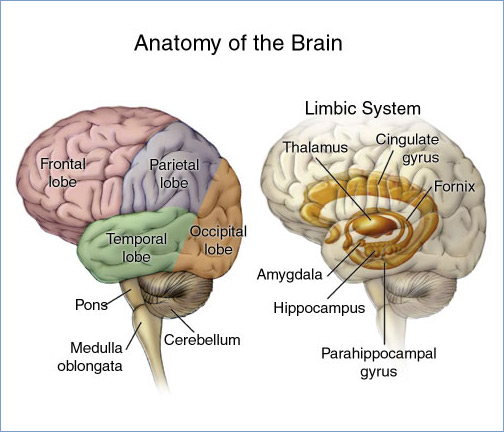
The acoustic startle reflex is thought to be caused by an auditory stimulus greater than 80 decibels. There are many brain structures and pathways thought to be involved in the reflex. The amygdala, hippocampus, bed nucleus of the stria terminalis (BNST) and anterior cingulate cortex are all thought to play a role in modulating the reflex. The anterior cingulate cortex in the brain is largely thought to be the main area associated with emotional response and awareness, which can contribute to the way an individual reacts to startle-inducing stimuli. Along with the anterior cingulate cortex, the amygdala and the hippocampus are known to have implications in this reflex.
The amygdala is known to have a role in the "fight-or-flight response", and the hippocampus functions to form memories of the stimulus and the emotions associated with it. The role of the BNST in the acoustic startle reflex may be attributed to specific areas within the nucleus responsible for stress and anxiety responses. The basic pathway follows the auditory pathway from the ear up to the nucleus of the lateral lemniscus (LLN) from where it activates a motor centre in the reticular formation. This centre sends descending projections to lower motor neurones of the limbs.
In slightly more detail this corresponds to ear (cochlea) → cranial nerve VIII (auditory) → cochlear nucleus (ventral/inferior) → LLN → caudal pontine reticular nucleus (PnC). The whole process has a less than 10ms latency. There is no involvement of the superior/rostral or inferior/caudal colliculus in the reaction that "twitches" the hindlimbs, but these may be important for adjustment of pinnae and gaze towards the direction of the sound, or for the associated blink.
Application in occupational settings
A study undertaken in 2005 by researchers at the Department of Aviation and Logistics, University of Southern Queensland, looked at the performance of aircraft pilots following unexpected critical events. Analysing a number of recent aircraft accidents, the authors identified the negative impact of the startle response as causal or contributory in these accidents. The authors argued that fear resulting from threat, especially if life-threatening, prompted startle effects which had a serious negative impact on pilots' performances. The study considered training strategies to address this, including exposing pilots to unexpected critical events more often, enabling them to improve their responses.
References
References
- Rammirez-Moreno, David. "A computational model for the modulation of the prepulse inhibition of the acoustic startle reflex". ''Biological Cybernetics'', 2012, p. 169
- (1990). "Emotion, attention, and the startle reflex.". Psychological Review.
- (1991b). "The effect of posture on the normal and pathological auditory startle reflex". J Neurol Neurosurg Psychiatry.
- (1999). "Patterned ballistic movements triggered by a startle in healthy humans". J Physiol.
- (December 2024). "Modulation of the startle response during human gait". J Neurophysiol.
- Davis, M. (2007). "Neural systems involved in fear and anxiety based on the fear-potentiated startle test." ''Neurobiology of Learning and Memory'' (pp. 381–425). Elsevier Incorporated.
- Fletcher, Mary Ann. (1998). "Physical Diagnosis in Neonatology". Lippincott Williams & Wilkins.
- Davis, M. (1984). "The mammalian startle response". In R. Eaton (Ed.), ''Neural stop of Startle Behavior'' (pp. 287–351). Plenum Publishing Corporation.
- The reflex is typically measured by [[electromyography]], [[MRI. brain imaging]] or sometimes [[PET scan. positron emission tomography]].Pissiota, Anna. "Amygdala and Anterior Cingulate Cortex Activation During Affective Startle Modulation:a PET Study of Fear". ''[[The European Journal of Neuroscience]]'', 2003, p. 1325
- Phillips, R.G. "Differential Contribution of Amygdala and Hippocampus to Cued and Contextual Fear Conditioning". ''[[Behavioral Neuroscience]]'', 1992, p. 274
- Medford, Nick. "Conjoint Activity of Anterior Insular and Anterior Cingulate Cortex:Awareness and Response". ''Brain Structure and Function'', 2010, p. 535
- Lee, Younglim. "Role of the Hippocampus, the Bed Nucleus of the Stria Terminalis, and the Amygdala in the Excitatory Effect of Corticotropin-Releasing Hormone on the Acoustic Startle Reflex". ''[[The Journal of Neuroscience]]'', 1997, p. 6434
- Grouen, Wouter. "Amygdala and Hippocampus Enlargement During Adolescence in Autism". ''[[Journal of the American Academy of Child & Adolescent Psychiatry]]'', 2010, p. 552
- (Jun 1982). "A primary acoustic startle circuit: lesion and stimulation studies". [[Journal of Neuroscience]].
- (Feb 2007). "A startle speeds up the execution of externally guided saccades". Experimental Brain Research. Experimentelle Hirnforschung. Experimentation Cerebrale.
- (2013). "Startle Effect Management (Report Number NLR-CR-2018-242)". European Aviation Safety Agency.
- (2015). "Fear-Potentiated Startle: A Review from an Aviation Perspective". [[The International Journal of Aviation Psychology]].
This article was imported from Wikipedia and is available under the Creative Commons Attribution-ShareAlike 4.0 License. Content has been adapted to SurfDoc format. Original contributors can be found on the article history page.
Ask Mako anything about Startle response — get instant answers, deeper analysis, and related topics.
Research with MakoFree with your Surf account
Create a free account to save articles, ask Mako questions, and organize your research.
Sign up freeThis content may have been generated or modified by AI. CloudSurf Software LLC is not responsible for the accuracy, completeness, or reliability of AI-generated content. Always verify important information from primary sources.
Report