From Surf Wiki (app.surf) — the open knowledge base
Star 48
American solid rocket motor developed by Thiokol
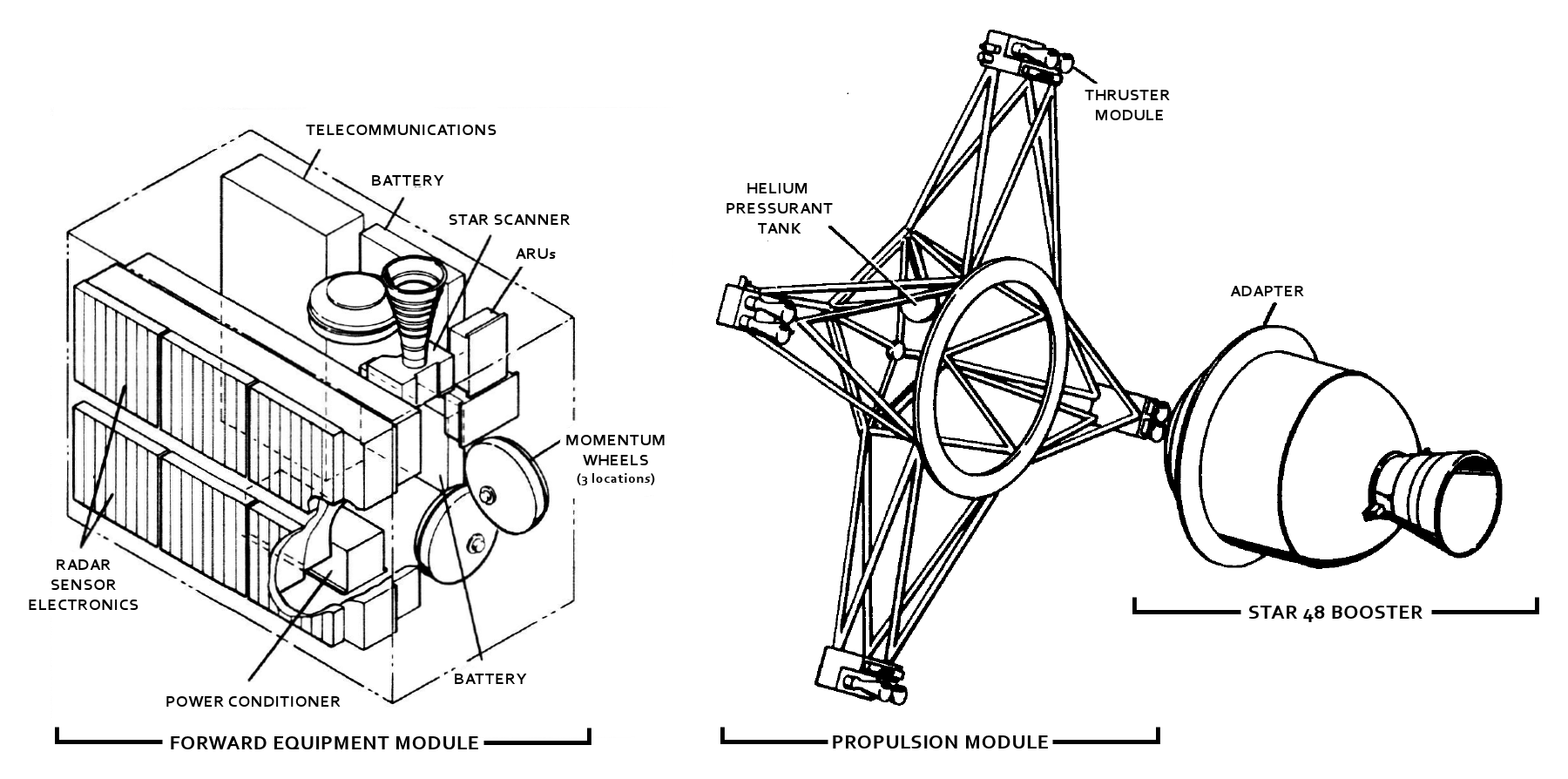
American solid rocket motor developed by Thiokol
| Field | Value |
|---|---|
| country_of_origin | United States |
| image | PAM-D rocket stage.jpg |
| image_size | 200 |
| caption | Star-48B rocket motor |
| name | Star 48 |
| date | 1982–present |
| manufacturer | Thiokol |
| predecessor | Star 37 |
| type | solid |
The Star 48 is the largest of a family of solid rocket motors used by many space propulsion and launch vehicle stages, almost exclusively as an upper stage. It was developed primarily by Thiokol Propulsion and after several mergers, is manufactured by Northrop Grumman’s Space Systems division. A Star 48B stage is also one of the few man-made items sent on escape trajectories out of the Solar System, although it is derelict since its use. The Star 48B variant was the PAM-D upper stage used on the retired Delta II rocket.
The Star 48 has been used as an upper stage in three- and four-stage launch systems.
Overview
The "48" designation refers to the approximate diameter of the fuel casing in inches (122 cm); Thiokol had also manufactured other motors such as the Star 37 and Star 30. Internally, Thiokol's designation was TE-M-711 for early versions and TE-M-799 for later ones. Subtypes are given one or more letter suffixes after the diameter number, or a trailing number (i.e., "-2") after the internal designation. The "T" prefix stands for Thiokol, and the following letter refers to the company division that developed the rocket motor. In this case, "E" refers to the Elkton, MD division, and the "M" stands for the motor.
The Star 48 holds 2,000 kg of propellant. The most common use of the Star 48 was as the final stage of the Delta II launch vehicles. Other launchers such as ULA's Atlas 551 have also incorporated the motor but with lower frequency. On board the Space Shuttle, the complete stage (motor plus accessories) was referred to as the Payload Assist Module (PAM), as the Shuttle could only take satellites to low Earth orbit. Because geostationary orbit is much more lucrative, the additional stage was needed for the final leg of the journey. On such missions, the stage was spin-stabilized. A turntable, mounted in the shuttle payload bay or atop the previous Delta stage, spun the PAM and payload to approximately 60 rpm prior to release.
Usually after motor burnout and just prior to satellite release the PAM is de-spun using a yo-yo de-spin technique.
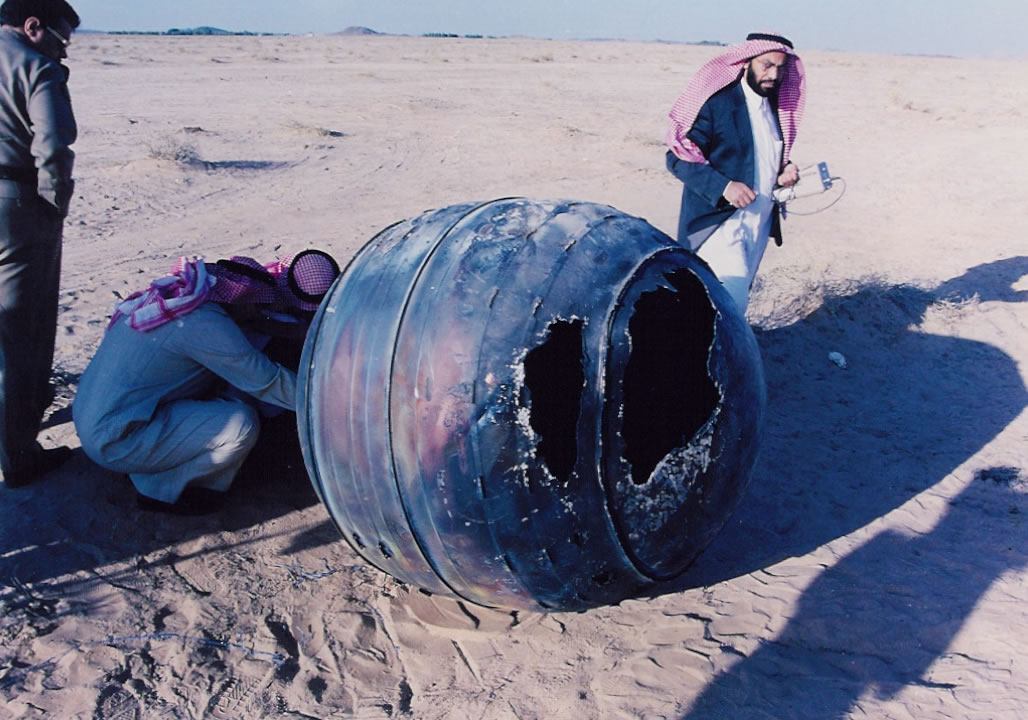
A Star 48 Payload Assist Module that had been used to launch a USA-91 GPS satellite in 1993 crashed in the Saudi Arabian desert in January 2001, after its orbit decayed. The unit did not burn up on reentry and was positively identified on the ground.
A Star 48B motor used in the 3rd stage of the New Horizons probe was the first part of the New Horizons mission to reach Jupiter, arriving before the probe. It also crossed Pluto's orbit in 2015 at a distance of 200 million kilometers.
In 2013 a Star 48GXV ("G" for "graphite case") was tested for the Solar Probe Plus mission (which later was renamed to the Parker Solar Probe) but the development was cancelled, in favor of a Delta IV Heavy / Star 48BV combination. for the launch in 2018.
A non-spinning, thrust-vectoring version called Star 48BV is available, and is the final stage of the Minotaur IV+ launch vehicle.
Star 48B
The Star 48B version has an extra 11 kilograms of propellant more than the regular Star 48, for a total of 2011 kg. There is a version of the Star 48B that is lengthened and also heavier, called the Star 48B L.
In operation as a third stage, the Star 48B sits on top of the spin table, and before it is separated, it is spun up to stabilize it during the separation from the previous stage. (see also spin-stabilisation) The Star 48B can produce 15,000 pounds of thrust ( newtons), with a burn time of 1 minute 27 seconds.
Star 48B was used on the Atlas-E/F SGS-2, and is the basis for the McDonnell Douglas PAM-D upper stage used on the Delta rocket.
Use on ''New Horizons''
A Star 48B was used on the third stage of the New Horizons spacecraft launch. New Horizons was launched by ULA's Atlas V 551 in January 2006, and the Star 48B booster was launched along with the New Horizonss spacecraft on an escape trajectory out of the Solar System. The Star 48B ignited and burned for 48 seconds, taking both on a trajectory past Pluto; however, because the Star 48B became derelict and did not have course corrections like the NH spacecraft, it was projected to miss Pluto by hundreds of millions of miles.
New Horizons Star 48B was calculated to arrive at Jupiter six hours before New Horizons, and on October 15, 2015, passed through Pluto's orbit at a distance of 213 million kilometers (over 1 au) distant from Pluto. This was nearly four months after the New Horizons probe did.
''Europa Clipper''
NASA intended to launch the Europa Clipper using a Star 48 on a SpaceX Falcon Heavy. The addition of a Star 48 "kick stage" would have allowed the Clipper mission to reach Europa without needing a gravity assist from Venus. This was later removed with an updated Mars gravity assist route.
Star 48 version details
| Name | Thiokol# | Mass (kg) | Prop. mass fract. | Imp. | Burn (s) | Total | Empty | Spec., I (s) | Tot. (kNs) |
|---|---|---|---|---|---|---|---|---|---|
| Star 48 | TE-M-711-3 | 2114.0 | 114.2 | 0.946 | 286.6 | 5647.51 | |||
| Star 48 | TE-M-711-8 | 2116.3 | 116.4 | 0.945 | 292.9 | 5766.23 | |||
| Star 48A S | TE-M-799-1 | 2574.1 | 144.2 | 0.944 | 283.4 | 6798.70 | 87 | ||
| Star 48A L | TE-M-799 | 2582.3 | 152.4 | 0.941 | 289.9 | 6955.98 | 87 | ||
| Star 48B S | TE-M-711-17 | 2133.7 | 123.8 | 0.942 | 286.0 | 5674.77 | 84 | ||
| Star 48B L | TE-M-711-1 | 2140.5 | 130.6 | 0.939 | 292.1 | 5799.17 | 84 | ||
| Star 48BV | TE-M-940-1 |
References
References
- (April 2001). "PAM-D Debris Falls in Saudi Arabia". NASA [[Johnson Space Center]].
- "ATK and NASA Successfully Demonstrate New Rocket Motor for Solar Probe Plus Mission".
- "Orbital ATK to Augment ULA Rocket for Launch of NASA Solar Probe". ExecutiveBiz.
- Clark, Stephen. (March 18, 2015). "Delta 4-Heavy selected for the launch of solar probe". Spaceflight Now.
- "ULA's heavy-lifter rolled out for solar probe launch – Spaceflight Now".
- "Star 48B".
- "Star 48B l".
- Michael J. Muolo. (1993). "Space Handbook: A War Fighter's Guide to Space, V. 1". Government Printing Office.
- "PAM-D Payload Assist Module Archives - This Day in Aviation".
- "Atlas-E/-F SGS-2 (Atlas-E/-F SVS-2)".
- "Press kit: NASA's First Mission to Pluto and the Kuiper Belt".
- (October 28, 2010). "Where Is the New Horizons Centaur Stage?". Johns Hopkins University Applied Physics Laboratory.
- "New Horizons trajectory: Star 48b Third-stage Motor".
- (26 January 2006). "Derelict Booster to Beat Pluto Probe to Jupiter".
- (23 July 2021). "SpaceX to launch the Europa Clipper mission for a bargain price".
- "EUROPA CLIPPER INCHES FORWARD, SHACKLED TO THE EARTH".
- "Star-48".
This article was imported from Wikipedia and is available under the Creative Commons Attribution-ShareAlike 4.0 License. Content has been adapted to SurfDoc format. Original contributors can be found on the article history page.
Ask Mako anything about Star 48 — get instant answers, deeper analysis, and related topics.
Research with MakoFree with your Surf account
Create a free account to save articles, ask Mako questions, and organize your research.
Sign up freeThis content may have been generated or modified by AI. CloudSurf Software LLC is not responsible for the accuracy, completeness, or reliability of AI-generated content. Always verify important information from primary sources.
Report