From Surf Wiki (app.surf) — the open knowledge base
Stanway House
Grade I listed historic house museum in the United Kingdom

Grade I listed historic house museum in the United Kingdom
| Field | Value | ||||||||||||
|---|---|---|---|---|---|---|---|---|---|---|---|---|---|
| name | Stanway House | ||||||||||||
| image | StanwayHouse(PhilipHalling)Jun2006.jpg | ||||||||||||
| image_alt | |||||||||||||
| image_caption | Stanway House front, 2006 | ||||||||||||
| location_city | Stanway, Gloucestershire | ||||||||||||
| location_country | England | ||||||||||||
| coordinates | |||||||||||||
| opened_date | late 16th and early 17th century | ||||||||||||
| demolition_date | |||||||||||||
| rooms | |||||||||||||
| website | |||||||||||||
| owner | James Charteris, 13th Earl of Wemyss | ||||||||||||
| {{Infobox designation list | embed | yes | designation1=Grade I | designation2=Register of Historic Parks and Gardens | designation3= | designation4= | designation5= | designation1_offname=Stanway House | designation1_date=4 July 1960 | designation1_number=1154381 | designation2_offname=Stanway House | designation2_date=28 February 1986 | designation2_number=1000480}} |
Stanway House is a Jacobean manor house near the village of Stanway in Gloucestershire, England. The manor of Stanway was owned by Tewkesbury Abbey for 800 years, then for 500 years by the Tracy family and their descendants, the Earls of Wemyss and March.
Stanway House, originally constructed in the late 16th and early 17th century for the Tracy family, is a Grade I listed building. The principal rooms are in a long south-facing range forming an L-shape with the hall, unlike the usual Tudor house plan of a central hall. The north-east wing, remodelled in 1913 by Detmar Blow, was demolished in 1948. The kitchen court was designed by William Burn in 1859. The gatehouse was built in about 1630. The construction includes Guiting yellow stone and some Jacobean mullions and gables.
The current owner James Charteris, then Lord Neidpath, now the 13th Earl of Wemyss and March, has pursued a programme of restoration for a number of years. The house and grounds are open to the public on a limited basis each summer.
History
The current earl recounted his understanding of the history of the property during a 2016 interview with the publication Cotswold Homes, as follows:
The estate goes back to 715, we think. It was given to Tewkesbury Abbey by Odo and Dodo, two Saxons who lived in the Winchcombe area. Then in 1533 it was leased to Richard Tracy. Richard had a bee in his bonnet about the fact his father was declared to be a heretic after he was already dead, his body being dug up and burnt. So he became friendly with Thomas Cromwell, who was leading an anti-monastic campaign at the time. Cromwell – who was so powerful at that point - suggested the abbey lease the land to Richard and it was done within four days of Cromwell writing the letter.
Records from 1291 indicate that the estate had three corn mills and a fulling mill used for processing wool from the many sheep owned by the abbey. The latter was converted in the late 17th century to grind corn and is now the Stanway Watermill. Another source states that the work on the house began around 1580 on the ruins of an earlier Tudor house, with construction commissioned by Paul Tracy, Richard Tracy's son. The triple-gabled Jacobean gateway was created by Paul's son, Sir Richard Tracy, in 1630. The water features were probably added by John Tracy who was the lord during 1724–35.
J. M. Barrie, creator of Peter Pan, was a frequent visitor during summers in the 1920s, until 1932. The house is the home of James Charteris, 13th Earl of Wemyss and his late wife, drug policy reformer Amanda Feilding. It is also the family home of Fielding's son, Kensington and Chelsea London Borough Council’s deputy leader Rock Feilding-Mellen, who was involved in the Grenfell Tower fire disaster. During some summer months, the property is open to the public.
Estate
Gardens
The gardens are Grade I listed on the Register of Historic Parks and Gardens. The estate brewery, an original Elizabethan feature, has been re-established.
Wider estate
Cutsdean Quarry, which is a nature reserve and designated a Key Wildlife Site (KWS) in the Cotswolds, is part of the Stanway Estate. The estate watermill, just outside the grounds, has been restored to full working condition and produces wholemeal and sifted flour.
Grade I listed buildings
In addition to the house, the gatehouse, the entrance courtyard gates, and the tithe barn all have Grade I listings. The ancient tithe barn was built in about 1370 for Tewkesbury Abbey and restored in 1927.
Stanway fountain
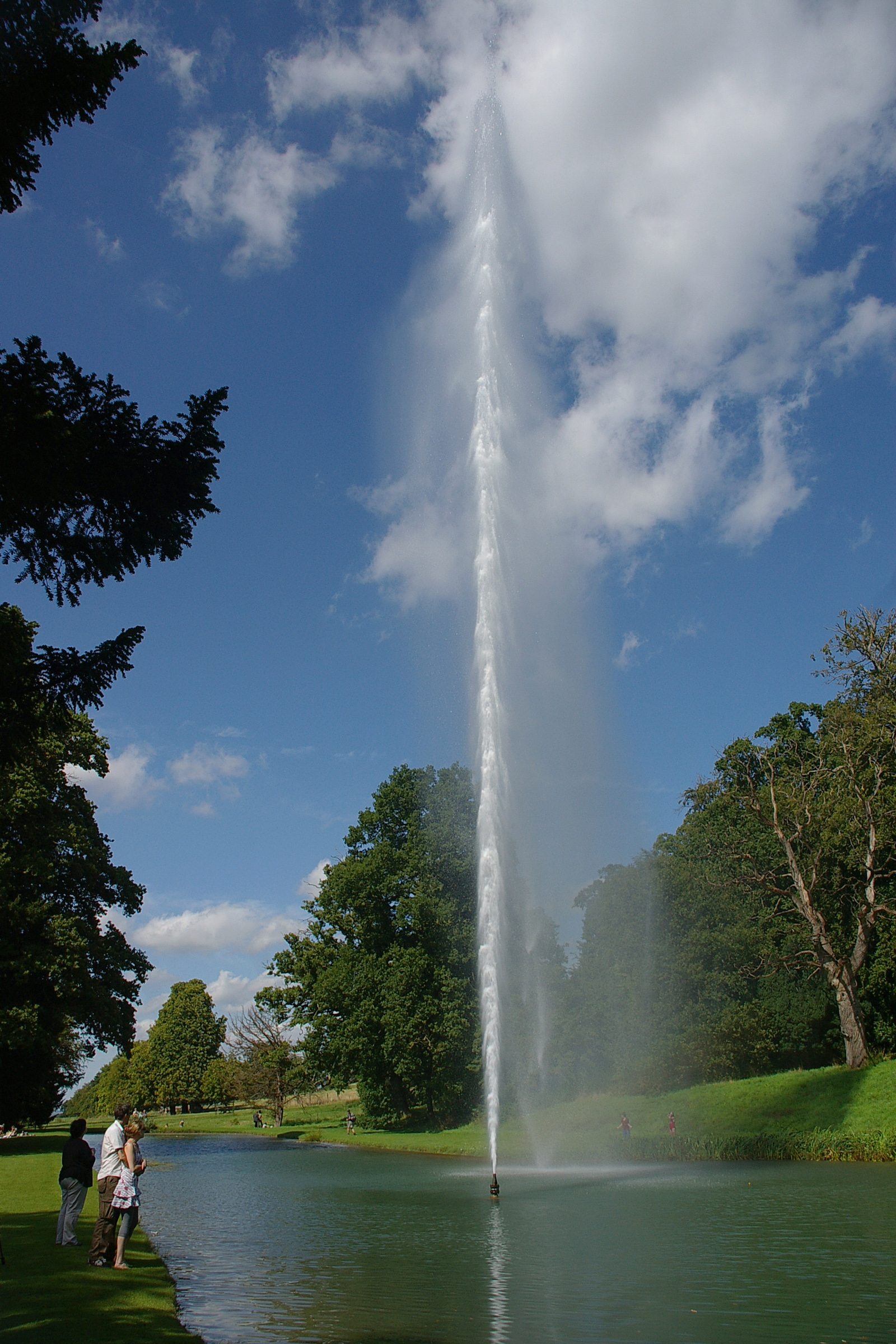
The Long Canal was filled in around 1850 but was restored in the early 2000s, a necessary step to creating the current fountain, which was not an original feature of the estate. The mill pond was dredged and the eight ponds and the cascade were restored at about the same time.
The Stanway Fountain was opened on 5 June 2004 in the grounds of Stanway House. The single-jet fountain, which rises to over 300 ft, is the tallest fountain in Britain (followed by Witley Court at 121 ft), the tallest gravity-fed fountain in the world (followed by the Fountain of Fame at La Granja de San Ildefonso, Segovia, Spain at 153 ft), and the second-tallest fountain in Europe, after the Jet d'Eau, a 400 ft high turbine-driven fountain in Geneva, Switzerland. The fountain has a 2 in bronze nozzle and is driven from a 100000 impgal reservoir, above the canal in which it is situated. The reservoir is 530 ft above the canal. The 12 in diameter pipe which feeds the fountain is 2 km long.
Media appearances
The house has featured as a filming set for TV and movies including: Jeeves and Wooster; Vanity Fair; The Christmas Candle; Father Brown; Emma and The Libertine; and Wolf Hall;;The Good Soldier (1981), and 'The Clandestine Marriage'.
References
Notes
Other sources
- Gloucestershire: the Cotswolds, David Verey, Pevsner Architectural Guides: The Buildings of England, Penguin, 1970, , pp. 415–417.
References
- "Stanway House & Fountain near Broadway Cotswolds | Visit Broadway".
- {{NHLE
- Dicks, Matt. (27 January 2016). "Stanway House - At home with Lord Wemyss". Cotswold Homes.
- "Plan your visit".
- Bingham, Jane. (18 February 2010). "The Cotswolds: A Cultural History".
- (19 June 2017). "Londoner's Diary: K&C's Rock Feilding-Mellen avoids family estate bash". [[London Evening Standard]].
- {{NHLE
- "Stanway Brewery". Stanway Brewery.
- "Cotswold District Local Plan, Appendix 2, Key Wildlife Sites". Localplan.cotswold.gov.uk.
- {{NHLE
- {{NHLE
- {{NHLE
- (2018). "Secret Houses of the Cotswolds". Frances Lincoln.
- Express, Britain. "Stanway Watermill, History & Photos | Historic Gloucestershire Guide".
- "Stanway House, The Cotswolds - Cotswold Journeys".
- Pauling, Keith. (31 December 2011). "Discovering The Cotswold Way". Lulu.com.
- "Stanway House & Fountain".
- Express, Britain. "Stanway Water Garden, Gloucestershire Travel Information".
- (2004-06-05). ""The Fountain" at". Stanwayfountain.co.uk.
- (6 November 2013). "Film Locations in the Cotswolds". Character Cottages.
- (January 2013). "Vanity Fair". Architectural Digest.
- "The Cotswolds on Film - Movies".
- "The Christmas Candle (2013)". IMDb.com.
- ""Father Brown" The Labyrinth of the Minotaur (TV Episode 2017) - IMDb".
- Meredith, Joe. "19 famous filming locations in the Cotswolds".
- "BBC Two - Wolf Hall - Wolf Hall: the locations".
This article was imported from Wikipedia and is available under the Creative Commons Attribution-ShareAlike 4.0 License. Content has been adapted to SurfDoc format. Original contributors can be found on the article history page.
Ask Mako anything about Stanway House — get instant answers, deeper analysis, and related topics.
Research with MakoFree with your Surf account
Create a free account to save articles, ask Mako questions, and organize your research.
Sign up freeThis content may have been generated or modified by AI. CloudSurf Software LLC is not responsible for the accuracy, completeness, or reliability of AI-generated content. Always verify important information from primary sources.
Report