From Surf Wiki (app.surf) — the open knowledge base
Stanleycaris
Extinct genus of basal hurdiid radiodonts

Extinct genus of basal hurdiid radiodonts
Pates, Daley & Ortega-Hernández, 2018
- S. qingjiangensis Wu et al., 2024 Stanleycaris ("Stanley's shrimp") is an extinct genus of hurdiid radiodont from the Cambrian (Stage 3 to Miaolingian). The type species is Stanleycaris hirpex. Stanleycaris was described from the Stephen Formation near the Stanley Glacier and Burgess Shale locality of Canada, as well as Wheeler Formation of United States. A second species, S. qingjiangensis is known from the Qingjiang biota of China. The genus was characterized by the rake-like frontal appendages with robust inner spines.
History of discovery
Stanleycaris was originally described only from frontal appendages and an oral cone. Its generic name means "Crab of Stanley Glacier"; hirpex, L. "large rake", reflects the rake-like nature of its spiny frontal appendages. However, in 2022, 268 specimens of Stanleycaris, many of which were complete, were studied, making Stanleycaris a well documented radiodont. Stanleycaris had three eyes, a bizarre configuration previously unknown among other radiodont genera; yet this head anatomy supports early differentiation among arthropod head and trunk segmentation.
The original description of the taxon appeared in an online supplement to the article published by Jean-Bernard Caron, Robert R. Gaines, M. Gabriela Mángano, Michael Streng and Allison C. Daley in 2010. the name was eventually validated by Pates, Daley & Ortega-Hernández (2018).
The specimen KUMIP 153923 from the Cambrian Wheeler Formation (Utah, United States), which was described by Robison (1985) as a whole body of new lobopodian species Aysheaia prolata, was reinterpreted as an isolated frontal appendage of Stanleycaris sp. by Pates, Daley & Ortega-Hernández (2017). They reported segmental boundaries between the structures previously thought to be 'lobopods' and curved terminal spines that resemble the frontal appendages of radiodonts, and thus they considered A. prolata as a nomen dubium and synonymised it with Stanleycaris on the basis of their interpretation.
Description
File:Stanleycaris diagram.png|Diagrammatic reconstruction File:20210518 Radiodonta frontal appendage Stanleycaris hirpex.png|alt=|Diagram of frontal appendage of S. hirpex File:20240914 Radiodonta frontal appendage Stanleycaris qingjiangensis.png|Reconstruction of frontal appendage of S. qinjiangensis File:Stanleycaris Turntable2 2.ogg|3D reconstruction of frontal appendages of S. hirpex File:20210520 Stanleycaris hirpex oral cone.png|alt=|Oral cone File:20210220 Stanleycaris size.png|alt=|Size estimation Stanleycaris was a small radiodont, with whole body specimen measured around 10 - long, excluding the tail. Even based on the largest isolated frontal appendage, the upper body length was thought to be less than 20 cm long. Unlike most hurdiids with large head and broad neck region, the body of Stanleycaris was streamlined like those of anomalocaridids and amplectobeluids.
Head
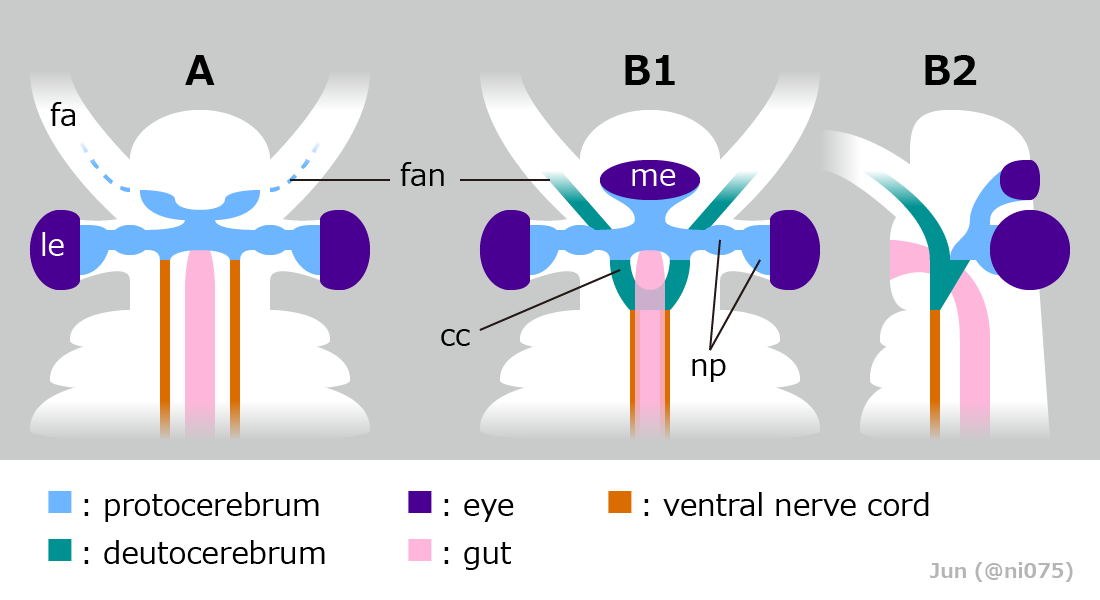
The small head occupies about 15% of the total body length. Each lateral compound eye was estimated to have around 1000 ommatidia. In addition of a pair of stalked lateral eyes, a third, large median eye was located behind its preocular sclerite (H-element). Similar structures were evident in the fossils of Peytoia and Lyrarapax, suggesting these genera possibly had a median eye too. Contrary to the agreement around mid and late 2010s (based on the discovery of Lyrarapax since 2014) suggest radiodonts had only protocerebrum on their cerebral ganglion, The neuroanatomical evidence of Stanleycaris suggests radiodonts have both protocerebrum and deutocerebrum, and circumesophageal connective that surround digestive system between them. Unlike other radiodonts, the paired lateral sclerites (P-element) are not evident in any Stanleycaris specimens, suggesting they were exclusively absent in this genus.
Frontal appendage
The frontal appendages, which are the most commonly found component of this taxon, range in length between 3.5 -. It comprises 14 segments (podomeres) with 5 long, rake-like curved blades (endites) protruding from the ventral surface of podomere 3–7, while podomere 2 and 9 have short endites. The upper surface bore a row of inner-facing, mostly forked robust spines (gnathites) which are unique to this genus. Similar to Peytoia, the distal podomeres have claw-like dorsal and terminal spines.
Oral cone
The mouth was surrounded by a tetraradial oral cone, which comprises 28 tooth plates instead of 32 like those of other hurdiid genera. Each of the 4 large plate have 2 additional nodes, and the mouth opening has no additional inner plates.
Trunk region
The trunk region have 17 segments with paired lateroventral flaps, as well as 4 caudal filiform blades on the tail. The setal blades (band of gill lamellae) were suggested to be positioned ventrally on each of the trunk segment, contrary to the general reconstruction of radiodont with dorsal setal blades.
Paleoecology

Stanleycaris was most likely a visual predator that specialized primarily on macroscopic, soft-bodied benthic prey. Based on its streamlined body shape and broad trunk flaps, it may have been able to chase relatively fast-moving prey. With strong differentiation of lateral–medial, inner–outer, and proximal–distal morphologies, Stanleycaris was probably able to manipulate prey with distal raptorial portion, trap and masticate prey items using endites and gnathites.
Classification
Stanleycaris was analysed to be one of the basalmost hurdiid radiodont, alongside Peytoia and Schinderhannes which shares some anatomical similarities. This suggests that the anomalocaridid/amplectobeluid-like traits (e.g. streamlined body; small head sclerites; frontal appendages with curved dorsal spines) found in these hurdiids represent radiodont ancestral characters.
The following cladogram by Moysiuk & Caron (2022) demonstrates the phylogenetic position of Stanleycaris:
References
References
- (21 August 2024). "Exceptionally preserved radiodont arthropods from the lower Cambrian (Stage 3) Qingjiang Lagerstätte of Hubei, South China and the biogeographic and diversification patterns of radiodonts". Papers in Palaeontology.
- (2010). "A new Burgess Shale-type assemblage from the "thin" Stephen Formation of the southern Canadian Rockies". Geology.
- (2022-07-08). "A three-eyed radiodont with fossilized neuroanatomy informs the origin of the arthropod head and segmentation". Current Biology.
- (2018). "Comment on "''Aysheaia prolata'' from the Utah Wheeler Formation (Drumian, Cambrian) is a frontal appendage of the radiodontan ''Stanleycaris''" by Stephen Pates, Allison C. Daley, and Javier Ortega-Hernández". Acta Palaeontologica Polonica.
- (2018). "Reply to Comment on "''Aysheaia prolata'' from the Utah Wheeler Formation (Drumian, Cambrian) is a frontal appendage of the radiodontan ''Stanleycaris''" with the formal description of ''Stanleycaris''". Acta Palaeontologica Polonica.
- (2017). "''Aysheaia prolata'' from the Utah Wheeler Formation (Drumian, Cambrian) is a frontal appendage of the radiodontan ''Stanleycaris''". Acta Palaeontologica Polonica.
- (2014). "Brain structure resolves the segmental affinity of anomalocaridid appendages". Nature.
- (2021). "Exceptional multifunctionality in the feeding apparatus of a mid-Cambrian radiodont". Paleobiology.
- (2015). "Anomalocaridid trunk limb homology revealed by a giant filter-feeder with paired flaps". Nature.
- (2019-08-14). "A new hurdiid radiodont from the Burgess Shale evinces the exploitation of Cambrian infaunal food sources". Proceedings of the Royal Society B: Biological Sciences.
- (2021). "A giant nektobenthic radiodont from the Burgess Shale and the significance of hurdiid carapace diversity". Royal Society Open Science.
This article was imported from Wikipedia and is available under the Creative Commons Attribution-ShareAlike 4.0 License. Content has been adapted to SurfDoc format. Original contributors can be found on the article history page.
Ask Mako anything about Stanleycaris — get instant answers, deeper analysis, and related topics.
Research with MakoFree with your Surf account
Create a free account to save articles, ask Mako questions, and organize your research.
Sign up freeThis content may have been generated or modified by AI. CloudSurf Software LLC is not responsible for the accuracy, completeness, or reliability of AI-generated content. Always verify important information from primary sources.
Report