From Surf Wiki (app.surf) — the open knowledge base
Standing rigging
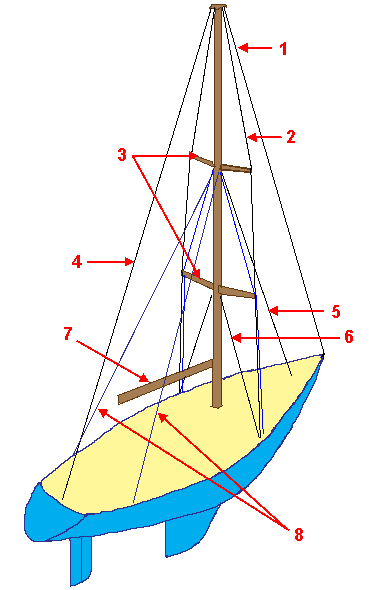
Rigging that supports masts
Rigging that supports masts
Key:
- Forestay
- Shroud
- (Spreaders)
- Backstay
- Inner forestay
- Sidestay
- (Boom)
- Running backstays]]
Standing rigging comprises the fixed lines, wires, or rods, which support each mast or bowsprit on a sailing vessel and reinforce those spars against wind loads transferred from the sails. This term is used in contrast to running rigging, which represents the moveable elements of rigging which adjust the position and shape of the sails.
Historical development
Early sailing vessels used rope of hemp or other fibers,
Materials
On modern yachts, standing rigging is often stainless steel wire, Nitronic-50 stainless steel rod or synthetic fiber. Semi-rigid stainless steel wire is by far the most common as it combines extreme strength, relative ease of assembling and rigging with reliability. Unlike rigid stainless steel rod, it is comparatively easy to recognize wear and stress as individual strands (normally 19) break often near a swage fitting, and can be inspected while standing. | url-access = registration
Fore-and-aft rigged vessels
Most fore-and-aft rigged vessels have the following types of standing rigging: a forestay, a backstay, and upper and lower shrouds (side stays). Less common rigging configurations are diamond stays and jumpers. Both of these are used to keep a thin mast in column especially under the load of a large down wind sail or in strong wind. Rigging parts include swageless terminals, swage terminals, shackle toggle terminals and fail-safe wire rigging insulators.
Square-rigged vessels

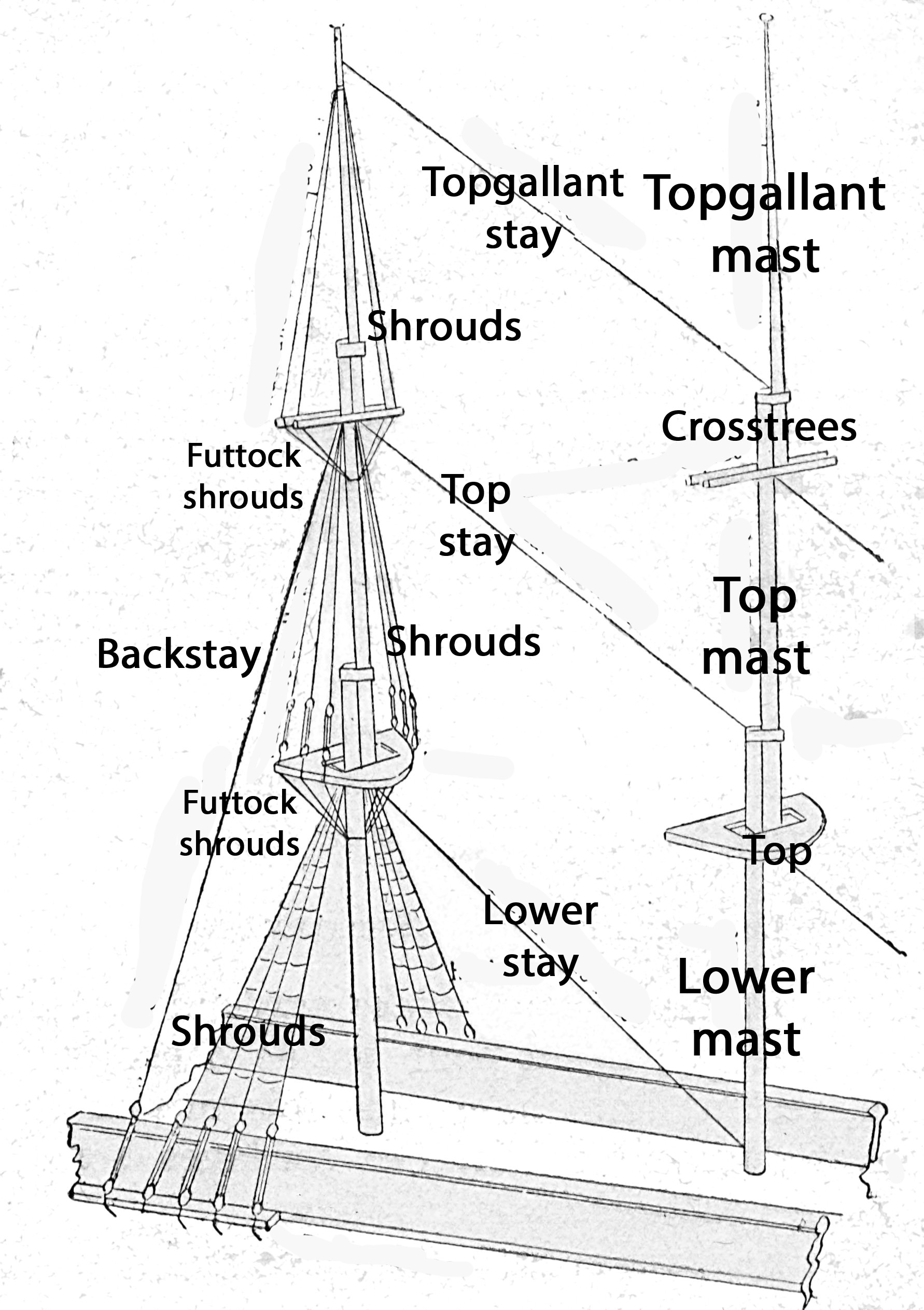
Whereas 20th-century square-rigged vessels were constructed of steel with steel standing rigging, prior vessels used wood masts with hemp-fiber standing rigging. As rigs became taller by the end of the 19th century, masts relied more heavily on successive spars, stepped one atop the other to form the whole, from bottom to top: the lower mast, top mast, and topgallant mast. This construction relied heavily on support by a complex array of stays and shrouds. Each stay in either the fore-and-aft or athwartships direction had a corresponding one in the opposite direction providing counter-tension. Fore-and-aft the system of tensioning started with the stays that were anchored in front each mast. Shrouds were tensioned by pairs of deadeyes, circular blocks that had the large-diameter line run around them, whilst multiple holes allowed smaller line—lanyard—to pass multiple times between the two and thereby allow tensioning of the shroud.
Lateral support
In addition to overlapping the mast below, the top mast and topgallant mast were supported laterally by shrouds that connected to either a platform, called a "top", or cross-wise beams, called "crosstrees", and anchored futtock shrouds from below that led to the lower mast.
Fore-and-aft support
Each additional mast segment was supported fore and aft by a series of stays that led forward. These lines were countered in tension by backstays, which were secured along the sides of the vessel behind the shrouds.
References
References
- Keegan, John. (1989). "The Price of Admiralty". Viking.
- "Care and Maintenance".
This article was imported from Wikipedia and is available under the Creative Commons Attribution-ShareAlike 4.0 License. Content has been adapted to SurfDoc format. Original contributors can be found on the article history page.
Ask Mako anything about Standing rigging — get instant answers, deeper analysis, and related topics.
Research with MakoFree with your Surf account
Create a free account to save articles, ask Mako questions, and organize your research.
Sign up freeThis content may have been generated or modified by AI. CloudSurf Software LLC is not responsible for the accuracy, completeness, or reliability of AI-generated content. Always verify important information from primary sources.
Report