From Surf Wiki (app.surf) — the open knowledge base
Standard illuminant
Theoretical source of visible light

Theoretical source of visible light
A standard illuminant is a theoretical source of visible light with a spectral power distribution that is published. Standard illuminants provide a basis for comparing images or colors recorded under different lighting.
CIE illuminants
The International Commission on Illumination (usually abbreviated CIE for its French name) is the body responsible for publishing all of the well-known standard illuminants. Each of these is known by a letter or by a letter-number combination.
Illuminants A, B, and C were introduced in 1931, with the intention of respectively representing average incandescent light, direct sunlight, and average daylight. Illuminants D (1967) represent variations of daylight, illuminant E is the equal-energy illuminant, while illuminants F (2004) represent fluorescent lamps of various composition.
There are instructions on how to experimentally produce light sources ("standard sources") corresponding to the older illuminants. For the relatively newer ones (such as series D), experimenters are left to measure to profiles of their sources and compare them to the published spectra:
Nevertheless, they do provide a measure, called the metamerism index, to assess the quality of daylight simulators. The Metamerism Index tests how well five sets of metameric samples match under the test and reference illuminant. In a manner similar to the color rendering index, the average difference between the metamers is calculated.
Illuminant A
The CIE defines illuminant A in these terms:
The spectral radiant exitance of a black body follows Planck's law: M_{e,\lambda}(\lambda, T) = \frac{c_1 \lambda^{-5}}{\exp\left(\frac{c_2}{\lambda T}\right) - 1}.
At the time of standardizing illuminant A, both c_1 = 2\pi \cdot h \cdot c^2 (which does not affect the relative SPD) and c_2 = h \cdot c/k were different. In 1968, the estimate of c2 was revised from 0.01438 m·K to 0.014388 m·K (and before that, it was 0.01435 m·K when illuminant A was standardized). This difference shifted the Planckian locus, changing the color temperature of the illuminant from its nominal 2848 K to 2856 K: T_\text{new} = T_\text{old} \times \frac{1.4388}{1.435} = 2848\ \text{K} \times 1.002648 = 2855.54\ \text{K}.
In order to avoid further possible changes in the color temperature, the CIE now specifies the SPD directly, based on the original (1931) value of c2: S_\text{A}(\lambda) = 100\left(\frac{560}{\lambda}\right)^5 \frac{\exp \frac{1.435 \times 10^7}{2848 \times 560} - 1}{\exp\frac{1.435 \times 10^7}{2848 \lambda} - 1}.
The coefficients have been selected to achieve a normalized SPD of 100 at 560 nm. The tristimulus values are , and the chromaticity coordinates using the standard observer are .
Illuminants B and C
Illuminant BIlluminant C Illuminants B and C are easily achieved daylight simulations. They modify illuminant A by using liquid filters. B served as a representative of noon sunlight, with a correlated color temperature (CCT) of 4874 K, while C represented average day light with a CCT of 6774 K. Unfortunately, they are poor approximations of any phase of natural daylight, particularly in the short-wave visible and in the ultraviolet spectral ranges. Once more realistic simulations were achievable, illuminants B and C were deprecated in favor of the D series.
Illuminant B was not so honored in 2004.
The liquid filters, designed by Raymond Davis and Kasson S. Gibson in 1931, have a relatively high absorbance at the red end of the spectrum, effectively increasing the CCT of the incandescent lamp to daylight levels. This is similar in function to a CTB color gel that photographers and cinematographers use today, albeit much less convenient.
Each filter uses a pair of solutions, comprising specific amounts of distilled water, copper sulfate, mannite, pyridine, sulfuric acid, cobalt, and ammonium sulfate. The solutions are separated by a sheet of uncolored glass. The amounts of the ingredients are carefully chosen so that their combination yields a color temperature conversion filter; that is, the filtered light is still white.
Illuminant series D
Illuminant D[[File:CIE illuminants D and blackbody small.gif|right|frame|Relative spectral power distribution of illuminant D and a black body of the same correlated color temperature (in red), normalized about 560 nm]]
The D series of illuminants are designed to represent natural daylight and lie along the daylight locus. They are difficult to produce artificially, but are easy to characterize mathematically.
By 1964, several spectral power distributions (SPDs) of daylight had been measured independently by H. W. Budde of the National Research Council of Canada in Ottawa, H. R. Condit and F. Grum of the Eastman Kodak Company in Rochester, New York,{{cite journal :y = 2.870 x - 3.000 x^2 - 0.275.
Characteristic vector analysis revealed that the SPDs could be satisfactorily approximated by using the mean (S0) and first two characteristic vectors (S1 and S2): :S_D(\lambda) = S_0(\lambda) + M_1 S_1(\lambda) + M_2 S_2(\lambda).
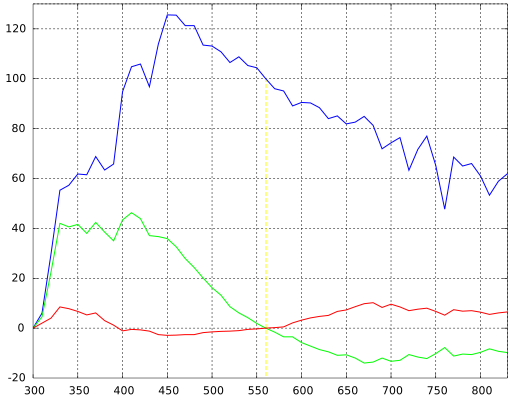
In simpler terms, the SPD of the studied daylight samples can be expressed as the linear combination of three, fixed SPDs. The first vector (S0) is the mean of all the SPD samples, which is the best reconstituted SPD that can be formed with only a fixed vector. The second vector (S1) corresponds to yellow–blue variation (along the locus), accounting for changes in the correlated color temperature due to proportion of indirect to direct sunlight. The third vector (S2) corresponds to pink–green variation (across the locus) caused by the presence of water in the form of vapor and haze.

By the time the D-series was formalized by the CIE, a computation of the chromaticity (x,y) for a particular isotherm was included. Judd et al. then extended the reconstituted SPDs to 300 nm–330 nm and 700 nm–830 nm by using Moon's spectral absorbance data of the Earth's atmosphere. The tabulated SPDs presented by the CIE today are derived by linear interpolation of the 10 nm data set down to 5 nm. However, there is a proposal to use spline interpolation instead.
Similar studies have been undertaken in other parts of the world, or repeating Judd *et al.'''s analysis with modern computational methods. In several of these studies, the daylight locus is notably closer to the Planckian locus than in Judd *et al.''Studies from the 1960s and 1970s include:
Analyses using the faster computation of the 1990s and 2000s include:
- {{cite conference
The CIE positions D65 as the standard daylight illuminant: |access-date=2018-12-17 |archive-url=https://web.archive.org/web/20171204115107/http://www.cie.co.at/publ/abst/s005.html |archive-date=2017-12-04 |url-status=dead}}}}

Computation
The relative spectral power distribution (SPD) S_D (\lambda) of a D series illuminant can be derived from its chromaticity coordinates in the CIE 1931 color space, (x_D,y_D). First, the chromaticity coordinates must be determined: : x_D = \begin{cases} 0.244063 + 0.09911 \frac{10^3}{T} + 2.9678 \frac{10^6}{T^2} - 4.6070 \frac{10^9}{T^3} & 4000\ \mathrm{K} \leq T \leq 7000\ \ \mathrm{K} \ 0.237040 + 0.24748 \frac{10^3}{T} + 1.9018 \frac{10^6}{T^2} - 2.0064 \frac{10^9}{T^3} & 7000\ \mathrm{K} \end{cases} :y_D = -3.000 x_D^2 + 2.870 x_D - 0.275 where T is the illuminant's CCT. Note that the CCTs of the canonical illuminants, D50, D55, D65, and D75, differ slightly from what their names suggest. For example, D50 has a CCT of 5003 K ("horizon" light), while D65 has a CCT of 6504 K (noon light). This is because the originally experimentally determined values of the constants in Planck's law have become more accurately known (and now take on fixed values in the international system of units and measurements) since the definition of these canonical illuminants, whose SPDs are based on the original values in Planck's law. The same discrepancy applies to all illuminants in the D series—D50, D55, D65, D75—and can be "rectified" by multiplying the nominal color temperature by \frac{c_2}{1.4380}; for example 6500\ \text{K} \times \frac{1.438776877\dots}{1.4380} = 6503.51\ \text{K} for D65.
To determine the D-series SPD (SD) that corresponds to those coordinates, the coefficients M1 and M2 of the characteristic vectors S1 and S2 are determined: :S_D(\lambda) = S_0(\lambda) + M_1 S_1(\lambda) + M_2 S_2(\lambda), :M_1 = (-1.3515 - 1.7703 x_D + 5.9114 y_D)/M, :M_2 = (0.0300 - 31.4424 x_D + 30.0717 y_D)/M, :M = 0.0241 + 0.2562 x_D - 0.7341 y_D where S_0(\lambda), S_1(\lambda), S_2(\lambda) are the mean and first two eigenvector SPDs, depicted in figure. The characteristic vectors both have a zero at 560 nm, since all the relative SPDs have been normalized about this point. In order to match all significant digits of the published data of the canonical illuminants the values of M1 and M2 have to be rounded to three decimal places before calculation of SD.
D65 values
Using the standard 2° observer, the CIE 1931 color space chromaticity coordinates of D65 are
\begin{align} x &= 0.31272 \ y &= 0.32903 \end{align}
and the XYZ tristimulus values (normalized to ), are
\begin{alignat}{2} X &={}& 95.047 \ Y &={}& 100\phantom{.000} \ Z &={}& 108.883 \end{alignat}
For the supplementary 10° observer,
\begin{align} x &= 0.31382 \ y &= 0.33100 \end{align} and the corresponding XYZ tristimulus values are
\begin{alignat}{2} X &={}& 94.811 \ Y &={}& 100\phantom{.000} \ Z &={}& 107.304 \end{alignat}
Since D65 represents white light, its coordinates are also a white point, corresponding to a correlated color temperature of 6504 K. Rec. 709, used in HDTV systems, truncates the CIE 1931 coordinates to x=0.3127, y=0.329.
Daylight simulator
There are no actual daylight light sources, only simulators. Constructing a practical light source that emulates a D-series illuminant is a difficult problem. The chromaticity can be replicated simply by taking a well known light source and applying filters, such as the Spectralight III, that used filtered incandescent lamps. However, the SPDs of these sources deviate from the D-series SPD, leading to bad performance on the CIE metamerism index.{{cite book |archive-url=https://web.archive.org/web/20170821085424/http://www.cie.co.at/publ/abst/51-2-99.html |archive-date=2017-08-21 |url-status=dead}}{{cite journal
Illuminant E
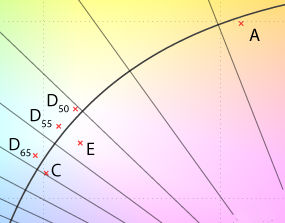
Illuminant E is an equal-energy radiator; it has a constant SPD inside the visible spectrum. It is useful as a theoretical reference; an illuminant that gives equal weight to all wavelengths. It also has equal CIE XYZ tristimulus values, thus its chromaticity coordinates are (x,y)=(1/3,1/3). This is by design; the XYZ color matching functions are normalized such that their integrals over the visible spectrum are the same.
Illuminant E is not a black body, so it does not have a color temperature, but it can be approximated by a D series illuminant with a CCT of 5455 K. (Of the canonical illuminants, D55 is the closest.) Manufacturers sometimes compare light sources against illuminant E to calculate the excitation purity.
Illuminant series FL
CIE Publication 15.2 introduced twelve new illuminants representing several fluorescent lamps and comprising series F, later renamed to series FL from CIE Publication 15:2004 onward. The original 12 standards are distributed to 3 groups:
- Standards FL1–FL6 represent "standard" fluorescent lamps consisting of two semi-broadband emissions of antimony and manganese activations in calcium halophosphate phosphor. FL4 is of particular interest since it was used for calibrating the CIE color rendering index (the CRI formula was chosen such that FL4 would have a CRI of 51).
- Standards FL7–FL9 represent "broadband" (full-spectrum light) fluorescent lamps with multiple phosphors, and higher CRIs.
- Standards FL10–FL12 represent narrow triband illuminants consisting of three "narrowband" emissions (caused by ternary compositions of rare-earth phosphors) in the R,G,B regions of the visible spectrum, which leads to poor CRI.
The members within a group represent different CCTs, such that the phosphor weights can be tuned to achieve the desired CCT. In each of these three groups, CIE states that FL2, FL7, and FL11 "take priority" to be representative of their respective groups.
Image:CIE illuminants F 1 to 6 corrected.svg|FL1–6: Standard Image:CIE illuminants F 7-9.svg|FL7–9: Broadband Image:CIE illuminants F 10-12.svg|FL10–12: Narrowband
CIE 15:2004 also introduced fifteen new fluorescent illuminants representing different kinds of fluorescent lamps and comprising subseries FL3. These 15 standards are distributed in 5 groups:
- Standards FL3.1-FL3.3 represent standard halophosphate lamps (similar to FL1-6)
- Standards FL3.4-FL3.6 represent DeLuxe type lamps (similar to FL7-9)
- Standards FL3.7-FL3.11 represent three-band lamps (similar to FL10-12)
- Standards FL3.12-FL3.14 represent multi-band lamps
- Standard FL3.15 represents a D65 simulating fluorescent lamp
File:FL3.1 to FL3.3.png|FL3.1-3.3 : standard File:FL3.4 to FL3.6.png|FL3.4-3.6 : DeLuxe File:FL3.7 to FL3.11.png|FL3.7-3.11 : three-band File:FL3.12 to FL3.14.png|FL3.12-3.14 : multi-band File:FL3.15.png|FL3.15 : D65 simulator
Illuminant series HP
CIE 15:2004 introduced five new illuminants representing different kinds of high pressure discharge lamps and comprising series HP.:
- Standard HP1 for standard high-pressure sodium lamps
- Standard HP2 for color-enhanced high-pressure sodium lamps
- Standards HP3-HP5 for metal halide lamps.
File:HP1 et HP2.png|HP1 and HP2 File:HP3 to HP5.png|HP3 to HP5
Illuminant series LED
CIE Publication 15:2018 introduces nine new illuminants representing several white LEDs with CCTs ranging from 2700~6600 K. LED-B1 through B5 define standard LED illuminants with phosphor-converted blue light. LED-BH1 defines a blend of phosphor-converted blue and a red LED. LED-RGB1 defines the white light produced by a tricolor LED mix. LED-V1 and V2 define LEDs with phosphor-converted violet light.
File:LED-B1 to B5.png|LED-B1 to B5 File:LED-BH1 et RGB1.png|LED-BH1 and RGB1 File:LED-V1 et V2.png|LED-V1 and V2
Illuminant series ID
CIE publication 184:2009 introduced two new illuminants representing natural indoor light, which were later included as series ID in CIE 15:2018. ID50 and ID65 are equivalent to their outdoor counterparts, D50 and D65, filtered through window glass, thereby removing the ultraviolet contents. The indoor CCTs are about 100K higher (cooler) relative to their outdoor counterparts.
White point
Main article: White point
The spectrum of a standard illuminant, like any other profile of light, can be converted into tristimulus values. The set of three tristimulus coordinates of an illuminant is called a white point. If the profile is normalized, then the white point can equivalently be expressed as a pair of chromaticity coordinates.
If an image is recorded in tristimulus coordinates (or in values which can be converted to and from them), then the white point of the illuminant used gives the maximum value of the tristimulus coordinates that will be recorded at any point in the image, in the absence of fluorescence. It is called the white point of the image.
The process of calculating the white point discards a great deal of information about the profile of the illuminant, and so although it is true that for every illuminant the exact white point can be calculated, it is not the case that knowing the white point of an image alone tells you a great deal about the illuminant that was used to record it.
White points of standard illuminants
References
References
- CIE Technical Report. (1999). "A Method for Assessing the Quality of Daylight Simulators for Colorimetry". Bureau central de la CIE.
- CIE Standard. (2004). "Standard Method of Assessing the Spectral Quality of Daylight Simulators for Visual Appraisal and Measurement of Colour".
- Lam, Yuk-Ming. (August 2002). "Evaluation of the quality of different D65 simulators for visual assessment". Color Research & Application.
- Schanda, János. (2007). "Colorimetry: Understanding the CIE System". [[Wiley Interscience]].
- Davis, Raymond. (January 21, 1931). "Filters for the reproduction of sunlight and daylight and the determination of color temperature". [[National Bureau of Standards]].
- Judd, Deane B.. (August 1964). "Spectral Distribution of Typical Daylight as a Function of Correlated Color Temperature". [[JOSA]].
- Simonds, John L.. (August 1963). "Application of Characteristic Vector Analysis to Photographic and Optical Response Data". [[JOSA]].
- Tzeng, Di-Yuan. (April 2005). "A review of principal component analysis and its applications to color technology". Color Research & Application.
- Commission Internationale de l'Eclairage. (1964). "Proceedings of the 15th Session, Vienna".
- Kelly, Kenneth L.. (August 1963). "Lines of Constant Correlated Color Temperature Based on MacAdam's (u,v) Uniform Chromaticity Transformation of the CIE Diagram". JOSA.
- Moon, Parry. (November 1940). "Proposed standard solar-radiation curves for engineering use". Journal of the Franklin Institute.
- [http://files.cie.co.at/204.xls CIE 1931 and 1964 Standard Colorimetric Observers] from {{nowrap. 380 nm to {{nowrap. 780 nm in increments of {{nowrap. 5 nm.
- Kránicz, Balázs. (August 2000). "Re-evaluation of daylight spectral distributions". Color Research & Application.
- The coefficients differ from those in the original paper due to the change in the constants in [[Planck's law]]. See [http://www.brucelindbloom.com/index.html?Eqn_DIlluminant.html Lindbloom] for the current version, and [[Planckian locus]] for details.
- Schanda, János. (2007). "Colorimetry: understanding the CIE system". John Wiley & Sons.
- Wyszecki, Gunter. (1970). "Development of New CIE Sources for Colorimetry". Die Farbe.
- (5 September 2023). "CIE Illuminant Technology - Yujileds".
- Philips. "Optical Testing for SuperFlux, SnapLED and LUXEON Emitters".
- [https://cie.co.at/datatable/relative-spectral-power-distributions-illuminants-representing-typical-fluorescent-lamps-0 Spectral power distribution of Illuminants Series FL] ([https://files.cie.co.at/CIE_illum_FLs_1nm.csv CSV] with [https://files.cie.co.at/CIE_illum_FLs_1nm.csv_metadata.json metadata]), in {{nowrap. 5 nm increments from {{nowrap. 380 nm to {{nowrap. 780 nm.
- CIE Technical Report. (2004). "Colorimetry". CIE Central Bureau, Vienna.
- (2009). "Indoor daylight illuminants". CIE Central Bureau.
- (2018). "Colorimetry". Commission Internationale de l'Eclairage.
This article was imported from Wikipedia and is available under the Creative Commons Attribution-ShareAlike 4.0 License. Content has been adapted to SurfDoc format. Original contributors can be found on the article history page.
Ask Mako anything about Standard illuminant — get instant answers, deeper analysis, and related topics.
Research with MakoFree with your Surf account
Create a free account to save articles, ask Mako questions, and organize your research.
Sign up freeThis content may have been generated or modified by AI. CloudSurf Software LLC is not responsible for the accuracy, completeness, or reliability of AI-generated content. Always verify important information from primary sources.
Report