From Surf Wiki (app.surf) — the open knowledge base
Stamped paper
Paper with a pre-printed revenue stamp, for purposes of collecting taxes on its use

Paper with a pre-printed revenue stamp, for purposes of collecting taxes on its use
.jpg)

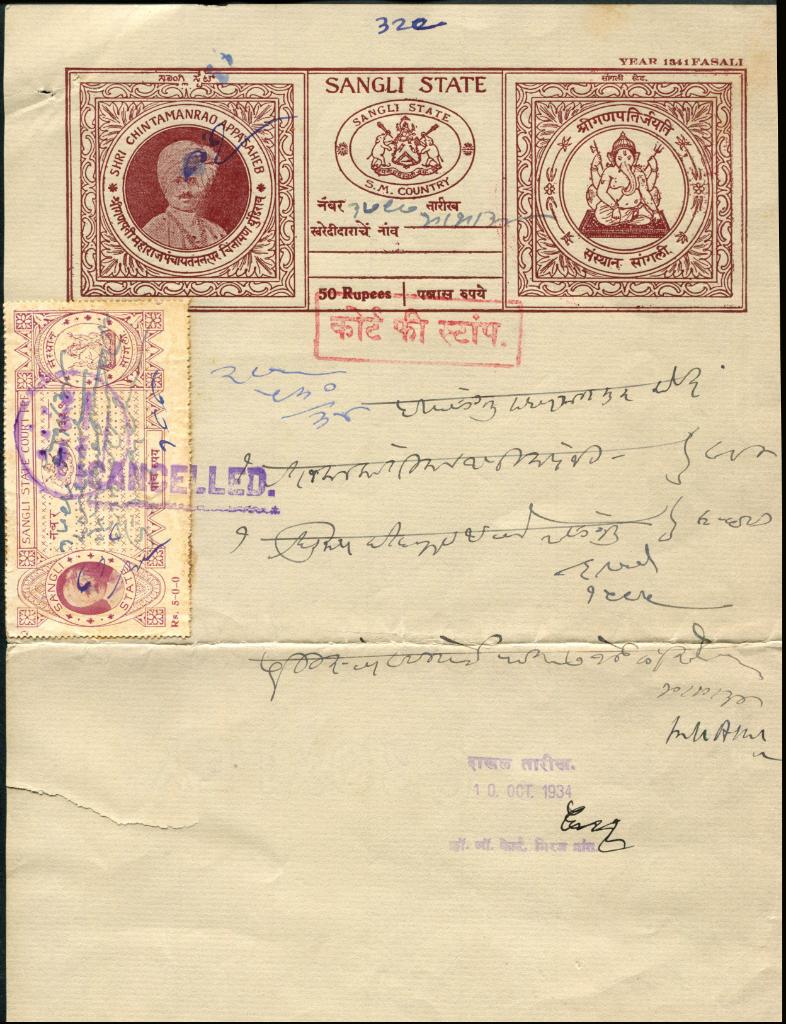
Stamped paper is an often-foolscap piece of paper which bears an imprinted revenue stamp. Stamped papers are not a form of postal stationery as although they may contain writing, they are not designed to be used to convey a message.
The use of stamped paper in the American colonies was so unpopular that it has been credited with sowing the seeds of the American Revolution.
Uses
The stamped paper has been widely used around the world to collect taxes on documents requiring stampings, such as leases, agreements, receipts, court documents and many others. The papers are bought blank apart from the pre-printed stamp and are available from stationers, lawyers' offices, post offices and courts according to local regulations. The parties to the matter then write their legal business on the paper and lodge it with the court or other interested party. This is an efficient way of collecting taxes and stamping documents without the need to submit them to a separate government stamp office.
History
Stamped paper is thought to have been a Spanish invention, being introduced (or reinvented) in the Netherlands in the 1620s. It has been used widely in France (from 1651), Great Britain (from 1694), the United States, India and elsewhere.
The 1765 Stamp Act required all British colonies in the New World to use stamped paper prepared in London and embossed with a revenue stamp. The ill-feeling created by this law has been credited with sowing the seeds of the American Revolution.

Collecting
Collecting stamped paper is part of revenue philately.
Security measures
The stamp sometimes occupies the entire width of the top part of the paper and is often of an intricate engraved design to enhance security. The paper will also frequently have a whole page watermark for the same reason.
Current uses
Stamped papers remain in use in many countries; however, electronic versions are being developed to reduce the risk of fraud. This has particularly been the case in India following a large-scale fraud in the year 2000. The use of stamped paper remains an important source of revenue in some developing countries, like Bangladesh, where other forms of tax are hard to collect.
References
References
- [[James A. Mackay. Mackay, James]]. ''Philatelic Terms Illustrated''. 4th edition. London: Stanley Gibbons, 2003, p. 147. {{ISBN. 0-85259-557-3
- "The British Postal Museum and Archive: Philatelic glossary".
- de Lacroze, Jean Cornand (1802). ''[https://books.google.com/books?id=bp-MP4_SJ2UC&q=%22stamped+paper%22+%22spanish+invention%22 A historical grammar: or A chronological abridgement of universal history]''. D. Carlisle for C. Bingham, p. 196
- [[Harry Dagnall. Dagnall, H.]] (1994) ''Creating a Good Impression: three hundred years of The Stamp Office and stamp duties.'' London: HMSO, p. 3. {{ISBN. 0116414189
- "The Stamp Act of 1765 - A Serendipitous Find" by Hermann Ivester in ''The Revenue Journal'', The [[Revenue Society]], Vol.XX, No.3, December 2009, pp. 87–89.
- [https://blogs.bl.uk/americas/2017/06/stamp-for-independence-a-brief-philatelic-tour-of-the-declaration-of-independence.html Stamp for Independence: A brief philatelic tour of the Declaration of Independence.] Richard Scott Morel, Americas and Oceania Collections blog, British Library, 30 June 2017. Retrieved 14 December 2023.
- [https://www.f-i-p.ch/wp-content/uploads/Revenues.pdf ''Special Regulations for the Evaluation of Revenue Exhibits at F.I.P. Exhibitions'']. Fédération Internationale de Philatélie. Retrieved 14 December 2023.
- [https://web.archive.org/web/20100107060247/http://www.chowchowbath.com/2008/03/30/e-stamping-of-properties-a-sure-way-of-avoiding-corruption-and-bribery-in-bengaluru/ E-Stamping of properties – a sure way of avoiding corruption and bribery in Bengaluru (Archived)] Retrieved 26 February 2010.
- [https://www.thequint.com/explainers/explainer-how-abdul-karim-telgi-pulled-off-a-rs-3000-cr-stamp-paper-scam#read-more How Telgi Pulled Off Rs 3,000 Cr Stamp Paper Scam Until He Didn’t] Retrieved 5 December 2021.
- [http://www.unpan.org/PublicAdministrationNews/tabid/115/mctl/ArticleView/ModuleID/1467/articleId/20808/default.aspx Bangladesh Govt to Amend Stamp Law to Boost Revenue] Retrieved 12 December 2010. [https://web.archive.org/web/20110727212239/http://www.unpan.org/PublicAdministrationNews/tabid/115/mctl/ArticleView/ModuleID/1467/articleId/20808/default.aspx Archived here]
This article was imported from Wikipedia and is available under the Creative Commons Attribution-ShareAlike 4.0 License. Content has been adapted to SurfDoc format. Original contributors can be found on the article history page.
Ask Mako anything about Stamped paper — get instant answers, deeper analysis, and related topics.
Research with MakoFree with your Surf account
Create a free account to save articles, ask Mako questions, and organize your research.
Sign up freeThis content may have been generated or modified by AI. CloudSurf Software LLC is not responsible for the accuracy, completeness, or reliability of AI-generated content. Always verify important information from primary sources.
Report