From Surf Wiki (app.surf) — the open knowledge base
Stadio Diego Armando Maradona
Football stadium in Fuorigrotta, Naples, Italy

Football stadium in Fuorigrotta, Naples, Italy
| Field | Value |
|---|---|
| name | Stadio Diego Armando Maradona |
| image | Stadio San Paolo Serie A.jpg |
| caption | UEFA |
| image_size | 250px |
| former_names | Stadio del Sole (1959–63) |
| Stadio San Paolo (1963–2020) | |
| location | Naples, Campania, Italy |
| coordinates | |
| broke_ground | 1952 |
| built | 1952–1959 |
| opened | |
| renovated | 1989–1990, 2018–2019 |
| owner | Comune di Napoli |
| surface | Grass |
| architect | Carlo Cocchia, Luigi Corradi |
| capacity | 54,732 |
| suites | 20 |
| record_attendance | (Napoli v Juventus, 15 December 1974) |
| dimensions | 110 x |
| tenants | SSC Napoli (1959–present) |
| Italy national football team (selected matches) | |
| website |
the stadium in Naples, Italy
Stadio San Paolo (1963–2020) Italy national football team (selected matches)
Stadio Diego Armando Maradona, formerly known as Stadio San Paolo, is a large multi-purpose stadium in Naples, Italy. Completed in 1959, it is the fourth-largest football stadium in Italy after Milan's San Siro, Rome's Stadio Olimpico and Bari's San Nicola. Originally built with a combination of standing and seating sections, the stadium is currently an all-seater, with a capacity of 54,726. It is the home of SSC Napoli, the reigning Serie A champions.
Following the death of Diego Maradona in 2020, city mayor Luigi de Magistris and Napoli president Aurelio De Laurentiis proposed renaming the stadium to "Stadio Diego Armando Maradona." The proposal was passed on 4 December 2020, and was announced by the mayor on social media and made official that same day.
History
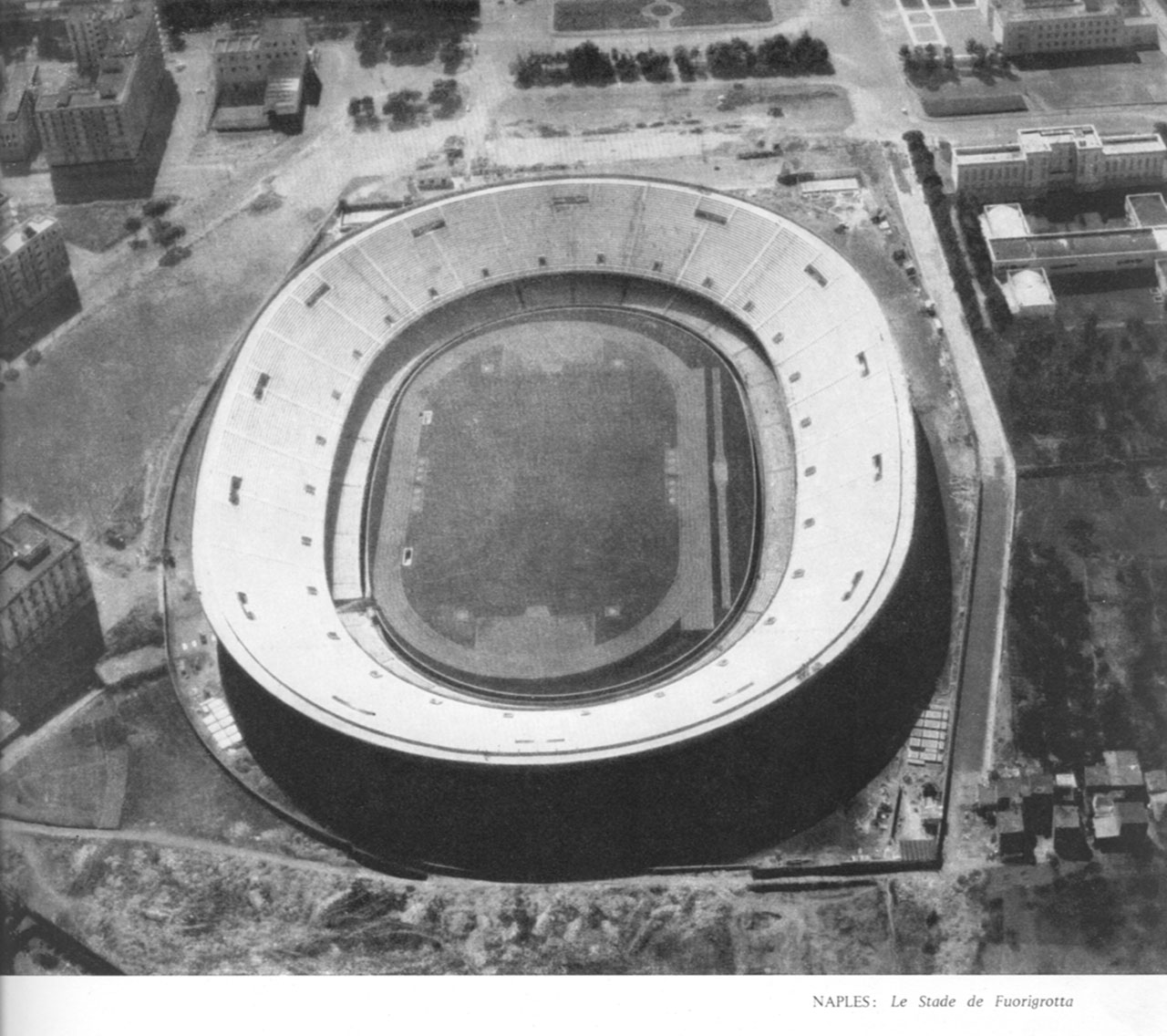
Napoli was in need of a new stadium to replace the Stadio Partenopeo following its destruction in 1942 during the bombing of Naples. They were playing at an undersized venue nearby, which had a capacity of only about 12,000. Fuorigrotta, a rapidly developing suburb to the west, was chosen as the site for the new stadium. Construction began on 27 April 1952 on what would become an open-air stadium made of reinforced concrete, designed to hold approximately 90,000 spectators — most of them standing. The laying of the first cornerstone was attended by then-Prime Minister, Alcide De Gasperi. Construction was prolonged, lasting seven years. It opened as Stadio del Sole ("Stadium of the Sun") on 6 December 1959, with Napoli defeating rivals Juventus 2–1. It was renamed to Stadio San Paolo four years later for Paul the Apostle, who arrived in the area by sea some 2,000 years ago. It held this name for 61 years before its renaming, and many fans still call it some form of San Paolo to this day. On 15 December 1974, Napoli broke the record for the most spectators in attendance for a home match, with 90,736 people in attendance.

The stadium's first renovations were done for the 1980 UEFA European Football Championships, which saw the addition of modern technology such as an electronic scoreboard and a new floodlight system. About a decade later, the stadium then underwent a slight transformation for the 1990 FIFA World Cup, when it was fully converted to an all-seater stadium. This brought the seating capacity down to about 76,000 people. Underground parking was also added during this time, but logistical issues prevented it from ever opening. After the World Cup, a decline of over two decades struck the stadium. The structure showed signs of age, as the concrete began to peel and the roof started to leak. Fans complained of broken seats, which led to the closure of entire sections and more reductions in seating capacity. Furthermore, the overall lack of modern accommodations for players, fans, and press alike was enough for FIFA to rank the stadium poorly during this time. The city of Naples actually owned the stadium, and so politics and funding issues were sometimes to blame for upgrades being delayed or cancelled. Napoli, who paid rent to the city, found themselves in a financial crisis prior to going bankrupt in 2004. The stadium continued to decay in the following years. [[File:Stadio San Paolo Napoli 2010.jpg|thumb|A view from 2010. |left]]Its long-awaited break came between 2018–2019, when €20 million in renovations were made ahead of the XXX Summer Universiade. The locker rooms and press areas were modernized, and improved lighting was installed stadium-wide. The aging seats were replaced with wider seats, and jumbotrons were added in the upper seating areas. Metal railings were also replaced with glass barriers. These additions reduced the stadium's seating capacity once again — from 60,240 to 54,726. On 4 December 2020, the stadium was officially renamed to Stadio Diego Armando Maradona after the former Napoli player's death.

On 26 July 2025, Napoli stated that they would build a new stadium instead of renovating the stadium after it was dropped from hosting UEFA Euro 2032.
Sporting events
1990 FIFA World Cup
The stadium hosted five matches during the 1990 FIFA World Cup, one of which being a semi-final between Italy and Argentina. The atmosphere was emotionally charged, as Diego Maradona, the superstar of Argentina's national team, also played for Napoli. He was an icon to Naples for bringing the club their first two Serie A titles, among other trophies. The match finished 1–1 after extra time, with Maradona scoring one of Argentina's goals in the ensuing penalty shoot-out to help his country earn the victory.
The matches spanned between 13 June and 3 July, with the first two contests coming from the Group B stage. The other three were a Round of 16 match, a quarter-final, and a semi-final match. Cameroon, who had just shocked the world after beating defending champions Argentina in their opening match, lost a thrilling 3–2 quarter-final to England, after striker Gary Lineker scored a penalty goal in the 105th minute of extra time.
XXX Summer Universiade
The XXX Summer Universiade, the 30th installment of the FISU World University Games, took place between 3 and 14 July 2019. The opening ceremony featured an appearance by President Sergio Mattarella, Olympic gold-medalist Massimiliano Rosolino, and a performance by Italian tenor Andrea Bocelli.
Concerts
The stadium has hosted many well-known acts in its lifetime. Italian pop band Pooh held a celebration concert in 1979 to honor their 1,000th live show. In 1982, The Rolling Stones played to a sold-out crowd during their European Tour 1982. Zucchero and U2 performed within a month of each other in 1993, and in 1998, Neapolitan artist Pino Daniele performed in front of a sold-out crowd in what some fans consider a top concert of his career. In 2023, Coldplay played two sold-out shows, during their Music of the Spheres World Tour.
| Date | Artist | Tour/Event | Attendance | Notes |
|---|---|---|---|---|
| 24 July 1979 | Pooh | Tour Viva | 50,000 | The band celebrated their 1000th concert. |
| 12 July 1982 | Frank Zappa with vocals by Massimo Bassoli | 1982 European Tour | Italian rock journalist Massimo Bassoli provided vocals. | |
| 17 July 1982 | The Rolling Stones | European Tour 1982/Tattoo Tour | 90,000 | |
| 12 June 1993 | Zucchero | L'urlo Tour | Guests Andrea Bocelli and Jenny B performed. | |
| 9 July 1993 | U2 | Zoo TV Tour | 76,000 | |
| 24 September 1996 | Eros Ramazzotti | Dove c'è musica Tour | ||
| 7 June 1997 | Gigi D'Alessio | 20,000 | The tour supported his new album Fuori dalla mischia. | |
| 14 June 1998 | Eros Ramazzotti | Eros World Tour 1998 | ||
| 18 July 1998 | Pino Daniele | Pino Daniele in Concerto 1998 | 80,000 | Guests Jovanotti & Raiz (former member of Almamegretta) performed. |
| 8 July 2001 | Eros Ramazzotti | Stile Libero Tour | ||
| 26 July 2002 | Pino Daniele, Francesco De Gregori, Fiorella Mannoia, & Ron | In Tour (2002) | ||
| 14 September 2002 | Ligabue | Live 2002 | ||
| 25-26 June 2022 | Ultimo | Ultimo Stadi 2022 – La Favola Continua | Both nights were sold out. | |
| 21-22 June 2023 | Coldplay | Music of the Spheres World Tour | Both nights were sold out. | |
| 28 June 2023 | Tiziano Ferro | TZN 2023 | 43,000 | Tickets reportedly sold-out within minutes. |
| 21 June 2025 | Imagine Dragons & Declan McKenna | Loom World Tour | 37,393 |
References
Other events

The stadium hosted the football preliminaries for the 1960 Summer Olympics.
The IV Mediterranean Games were held from 21 to 29 September 1963.
Italy won the "coin-toss semifinal" against the Soviet Union in the 1968 UEFA European Football Championship here, in front of 68,582 spectators.
The stadium hosted four matches during the 1980 UEFA European Football Championship.
On 2 September 2006, Italy's Euro 2008 qualifier against Lithuania was played here.
References
References
- Edwards, Andy. (4 December 2020). "Napoli's stadium now officially Stadio Diego Armando Maradona". [[NBC Sports]].
- (23 March 2015). "Stadio San Paolo". The Stadium Guide.
- "Stadio Diego Armando Maradona (Stadio San Paolo) –". Stadiumdb.com.
- (4 December 2020). "Official: Stadio Diego Armando Maradona". Football Italia.
- (2021-04-29). "San Paolo Stadium Naples: History and Facts".
- "SSC Napoli - Juventus 2:1 (Serie A 1959/1960, 10. Round)".
- "Naples: The great... no, it's just repairs for San Paolo – StadiumDB.com".
- Rial, Bradley. (July 28, 2025). "Napoli confirms new stadium plans, rejects Maradona revamp".
- (22 Aug 2024). "England v Cameroon {{!}} Greatest Games {{!}} 1990 World Cup".
- "Pino Daniele allo Stadio San Paolo: il concerto del 98".
- "POOH: 1979 Tour Viva - iPooh.it - Una canzone lunga una vita".
- "1982 Concert History of Stadio Diego Armando Maradona Naples, Campania, Italy {{!}} Concert Archives".
- "ROCKS OFF SETLISTS".
- Axver, Matthias Muehlbradt, Andre. (1993-07-09). "U2 Naples, 1993-07-09, Stadio San Paolo, ZOO TV Tour - U2 on tour".
- (2025-06-14). "SSC Napoli stadium {{!}} Stadio Diego Armando Maradona".
This article was imported from Wikipedia and is available under the Creative Commons Attribution-ShareAlike 4.0 License. Content has been adapted to SurfDoc format. Original contributors can be found on the article history page.
Ask Mako anything about Stadio Diego Armando Maradona — get instant answers, deeper analysis, and related topics.
Research with MakoFree with your Surf account
Create a free account to save articles, ask Mako questions, and organize your research.
Sign up freeThis content may have been generated or modified by AI. CloudSurf Software LLC is not responsible for the accuracy, completeness, or reliability of AI-generated content. Always verify important information from primary sources.
Report